
We prepared this guide to help you understand what IT services you can pursue, what each one covers, the operations it strengthens, and where the boundaries of a standard scope lie. By the end, you'll know exactly what to look for in a proposal.
Core IT services
Managed IT services
Managed IT services is a model where an IT company takes ongoing responsibility for monitoring, maintaining, and supporting your entire technology infrastructure for a fixed monthly fee. The deliverable is operational continuity, i.e., keeping your systems up and resolving issues before they become outages.
Providers generally fall into different operational categories, ranging from monitoring firms to specialized 'staffing-led' partners. You can read a complete breakdown of these structures in DesignRush's guide on what a managed service provider is.
What's included by default: around-the-clock network and device monitoring, helpdesk support, patch management, and incident response.
Network infrastructure and management
Network infrastructure management covers the design, installation, and administration of the systems that connect the business: routers, switches, firewalls, Wi-Fi access points, and the cabling that ties them together. Businesses pursue the service to maintain a stable and secure network that supports operations without disruption.
Commonly, it covers network design, equipment configuration, and monitoring. It does not include the cost of hardware itself, which is typically quoted separately.
Cybersecurity services
Cybersecurity services protect your business from unauthorized access, data breaches, ransomware, and other digital threats. An IT services provider typically deploys a layered security stack: endpoint protection (antivirus and device management), email filtering, multi-factor authentication setup, firewall configuration, and security awareness training for staff.
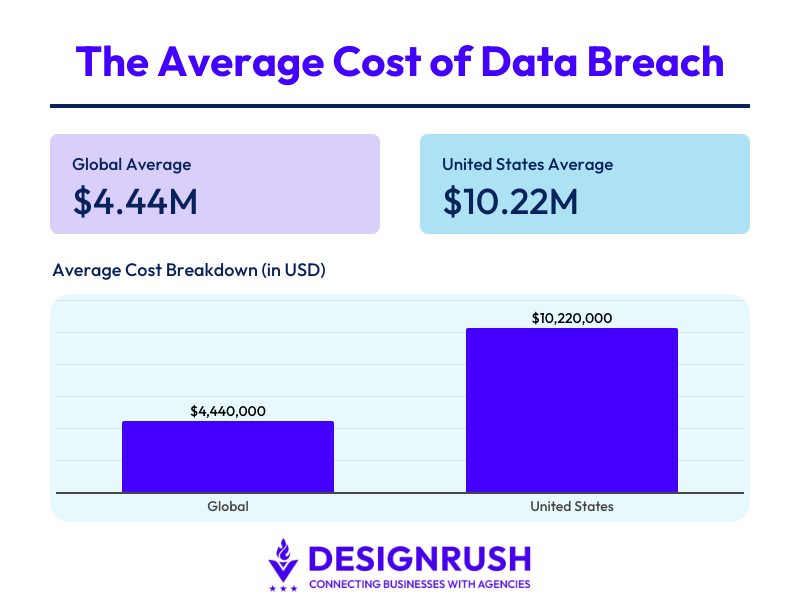
According to IBM, data breach costs in the US reached an all-time high of $10.22 million, driven largely by regulatory penalties and slow threat containment.
Keep in mind that cybersecurity services do not eliminate risk entirely, and any provider that claims otherwise is overselling its services.
Cloud services and migration
Cloud services cover the planning, setup, migration, and management of your business systems on platforms like Microsoft 365, Google Workspace, or Amazon Web Services. In essence, they establish a functional cloud environment: email, file storage, collaboration tools, and line-of-business applications hosted off-premises and accessible from anywhere.
Standard engagements include migration planning, data transfer, user setup, and post-migration support. Ongoing cloud cost optimization and custom cloud architecture are typically billed separately.
IT helpdesk and end-user support
Through IT helpdesk support, you’ll be able to resolve day-to-day tech problems for your staff, namely password resets, software errors, printer failures, connectivity issues, and device setup. The service is typically delivered as a combination of remote support tools and, where necessary, on-site visits.
Most IT management services include helpdesk access as a core component, with response time guarantees (SLAs) specifying how quickly a ticket will be acknowledged and resolved. Response time is one of the clearest differentiators between IT service companies, so it’s recommended to look for SLAs that commit to sub-one-hour response times for critical issues.
Data backup and disaster recovery
Data backup and disaster recovery (DR) are a set of systems and processes that ensure your business can recover from data loss, whether caused by hardware failure, ransomware, accidental deletion, or a natural disaster.
When hired for the service, IT companies prepare a tested recovery plan and a functioning backup system, with a defined RTO (recovery time objective) and RPO (recovery point objective, or how much data can be lost).
Additional services of IT specialists
Not every IT service company offers the following services, and not every business needs them. These are common add-ons that vary by provider.
IT strategy and virtual CIO (vCIO) services
A virtual CIO (vCIO) is a senior-level technology advisor provided by your IT company on a fractional basis, typically for a set number of hours per month. The vCIO translates business goals into an IT strategy: what systems to invest in, what to retire, what to upgrade, and how to maximize IT spending against set objectives. This service is most valuable for businesses that lack an internal IT director and is usually offered at higher service tiers.
Software and application management
Some IT companies manage the deployment, licensing, updating, and troubleshooting of business software like ERP systems, CRM platforms, accounting tools, and industry-specific applications. The scope varies considerably: some providers manage only Microsoft or Google products, while others handle complex multi-application environments.
Hardware procurement and asset management
Many IT service companies act as procurement agents, wherein they source the laptops, servers, printers, and peripherals on your behalf, often at volume discounts not available to individual buyers. Asset management extends the service for tracking every device in your organization: who has it, when it was last patched, and when it needs replacing.
VoIP and unified communications
Voice over IP (VoIP) is a phone system that runs over your internet connection instead of traditional phone lines. As a complementary offering to VoIP services, unified communications integrate video conferencing, instant messaging, and file sharing into a single platform. Ongoing VoIP management is typically billed per user per month, separate from your base IT management services agreement.
What IT companies do NOT do
When browsing agencies, it’s important to understand the limits of a business IT services provider. In general, IT companies avoid creative, strategic, or domain-specific work outside tech operations. They focus on implementation rather than origination or interpretation. Most IT companies DO NOT:
- Design or build websites from scratch (they only host, secure, or maintain them)
- Run paid ads, SEO, or content strategies
- Interpret regulations or provide legal advice (they implement compliance tech only)
- Develop business intelligence planning or curate analytics roadmaps
How to tell if an agency's services match your needs
Before you request a proposal, be specific about what you actually need. Ask yourself:
- How many people, devices, and locations need to be supported?
- What is your most pressing IT problem right now? Is it reliability, security, or something else?
- Which systems are mission-critical, and what is the real cost to your business if they go down for an hour?
- What level of response time is actually acceptable for your team, and does that differ by severity of issue?
- How much customization do you expect versus standardized, off-the-shelf solutions?
The clearer you are about scope, the more accurate the proposals you'll receive and the less likely you are to pay for services you don't need.
Ready to find an IT services company that matches your needs? Browse DesignRush's IT services company directory and filter agencies by budget, specialty, and client reviews.