
IT services cost between $80-$400 per user per month, depending on infrastructure complexity, compliance requirements, and service scope.
This guide breaks down the factors that drive those numbers, so you can build an accurate budget before reaching out to any agency.
What is the average IT services price for each tier?
Monthly IT services costs range from $2,000–$4,000 for entry-level coverage to $10,000–$15,000+ for enterprise-grade managed services. The price difference across tiers reflects the depth of coverage, response availability, and how proactively the provider manages your infrastructure.
| Tier level | Average cost | What is included |
| Entry-level tiers | $2,000-$4,000 per month |
|
| Mid-level tiers | $5,000-$7,000 per month |
|
| Enterprise-level tiers | $10,000-$15,000+ per month |
|
What are the typical IT services pricing models?
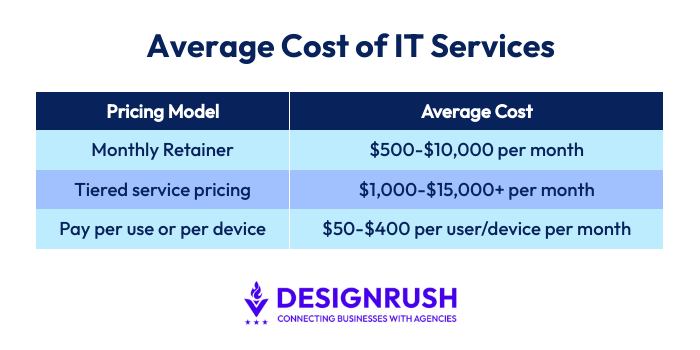
IT services providers use four main pricing models: monthly retainer, tiered service pricing, per-user or per-device pricing, and project-based pricing. The right IT services pricing model depends on whether your IT needs are ongoing, predictable, headcount-driven, or tied to a one-time initiative.
| Pricing Model | Average cost | Best for | Potential drawbacks |
| Monthly retainer | $500-$10,000+ per month |
|
|
| Tiered service pricing | $1,000-$15,000+ per month |
|
|
| Pay per user or per device | $50-$400 per user/device per month |
|
|
| Project-based pricing | Variable |
|
|
The volume-based IT service pricing model is the most common, as it provides businesses with a transparent breakdown of what they are paying for.
For smaller operations, leveraging these models is often the only way to access enterprise-grade talent without the overhead of an internal department, as detailed in our small business IT outsourcing guide.
However, it can put smaller businesses at a disadvantage.
Promatics explains: “At lower volumes, pricing is higher due to shared infrastructure and baseline support, while at around 50+ users or devices, we begin offering volume discounts with improved cost efficiency.
“As the scale crosses 100+ users/devices, we typically introduce more dedicated resources, enhanced support SLAs, and performance optimizations.
“At higher volumes, the engagement evolves further with options for partially or fully dedicated infrastructure, priority support, and deeper customization, ensuring both cost efficiency and improved service levels as the platform grows.”
How much do IT services cost in the US?
IT services in the US cost between $125 and $300 per hour for break/fix support, $180–$500 per user per month for managed services, and $2,000–$10,000 per month for flat-rate retainers.
The model you choose determines not just the price but how much financial risk you carry. The break/fix costs scale with incidents, while retainers and per-user pricing keep monthly spend predictable.
| Service type | Estimated price |
| Break/fix services | $125-$300 per hour of incident |
| Co-managed service | $100-$200 per user per month |
| Fully managed IT service | $200-$500 per user per month |
US IT support services also offer a monthly retainer fee, which ranges between $2,000-$10,000 per month, depending on your service-level needs.
What IT costs do proposals often skip?
Software licenses, hardware procurement, maintenance, infrastructure hosting, third-party integrations, on-site visits, security measures, and migration requirements are some of the most frequently omitted line items.
These collectively represent the gap between what a proposal quotes and what a project actually costs.
| Cost item | Estimated price range |
| Software licenses, tools, and platforms | 10%-30% of total budget |
| Infrastructure and hosting | $200-$200,000 per month |
| Hardware procurement | $100-$300 per device |
| Ongoing maintenance and updates | 10%-25% of initial budget |
| Performance optimization | 10%-30% of initial budget |
| System integrations | 10%-20% of initial budget |
| Onsite visit | $120-$800 per visit |
| After-hours support | $150-$500 per incident |
| Cybersecurity | $300-$2,000 per month |
| Backup and disaster recovery | $200-$1,000 per month |
| Migration | $1,000-$15,000 per project |
Third-party tools and API costs are other items that businesses often overlook. These include:
- DevOps tools
- Email and notification delivery platforms
- Payment gateway transaction fees
- CDN and media storage
- SMS/OTP providers
- Monitoring and logging tools
- Analytics platforms
What pushes IT costs up?
Six factors consistently drive IT services costs above initial estimates: system complexity, compliance requirements, user and endpoint scale, AI requirements, data migration scope, and the geographic location of the provider.
Understanding these cost drivers before briefing a provider helps you anticipate where proposals will differ and why a lower quote does not always mean a better deal.
- System complexity and legacy infrastructure. Integrating new solutions with outdated operating systems or proprietary databases requires specialized expertise and extended timelines. For instance, legacy infrastructure discovered after the audit can add $2,000+ to the overall billing, while unlicensed software can add $1,500, according to product engineering company TechnoYuga.
- Compliance and security requirements. Businesses in healthcare, finance, or government contracting face mandatory compliance frameworks (HIPAA, PCI-DSS, SOC 2, FedRAMP). Meeting these standards requires specialized audits, documentation, and architectural decisions that can add $5,000-$50,000+ to your total development costs.
- Number of users and endpoints. Managed IT services are typically priced per user or per device. However, scaling from 20 to 200 users is not linear in cost. When you have a greater number of users, you gain negotiating leverage, but you will also require more complex identity management, licensing, and support infrastructure.
- AI requirements. When projects involve AI, businesses must account for fees related to model usage, vector databases, and streaming services. Additionally, IT services providers may charge extra for businesses with unstructured data to train the AI model. McKinsey points out that even though 88% of organizations now use AI in some capacity, only a small fraction have managed to successfully scale these deployments across the entire enterprise. This constitutes a bottleneck that often requires specialized external IT integration support.
- Data migration volume and sensitivity. Moving large datasets, especially from siloed legacy systems, requires detailed planning and quality checks. Moreover, projects involving sensitive customer or financial data require additional validation steps, encrypted transfer protocols, and rollback planning. IT services providers price this risk accordingly.
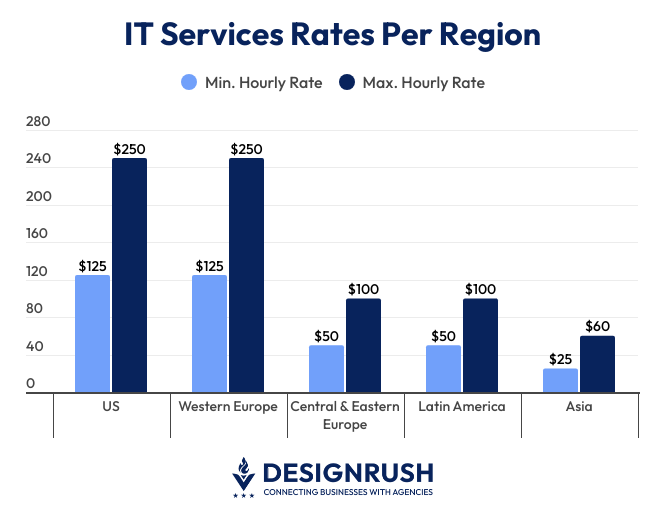
- Geographic and time-zone factors. Onshore U.S.-based IT teams typically bill $125-$200/hour. On the other hand, nearshore teams (Latin America) run $50-$100/hour. Offshore teams (South/Southeast Asia) range from $25-$60/hour. The spread reflects both labor costs and the coordination overhead that comes with larger time-zone gaps.
Other items that can push IT costs up after proposal include:
- Requirement changes after development
- Introduction of new features, workflows, third-party systems, and hardware
- Client feedback delays that impact the timeline
- Expanded testing requirements
- Sudden usage spike, requiring higher storage and performance capacity
If you are already seeing your technology spend creep upward, read practical guides for reducing IT costs to learn how to trim waste without sacrificing security or operational speed.
How to spot problems in IT services proposals
A well-structured IT services proposal should define scope boundaries explicitly, including the sites, systems, and users covered.
It should also detail the SLA response times with defined escalation paths and licensing cost ownership.
Watch for vague language like "reasonable efforts" or "standard support", as these signal that response commitments are not contractually binding.
Before signing, verify three things:
- Offboarding terms provide full portability of your data, configurations, and credentials.
- The contract specifies what triggers out-of-scope billing, so surprise invoices don't follow every incident.
- The liability cap is at least equal to your annual contract value. A cap set below that means the provider's maximum financial exposure is lower than what you're paying them, which works against you in any serious incident.
How can you receive more accurate IT pricing quotes?
IT services providers produce more precise project estimates when clients provide a detailed document of their infrastructure and technical requirements. These include:
- Number of users and devices
- Infrastructure type (e.g., cloud, on-premise, or hybrid)
- List of software systems in use
- Active compliance requirements
If you are moving from another IT provider, you should include the most recent service summary or incident log. Doing so helps the IT services company assess risk quickly rather than pricing conservatively to cover unknowns.
A brief that reflects operational reality rather than initial development capacity will help prevent scope creep and ensure that you receive an accurate estimate from your potential IT services partner.
Looking for IT services companies within your budget? Browse DesignRush's directory — filter by budget range, specialty, and verified client reviews.