
International search engine optimization (SEO) is the process of optimizing your website to attract organic traffic from different countries and languages. By aligning your SEO strategy with your target market’s cultural and linguistic preferences, you can increase visibility in global search results.
In this guide, we’ll discuss the benefits of international SEO and outline precise steps and best practices for navigating foreign search engines, keyword targeting, and multilingual websites.
Why Is International SEO Important?
International SEO is crucial for reaching customers beyond your home market and extending your reach, making sure your website has the power to capture the attention of people from all around the world. It optimizes your website for different languages, regions, and search behaviors, helping you rank better in local search results and boost conversions in international markets.
With 67% of the global population browsing the internet, there is tremendous potential to expand beyond domestic markets. With international SEO marketing, your website can be discovered by search engines beyond your own borders at a faster rate.
Moreover, integrating international SEO strategies into your business plan can help your company establish realistic goals and allocate the resources to effectively grow your online presence worldwide.
6 Simple Steps To Master International SEO
How do you gain the benefits of international SEO? Let us walk you through the step-by-step process of implementing it for your website:
- Understand your intended audiences
- Learn the technical requirements
- Conduct local keyword research
- Localize content and landing page optimization
- Ensure seamless navigation
- Create a backlink profile for each targeted country
Step #1: Understand Your Intended Audiences
Understanding your target audience is the cornerstone of a successful international SEO strategy and will help you create content that resonates in your target region. Here are important steps to learn about your international customers:
- Explore local search behavior: Google is undoubtedly a dominant global search engine, but local options are more popular in some regions (e.g., Naver in South Korea and Baidu in China). Consider regional internet speeds and device preferences to align website experience with local user expectations.
- Understand cultural nuances: People in different regions might have varying preferences for how information is presented to them. Some cultures prefer formal and structured content, while others respond to more casual and engaging styles.
- Create detailed buyer personas: Gather key demographic details, behavioral insights, and pain points for customers in each region. Use this data to develop region-specific personas that you can target with your content and messaging.
- Conduct local surveys: Direct research through audience surveys and third-party market data will provide critical insights into your target audience’s preferences and needs.
Step #2: Learn the Technical Requirements
It's crucial to lay the right technical foundations for international SEO success. Here are some essential technical elements you need to get right:
2.1. Dedicated URLs
For even more hyper-focused results, creating individual country-specific website versions is highly advised. Google strongly suggests utilizing dedicated URLs that enable its crawlers to efficiently read and index all of your content variations.
When it comes to URLs, the country code top-level domain (ccTLD) is a popular choice for many (e.g., yourwebsite.fr for France). It provides users with a sense of familiarity and trust, as they recognize the top-level domain of their own country. This ensures visitors feel confident they have found what they were looking for upon landing on your website.
2.2. Core Web Vitals
Core web vitals are critical ranking factors, and slow website loading times from abroad can negatively impact your website's ranking. This is why you should optimize your website to boost page loading speeds and consider installing a content delivery network (CDN). A CDN can distribute your website's content across multiple servers, allowing users to load your website faster from a localized server.
2.3. Localized Metadata
Optimize your title tags, meta descriptions, and alt text for images for each country or language. Naturally incorporate region-specific keywords that align with local search behaviors into all of your website content. Search engines rely on these elements to understand webpage content and display relevant information in search results.
Step #3: Conduct Local Keyword Research
Conducting thorough keyword research is critical for capturing a localized market. And it is not just a matter of translating the same words into different languages. Note that terminology and search volume can vary widely from country to country.
Local keyword research ensures your content aligns with how people in different countries phrase their search queries. By finding out what local customers are searching for, you can optimize your web pages to reach them.
Working with skilled SEO specialists who are fluent in the target language usually leads to better results. If you haven't already, we advise you to tap into the expertise of professional SEO consultants and SEO agencies with extensive experience in the field. Several of these specialists offer multilingual services.
Step #4: Localize Content and Landing Page Optimization
Understanding local nuances and terminology ensures an excellent user experience, which is rewarded by Google’s algorithm. Keep in mind that localization goes beyond just website content and metadata. It also includes:
- Currency
- Time zones
- Phone numbers (if applicable)
- Office addresses (if applicable)
Localize everything on your website that should be localized. Do not cut corners, or you may risk losing valuable international prospects.
Step #5: Ensure Seamless Navigation
Seamless website navigation and a good internal linking structure ensure that visitors are directed to the correct region-specific version of the content. It also ensures that all localized pages are correctly indexed by search engines.
Put a language or region switcher in a prominent position in your website’s header or footer. Make sure it is easy to find and links users directly to the correct language or regional version of the page they are currently on.
When internally linking from one page to another, always link to the most relevant regional version. If you’re linking from a blog post written in Spanish, ensure that you link to the Spanish version of a product or service page. Do not cross-link unrelated regional pages, or else you risk an increased bounce rate.
Step #6: Create a Backlink Profile for Each Targeted Country
Building authority is vital when expanding your business to new markets. Simply having a strong presence in your home market may not necessarily translate to success in other regions.
Kosta Hristov, Founder and CEO of QGP, notes the importance of establishing yourself as an authoritative voice in the markets you want to expand into: “Every country has its own instance of Google. And although international links matter, the ones that matter the most are local, country-specific backlinks. Using one project for all of them will result in a management mess. That’s one of the problems we solve at QGP, with our platform QGP 3.0.”
4 International SEO Best Practices
Boost your website's global reach with these top tips for international SEO success:
- Use hreflang tags
- Reflect local cultures on your website
- Develop a localized content strategy
- Optimize for mobile
1. Use Hreflang Tags
Hreflang tags are HTML attributes that tell search engines which language and geographical region a webpage is intended for. They ensure that the correct version of your website is shown to the right audience, thus improving rankings for local searches.
Here’s an example of an hreflang tag:
<link rel="alternate" hreflang="fr" href="https://yourwebsite.fr" />
The fr tag targets French speakers, and the domain leads to the French version of your website.
Hreflang tags also help search engines understand that similar or identical content is intended for different audiences, which avoids duplicate content penalties. You can use Google Search Console or hreflang testing tools to check for any errors with your hreflang tags.
2. Reflect Local Cultures on Your Website
To truly excel in global SEO, you need to embrace cultural immersion. Your website's design should be tailored to the target audience's cultural preferences. Don't forget the essentials: language, currency, and time zone specific to the region. Research each country's unique perspective on color, style, and user experience for websites. What works in the US may not necessarily be the best choice in other parts of the world.
3. Develop a Localized Content Strategy
A robust content strategy requires tailored keyword research for your target region and language. Even if your content appears valuable, you may not be using the right keywords to reach your multilingual audience. For more keyword ideas, perform competitor research to identify the phrases they are targeting.
Region-specific content allows you to address the unique needs and interests of users in each target market. Write blog posts that cover topics relevant to a specific country and tailor product descriptions to better match local needs. Highlight customer stories from locals to build trust with your target audience.
Additionally, set up country-specific tracking to monitor your keyword and URL performance. Keeping a close eye on URL ranking can also help identify any potential issues with hreflang.
4. Optimize for Mobile
Google uses mobile-first indexing, meaning it primarily evaluates your website’s mobile version for ranking purposes. Furthermore, many regions around the world have higher mobile internet usage compared to desktops.
A well-optimized mobile experience enhances user engagement, reduces bounce rates, and increases conversions, especially in regions with slower internet speeds. A clean navigation system, readable font sizes, and touch-friendly design keeps mobile browsing easy and simple.
International SEO Takeaways
Expanding your business reach to customers worldwide is a game-changing move, but without the benefits of international SEO, it may be difficult for your business to gain visibility. A successful strategy can bring fruitful results like higher Google rankings and increased revenue.
By focusing on localized content, optimizing technical elements like hreflang tags, and ensuring mobile-friendly experiences, you can improve your website’s visibility in local results and provide a seamless user experience. Start optimizing today for long-term global success!
Scaling this in multiple markets and languages is complex, which is why many businesses choose to work with international SEO agencies to get it right.

Our team ranks agencies worldwide to help you find a qualified partner. Visit our Agency Directory for the top SEO agencies, as well as:
- Top SEO Agencies in Colorado Springs
- Top Event Marketing Agencies
- Top Branding Companies
- Top Reputation Management Companies
- Top Digital Strategy Agencies
International SEO FAQs
1. What is the difference between international SEO and local SEO?
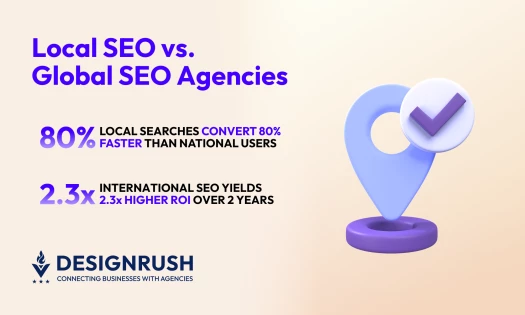
International SEO strategies help businesses take their website to the world stage, reaching a global audience and expanding their brand's horizon. Meanwhile, local SEO aims to target customers in a specific geographic area, catering to the needs of the local community and building strong customer relationships.
2. How to optimize international SEO?
To optimize your international SEO strategy, follow these steps:
- Identify the markets you should target
- Build a keyword plan with localized terms
- Develop an SEO-friendly URL structure and sitemap
- Align your language and country targets
- Allow visitors to seamlessly switch between languages
- Ensure the correct use of hreflang tags
- Convert prices to local currencies
- Fix redirects and broken links
- Create a link-building strategy for each market
- Stay up to date with global search trends
By attending to these details, your site will be primed and ready to thrive globally.
3. What are the benefits of international SEO?
International SEO tactics can help you effortlessly target specific countries and make your brand appeal to diverse audiences. It enables search engines to pinpoint your intended audience and the languages you use, improving your visibility in local search results.