
Outsourced phone answering services ensure calls are answered 24/7, capturing inquiries that would otherwise hit voicemail or go to competitors. By outsourcing call reception, you extend your responsiveness globally and safeguard revenue that might be lost due to slow or missed responses.
Outsourced Phone Answering Services: Key Findings
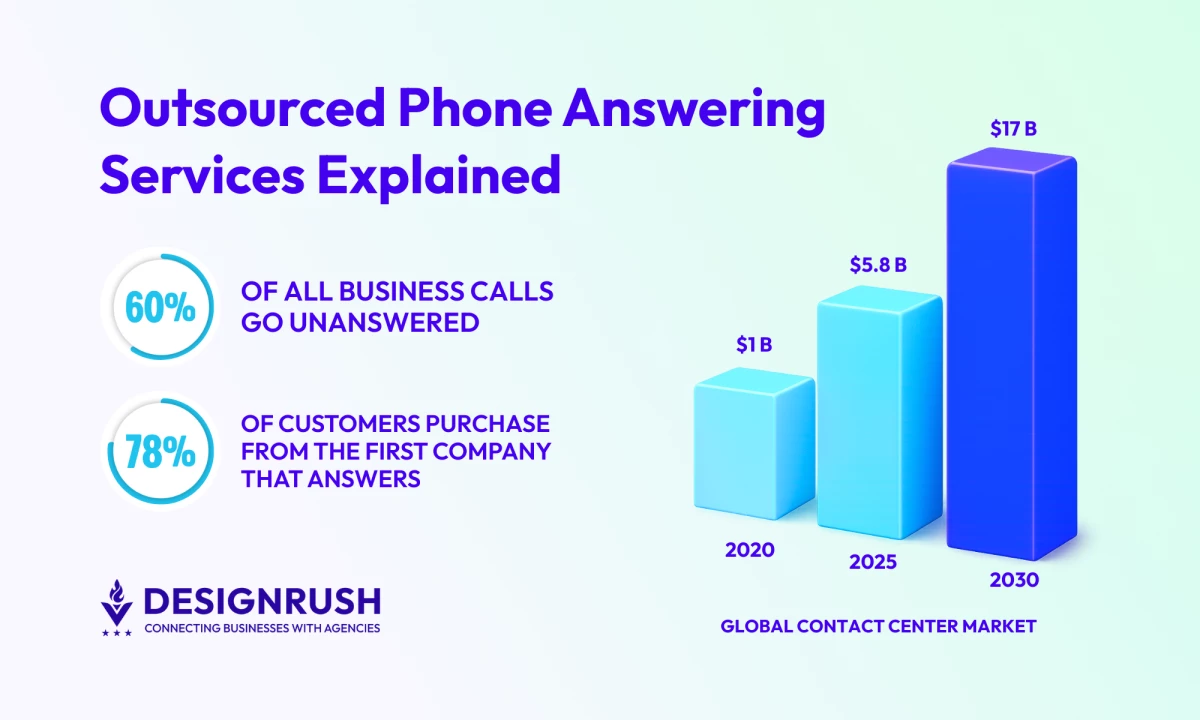
- Over 60% of business calls still go unanswered, especially after hours, yet 78% of customers buy from the first company that responds. Outsourced services solve this gap by offering 24/7, on-brand coverage that drives lead conversion.
- Businesses save an average of $30K to $50K annually by outsourcing vs. hiring in-house staff, while gaining flexible, scalable plans that adjust to seasonal spikes or campaign surges.
- Top providers integrate with CRM platforms like Salesforce and HubSpot, enabling immediate follow-up, lead tracking, and visibility into metrics like cost per lead, call-to-close rate, and CSAT.
Where Outsourcing Phone Answering Delivers Measurable ROI
Nearly half of calls to local businesses go unanswered, and each missed call represents a lost chance to build a customer relationship or close a sale. Speed also matters: one study found 78% of customers buy from the first company to respond to their inquiry.
Let’s break down the business case and ROI of phone answering services in detail.
Lead Capture Without Added Staff
Outsourcing lead capture
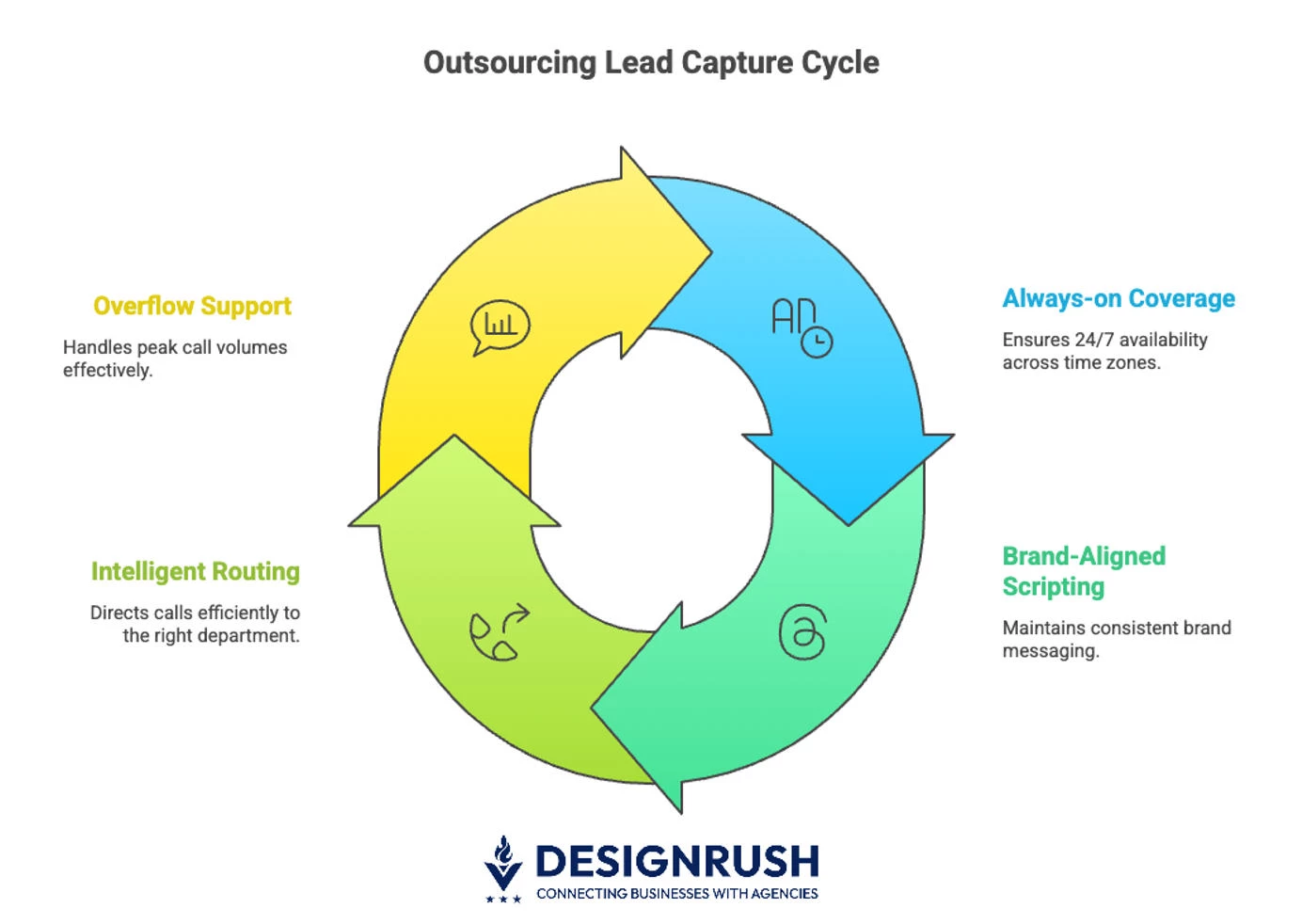
Outsourcing allows you to capture leads around the clock without adding full-time staff. Key advantages include:
- Always-on coverage across time zones: A live answering team provides 24/7 call answering so that inquiries from different regions or after-hours are handled immediately.
- Professional, brand-aligned scripting: Reputable services train agents on your tone, so they follow custom call scripts and protocols to match your brand identity and procedures. This ensures callers get a seamless, on-brand experience.
- Intelligent routing systems: Calls are triaged by need and urgency, ensuring important callers are escalated to the right person or department promptly.
- Overflow support for peaks or gaps: Call volumes can surge during marketing campaigns, product launches, or seasonal spikes. An outsourced team scales instantly to handle the overflow without hiring or scrambling internally.
Financial Efficiency & Strategic Agility
Outsourced reception isn’t just about call coverage; it also provides financial flexibility and agility for your operations:
- Avoid full-time salaries and overhead: One provider notes that clients typically save over $30,000 annually by outsourcing vs. hiring in-house. Expenses like office space, equipment, and HR overhead are eliminated.
- Elastic, usage-based service tiers: Providers offer plans that scale with your needs, so you can adjust yours based on expected call volume or campaign surges. Many services have month-to-month or flexible contracts, so you’re not locked into a fixed cost if your needs change.
- Transparent ROI tracking: With outsourced services, it’s easier to monitor the cost per qualified call and compare it to the revenue generated. Usage reports and call analytics ensure you see exactly what you’re getting.



4 Types of Outsourced Answering Services
Outsourced phone services come in a variety of flavors. Understanding these categories will help you choose the solution that best matches your business needs:
- Live virtual receptionists
- Call center services
- After-hours and overflow coverage
- Industry-specific specializations
1. Live Virtual Receptionists
Virtual receptionists sound like they’re right in your office. You can customize scripts and protocols, so they reflect your brand voice and values. They're ideal for handling client inquiries, setting appointments, and making sure every caller feels like a priority — all without hiring in-house staff.
Best for: Small businesses, solo consultants, and agencies seeking a warm, professional touch without the full-time expense.
2. Call Center Services
Call centers are built for scale, handling hundreds of calls daily, both inbound and outbound. They integrate directly into your customer relationship management (CRM) system, helpdesk, or sales platform to log calls, escalate issues, and sync data in real time.
Many serve as Tier-1 support, resolving FAQs or qualifying leads before passing complex issues to your internal team.
Best for: High-volume businesses that need full spectrum call handling for customer service, outbound sales, and technical support.
3. After-Hours and Overflow Coverage
Studies show missed after-hours calls can cost thousands in lost deals or service gaps.
These services ensure your business never misses a call, even on weekends, holidays, or during peak hours. When your internal team is unavailable, trained agents step in to field inquiries, take messages, and escalate urgent issues.
Best for: Companies aiming for 24/7 responsiveness and consistent customer service across all time zones.
4. Industry-Specific Specializations
Specialized answering services are trained in specific industries, from HIPAA-compliant healthcare receptionists to legal intake pros and SaaS-savvy agents. They speak your industry’s language, follow strict compliance protocols, and often integrate directly with electronic health records (EHR), ticketing, or order management systems.
The result is fewer errors, faster resolution, and a smoother client experience from day one.
Best for: Regulated, high-touch industries like healthcare, legal, financial services, or SaaS/eCommerce with complex caller needs.
| Answering Service | Primary Function | Key Features | Ideal For |
| Live Virtual Receptionists | Remote call answering | Branded scripting, appointment scheduling | Small businesses, solo consultants, boutique agencies |
| Call Center Services | High-volume handling | CRM integration, Tier-1 support, outbound capabilities | Customer service teams, sales-driven organizations, tech support |
| After-Hours & Overflow | 24/7 coverage | Weekend/holiday support, urgent call escalation | Businesses needing round-the-clock responsiveness |
| Industry-Specific Specialists | Specialized call support | Trained agents, compliance (HIPAA, PCI), system integration (EHR, CRMs) | Healthcare, legal, financial, SaaS, and ecommerce companies |
Pricing Models and ROI-Driven Cost Strategies
Understanding phone answering service costs is essential for choosing the right provider and maximizing ROI. This section breaks down what you should monitor to ensure every dollar drives value.
- Common pricing structures
- Cost efficiency tips for CMOs & ops leaders
- Strategic ROI metrics to monitor
Common Pricing Structures
Understanding core pricing models is the first step to selecting a service that aligns with your call volume, budget, and operational needs.
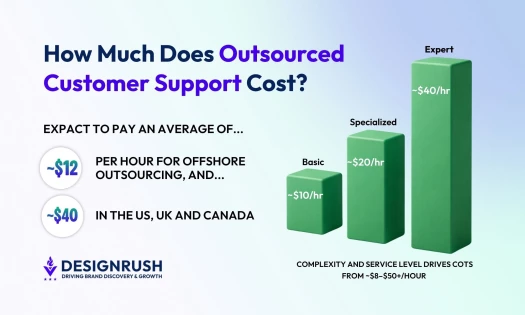
- Per-minute billing offers flexible pay-as-you-go pricing, typically ranging from $0.75 to $1.50/minute, ideal for businesses with unpredictable call volume. Note that costs can spike during high-traffic periods, though some providers offer discounted bulk-minute tiers.
- Flat-rate packages deliver predictability with fixed monthly pricing (starting around $100), often tied to a block of minutes or calls. It’s great for stable workloads, but unused or overused minutes can impact value if your plan isn’t optimized for your organization.
- Tiered plans with bundled features scale with your needs and often include perks like CRM integration, bilingual agents, or faster response service level agreements (SLAs). Paying slightly more for the right tier can improve service quality and unlock backend efficiencies.
Pro tip: Start small, analyze real usage, and scale up — many providers offer usage alerts or flexible upgrades once patterns are clear.
Cost Efficiency Tips for CMOs & Ops Leaders
Optimizing your plan structure and integrations can significantly reduce waste and enhance service ROI without compromising call quality.
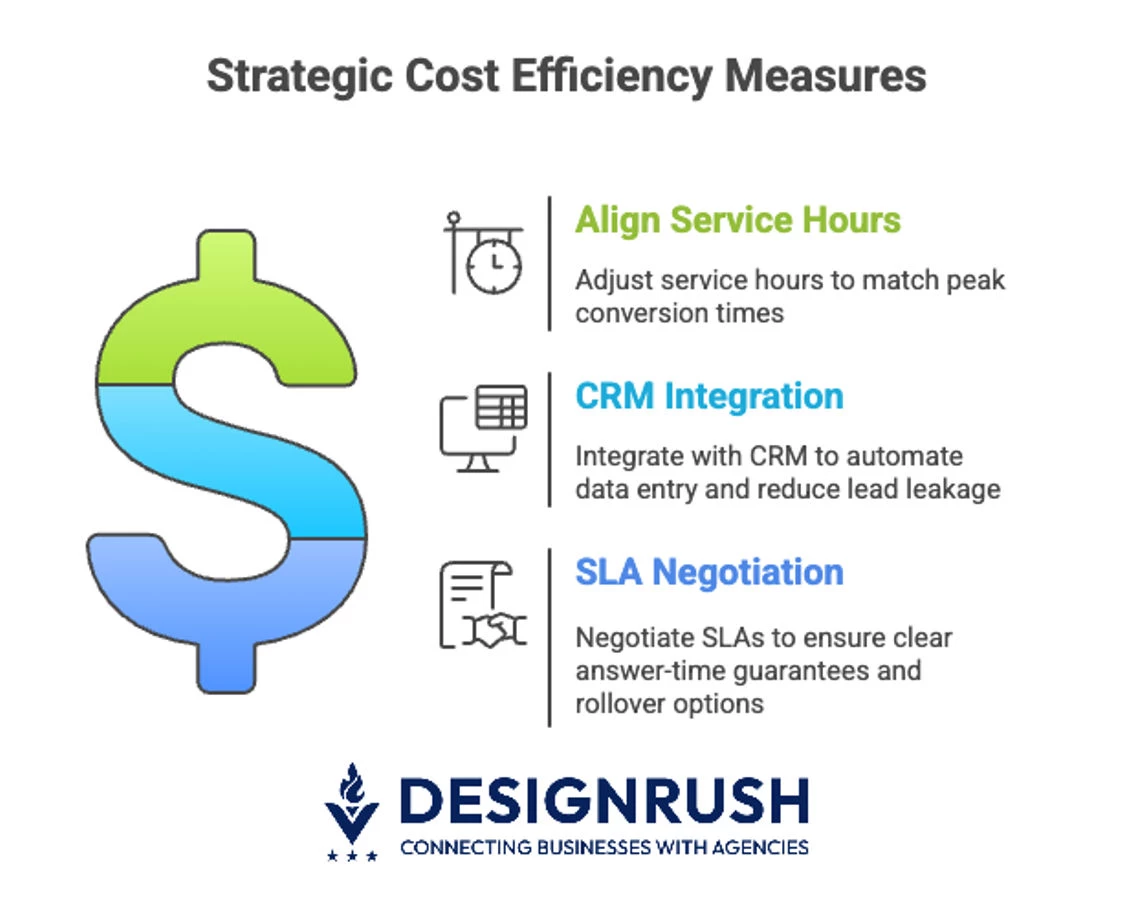
- Align service hours with peak conversion times. Evening, weekend, or campaign-specific plans ensure you’re responsive when prospects are most likely to call.
- Integrate with your CRM or calendar to reduce lead leakage, automate data entry, and increase booked appointments without manual follow-up.
- Negotiate SLAs and rollover options to avoid wasted spend. Ensure clear answer-time guarantees and confirm whether unused minutes carry forward or can be pooled across departments.
Strategic ROI Metrics to Monitor
Tracking the right performance indicators ensures your investment in phone answering services directly supports revenue growth and customer satisfaction.
- Call answer rate: Aim to answer 85% to 100% of incoming calls live; services typically outperform internal teams by 30% or more.
- Lead response time: Cutting time-to-contact from hours to minutes can double qualification rates and slash opportunity loss.
- Call-to-close rate: Track how many calls turn into appointments or sales, especially for high-intent, off-hour leads that otherwise go unanswered.
- CSAT (Customer Satisfaction Score) and NPS (Net Promoter Score): Monitor caller satisfaction post-service; responsive, personalized support often drives major gains in customer loyalty.
- Cost per lead vs. customer lifetime value: Ensure your spend per call is justified by downstream revenue. Most companies see strong ROI when even one converted lead covers a full month of service.
Strategic Vendor Selection Framework
Choosing the right outsourced phone answering provider can make or break your customer experience and operational efficiency. This will help you evaluate vendors and ensure alignment with your long-term business goals.
| Criteria | What to Look For |
| S - Scalability | Can they handle your growth? Check that they have enough agents and flexible plans to support volume surges or expansion into new regions without service degradation. For example, if your call volume doubles during peak season, can the provider scale up seamlessly? |
| C - Compliance | Are they certified or experienced in your industry’s regulations? If you’re in healthcare, are they HIPAA-compliant and willing to sign a BAA? For finance, do they follow PCI guidelines for any payments? Basically, do they take security and compliance seriously (e.g., SOC 2 audited infrastructure, agent NDAs)? |
| A - Agent Training | How are their receptionists trained and vetted? You want agents who can follow tailored scripts and mirror your brand tone. Ask if you can provide a custom script and how agents learn it. Do they have experience in handling the types of calls you get? The provider should be willing to do a knowledge transfer/training period for your account. |
| L - Language Support | Do they offer multilingual capabilities if you need them? If you require bilingual support (Spanish, French, etc.), ensure the provider has fluent agents or translation services available. Also, consider if they have cultural knowledge of your customer base if operating internationally. |
| E - Ecosystem Integration | Will the service integrate with yourexisting tech stack? This includes CRM systems, calendar booking software, help desk systems, etc. An ideal partner can plug into your workflows rather than operate in a silo. Ask about specific integrations (e.g., “Can you work with my Calendly to schedule appointments?” or “Do you integrate with HubSpot CRM?”) – the easier they can connect to your tools, the smoother the experience. |
Be cautious of providers that display these red flags:
- Vague or hidden pricing: If a provider dodges pricing details or buries fees in fine print, walk away — transparent cost structures are non-negotiable for strategic budgeting.
- No analytics or QA process: Providers without performance tracking or quality control can’t prove ROI. Ask for basic reporting and internal QA to ensure accountability.
- Generic, non-customized scripting: One-size-fits-all scripts erode brand trust. If a provider won’t tailor messaging to your business, they’re not representing you, they’re hurting you.
In short, the right partner will be transparent, technologically capable, and willing to tailor their service to your business.
Future-Proofing Your Call Strategy
The outsourced answering market is evolving fast. Two major trends are shaping the future of call answering:
- AI-powered voice tech: Modern AI voice assistants now triage calls, answer FAQs, and update CRMs in real time, cutting response times and boosting efficiency. Leading firms use hybrid models that pair AI speed with human empathy.
- Global coverage & remote-first expectations: Clients expect seamless support across time zones and channels. Today’s top providers offer multilingual, 24/7 coverage and unified communication systems that support remote-first scaling without sacrificing brand quality.
If AI features interest you, ask potential partners about their roadmap for AI (some have their own proprietary call bots; others integrate with third-party AI). By aligning with a forward-looking service, you won’t outgrow them when the next tech shift comes.
Outsourced Phone Answering Services: Wrap-Up
Whether you’re running a growth-stage agency, scaling a healthcare network, or refining CX at a SaaS firm, every missed call is a missed opportunity. With the right answering service partner, you can improve responsiveness, strengthen brand trust, and drive measurable pipeline performance without inflating headcount.

Our team ranks agencies worldwide to help you find a qualified provider. Check out our Agency Directory for the top-rated outsourced phone answering service agencies, as well as:
- Top Call Center Companies
- Top Virtual Receptionist Companies
- Top BPO Companies
- Top Customer Service Outsourcing Companies
Outsourced Phone Answering Services FAQs
1. How much do outsourced answering services cost?
Pricing varies based on call volume and service level: per-minute rates typically range from $0.75 to $1.50, while flat-rate packages start around $100/month. Advanced plans with CRM integration, bilingual agents, or 24/7 support can reach $500+/month.
2. When is the right time to outsource phone reception?
Typically when internal response time lags, lead conversion drops, or coverage gaps during nights/weekends cost opportunities. If your team is missing calls, sending leads to voicemail, or juggling client service with admin duties, outsourcing can restore focus and revenue.
3. Should we choose a live-only, AI-only, or hybrid model?
Hybrid models offer the best balance—AI handles basic triage; humans manage nuance. This approach cuts response time and operating costs without sacrificing the personal touch for complex or high-value conversations. Evaluate your call volume and type: AI excels at FAQs and scheduling, but live agents are critical for sensitive issues, upselling, or industries where empathy and persuasion drive outcomes.
4. Can these services scale with seasonal or campaign spikes?
Yes, many providers offer elastic plans and tiered packages for campaign flexibility and high-volume demand without fixed hiring costs. Whether it’s tax season, a product launch, or holiday rush, outsourced teams can expand or contract support rapidly, protecting customer experience while keeping overhead low. Proactive planning with your provider ensures seamless scale-up before key business moments.