
Key Findings
- Include clear business objectives, functional requirements, design preferences, technology stack, and vendor experience to ensure tailored proposals that meet your eCommerce site’s unique needs.
- To ensure accuracy and alignment, avoid vague details, specify critical security requirements (like SSL encryption), and establish clear evaluation criteria for easier vendor comparison and decision-making.
- Customize your RFP for different eCommerce models by specifying features such as bulk ordering for B2B or automated billing for subscription-based businesses.
Why Do You Need an eCommerce RFP?
An eCommerce Request for Proposal (RFP) defines the scope and requirements of your eCommerce project, helping you find the right vendor.
An RFP document will:
- Expand your reach to more agencies and help you find one with the right expertise.
- Provide agencies with a clear understanding of your needs and what you’re looking for, allowing them to evaluate whether they have the resources to deliver.
- Ensure you receive accurate and transparent quotes for your eCommerce project.
Additionally, an effective RFP acts as a guide that ensures both you and the vendor are aligned from the start.



What To Include in Your RFP for eCommerce Websites
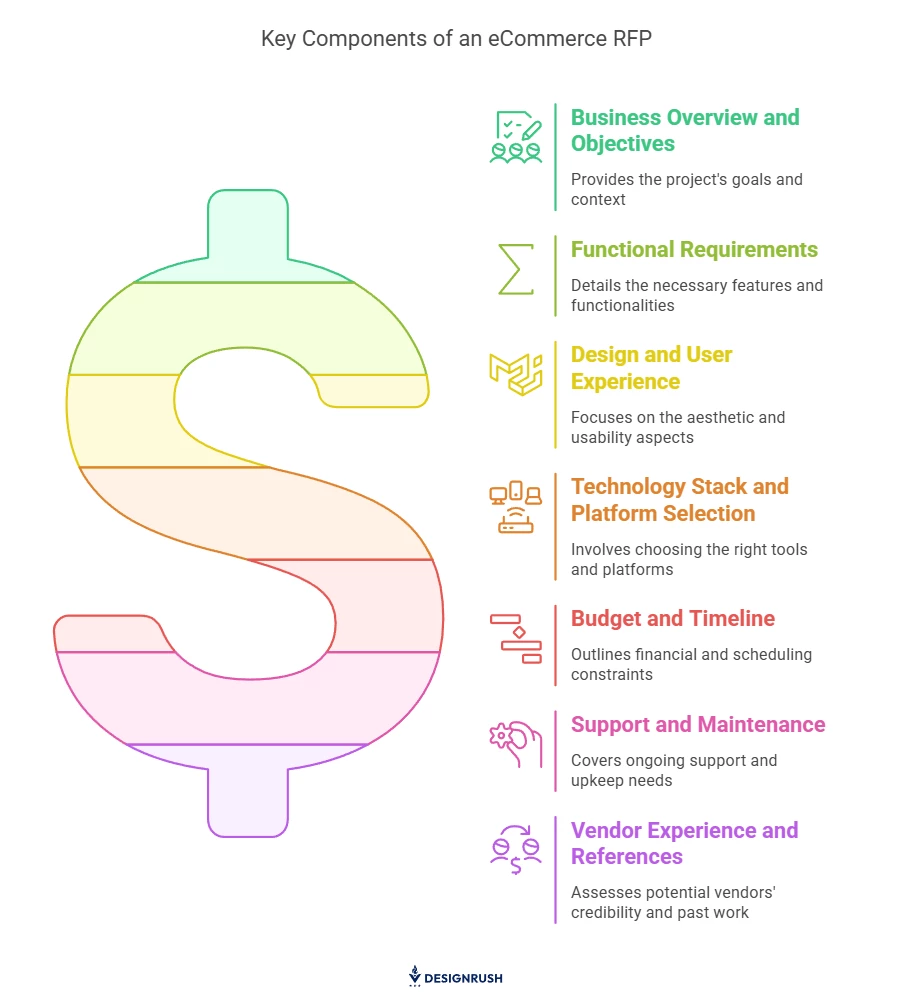
Creating a comprehensive RFP for your eCommerce website is essential to ensure vendors understand your needs and can propose the best solutions. The more specific you are about your business, your goals, and the features you require, the more tailored and relevant your proposals will be.
With that said, here are the key elements to include in your RFP:
- Business overview and objectives
- Functional requirements
- Design and user experience
- Technology stack and platform selection
- Budget and timeline
- Support and maintenance
- Vendor experience and references
1. Business Overview and Objectives
Start by giving vendors a solid understanding of your business. Describe your products, services, and target audience so they can create a tailored approach for your brand. If you operate in a niche market, this context will help them design an experience that directly addresses your customers’ needs.
Alongside the business overview, clearly define your objectives for the eCommerce site. Whether you’re focused on improving user experience, increasing conversion rates, or expanding into new markets, these goals should be front and center. By specifying your aims, you’ll give vendors a clear direction for how the website should function and what it needs to achieve.
Example questions to ask vendors:
- How do you align your solutions with specific business objectives?
- Can you share examples of similar businesses you’ve worked with?
- What strategies would you recommend to help us achieve our conversion goals?
2. Functional Requirements
Next, outline the core functionality your eCommerce site must support. This includes essentials like product catalogs, shopping carts, and secure payment gateways. Be detailed here — if your site needs advanced features such as subscription models, multi-currency support, or loyalty programs, list these explicitly.
Additionally, consider how your site will integrate with other business systems, such as inventory management, CRM, or email marketing platforms. Vendors need a clear understanding of your full technical ecosystem, so they can ensure smooth data flow and functionality across systems. The clearer you are, the more accurate their proposals will be, avoiding costly surprises down the road.
Example questions to ask vendors:
- How will you ensure our systems integrate smoothly with the website?
- What eCommerce features do you think are essential for our business?
- Can you provide a timeline for developing these features?
3. Design and User Experience
The design and user experience of your site are crucial in converting visitors into customers. Share your vision for the website’s look and feel, including brand guidelines, color schemes, or layout preferences. This helps vendors align with your visual direction and create a cohesive, on-brand experience.
UX is just as important as design. Clearly communicate your expectations for intuitive navigation, mobile responsiveness, and fast load times. A good UX helps reduce bounce rates and boost conversions, so make sure vendors understand the customer journey and how the site should guide users to complete purchases effortlessly.
Example questions to ask vendors:
- How do you prioritize user experience in the design process?
- Can you show us examples of websites you’ve designed that are optimized for mobile users?
- What steps will you take to ensure fast loading speeds?
4. Technology Stack and Platform Selection
Choosing the right technology platform is essential for your eCommerce site’s long-term success. Vendors should suggest scalable and secure platforms that align with your business needs.
Whether you require a custom-built solution or an off-the-shelf platform like Shopify or Magento, the choice should be based on factors such as product volume, expected traffic, and business growth plans.
Ensure the platform is flexible enough to support future expansion. If you plan to enter new markets or increase your product range, the technology should accommodate these changes with minimal disruption.
Example questions to ask vendors:
- What platforms do you recommend for our specific needs and why?
- How will the platform scale as our business grows?
- How do you handle platform updates and security patches?
5. Budget and Timeline
It’s critical to be transparent about your budget from the start to help vendors propose solutions that fit your financial constraints. A clear budget prevents vendors from suggesting overly expensive solutions that might not align with your goals. You should also ask for a detailed breakdown of costs, including design, development, integration, and ongoing maintenance.
Setting a realistic timeline is equally important. Knowing how much time each phase will take helps you keep the project on track and ensures you don’t rush critical elements, such as testing or final revisions.
Example questions to ask vendors:
- Can you provide a detailed breakdown of costs for this project?
- What is your standard timeline for similar projects?
- How would you handle project delays or unexpected challenges?
6. Support and Maintenance
Once your site is live, ongoing support and maintenance become essential to keep it running smoothly. Your RFP should specify the level of post-launch support you require, such as regular updates, bug fixes, and security patches.
Also, think about the future. Will you need ongoing content updates or SEO optimization? Make sure you clarify what ongoing services are available and how vendors will support your website’s growth after it launches. This is not just about fixing bugs — it’s about building a long-term partnership to help your site evolve.
Example questions to ask vendors:
- What is your process for handling post-launch issues or support requests?
- Can you provide a maintenance plan and its costs?
- What ongoing services do you offer for website optimization?
7. Vendor Experience and References
Lastly, you should ask vendors for their portfolio of previous work, and don’t hesitate to request case studies. A vendor’s experience in creating eCommerce websites, particularly for businesses in your industry, will give you confidence that they understand your unique challenges.
Client references are an invaluable resource in assessing a vendor’s reliability and quality. Reach out to past clients to get a sense of how well the vendor manages projects, communicates, and delivers on promises. This feedback will be critical in helping you decide whether the vendor is the right fit for your business.
Example questions to ask vendors:
- Can you share examples of eCommerce websites you’ve designed for businesses similar to ours?
- How do you ensure that your projects stay on track and within scope?
- Would it be possible to speak with one of your clients who can speak to your work and process?
eCommerce RFP Template
An eCommerce RFP template is useful for creating your own request for proposal from scratch because it already contains all the essential fields and questions that just need filling out by the agency.
Here is an example of what a well-rounded B2B eCommerce RFP template should contain:
Our Company
Provide a brief overview of your company, including history, mission, products, and target audience.
Project Description
Summarize the project, including the need for a new eCommerce platform or enhancements to an existing one.
Basic Goals
List primary objectives, such as improving user experience, increasing conversions, streamlining operations, etc.
Dates and Timeline
- RFP Issued: [Date]
- Proposal Due: [Date]
- Vendor Selection: [Date]
- Project Kickoff: [Date]
- Expected Completion: [Date]
Budget
Provide a general budget range or indicate flexibility.
Our Competitors
List key competitors and their eCommerce platforms to provide insight into industry standards.
Functionality
List required functionalities such as product catalogs, search, filters, customer accounts, reviews, etc.
Shopping Cart
- Guest and registered user checkout options
- Saved carts and wish lists
- One-page checkout vs. multi-step checkout
Technology / Programming Language Requirements
List any preferred technology stacks, programming languages, or frameworks (e.g., Shopify, Magento, WooCommerce, custom solutions).
Shipping
- Integration with major carriers (UPS, FedEx, USPS, DHL, etc.)
- Real-time shipping cost calculations
- Local pickup and delivery options
Payment Gateway
List required payment providers (e.g., PayPal, Stripe, Authorize.net) and preferred security standards.
Custom Features and Integrations
- Third-party integrations (CRM, ERP, email marketing, analytics, etc.)
- Subscription-based features
- Personalized recommendations
Support & Maintenance
- Expected post-launch support
- Ongoing maintenance plans
- Bug fixes and security updates
What We Need From You
- Team overview and office location
- Project scope and custom functionality
- Shopping cart selection or suggestions
- Content management system capabilities and customizations
- Your development and account management process overview
- Search marketing details
- Support and maintenance policy
- Hosting information or recommendations
- Payment and pricing structure
- Project timeline
- Agreement and/or contract
Common Mistakes To Avoid When Drafting an RFP
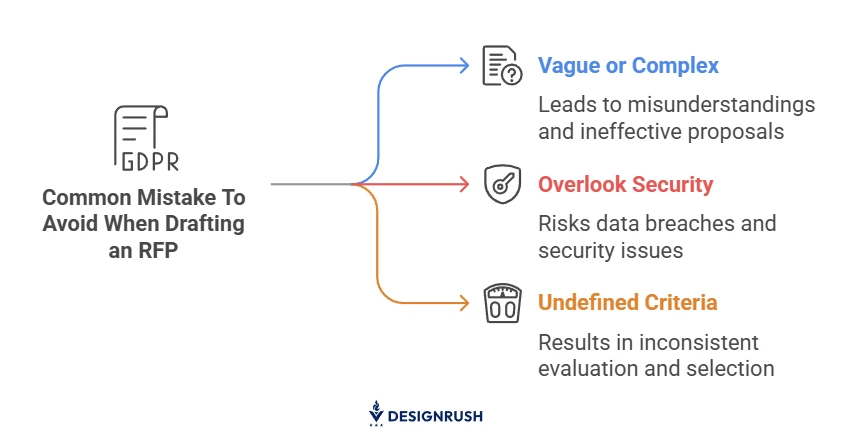
Creating an effective eCommerce RFP requires careful planning, but many businesses make avoidable mistakes that lead to vague proposals, misaligned vendor responses, or overlooked priorities. A well-structured RFP ensures that vendors clearly understand your requirements and can provide solutions that fit your needs.
Here are three common mistakes to watch out for when drafting your RFP.
- Being too vague or overly complex
- Overlooking security requirements
- Failing to define evaluation criteria
1. Being Too Vague or Overly Complex
An RFP that lacks clear details will lead to vendor proposals that are generic, misaligned, or missing critical elements. On the other hand, an overly complex RFP filled with unnecessary information can overwhelm vendors and make it difficult for them to focus on the most critical aspects of your project.
Instead of including every possible feature or technical detail, businesses should prioritize their most important goals, must-have features, and expected outcomes in a clear and structured manner.
2. Overlooking Security Requirements
Security is one of the most critical aspects of an eCommerce website, yet it’s often not emphasized enough in RFPs. Without precise security requirements, businesses risk ending up with a platform that lacks essential protections, leaving customer data and transactions vulnerable.
To prevent this, the RFP should outline necessary security measures such as the following:
- PCI DSS compliance
- SSL encryption
- Fraud protection
- Two-factor authentication
- Data backup protocols
These measures help ensure that vendors propose solutions that prioritize security from the start.
3. Failing To Define Evaluation Criteria
Without a clear evaluation framework, comparing vendor proposals becomes difficult, leading to decision-making delays or choosing a solution that doesn’t fully meet business needs. A well-defined set of criteria ensures that all proposals are assessed fairly and consistently.
Businesses should specify key evaluation factors such as budget alignment, platform compatibility, scalability, post-launch support, and vendor experience. Doing so will streamline the selection process and help make sure they select a vendor that aligns with their objectives.
Creating a Simplified RFP for Small Businesses
Small businesses should create a clear, focused RFP that prioritizes essential details, helping vendors quickly understand the project scope and provide accurate proposals.
Below are key tips to create a lean but effective RFP that works within your constraints.
- Keep it concise: Focus on the must-have details rather than an exhaustive list of requirements. A well-structured, one-to-three-page document should clearly outline your needs without overwhelming potential vendors.
- Define clear objectives: Explain what you need in simple terms, avoiding overly technical jargon. Vendors should immediately understand your business goals, whether it’s improving online sales or streamlining inventory management.
- Prioritize essential features: List only the features that are absolutely necessary for your eCommerce site. If additional features are desired but not essential, categorize them separately as “nice-to-haves” to keep vendors focused on core functionality.
- Set a realistic budget: Be upfront about your budget limitations to filter out vendors that may not be a good fit. Providing a rough price range will help ensure you receive proposals that align with what you can afford.
- Ask for practical solutions: Instead of requesting a highly customized build, consider platforms and analytics tools that offer built-in functionalities. Solutions like Shopify, WooCommerce, or BigCommerce often reduce development time and costs while still providing flexibility.
- Request only essential vendor information: Avoid asking for excessive documentation or lengthy case studies. Instead, focus on key aspects such as relevant experience, project timelines, and a brief overview of their proposed solution.
- Set clear decision-making criteria: Outline how you will evaluate proposals so vendors can tailor their responses accordingly. Defining priorities will simplify the selection process, whether it’s affordability, ease of integration, or long-term support.
How Long Does It Take To Receive eCommerce Proposals?
So, when can you expect RFP responses for your eCommerce project? Depending on different factors, such as the number of vendors you send your RFP to and the type of questions included, the eCommerce RFP process typically takes between six and 12 weeks, including:
- RFP planning and creation: Identifying the need for a new platform, determining your eCommerce priorities, and preparing the document typically takes between one and three weeks.
- RFP administration: Selecting vendors and waiting for them to submit their proposals can take between three and six weeks.
- RFP evaluation: Reviewing the proposals, shortlisting vendors, making a decision, and notifying the agencies typically takes between one and four weeks.
Evaluating Proposals Based on Pre-Defined Criteria
Once you receive vendor proposals, evaluate them based on criteria that match your business needs and narrow down your options. A structured approach ensures an objective comparison and helps you choose the right partner.
Consider factors that impact your website’s long-term success, including:
- Price and budget alignment
- Experience and industry knowledge
- Technical expertise and capabilities
- Proposed solution and approach
- Vendor communication and support
1. Price and Budget Alignment
Price is often a key deciding factor in vendor selection, but it should be assessed in the context of your overall project budget. The lowest bid might seem appealing, but it may not always be the best choice if it compromises quality or essential features. Evaluate whether the proposed cost aligns with the value and scope of the services offered.
Important elements to consider when reviewing price include:
- Total cost of ownership: Ensure the proposed cost covers all aspects of the project, including development, design, integrations, and ongoing maintenance.
- Payment structure: Review how the payment is structured and if it is tied to clear project milestones, ensuring transparency and accountability.
- Additional costs: Identify any hidden or recurring costs that may arise over time, which could impact your budget and project scope.
2. Experience and Industry Knowledge
A vendor with an established record of delivering high-quality eCommerce websites can bring valuable insights to the table. Their previous work can help you gauge their ability to meet your specific business needs.
Key aspects to evaluate are:
- Previous projects: Assess the complexity and scope of the vendor’s past work to ensure they can handle your project’s needs.
- Industry relevance: Consider if the vendor has engaged with companies of a similar size or in the same industry, which can help them understand your challenges and requirements.
- References: Check client references to gauge the vendor’s reliability, performance, and ability to meet deadlines.
3. Technical Expertise and Capabilities
Your website will require robust back-end support to handle transactions, security, and integrations. Assessing the vendor’s technical proficiency ensures they can deliver a solution that is scalable, secure, and efficient.
A vendor should demonstrate familiarity with the latest technologies and platforms relevant to your project. Additionally, they should explain how their proposed technology will evolve with your business and integrate smoothly with your existing systems.
Important considerations for technical evaluation include:
- Platform knowledge: Evaluate the vendor’s experience with the platform you intend to use, ensuring they can provide optimal solutions.
- Security expertise: Ensure the vendor has a strong understanding of security practices to protect user data and maintain compliance with industry standards.
- Custom development ability: Consider the vendor’s ability to develop custom features or integrations that meet your business’s specific needs.
4. Proposed Solution and Approach
The given solution needs to take into account all aspects of your RFP, including the functionality, design, and user experience you’ve outlined. It’s important to assess how well the vendor’s proposal aligns with your business objectives.
A strong proposal will not only meet your requirements but also offer creative solutions that improve upon your initial vision.
Points to review in the proposed solution are:
- Feature completeness: Ensure the proposal includes all the essential features needed to support your eCommerce operations, such as payment gateways and inventory management.
- Innovative ideas: Look for innovative ideas that add value to the project and improve the user experience beyond the basic requirements.
- Timelines and deliverables: Ensure the proposed timeline is realistic and aligns with your expectations. The vendor should outline clear milestones, including design approvals, testing phases, and the final launch.
5. Vendor Communication and Support
Effective communication and reliable support are key to the successful execution of any eCommerce project. The vendor should demonstrate transparency, responsiveness, and a willingness to collaborate throughout the project lifecycle. Evaluating their approach to customer support can also give you insight into the level of service you can expect once the website is live.
Key elements to assess include:
- Communication style: Review the vendor’s communication practices, ensuring they are clear, transparent, and consistent throughout the proposal process.
- Ongoing support: Clarify post-launch support, including response times and issue resolution. Vendors should detail their maintenance packages and expected response times for critical issues.
- Collaboration approach: Ensure the vendor is open to feedback and can work collaboratively with your team to make necessary adjustments during the project.
Interview Questions for Prospective Agencies
Once you've identified your top contenders, reach out to the agencies to set up an interview.
Categorize your questions and keep notes during the interview to ensure all of your questions are answered. Examples of questions you might ask include:
- Is your design solution mobile-responsive?
- Do you have a local development environment to manage and test code customizations before publishing?
- What is the way to support products with multiple configurations (in terms of size, color, etc.)?
- Does the new solution have an ISO/IEC 27001:2013 certification for Information Security Management?
- Does the solution include Secured Sockets Layer (SSL) certificates?
- Are built-in security patches provided with the new solution?
- How is your eCommerce solution hosted (on-premise, through a third-party, or on-cloud)?
- Can the existing payment gateway be migrated to the new platform?
- Does your solution support shipping from multiple warehouses?
- Does your platform support Google Custom Reviews?
- Who will be working on this project and what kind of experience do they have?
- Do you have a portfolio of similar projects and solutions?
- How do you measure success?
- Can my project be completed within my desired timeframe and my allocated budget?
- Do you have any additional recommendations for my project?
A thorough interview with each prospective agency will choose the best agency for your eCommerce project.
Key Considerations When Choosing an eCommerce Platform
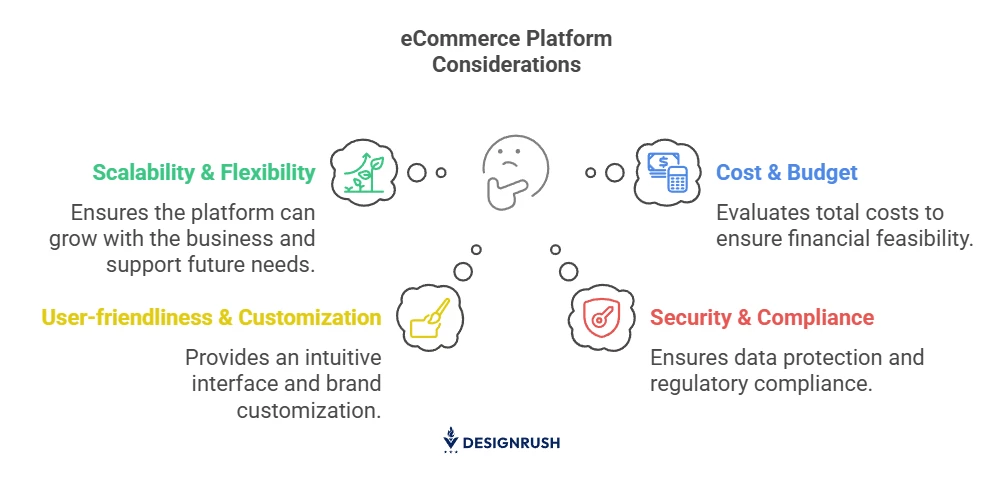
A well-defined RFP helps vendors propose a platform that meets your current and future business needs, ensuring seamless operations, scalability, and customization within your budget and technical requirements. Deciding on the right eCommerce platform is essential in making sure your online shop runs smoothly and can grow with your business.
Key factors to keep in mind when selecting your platform include:
- Scalability and flexibility: Can the platform accommodate your future business growth, such as international expansion or increased product offerings?
- Cost and budget: What are the total costs, including transaction fees, maintenance, and platform upgrades?
- User-friendliness and customization: Does the platform offer an intuitive interface and the ability to customize features for your brand?
- Security and compliance: Is the platform secure, and does it comply with necessary regulations like PCI DSS and GDPR?
- Support and maintenance: What level of ongoing support does the platform offer, and how often does it require updates or patches?
Tailored Advice for Different Types of eCommerce Businesses
Choosing the right eCommerce platform starts with understanding your business model and ensuring it aligns with your operational needs and customer expectations. A detailed RFP helps you define essential requirements, evaluate vendor capabilities, and ensure the platform you choose supports your long-term business goals.
Let's take a look at tailored advice for different eCommerce models to help shape your RFP criteria effectively:
1. Business-to-Consumer (B2C)
- Focus on a seamless shopping experience that encourages quick conversions. Prioritize intuitive navigation, mobile-friendly designs, and a fast checkout process.
- Personalization also plays a major role. Use AI-driven recommendations and dynamic pricing to help improve engagement.
- Offer multiple payment methods, including digital wallets and buy-now-pay-later options, to reduce cart abandonment.
A strong example of B2C eCommerce success is Nike’s online store, which offers a highly personalized shopping experience with AI-powered recommendations, interactive product customization, and frictionless checkout.
2. Business-to-Business (B2B)
- B2B eCommerce platforms require advanced features such as bulk ordering, custom pricing, and integration with ERP and CRM systems.
- Long sales cycles and high-value transactions require support for multiple user roles, personalized quotes, and flexible payment terms.
- Automation helps streamline order processing and reduces manual work for both buyers and sellers.
A great example of a B2B eCommerce platform is Grainger, an industrial supply company that allows businesses to order in bulk with customer-specific pricing, offering advanced search filters, automated restocking, and integration with procurement systems.
3. Subscription-Based Businesses
Subscription eCommerce relies on recurring payments and customer retention:
- Platforms must support automated billing, flexible membership options, and personalized experiences to keep customers engaged.
- Retention strategies like loyalty rewards, referral programs, and exclusive content help maintain long-term subscribers and reduce churn.
A leading example of subscription eCommerce is HelloFresh, a meal-kit delivery service that personalizes meal selections based on customer preferences.
4. Marketplaces
- Marketplaces require robust multi-vendor management, allowing multiple sellers to list and manage their products.
- Key features include vendor onboarding, commission structures, and dispute-resolution tools.
- Strong search functionality, customer reviews, and a secure payment system are also crucial to building trust between buyers and sellers.
One of the best marketplace examples is Etsy, a global platform that connects independent sellers with shoppers searching for unique handmade and vintage items. Etsy provides sellers with an easy-to-use dashboard for managing listings, processing orders, and handling customer interactions.
Wrapping Up on eCommerce Website Proposal
Choosing the eCommerce platform that meets your business goals and customers’ expectations is crucial to attracting traffic, providing an excellent user experience, and boosting conversion.
An eCommerce RFP can help you outline the details of your project and find prospective agencies that can provide you with an encompassing solution.
Additionally, this RFP checklist can be adapted for a wide range of services or industries, such as: