
Our directory of top DevOps solutions in the USA has been evaluated by 12 executive experts using our five-point criteria and supported by over 1,200 verified client reviews — providing a credible, curated selection to streamline your search.
Organic rankings are determined by five factors: top services, reviews, portfolio, awards/press, and team expertise. Sponsored listings pay for a placement that appears above organic positions. Sponsorship does not affect star ratings or review content - read more on our methodology page.
IBC Mobile, as a leading software development company, has been transforming businesses with innovation-led services. Our mission is to not only develop software but to build dynamic digital experiences that engage, inspire, and empower users. Our software solutions are designed to redefine industry standards...
Top Services:
- Web Development
- Web Design
- eCommerce Development
- Digital Marketing
- eCommerce
- Show more
- Location
- Coatesville, Pennsylvania
- Number of Employees
- 50 - 99
- Average Hourly Rate
- $40/hr
- Minimal Budget
- Under $1,000

DevOps Consulting Companies by City
DevOps Consulting Companies by State
Popular Services
Hiring Guide: How to Choose the Right DevOps Services in the US
What can the right company do for business?
Top DevOps consulting companies in the US embed best practices, culture shifts, and modern toolsets.
In doing so, they help businesses streamline operations, enhance organizational agility, and align technical workflows with overarching business objectives.
In fact, GitLab’s DevSecOp study reported that 34% of businesses state that they have more secure applications, and 33% say they have faster iteration cycles.
Additionally, 26% mentioned that they have better code quality, greater developer productivity, and improved time to market.
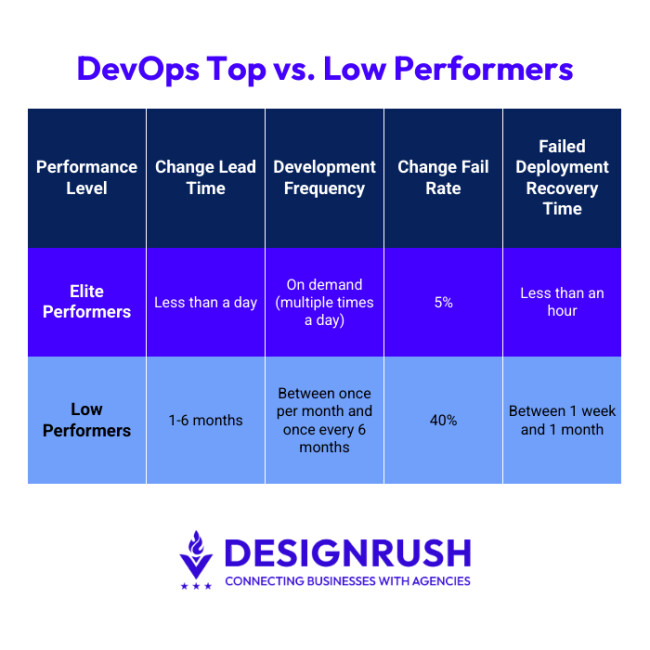
DORA’s report further confirms this.
Elite performers are observed to achieve a lead time for changes of less than one day and on-demand deployment frequency, with the capacity to deploy multiple times a day.
They also maintain a 5% change failure rate and a 60-minute failed deployment recovery time.
By contrast, low performers have a lead time for changes of 1-6 months, and a deployment frequency between once per month and once every six months.
They also have a 40% change failure rate and a failed deployment recovery time of 1-4 weeks.
What ROI can businesses expect from DevOps?
The return on investment (ROI) from DevOps hinges on the existing IT infrastructure, desired outcomes, the business size and model, initial investment costs, and rate of adoption.
According to Forrester’s Total Economic Impact (TEI) reports for platforms like GitLab and Atlassian Open DevOps, the potential ROI of DevOps can range between 358% and 483%.
Some of the key risk-adjusted present value quantified benefits include:
- Up to 20% increase in developer productivity by automating low-value tasks and gaining better visibility through integrated toolchains.
- Up to 75% faster developer onboarding to full productivity through standardized workflows, processes, and documentation.
- Up to 50% increase in delivered features and 10% improvement in code quality due to streamlined processes and higher team collaboration.
- 25%-30% reduction in software licensing costs, as organizations consolidate their toolchain, decrease shadow IT, and remove redundant technology.
- Security efficiencies improve, with 81% less effort required to maintain issue-free software by integrating security protocols/scanning throughout the SDLC.
What questions should be asked before hiring?
Before hiring a company in the USA, ask these questions to validate business and project fit:
Relevant Background
- What DevOps technologies and methodologies do you specialize in?
- Can you provide case studies or client references relevant to our industry, business size, and project complexity?
- How familiar are you with our regulatory environment, and how will you assist us in meeting compliance requirements?
Services and Processes
- Can you walk me through your end-to-end DevOps process, including toolchain selection, system migration, implementation, and optimization?
- How do you approach quality assurance and operational and delivery security?
- What are your post-implementation services?
Related to Your Project
- What are the biggest risks in our project, and what are your plans to mitigate these?
- How will you integrate DevOps into our existing IT infrastructure and business workflows without disrupting critical operations?
- How do you define, measure, and report success in DevOps implementation?
- What change management and enablement do you provide?
How to choose the best company for business?
To choose the best company for your business, compare the company’s expertise and experience with your needs and objectives. Here are some steps to guide you in your selection:
- Clarify your requirements
Conduct an initial assessment, define your priorities, set your short-term and long-term goals, and establish your success metrics, budget, and timeline. - List potential partners
Search for DevOps consulting firms with experience in your domain, industry, and business model by looking at their case studies, client references, and tech stack. - Do a background check
Review the firm’s certifications, list of awards and recognitions, and client reviews and testimonials to evaluate its service quality and reliability. - Issue a detailed request for proposal
Include your company background, technical requirements, target outcomes, budget band, timeline, milestones, and service level objectives in your RFP. - Arrange for a meeting
Meet with your top DevOps candidates to learn more about their processes, project management approach, security practices, and team culture. - Request a demonstration
Ask if the DevOps consulting firm offers an initial assessment or a 30-day service trial period to ensure the right fit before signing a long-term agreement.
How to find the right company on DesignRush that fits your budget?
We’ve curated a list of top providers on DesignRush across multiple price points, so you can identify a vendor that's within your budget.
| High budget: $50,000+ |
|
| Low budget: $25,000-$50,000 |
|
Beyond budget, our agency directory allows you to filter agency profiles by location, area of expertise, agency reviews, client types, team size, and hourly rates.

Why companies trust DesignRush
Every agency is independently vetted before it can be listed or ranked
 4.8
4.8 4.8
4.8Some agencies pay for sponsored placement, clearly labeled and held to the same vetting standards.
Frequently Asked Questions About DevOps Consulting
What services do these companies typically provide?
DevOps (Development and Operations) consulting helps organizations improve software delivery and product reliability through a mix of strategy, engineering, and operational support. Common services include:
- DevOps assessment and strategy: Evaluating current delivery performance, infrastructure, and operating model, and developing a roadmap, governance, and target-state architecture to meet business goals.
- Technical and platform engineering: Selecting, configuring, and integrating the DevOps toolchain, including the cloud platform, CI/CD, container platforms, and infrastructure automation tools.
- CI/CD implementation and optimization: Designing and enhancing continuous integration (CI) and continuous deployment (CD) pipelines to increase delivery speed and reduce deployment risk.
- Infrastructure as Code (IaC): Managing infrastructure via version-controlled code for consistent, repeatable, and scalable deployments.
- Managed DevOps and SRE support: Providing ongoing monitoring and observability, incident response support, and reliability improvements after go-live.
How much do DevOps services cost in the USA?
They typically charge depending on service scope, architecture and infrastructure complexity, number of environments, level of customization, and compliance requirements.
Skill level is another key cost factor, with consultants in the U.S. typically falling into the following rate bands:
- Junior DevOps consultants bill around $120-$150 per hour. They typically have 1-3 years of experience and a foundational knowledge of DevOps tools and methodologies.
- Intermediate-level consultants cost around $150-$250 per hour. These DevOps consultants have 3-7 years of experience working with various software and strategies and have a few projects in their portfolio.
- Senior consultants have an hourly rate of $250 to over $350. With over 7 years of experience, these consultants have a solid reputation in the industry and have worked with large and complex business environments. They can also offer specialized expertise for a specific sector or tech stack.
How long do DevOps solutions typically take?
DevOps solutions can take anywhere between 4 weeks and over 18 months. Timelines depend on business size, infrastructure maturity, security and regulatory requirements, and the scope of deliverables.
Below is an approximate timeline based on project complexity:
- DevOps pilots (4-6 weeks): Focuses on one application or product team and delivers a minimum viable product (MVP), including a CI/CD pipeline, repeatable environments using IaCs, and basic alerts and monitoring.
- Mid-sized rollouts (3-6 months): These projects expand to multiple environments (development, stage, and production) and services, including cloud security foundations. It may also include containers/Kubernetes.
- Enterprise transformation (6-18+ months): These projects implement standardization across teams and systems, including toolchain customization, advanced automation, production-grade observability, and site reliability engineering (SRE) practices. It may also have ongoing optimization services.
What processes do these consulting companies follow?
They follow a custom implementation plan based on a business’s specific needs and goals. It typically involves the following steps:
- Assessment and strategy: Auditing infrastructure, operating workflows, and delivery practices, then creating a prioritized roadmap and implementation plan.
- Toolchain selection and integration: Choosing and integrating tools for cloud, CI/CD, monitoring/observability, security, and IaC that align with the target architecture.
- IaC adoption and environment automation: Treating infrastructure like software by defining environments in version-controlled code to automate provisioning and reduce configuration drift.
- CI/CD pipeline implementation: Setting up or refining CI/CD pipelines, including release strategies (e.g., canary release or blue-green deployments) and automated build/test/deploy gates.
- Containerization and orchestration: Standardizing application packaging and deployments to reduce environment inconsistency.
- Security and compliance implementation: Applying security practices across the CI/CD pipeline and toolchains and producing compliance documentation when required.
- Observability and reliability practices: Implementing monitoring, logging, tracing, alerting, and incident-response workflows to enhance system reliability and recovery.
- Knowledge transfer and team enablement: Training users on the DevOps tools, processes, and culture to sustain adoption.
- Continuous optimization: Conducting ongoing audits and enhancements to improve system speed, security, reliability, and resilience.
Which industries typically use these services?
While there’s no data on industries that primarily work with DevOps solutions, GitLab’s DevSecOps survey provides some insight. These are the top sectors where DevSecOps professionals work:
- Software/SaaS/Computer Hardware: 21.6%
- Finance: 10%
- Telecommunications: 9.7%
- Automotive: 9.5%
- Government: 7.9%
- Aerospace & defense: 5%
- Manufacturing: 4.6%
- Retail: 4.6%
- Insurance: 4.5%
- Healthcare: 4.3%