
Our directory of direct marketing companies in the USA is based on five core criteria, reviewed by 12 experts, and backed by 500+ verified client reviews, all to help you choose the right partner for your business.
Organic rankings are determined by five factors: top services, reviews, portfolio, awards/press, and team expertise. Sponsored listings pay for a placement that appears above organic positions. Sponsorship does not affect star ratings or review content - read more on our methodology page.
Revenue Boost helps B2B founders replace word-of-mouth with predictable pipeline. We design outbound systems that combine cold email, LinkedIn outreach, and cold calling into one connected engine, then run them. Across 600+ campaigns and 50+ niches, our clients double or triple monthly revenue inside four to...
Top Services:
- Email Marketing
- Direct Marketing
- Business Consulting
- Digital Marketing
- Call Centers
- Show more
- Location
- Fort Myers, Florida
- Number of Employees
- Under 49
- Minimal Budget
- Under $1,000
- Portfolios Count
- 1 Project Listed
American Ecommerce Hub is a full service eCommerce agency dedicated to helping entrepreneurs and businesses across the USA build, automate and scale profitable online stores. With a skilled team of eCommerce specialists, strategists and account managers, we deliver end-to-end solutions designed to simplify...
Top Services:
- Digital Services
- Digital Strategy
- Creative Services
- SEO
- PPC
- Show more
- Location
- Atlanta, Georgia
- Number of Employees
- Under 49
- Average Hourly Rate
- $25/hr
- Minimal Budget
- Under $1,000
- Portfolios Count
- 3 Projects Listed
Centripe is an all-in-one CRM and marketing automation platform that helps marketing agencies and businesses run their sales and marketing from one place. You can collect and manage leads, send email and SMS campaigns, build websites and landing pages, and automate everyday tasks. Centripe also uses smart AI...
Top Services:
- Affiliate Marketing
- Direct Marketing
- Event Marketing
- eCommerce
- Email Marketing
- Show more
- Location
- Menlo Park, California
- Number of Employees
- Under 49
- Average Hourly Rate
- $1/hr
- Minimal Budget
- Under $1,000



Direct Marketing Companies by City
Direct Marketing Companies by State
Popular Services
Hiring Guide: How to Choose the Top Direct Marketing Company in the US
What can a top direct marketing agency do for businesses in the US?
They help businesses reach specific audiences with targeted, personalized campaigns that are easier to measure than mass advertising.
According to research, personalized direct mail campaigns see a 15% higher response rate than generic ones.
Furthermore, brands that use 4 or more channels in their direct marketing efforts outperform those using 1 to 2 channels by 300% engagement.
Top direct marketing agencies plan and execute data-driven outreach across email, direct mail, SMS, and telemarketing, while managing audience segmentation, messaging, testing, and performance tracking to improve effectiveness.
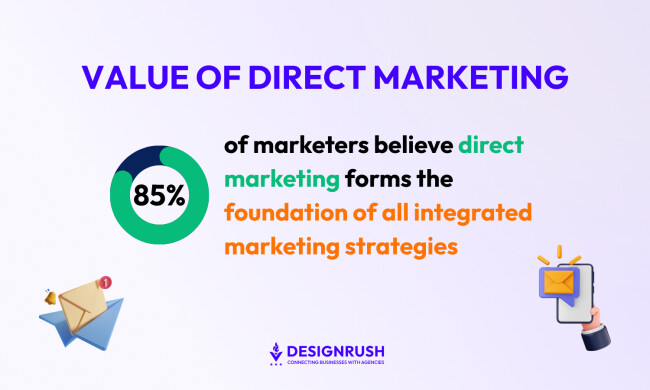
According to Linearity, 85% of marketers believe direct marketing forms the foundation of all integrated marketing strategies, highlighting its role in driving engagement and measurable results.
By working with experienced agencies, businesses can reduce wasted spend, improve message relevance, and gain clearer visibility into what influences responses, conversions, and long-term customer growth, enabling more informed marketing decisions over time.
What kind of ROI can I expect from these campaigns?
The return on investment from direct marketing varies by channel and execution, but it delivers an average return of $42 for every $1 spent, reflecting strong long-term performance across industries.
Email marketing also produces high returns, with benchmarks placing ROI at $36 for every $1 spent when campaigns are properly segmented and automated.
These results are driven by the direct marketing company’s ability to target known audiences, track responses, and optimize campaigns through data and personalization, making it a cost-efficient approach to customer acquisition and retention.
How do direct marketing companies in the United States measure project success and ROI?
They ensure success by tracking direct, quantifiable customer actions and cost efficiency.
- Response and conversion rates: Direct marketing campaigns are evaluated based on how many recipients take action. Industry benchmarks show average direct mail response rates between 2.7% and 4.4%, which are commonly used as a reference point for performance.
- Cost per acquisition (CPA): Agencies calculate how much it costs to generate each lead or customer, which helps businesses compare campaign performance and assess profitability.
- Attribution and tracking: Tools such as unique URLs, promo codes, and call tracking are used to connect responses directly to specific campaigns, which improves measurement accuracy and clarifies which efforts are driving results.
- Revenue-based ROI: Final performance is assessed by comparing campaign-generated revenue against total costs. Standard ROI calculations are used to determine overall financial impact.
When should a business outsource marketing rather than rely on an in-house team?
Hiring one of these agencies makes sense when internal resources or expertise limit campaign performance or scalability.
- Limited in-house expertise: When internal teams lack experience in audience segmentation, list management, or direct response strategy, campaign effectiveness can suffer. A direct marketing agency brings specialized knowledge and proven frameworks to fill those gaps.
- Need for faster execution: Agencies can launch campaigns more quickly using established processes, tools, and vendor relationships, so businesses can meet tight timelines or respond faster to market opportunities.
- Campaign scale or complexity increases: Multi-channel campaigns involving email, direct mail, SMS, or telemarketing can become difficult to manage internally. Agencies provide the structure and resources needed to coordinate execution and tracking across channels.
- Performance plateaus: When in-house campaigns stop improving response rates or ROI, an external partner can offer a fresh perspective. Agencies apply testing and optimization methods to identify new opportunities for growth.
- Short-term or specialized needs: direct marketing companies are useful to have onboard for one-off campaigns or specialized initiatives that do not justify long-term hiring. In that way, businesses access expertise without increasing permanent headcount.
What should you look for when selecting a marketing firm for your business?
Choosing the right marketing firm requires evaluating both strategic fit and execution capability.
- Relevant experience
Look for firms with proven experience running campaigns similar to your industry, audience, or business goals. Prior experience helps reduce risk and improves the likelihood of effective execution. - Measurement and transparency
The firm should clearly explain how success, performance, and ROI are tracked and reported. Regular, understandable reporting ensures accountability and informed decision-making. - Data and compliance practices
Strong list sourcing, data handling, and privacy compliance are essential in direct marketing. Firms should follow applicable data protection regulations and clearly document their data practices. - Channel expertise
Ensure the firm has hands-on experience with the channels you plan to use, not just high-level strategy. Practical execution experience is critical for managing performance and optimization. - Clear communication and expectations
A good partner sets realistic timelines, budgets, and outcomes from the start. Clear communication helps prevent misalignment and ensures smoother collaboration throughout the engagement.
Sources
DesignRush sustains a directory of over 40,000 agencies categorized by service category, location, expertise, and reviews. We build our database in two ways:
- Our dedicated team of agency experts actively searches the web for top-performing companies. We then pull information from their websites, online presence, and client testimonials to verify their status and qualifications prior to listing.
- The agencies listed get notified of their profiles on the website and they can choose to claim it or not, which suggests their availability for more collaborations.
Agencies can also reach out to DesignRush and must go through the verification process prior to being listed.

Why companies trust DesignRush
Every agency is independently vetted before it can be listed or ranked
 4.8
4.8 4.8
4.8Some agencies pay for sponsored placement, clearly labeled and held to the same vetting standards.
FAQs for Direct Marketing Companies
What services do these types of companies typically offer in the US?
They typically offer the following core services:
- Direct mail marketing campaigns: Targeted physical mail that still delivers some of the highest response rates among marketing channels, with an average response rate around 4.4% versus 0.12% for email.
- Telemarketing: Outreach via phone calls to generate leads, sales, or market feedback; 45% of businesses still consider telemarketing an effective lead conversion strategy.
- Email marketing: Sending targeted emails to subscriber lists to promote products and nurture relationships; 89% of marketers say email is their primary lead-generation channel.
- SMS/text marketing: Short text message promotions sent directly to mobile users; SMS messages have an exceptionally high 98% open rate and over half of consumers find them useful.
- Direct selling support: Campaigns designed to initiate immediate purchase responses from targeted audiences. Examples include list rentals, offer fulfillment, personalization, and tracking.
How much do direct marketing companies in the United States cost?
Typically, the cost ranges from a few thousand dollars for small businesses to $50,000 or more for large-scale campaigns, depending on campaign size, channel mix, data usage, and the level of personalization involved.
Unlike some digital services, direct marketing agencies rarely publish standalone hourly rates.
Instead, pricing is most often based on project fees, retainers, or per-unit campaign costs, which provide clearer and more verifiable benchmarks.
| Pricing model | Typical cost range | What it usually covers |
| Project-based pricing | $3,000-$50,000+ per campaign | Strategy, creative, list management, execution, and reporting for one-off or time-bound campaigns |
| Monthly retainer | $1,500-$10,000+ per month | Ongoing direct marketing management, optimization, and reporting |
| Per-unit campaign costs (direct mail) | $0.30-$1.00+ per mail piece | Printing, postage, and mailing (agency fees usually billed separately) |
| Telemarketing programs | $25-$75+ per hour or per-call pricing | Call labor, scripting, and lead qualification |
Hourly billing is less common in direct marketing, but some agencies use this model for planning, segmentation, or analytics.
When used, rates typically align with broader US marketing agency benchmarks, with industry data indicating a reference range of $100-$150 per hour.
How long does it typically take to see measurable campaign results?
Timelines vary by channel, with measurable results typically appearing within a few weeks to a few months.
- Email and SMS campaigns often show initial engagement within days, with simpler efforts gaining traction in 1-2 weeks.
- Direct mail responses are usually seen over several weeks, with performance commonly evaluated after 6-8 weeks.
- Multi-channel campaigns that combine email, SMS, direct mail, or telemarketing often take 1-3 months to show consistent results.
Longer-term ROI trends, such as improvements in cost efficiency, repeat conversions, and customer lifetime value, may become clearer over 3-6 months as campaigns are refined and scaled.
Which marketing channels are most effective today?
Several direct marketing channels are effective, including:
- Email marketing: Effective due to its scale and personalization, with segmented campaigns generating higher revenue than non-segmented sends.
- Direct mail: Physical mail is effective because it creates strong brand recall and is more memorable than many digital formats, especially when paired with online channels. According to CompereMedia, 85% of marketers agree direct mail delivers the best conversion rate of all channels they use, up from 74% in 2023.
- SMS marketing: Widely used for its immediacy, with many consumers preferring text messages for transactional or time-sensitive brand communications.
- Telemarketing: Plays a role in complex or high-value sales, particularly in B2B, where live conversations support qualification and relationship building. As research suggests, 45% of businesses still consider telemarketing an effective strategy for lead conversion.
- Multi-channel direct marketing: Campaigns that integrate multiple direct channels drive higher engagement by reinforcing consistent messaging across touchpoints.
Why should businesses invest in this approach instead of relying on mass advertising?
Direct marketing companies offer businesses a more targeted and measurable alternative to mass advertising.
- Targeted audience reach: Direct marketing focuses on specific customer segments rather than broad exposure, improving message relevance and reducing wasted spend, which helps businesses allocate budgets more efficiently.
- Clear performance tracking: Agencies design campaigns to generate direct responses, making it easier to evaluate which messages, channels, and audiences are driving results.
- Greater control and flexibility: Businesses can test and refine messaging, offers, and targeting based on real campaign feedback. Changes can be made quickly without waiting for long campaign cycles.
- More predictable outcomes: The ability to measure and adjust campaigns in real time leads to more consistent and manageable results compared with mass advertising, which reduces uncertainty and improves planning accuracy.