Connect with top-rated 3D modeling companies, known for delivering high-quality visual assets, product renders, and immersive designs. Our experts vetted these agencies, making it easier to choose a reliable partner.
Organic rankings are determined by five factors: top services, reviews, portfolio, awards/press, and team expertise. Sponsored listings pay for a placement that appears above organic positions. Sponsorship does not affect star ratings or review content - read more on our methodology page.
AGENCY LISTING COMING SOON.
Explore Product Design Specializations
Popular Services
Everything You Need to Know Before Hiring 3D Modeling Studios
Should I hire a 3D modeling company or a freelancer?
A custom 3D modeling company is the stronger choice because quality, reliability, and scalability are not optional in production work. These factors directly affect delivery, consistency, and business outcomes.
Companies operate through teams, structured workflows, and defined quality control processes. This reduces errors, avoids delays, and ensures consistent output across all assets.
Freelancers are limited by individual capacity and availability. They can handle small, simple tasks, but struggle with larger scope, tight timelines, or ongoing production needs.
For complex or business-critical projects, companies provide predictable delivery and lower execution risk.
You can see how 3D modeling companies and freelancers compare in the following table:
| Aspect | 3D modeling company | Freelancer |
| Best for | Complex, large, ongoing projects | Small, one-off tasks |
| Reliability | High, team-based delivery | Variable, depends on one person |
| Quality control | Structured QA and review process | Limited or informal |
| Scalability | Handle multiple assets and growth | Limited capacity |
| Expertise | Specialized roles within a team | Generalist skills |
| Project management | Defined process and communication | Less structured |
| Risk | Lower risk of delays and inconsistencies | Higher risk if issues arise |
| Cost | Higher upfront, but more predictable | Lower upfront, less predictable long-term |
What can a 3D modeling studio do for your business?
Working with a 3D modeling company is now a standard part of how businesses design, present, and sell products. By 2026, the global 3D modeling market is projected to reach $8.64 billion, showing how quickly adoption is growing across industries.
Here are five key benefits of using 3D modeling in your business:
1. Increase in conversion rates
3D modeling allows for interactive product viewers that traditional photography simply can't match. When customers can rotate, zoom, and customize a product in real-time, their confidence in the purchase increases exponentially.
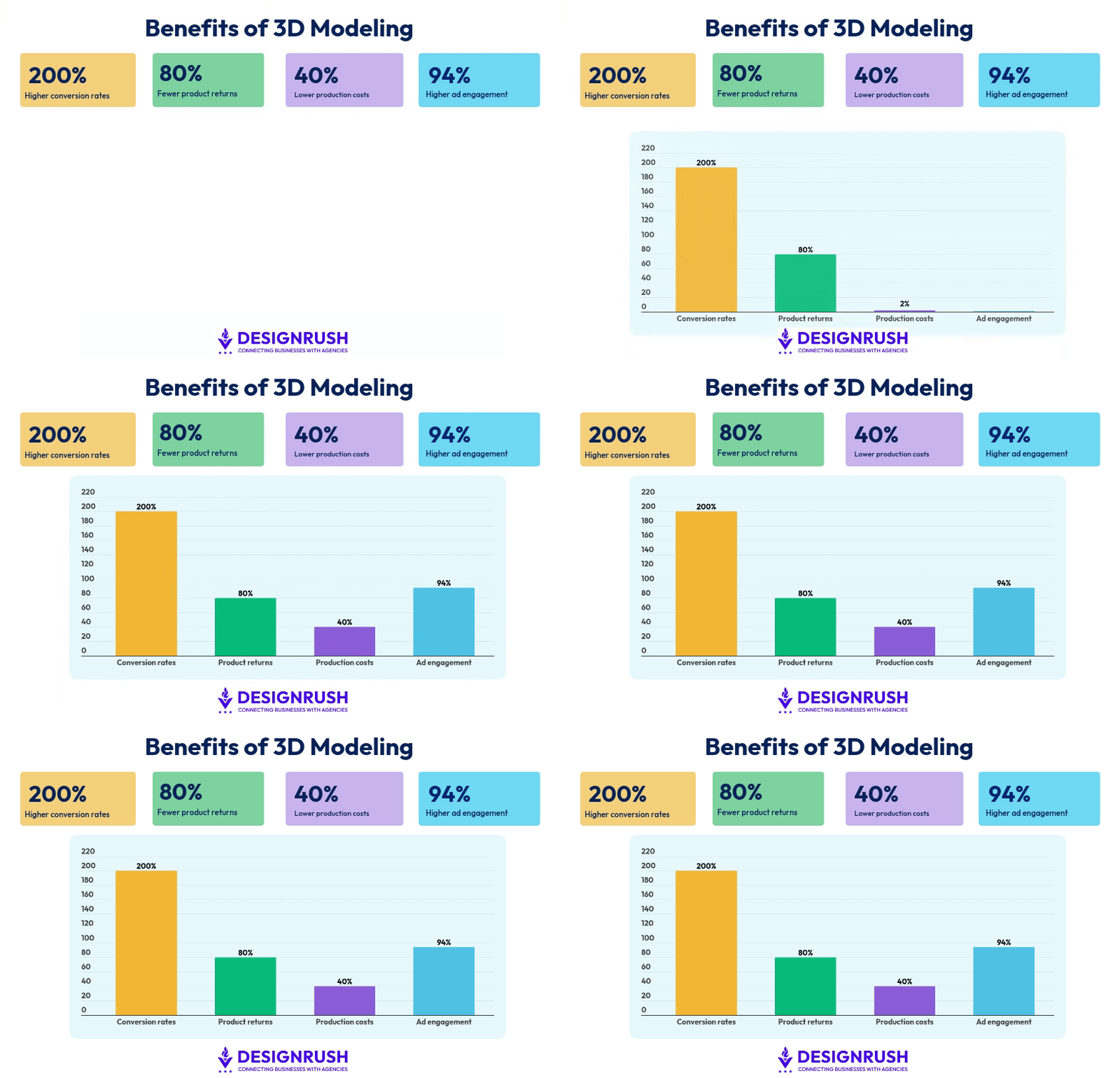
- High-value sectors like furniture have seen conversion jumps as high as 200% after implementing 3D and AR tools.
- More than 8 in 10 shoppers will choose to interact with a 3D view over 2D images when given the option.
2. Reduction in product returns
The imagination gap, where a customer expects one thing but receives another, is a leading cause of returns. 3D models provide a perfect representation that accurately manages expectations.
- Brands that use 3D visualization report an average 40% reduction in return rates, as shoppers gain a clearer understanding of size, texture, and fit.
- In some specific cases, high-quality 3D visuals have slashed returns by up to 80%.
- Companies that use 3D configurators (where users build their own versions of products) see a 25% increase in average order value.
3. Accelerated time-to-market and prototyping
A 3D modeling company can create digital twins of your products before a physical prototype even exists. This allows marketing and sales teams to begin their work months ahead of production.
- Global manufacturers have reported improving product launch timelines by an average of 4 weeks by replacing traditional photography with 3D pipelines.
- The automotive and retail sectors use 3D modeling to reduce customer decision time by 33%, accelerating the overall sales cycle.
- Enterprises typically reach the ROI breakeven point for 3D visualization within just 6 to 9 months.
4. Long-term cost efficiency
While the initial cost of a 3D asset can be higher than a single photo, the long-term savings are massive. Once a model is created, you can generate unlimited angles, colors, and environments at near-zero marginal cost.
- Furniture manufacturers have seen visual production costs drop by 38% over two years after shifting 60% of their catalog to 3D.
- Enterprises often report a 25% to 40% reduction in annual visual production spending after moving away from recurring studio fees.
5. Improved marketing engagement and recall
3D content is inherently stickier. It captures attention better than static ads, leading to higher brand recall and interaction across social and digital channels.
- In 2025, AI-driven 3D advertising solutions boosted brand recall by over 45%.
- Advertisements featuring interactive 3D elements achieve up to 94% higher click-through rates than standard ads.
What information should I prepare before contacting a 3D modeling company?
Prepare clear project details so the 3D modeling firm can accurately estimate the scope, cost, and timeline. Strong input will reduce back-and-forth and prevent delays.
- Project goal: Define what you’ll use the model for – for example, a product render, a game asset, or an AR experience requires different quality and workflows.
- Reference materials: Provide images, sketches, CAD files, or similar examples. Clear references reduce guessing and speed up alignment.
- Scope and quantity: Specify how many models you need and if there are variations. Keep in mind that the larger scope increases costs and timeline.
- Level of detail: Clarify realism and complexity. Low-poly models differ significantly from high-end, photorealistic assets.
- Technical requirements: List formats, platforms, or engines. Requirements like .fbx, Unity, or Unreal affect how the model is built.
- Timeline and budget: Set expectations early. Deadlines and budget constraints directly shape what is feasible.
What criteria should I use to compare 3D modeling companies?
Focus on portfolio quality, relevant experience, and ability to deliver within your scope, timeline, and technical requirements. The right 3D modeling agency should match your project type, not just offer generic 3D capabilities.
Check out:
- Portfolio quality: Review finished work, not just concepts. Look for consistency in detail, realism, and execution across multiple projects, not one standout example.
- Relevant experience: Check if they’ve worked on similar industries or asset types like products, games, or architecture. Prior work in your industry also reduces onboarding time.
- Technical capability: Confirm they support required formats, engines, and optimization standards, such as .fbx, Unity, or Unreal.
- Process and communication: A structured workflow with clear stages, approvals, and updates reduces risk. Poor communication leads to delays, rework, and misalignment.
- Pricing structure: Clear pricing should define what is included, including the number of models, revisions, and the level of detail. Hidden costs often come from a vague scope.
- Timeline reliability: Past delivery performance matters more than promises. A reliable 3D modeling agency will set realistic deadlines and stick to them.
- Reviews and client feedback: Consistent positive feedback indicates reliable, high-quality delivery.
- Scalability: Ensure they can handle larger workloads or ongoing projects if needed.
What questions should you ask 3D modeling companies before signing a contract?
Asking the right questions reduces risk before work starts. It helps you validate capability, clarify expectations, and avoid delays, rework, or hidden costs later.
Relevant background
- What types of 3D modeling projects have you completed recently?
- Which industries do you have the most experience in?
- Can you share case studies or examples similar to my project?
- What tools and software does your team use?
Services and processes
- What is your typical workflow from briefing to final delivery?
- How do you handle revisions and feedback cycles?
- What is included in your pricing, and what costs extra?
- How do you ensure quality control before delivery?
Related to your project
- Have you handled projects with a similar scope or requirements?
- What timeline do you estimate for this type of work?
- What file formats and outputs will you deliver?
- What do you need from me to start and keep the project on track?
Sources
DesignRush sustains a directory of over 40,000 agencies categorized by service category, location, expertise, and reviews. We build our database in two ways:
- Our dedicated team of agency experts actively searches the web for top-performing companies. We then pull information from their websites, online presence, and client testimonials to verify their status and qualifications prior to listing.
- The agencies listed get notified of their profiles on the website and they can choose to claim it or not, which suggests their availability for more collaborations.
Agencies can also reach out to DesignRush and must go through the verification process prior to being listed.
Latest Trends Related to 3D Modeling