
Our directory is designed to help you find the right software testing company in the USA, based on five ranking criteria, expert review, and 1,300 verified client reviews.
Organic rankings are determined by five factors: top services, reviews, portfolio, awards/press, and team expertise. Sponsored listings pay for a placement that appears above organic positions. Sponsorship does not affect star ratings or review content - read more on our methodology page.
Expert software developers delivering top-tier web and mobile apps for startups and SMBs. With diverse industry experience spanning e-commerce, fintech, online dating, media, and travel, we bring a wealth of expertise to every project...
Top Services:
- Staff Augmentation
- Mobile App Development
- Software Development
- Software Testing
- Web Development
- Show more
- Location
- St. Petersburg, Florida
- Number of Employees
- Under 49
- Average Hourly Rate
- $50/hr
- Minimal Budget
- $25,000 - $50,000

Software Testing Companies by City
Software Testing Companies by State
Popular Services
Hiring Guide: How to Choose the Best Software Testing Company in the US
What do the best software testing companies in the US do for businesses?
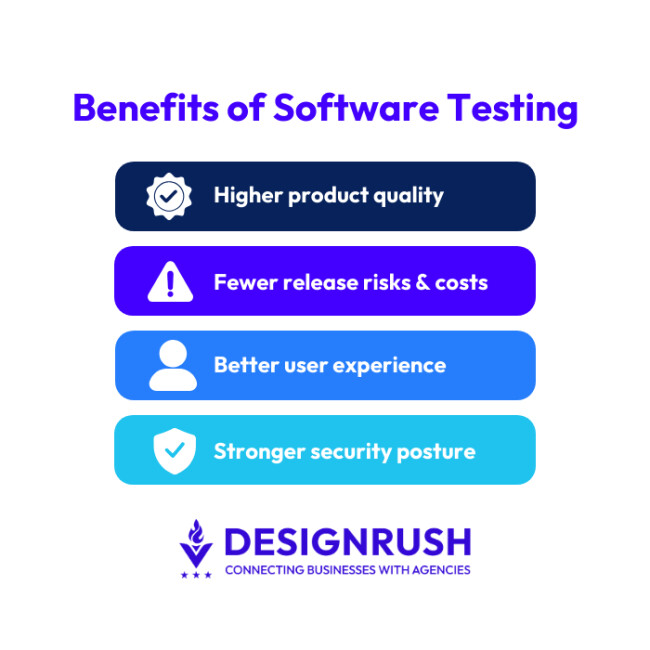
They help businesses reduce release risks, enhance user experience, and strengthen security posture by ensuring that the finished solution meets industry and business-specific standards.
In fact, research found that fixing bugs before product release results in 6.5x less cost than resolving the issue after launch.
Moreover, automating load and performance tests can accelerate the regression testing timeline by up to 90%.
Gartner’s study also found that the top reasons that organizations use automated testing are to improve product quality (60%), accelerate deployment speed (58%), and enhance department agility (41%).
How to choose the best company for your business?
To choose the best US software testing company for your business, evaluate its expertise and experience against your requirements. Here are some steps to guide you:
- Define testing requirements
Outline current software issues, testing goals and priorities, project scope, compliance requirements, budget, and timeline. - Search for relevant experience
Evaluate case studies and client references to find a company familiar with your industry-specific requirements, tech stack, and testing coverage and methodology. - Conduct due diligence
Assess the company’s certifications, vendor partnerships, awards and recognitions, and client reviews to confirm it’s trustworthy and credible. - Issue a request for proposal (RFP)
Provide a detailed project brief illustrating your business's current predicaments, so that the company can provide an accurate quote that aligns with your needs. - Schedule a consultation
Meet the team who’ll work on your project and request sample reports or pilot tests to further gauge project fit. - Make your decisions
Beyond technical proficiency, select an agency that aligns with your values and is capable of supporting your growing needs with flexible team sizes and service levels.
Need help finding a US software testing company? Visit our Marketplace and submit your project brief. We’ll connect you with the most suitable companies — free of charge.
What questions should you ask a US software testing firm before hiring?
Before hiring a US software testing firm, consider asking these questions:
Relevant Background
- How familiar are you with our industry-specific requirements? What deliverables can you provide to help us comply with the regulations?
- Can you share projects similar to our testing coverage, methodology, and criteria?
- What testing tools and frameworks do you use?
Services and Processes
- What is your software testing process — from discovery and planning to execution and reporting?
- How will you set up/manage test environments and test data?
- How do you balance manual vs automated testing? What are your criteria for automating tests?
- How do you handle access control, credentials, and confidentiality?
Relevant to Your Project
- What test types do you recommend for us, and why?
- What are your SLAs for triage, retesting, and regression after fixes?
- How do you measure quality and progress (coverage, defect trends, escape rate, release readiness)?
What are common mistakes to avoid when hiring a software testing agency?
Selecting the right testing partner requires careful evaluation beyond surface-level factors.
Common mistakes include:
- Choosing based solely on cost: The cheapest option often leads to lower quality, missed defects, and costly rework. Organizations should evaluate "results per dollar" rather than "hours per dollar."
- Failing to define requirements clearly: Vague project scopes lead to miscommunication, scope creep, and budget overruns. Clear documentation of testing objectives, success criteria, and testing entrance and exit criteria is essential.
- Underestimating testing needs: Setting up additional testing environments and infrastructures beyond the agreed scope leads to longer project timelines and higher fees. One way to avoid this is to ask the company to conduct audits, so you can more clearly define the testing needs and strategies.
- Neglecting long-term maintenance planning: Testing isn’t a one-time launch task. Without ongoing QA as the product changes, defects and security gaps reach users and become far more expensive to fix after release.
- Ignoring communication and cultural fit: Testing teams need to integrate with development workflows. Time zone differences and communication barriers can impact collaboration quality.
When asked about the most significant challenges to automated software testing deployment, struggles with implementation (36%), automation skill gaps (34%), and high upfront costs (34%) were among the most commonly reported.
How to evaluate the effectiveness of a US software testing firm?
Per the State of Testing Report, these are the most common metrics businesses are using to measure a software testing team’s effectiveness:
- Test coverage (56%): Compares how much of the software has been tested to determine the thoroughness of the testing process.
- Defect metrics (54%): Measures the number of identified defects, organizes them according to severity, and the rate at which they’re identified.
- Test execution metrics (45%): Monitors the speed, progress, and outcomes of running tests through test execution rate, test pass/fail/block percentage, and cycle time.
- Escaping defects rate (34%): Tracks the percentage of defects or issues identified after a software has been released.
- Test effectiveness metrics (25%): Identifies testing process performance in identifying defects and ensuring product quality before launch.
- Test economics (8%): Determines if the business maximizes the return on investment (ROI) of software testing.
Sources
DesignRush sustains a directory of over 40,000 agencies categorized by service category, location, expertise, and reviews. We build our database in two ways:
- Our dedicated team of agency experts actively searches the web for top-performing companies. We then pull information from their websites, online presence, and client testimonials to verify their status and qualifications prior to listing.
- The agencies listed get notified of their profiles on the website and they can choose to claim it or not, which suggests their availability for more collaborations.
Agencies can also reach out to DesignRush and must go through the verification process prior to being listed.

Why companies trust DesignRush
Every agency is independently vetted before it can be listed or ranked
 4.8
4.8 4.8
4.8Some agencies pay for sponsored placement, clearly labeled and held to the same vetting standards.
FAQs for Software Testing Companies
What services does a software testing company provide for your business in the United States?
They provide a comprehensive range of services designed to validate and improve software quality through systematic evaluation and advanced tooling.
Core testing services include:
- Quality assurance and testing strategy: Audits software and defines testing scope, priorities, coverage, approach, and reporting.
- Functional testing: Verifies that software features work according to specified business and functional requirements.
- Regression testing: Detects unintended issues introduced by system changes and releases.
- Performance and load testing: Measures the application’s reliability and responsiveness during peak usage.
- Security testing: Identifies and resolves security vulnerabilities and tests against compliance and governance requirements.
- Usability testing: Assesses user experience, interface intuitiveness, and overall accessibility of the solution.
- Integration and API testing: Validates how different system components and third-party services work together.
In addition to these services, software testing companies implement a mix of manual (often for exploratory and user experience-focused scenarios) and automated (repeatable checks throughout the development cycle for speed and consistency) testing models.
How much does software testing cost?
Software testing costs about 15%-25% of the development costs or 23% of the IT budget. In terms of hourly rates, US software testing companies charge an average of $100-$250 per hour, with more complex systems or specialized tests going beyond $300/hour.
The final rate will depend on solution complexity, testing coverage, quality requirements, project timeline, and current technical debt.
Here’s how much software testing costs as a percentage of the software development budget:
- Critical systems and highly regulated industries: 40%-50%
- Enterprise applications: 25%-35%
- Consumer-facing applications: 15%-25%
- Mobile applications: 20%-30%
In practice, basic one-time testing projects, such as a website penetration test, cost approximately $5,000-$10,000.
On the other hand, continuously evolving software solutions that require regular comprehensive testing can fetch between $20,000 and $70,000+ per month.
Are there any additional costs to consider when working with US software testing agencies?
Beyond project scope, complexity, and timeline, these are additional costs to consider when working with software testing agencies in the USA:
- Tooling and platform fees: Software license or subscription fees for device farms, performance testing platforms, and security scanning tools may be billed separately from the company’s overall rates.
- Device/browser lab coverage: For tests that require broad compatibility coverage, costs can increase based on access to real devices, operating system versions, and browsers.
- Scope growth: New testing requirements, additional integrations, new platforms (mobile/web), or expanding acceptance criteria often require a change order.
- Additional test cycles: Extra rounds of re-testing and regression tests beyond what’s defined in the service level agreement (SLA) incur additional costs.
- Defect remediation effort: Fixing defects is often outside the testing scope and is billed as an additional engineering or development fee.
- Compliance and security deliverables: If you require additional formal evidence (e.g., audit artefacts and traceability) or expanded security testing, expect incremental charges.
How long does software testing usually take?
On average, software testing takes around 20%-40% of the total software development time. However, the final timeline will depend on infrastructure complexity, test scope and methodology, and quality requirements.
Here’s an approximate software testing timeframe based on the typical software project schedules:
| Full Release Schedule | Software Testing Timeframe | |
Small software builds | 12-24 weeks | 2-4 weeks |
| Mid-sized builds (e.g., Fully customized mobile apps) | 16-40 weeks | 3-4 months |
| Large builds (e.g., Multi-module platforms) | 36-144 weeks | 6-12 months |
Notably, software testing is often integrated into the software development lifecycle (SDLC). As such, it’s common to see QA and testing done in 1-2-week sprints rather than a separate stage altogether.
What industries do US software testing firms typically work with?
US software testing providers work with a wide range of industries, as all digital solutions need to be tested in some capacity. However, these are the sectors that quality assurance (QA) and testing experts work in based on the State of Testing Report 2025:
- Tech: 35.2%
- Finance and insurance: 16.9%
- Others: 12.7%
- Healthcare: 10.9%
- Business and information: 4.5%
- Retail: 4.1%
- Marketing: 3.7%
- Transportation: 3%
- Government: 3%
- Gaming: 2.6%
- Education: 1.9%