Our Verified Agencies
are Trusted by Top Brands:
are Trusted by Top Brands:





Each agency listed on DesignRush is assessed for industry expertise and customer testimonials are evaluated in order to provide you with a vetted selection. Certain listings represent paid partnerships.
-thumb-webp.webp)
Clay built our new website to support a product launch, and we were impressed by how quickly they delivered. The site met our expectations perfectly. They worked efficiently and provided high-quality results right on schedule.
Show moreClay designed and developed our car retail website, and the results were outstanding. The site looked stunning and worked exactly as needed. They stood out for their patience, attentiveness, and excellent service. Communication was always clear, and they delivered on time.
Show moreClay redesigned and rebuilt our nonprofit’s website with fresh UX/UI research to guide the process. The new site improved conversions, earned great user feedback, and boosted internal efficiency. Communication across all channels was seamless, and their responsiveness and high-quality results went beyond what we expected.
Show more


Raymond Ferrara's Review Sourced from Google
I have retained Mobidev on three different projects over a period of four years. Mobidev was and is an excellent technical partner in all respects.
Show moreAn AR/VR agency is a specialized partner that helps brands use augmented reality (AR) and virtual reality (VR) to create immersive ways of engaging with their audience. Instead of relying on traditional media, these agencies design experiences that make products, places, or stories feel interactive and real.
They bridge creativity and technology by turning abstract ideas into experiences that people don’t just watch but actually feel part of. This sense of immersion helps audiences form stronger memories and emotional connections with a brand.
An AR/VR agency helps brands create immersive experiences by blending creative storytelling with advanced technology. For example, a furniture brand might allow customers to use AR to place a 3D sofa in their living room using their phone. Instead of guessing from a catalog, people see how it fits in real life, creating a far more engaging and confident buying experience.
By making the audience feel like they’re “inside” the story, AR/VR turns ordinary interactions into memorable moments that leave a stronger impression than static ads or traditional media.
Industries that benefit the most from AR/VR are those where immersion saves time, builds trust, or improves learning:
The top-rated AR/VR agencies on DesignRush in 2025 are:
Core AR/VR services these agencies provide include:
Specialized AR/VR services:
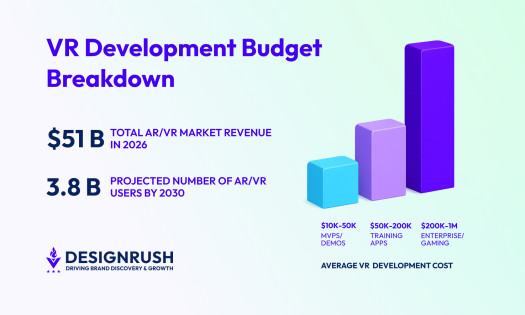
The cost of AR/VR development services in 2025 depends on project complexity and features, agency expertise, and expected timeframe. Here is a breakdown:
The timeline for AR/VR results depends on scope and complexity, but agencies usually provide an early prototype within a few weeks to a couple of months. Simple proof-of-concept demos can be turned around quickly, especially if they use pre-built assets or existing platforms.
For full projects, like training simulators, eCommerce try-on tools, or custom games, you’re looking at 3 to 6 months or more. The more advanced the features (multi-user, hardware integration, complex 3D worlds), the longer it takes.
Clear goals and feedback cycles help speed things up.
When evaluating an AR/VR agency, prioritize:
Warning signs that suggest a poor-fit AR/VR partner are:
Must-ask questions you should pose before hiring an AR/VR agency are:
AR/VR services go beyond standard interactive app development by focusing on immersion and presence. Traditional apps let users tap, swipe, or scroll through information, while AR/VR surrounds them with a 3D environment they can explore and interact with. The difference is less about functionality and more about how people experience the content.
For example, a standard app might let you spin a 3D product model on your phone, but AR/VR can place that product in your living room or let you handle it in a virtual showroom. This deeper engagement makes AR/VR especially powerful for industries where visualization, training, or storytelling matter most.
Leading AR/VR agencies use:
We prioritize providing accurate and practical information to businesses and agencies alike, which is why we partnered with Keith Shields, CEO and co-founder of Designli, a prominent software development firm. He shared insight on how organizations can select the right AR/VR company for their project needs.
Boasting over 20 years of experience in the tech niche, Keith Shields has built a career on turning big ideas into robust software solutions. Under his leadership, Designli has received more than 200 five-star reviews and a reputation as a go-to partner for scalable digital products.
Selina Garcia has authored 500+ articles and edited 50+ published books in economics, law, and history. Her unique blend of experiences allows her to approach content creation from a well-rounded perspective. Currently, Selina applies her expertise to producing insightful articles on IT, software, and applications for DesignRush.
Sergio is a technology leader with over six years of experience managing global teams and delivering projects across fintech, sportstech, and B2B platforms. At DesignRush, he drove product growth and development execution, building tools that speed up processes by 95% and cut costs by 35% while maintaining full uptime.