
Reputation management services monitor and shape how your brand appears across search results, reviews, social platforms, and AI-generated answers.
Here's what's actually included, what it typically costs, and how to vet a provider before you sign anything.
Reputation Management Services: Key Findings
- Reputation management covers nine main areas, including reviews, SEO, crisis response, and AI search visibility, with most providers combining several services.
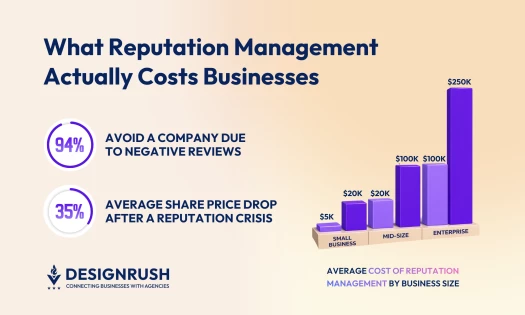
- Costs typically range from $5,000 to $100,000, depending on the size of the business, the scope of the work, and how quickly support is needed.
- Poor customer experiences will put $973 billion in US consumer spending at risk in 2026, making reputation a revenue issue rather than only an image concern.
What Are Reputation Management Services?
Reputation management services monitor, protect, and improve how a business or individual is perceived across search engines, review platforms, social media, news coverage, and, increasingly, AI-generated answers.
Providers typically combine a few core disciplines, such as search engine optimization, content creation, review management, and social media oversight.
In practice, that means a provider might do any combination of the following:
- Monitor what's being said about a brand across the open web and AI platforms.
- Respond to or help resolve negative reviews and feedback.
- Build and promote positive, owned content to improve branded search results.
- Suppress or work to remove damaging content where legally possible.
- Manage how a brand or executive is represented on social media.
- Coordinate PR and crisis response when something escalates.
But not every provider does all of this. Some specialize in reviews alone, others handle only search-result suppression, and a smaller group offers the full stack.
Knowing which categories exist, which we’re covering next, is the first step to figuring out what you actually need.
Why Businesses Invest in Reputation Management
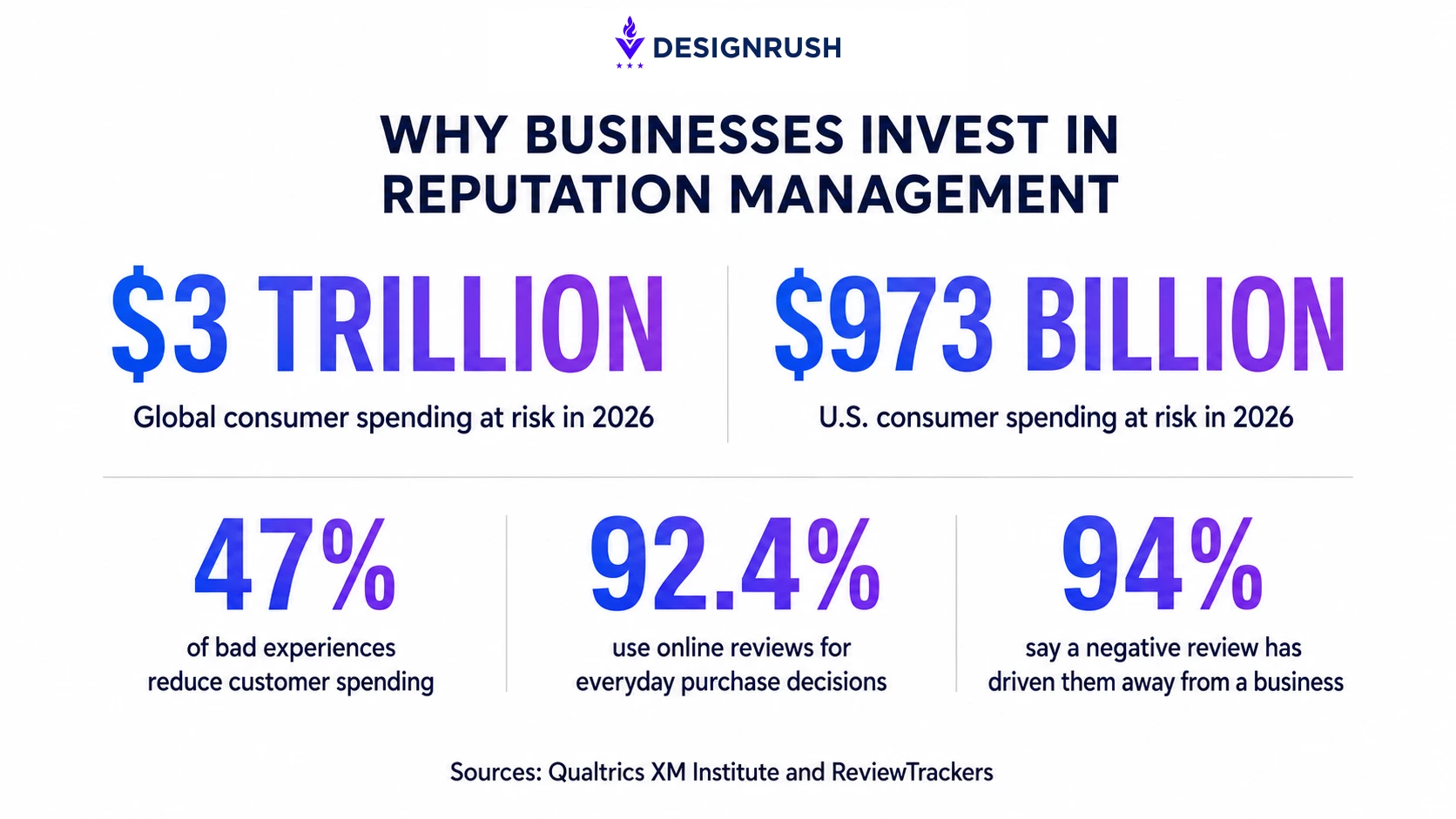
One of the main reasons businesses invest in reputation management is the financial impact of poor customer experience.
- Qualtrics XM Institute estimates that negative experiences will put nearly $3 trillion in global consumer spending at risk in 2026. In the US alone, the figure reaches roughly $973 billion, with 47% of bad experiences leading customers to reduce their spending.
Online reviews can compound that financial impact by influencing customers before they ever interact with a business.
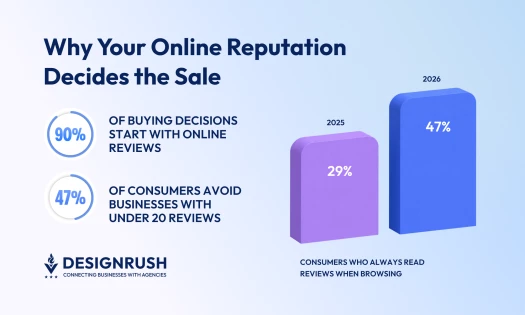
- ReviewTrackers has reported that 92.4% of consumers use online reviews to guide most of their ordinary purchasing decisions, and that 94% say a negative review has convinced them to avoid a business outright.
Customer patience for a bad experience is also thinner than many businesses assume.
Put together, these numbers explain why reputation management has shifted from a reactive PR line item to a standing budget category for many mid-sized and larger businesses.

What Reputation Management Services Include
Reputation management can include anything from review monitoring and search result cleanup to executive positioning, crisis response, and visibility in AI-generated answers.
The right mix of services depends on where the reputational risk appears, who it affects, and whether the business needs ongoing protection or help resolving a specific issue.
- Personal and executive reputation management
- Content management and search result cleanup
- Review and local reputation management
- SEO and branded search management
- Social media reputation management
- Third-party platform and directory management
- Crisis and misinformation response
- PR and thought leadership
- AI and search reputation management
1. Personal and Executive Reputation Management
Personal and executive reputation management focuses on how founders, executives, and other public-facing employees are perceived separately from, but still in connection with, the company.
It is particularly relevant for leaders in regulated industries, public figures, and executives whose statements or social media activity can affect the wider brand.
According to DesignRush’s 2026 reputation management cost analysis, based on agency portfolio data, executive reputation campaigns typically cost $20,000 to $100,000.
- Enterprise, public figure, and other high-exposure engagements can reach $100,000 to $250,000 or more, especially when they involve several names, platforms, or markets.
How Erase.com Pushed Two Negative Results Off Page One in Nine Months
Erase.com’s executive case shows why personal and company reputations may require separate campaigns, even when they affect the same business relationship.
Cenk Uzunkaya, CEO of Erase.com, explains:
“Google doesn’t treat an executive and their company as one thing. An executive’s name and the company’s name produce separate search-result pages, each with its own mix of competing content.”
Company-name searches are more likely to feature business directories, press releases, corporate news, and review platforms. Using one publishing plan for both would therefore produce assets that could rank for one name while having little effect on the other.
“An asset that wins on one page and never shows up on the other only did half the job,” Uzunkaya says.
Erase.com published 82 assets over nine months, dividing them between two publishing strategies with separate link work and monthly monitoring.
The first meaningful movement appeared in month two, but Uzunkaya says the slower search determined the overall timeline because the campaign was not complete until both first pages were clear.
After nine months, both negative results had moved off page one, while six of the results appearing across the two first pages were assets the agency had created or placed.
2. Content Management and Search Result Cleanup
This service combines the creation of positive, brand-owned content with efforts to improve what appears in branded search results.
Agencies may promote favorable coverage, address outdated or inaccurate pages, and pursue the removal of damaging content where legal and platform policies allow it.
- According to DesignRush reputation management cost data, basic content and search cleanup projects can start below $5,000 and reach $20,000, depending on how much content the agency must create and how difficult the existing results are to replace.
How Volkswagen Rebuilt Its Narrative and Returned to Record Sales After Dieselgate
After regulators exposed Volkswagen’s emissions cheating in September 2015, the company could not remove the accurate reporting or erase the financial consequences.
Dieselgate has since cost Volkswagen more than $34 billion in fines, settlements, and other expenses.
Instead, Volkswagen began building a new public narrative around electric mobility, sustainability, and technological change.
Its owned communications supported the Transform 2025+ strategy, while the company backed the messaging with product development and almost €44 billion in planned investment across electric vehicles, autonomous driving, mobility services, and digitalization.
Volkswagen delivered a record 10.3 million vehicles in 2016 and moved ahead of Toyota as the world’s largest automaker by volume.
3. Review and Local Reputation Management
Review management is focused specifically on ratings and reviews across Google Business Profile, industry-specific platforms, and marketplaces.
- Review management typically costs less than $5,000 to $20,000, according to DesignRush data, making it one of the more affordable ways to start managing a business’s reputation. Many small businesses begin here before investing in broader search, content, or crisis support.
DesignRush's small business reputation guide goes deeper on this tier specifically.
How Chipotle Returned to Double-Digit Sales Growth After a Four-Year Trust Rebuild
Following several foodborne illness outbreaks in 2015, Chipotle’s fourth-quarter net income fell 44%, while comparable restaurant sales dropped by more than 29% in the first quarter of 2016.
Recovery required changes beyond public messaging, including new leadership, stronger food-safety procedures and a program providing up to $10 million to help smaller suppliers meet the company’s updated standards.
By 2019, comparable restaurant sales had grown 11.1% and annual revenue had increased 14.8%, showing that the company’s recovery took several years of operational and reputational work.
4. SEO and Branded Search Management
Branded search management improves how a brand ranks for its own name and related terms, so that owned, positive content, rather than outdated news, a single bad review, or a competitor's page, controls the first page of results.
This overlaps with general SEO but is scoped specifically around brand and executive names rather than product keywords.
- Basic branded search campaigns can start below $5,000 and reach $20,000, while complex executive or enterprise campaigns can exceed $100,000 when they involve sustained content production and multiple search profiles, according to DesignRush Agency Directory portfolio data.
How BP Bought Search Visibility but Still Carried a 50% Reputation Gap Seven Years Later
In 2010, BP purchased search ads for terms such as “oil spill,” “volunteer” and “claims,” placing links to its response website above organic news results. A BP spokesperson said the ads were intended to help affected people find information about claims, cleanup reporting and volunteer opportunities.
The strategy gave BP a prominent position in search results, but only through paid placement. It did not remove critical coverage or change how the public viewed the company.
BP’s reputation declined by approximately 50% compared with a synthetic control group and remained impaired through the end of 2017.
The case shows that search campaigns can help a company present its response during a crisis, but visibility alone cannot repair damage when public criticism reflects a serious, unresolved event.
5. Social Media Reputation Management
Social media reputation management tracks how customers talk about a brand across social platforms and shapes the brand's own posting and response strategy.
Unlike broader social media marketing, the primary goal is to build and protect trust rather than increase engagement for its own sake.
- Agencies often include this work in basic ORM packages, which can cost less than $5,000 to $20,000 depending on the number of platforms and the amount of monitoring and response support required.
How Domino’s Responded to a Viral Crisis and Later Grew Same-Store Sales 14.3%
In April 2009, two Domino’s employees posted a food-tampering prank video that attracted more than 1 million views within days.
Domino’s initially responded behind the scenes, but the company soon moved its response onto the same platforms where the crisis was spreading.
It created the @dpzinfo Twitter account and published a YouTube apology from then-Domino’s USA President Patrick Doyle.
Later that year, Domino’s launched its separate Pizza Turnaround campaign after research showed widespread dissatisfaction with its food.
The company publicly shared harsh customer criticism, changed its pizza recipe, and built the campaign around showing that it had listened.
US same-store sales increased 14.3% in the first quarter of 2010 following the new pizza’s launch. Millward Brown also ranked the campaign’s main advertisement among the top 1% it had tested during the previous five years.
6. Third-Party Platform and Directory Management
This service manages how a brand appears across review aggregators, industry directories, marketplaces, and other websites outside its direct control.
Keeping these profiles accurate and consistent is important because customers often use them to compare providers and read feedback before making a decision.
- Agencies usually include this service in review management or basic ORM packages costing less than $5,000 to $20,000.
How Amazon Blocked More Than 275 Million Suspected Fake Reviews in One Year
Amazon filed its first lawsuit against fake-review brokers in 2015. In 2024 alone, the company said it blocked more than 275 million suspected fake reviews and took action against thousands of people and businesses attempting to manipulate its review system.
In 2025, Amazon won a court order transferring ownership of more than 75 domains connected to services selling fake positive reviews, negative reviews targeting competitors, and fraudulent seller accounts.
This case shows why third-party profiles cannot be left unattended.
You need to monitor reviews, document suspected manipulation and use each platform’s reporting process quickly, since fake feedback can affect customer trust, search visibility and legitimate sellers before the platform removes it.
7. Crisis and Misinformation Response
Crisis response addresses urgent threats such as a viral complaint, a coordinated fake-review campaign, brand impersonation, or a false claim spreading faster than a business can correct it.
- Limited incidents may cost less than $5,000, while sustained or high-risk crises can run from $20,000 to more than $100,000. These engagements cost more because they often require rapid monitoring, media coordination, legal input, and senior-level support.
You can see what to do when something starts spreading in DesignRush's misinformation response guide for the full step-by-step workflow.
How Tylenol Regained More Than 80% of Its Former Market Share Within a Year
In September 1982, seven people in the Chicago area died after taking Extra-Strength Tylenol capsules that someone had laced with cyanide after they reached store shelves.
Johnson & Johnson responded by warning consumers, stopping production and advertising, cooperating with investigators and recalling approximately 31 million bottles nationwide. The recalled products had a retail value of more than $100 million.
The company also kept the public informed through press conferences and media appearances. When Tylenol returned to stores, it came in new triple-sealed, tamper-resistant packaging that made interference easier to detect.
Tylenol’s market share initially fell from 35% to 7%.
By September 1983, however, the brand had recovered more than 80% of the market share it held before the poisonings.
The response succeeded because Johnson & Johnson treated customer safety as the first priority and communicated its actions clearly.
8. PR and Thought Leadership
PR and thought leadership build credibility through media coverage, executive visibility, and industry positioning.
Instead of waiting for a reputation problem to emerge, this work creates a stronger base of authority and positive recognition that can support the brand over time.
- PR and thought leadership campaigns can cost from $5,000 to more than $250,000, depending on the executive’s profile, the target publications, and the length and reach of the campaign.
How GE Linked Ecomagination to $85 Billion in Reported Revenue
GE launched Ecomagination in 2005 under then-CEO Jeff Immelt as both a clean-technology strategy and a public positioning initiative.
Its initial commitments included increasing annual clean-technology research and development spending from $700 million to $1.5 billion and growing annual Ecomagination revenue to $20 billion by 2010.
GE met its first $5 billion research investment target in 2009, one year early.
By the end of 2010, the company reported more than $85 billion in cumulative sales from Ecomagination products and services, including $18 billion that year.
GE also used an independent third party to assess whether products and their associated revenue met the program’s standards.
The initiative drew real pushback as critics called parts of it greenwashing, since GE continued operating in coal and oil throughout, but it's still one of the clearer examples of thought leadership generating tracked revenue.
9. AI and Search Reputation Management
AI reputation management focuses on how platforms such as ChatGPT, Gemini, and Perplexity describe a brand, rather than only where the company ranks on Google.
- According to DesignRush's cost breakdown, this work typically runs $20,000 to $100,000 because they require specialized monitoring, technical analysis, and content development.
If you're evaluating software for this specifically, DesignRush's AI reputation management tools review tested ten platforms, including tools built specifically to track brand visibility inside AI answers.
How a False AI Overview Triggered a Defamation Suit Seeking Up to $210 Million
Starting in 2024, Google's AI Overview told anyone who searched "Wolf River Electric lawsuit" that the Minnesota solar installer was a defendant in a Minnesota Attorney General case over deceptive sales practices.
It wasn't true as the sources the AI Overview cited, including a Star Tribune article and an Attorney General press release, named four other solar-lending companies, not Wolf River.
Wolf River alleged that the false result caused customers to cancel contracts, including one worth $150,000. A letter served with the complaint placed its claimed 2024 losses at $24.7 million, while later disclosures estimated total damages at $110 million to $210 million.
Wolf River sued Google for defamation in March 2025, initially citing $24.7 million in 2024 damages alone, later revising that estimate to $110-210 million in formal disclosures.
Google removed the AI Overview once the issue surfaced, but the litigation itself remains active, and a federal judge ruled in January 2026 that Google had missed a filing deadline in the case.
It's a live, unresolved example of exactly what's at stake when nobody is monitoring what AI search says about a company.
Signs Your Business Needs Reputation Management Services
- A negative result or review is now visible on the first page of your branded search, and it isn't going away on its own.
When a negative result or review reaches the first page of your branded search, it can influence every customer who looks up your business.
Growth for Local illustrates this with a profile that has 20 reviews and a 4.8 rating. One new 1-star review would lower the average to about 4.62, requiring 19 new 5-star reviews to return to 4.8.
If the review does not violate Google’s policies, the business generally cannot have it removed simply because it is negative, leaving it to respond professionally and rebuild its rating through genuine customer feedback.
- You're growing past the point where founders or a small team can track every review and mention manually.
As your business grows, a founder or small team may no longer have time to track every review, social mention, and AI-generated answer.
Falling behind can affect how customers see the business.
BrightLocal’s 2026 research found that 89% of consumers expect companies to respond to reviews, while 42% are unlikely to choose one that never replies. If unanswered reviews keep piling up, limited capacity starts turning into a reputation problem.
- You've had a cluster of negative reviews or a public complaint that's gaining traction, especially across more than one platform.
Once a complaint starts spreading across platforms, a small team can quickly lose control of the response.
In 2026, criticism from Reese’s founder’s grandson, Brad Reese, grew into national coverage before Hershey announced that all Reese’s products would return to classic recipes by 2027, although the company said the decision was already underway.
- You have no visibility into how your brand is described in AI-generated answers and don't currently have a way to check.
L.E.K. Consulting found that 46% of AI users now begin purchase research on a standalone AI platform, up from 25% in 2024, while the share starting with traditional search fell from 43% to 24%.
If customers use AI to research your business, but you have no way to monitor or correct what they see, you have a growing gap in your reputation strategy.
- You're a professional, executive, or public figure whose personal search results affect business outcomes.
If clients or patients search your name before contacting you, your personal reputation can directly affect your business. This is especially important in healthcare, law, finance, and other fields where people need to trust the professional as much as the company.
In rater8’s 2026 survey, 55% said they had canceled or avoided booking with a provider because of online reviews, up from 40% in 2025.
Another 75% said they would not book with a provider rated below 4.0 stars. AI also influenced 39% of patients who switched providers, which means professionals now need to monitor how they appear in AI answers as well as reviews and search results.
How To Choose a Reputation Management Company
The best way to evaluate a reputation management company is to ask what it will do, how it will measure progress, and what happens if the work does not deliver.
If the answers stay at surface level, keep asking until you get specifics in writing.
- Ask for an itemized scope so you know what you are paying for
- Set clear metrics so you can tell whether the work is paying off
- Check the proposed tactics so you do not create a bigger problem
- Speak with similar clients so you can check the company’s claims
- Ask how AI monitoring works so you know what the service covers
1. Ask for an Itemized Scope so You Know What You Are Paying For
Ask how many platforms the company will monitor, how much content it will produce each month, and whether it writes review responses individually or uses templates.
You should also know whether removal and suppression work are included in the retainer or priced separately.
Make sure every promised deliverable appears in the contract.
2. Set Clear Metrics so You Can Tell Whether the Work Is Paying Off
Ask the company to record a baseline before starting and explain how it will measure progress. Depending on your goals, this could include the position of negative search results, ratings and review volume by platform, response times, and changes in how AI platforms describe your brand.
You should receive a report at least once a month showing what changed, what work was completed, and what the team plans to do next, so you know if the campaign is working.
3. Check the Proposed Tactics so You Do Not Create a Bigger Problem
Ask which content the company can realistically remove, which it can only push lower in search results, and how it plans to improve your reviews.
Accurate news coverage, court records, and regulatory findings are often difficult or impossible to delete, so suppression through stronger content may be the only realistic option.
Also walk away from any provider that pressures you to buy fake reviews or offer incentives tied to positive ratings.
The FTC’s rule on fake reviews took effect on October 21, 2024, and allows penalties of up to $53,088 per knowing violation. Treat promises to remove anything or quickly raise your rating through paid reviews as major red flags.
4. Speak With Similar Clients so You Can Check the Company’s Claims
Ask for two or three references from clients who faced a similar problem because reputation management results are often difficult to verify publicly, especially when case studies redact client names for privacy.
Speaking with past clients helps you confirm whether the company delivered measurable results, reported progress honestly, and handled sensitive information carefully. Ask about response times, reporting, and how long it took to see progress.
5. Ask How AI Monitoring Works so You Know What the Service Covers
If AI visibility matters to your business, ask which platforms the company monitors, how often it checks them, and how it confirms that a correction continues to appear over time.
Coverage may include ChatGPT, Gemini, Perplexity, and Google AI Overviews. If AI monitoring costs extra or requires another provider, find that out before signing.
DesignRush vets agencies against a published Agency Ranking Methodology before they're listed in the directory, worth a look if you'd rather start from a pre-vetted shortlist than cold-research providers yourself.
You can also check:
- Top Reputation Management Agencies in New York City
- Top Branding Companies
- Top Public Relations Firms
- Top Creative Agencies
- Top Media Buying Agencies
Reputation Management Services FAQs
1. What do reputation management services actually include?
Most providers combine some mix of review management, content creation, SEO for branded search terms, social media oversight, and monitoring, with fewer providers also offering PR, crisis response, and AI-platform visibility work. Few offer all of it; most specialize in a subset.
2. How much do reputation management services cost?
Typically, $5,000 to $100,000 depending on business size and urgency, with small businesses often spending under $20,000 on focused work.
3. Can a reputation management company remove negative reviews or articles?
Sometimes, but not always, and never on demand. Removal depends on whether content violates a platform's own policies, contains false statements, or is otherwise legally actionable as accurate negative reviews, and legitimate news coverage generally cannot be removed. Any provider promising guaranteed removal regardless of content should be treated as a red flag.
4. How is AI reputation management different from traditional reputation management?
Traditional reputation management focuses on search rankings, reviews, and social mentions. AI reputation management specifically tracks and works to improve how a brand is described inside AI-generated answers from tools like ChatGPT, Gemini, and Perplexity, which is a newer, separate discipline.
5. Do reputation management services and PR agencies do the same thing?
They overlap but aren't identical. PR is generally proactive by building visibility and credibility before an issue exists. Reputation management includes that but also covers reactive work: review response, search cleanup, and crisis containment.
6. What's the difference between a reputation management agency and reputation management software?
Software, like review platforms and social listening tools, helps you monitor and respond at scale, but requires your team to act on what it surfaces. Agencies provide the strategy and execution behind those insights, which matters most once issues get complex enough to need senior judgment rather than just alerts.
7. How long does it take to see results?
This varies significantly by scope and severity, ask any provider you're evaluating timeline expectations tied specifically to your situation rather than relying on industry averages.