
Our directory of the top wearable technology companies in the USA is built on five main ranking criteria and reviewed by a team of 12 experts, supported by a 4.6-star average rating from over 600 verified client reviews. This gives you a clear and reliable way to choose the right company for your needs.
Organic rankings are determined by five factors: top services, reviews, portfolio, awards/press, and team expertise. Sponsored listings pay for a placement that appears above organic positions. Sponsorship does not affect star ratings or review content - read more on our methodology page.
Quickest File Transfer With Cloud Storage
SwiftSend is a lightweight file transfer service for fast and reliable sharing of large files. It enables users to upload files and create secure links that can be accessed on any device without installation. It is designed for simplicity and works well for files that are too large for email or messaging...
Top Services:
- Wearables
- Digital Services
- Location
- Alabama, New York
- Number of Employees
- Under 49
- Minimal Budget
- Under $1,000
Data sourced from the agency's DesignRush profile, its website, and other relevant accountsSwiftSend Services
Data sourced from the agency's DesignRush profileWeTransfer SwiftSend GoTransfer
Fastest Mobile App Development Company in the US.
Dive into Apptonic.io! We specialize in crafting tailored solutions for Android, iOS, Wearables, Cross-Platform projects, and even Game Development. Whether you're dreaming up the next big app or need a sleek solution for your business, Apptonic.io is here to turn your ideas into reality...
Top Services:
- Mobile App Development
- Software Development
- AI Development
- Wearables
- IoT
- Show more
- Location
- Carolina Beach, North Carolina
- Number of Employees
- 100 - 249
- Average Hourly Rate
- $50/hr
- Minimal Budget
- Under $1,000
Data sourced from the agency's DesignRush profile, its website, and other relevant accountsApptonic.io Services
Data sourced from the agency's DesignRush profileVirtu Hub Nomad's Nest Fit Fusion Mind Meld Well Wave Tail Tales Event Sync Learn Leap Eco Trail
Apptonic.io Reviews & Testimonials
Eobard Shaun's Review Sourced from Google
I worked with Apptonic to develop my app, and it was a positive experience overall. The team was friendly and easy to talk to, and they helped shape my idea into something better. There were a few delays, and I had to follow up a couple of times, but they always responded quickly and fixed any issues. In the end, the app turned out great and worked as I wanted. They did a good job, and I’d recommend them with a little patience for timelines.
Reviews verified by DesignRush and sourced from the agency's profile View All ReviewsArgus Logistics provides customized freight and supply chain solutions to help businesses improve efficiency and streamline transportation...
Top Services:
- Digital Services
- Public Relations
- UI/UX Design
- CRO
- Wearables
- Show more
- Location
- Michigan City, Indiana
- Number of Employees
- Under 49
- Average Hourly Rate
- $100/hr
- Minimal Budget
- Under $1,000
Data sourced from the agency's DesignRush profile, its website, and other relevant accountsArgus Logistics Services
Data sourced from the agency's DesignRush profileJacson Jolly jack
Argus Logistics Reviews & Testimonials
Scott O'Connell's Review Sourced from Google
Carriers beware. Our company was taken off a 20+ year account because a completely un-related customer decided to hire our company direct instead of using Argus's services. Argus's management team got butt hurt and took revenge on us. The management team is very unprofessional. They also will not pay a carrier until a customer pays them, but will tell the carrier you work for Argus. Very shady business practice for a so called logistics company.Customers considering Argus just understand they are a very Archaic company. Much better logistics options out there to keep from that revolving door of carriers, as they are not a carrier friendly company to work for.
Marie Anderson's Review Sourced from Google
Worst experience ever with a company like this. There are no call backs no explanation. I have invoice skipped over from the first of may. The listed the very last check we received as paid on 7/13/25. Did not actually get the check until 7/1/25. We are in the same state, Michigan. Haven’t seen a check since and not one response. I will have to take on legal action soon.
Melissa Schoenherr's Review Sourced from Google
If your truly looking for 5 star personalized service that can save you stress, money, and time, look no further. I highly recommend Argus Logistics for anything supply chain or logistics related!
Reviews verified by DesignRush and sourced from the agency's profile View All Reviews






Wearable Technology Companies by City
Wearable Technology Companies by State
Popular Services
Hiring Guide: How to Choose the Top Wearable Technology Company in the US
How should businesses choose the right company for them?
Businesses should prioritize wearable technology agencies with proven experience in their specific use case, such as healthcare, fitness, or enterprise applications.
Key criteria to evaluate include:
- Relevant delivery experience: Wearable projects frequently fail when vendors lack real-world deployment experience, especially in regulated or hardware-dependent environments.
- Data handling and validation approach: Businesses should assess how a company tests, validates, and monitors device data in real-world conditions, particularly for products that influence operational or health-related decisions.
- Security and compliance readiness: In the United States, wearables that handle personal or health-related data must comply with regulations such as HIPAA and FTC data protection requirements.
- Long-term support capability: Wearable products require ongoing firmware, software, and security updates throughout their lifecycle, making post-launch support a critical selection factor.
What kind of ROI can I expect from wearable device implementation?
The financial return generated by the wearable device should be >25% to indicate a strong performance. However, it will vary by industry and specific use cases.
The ROI that you achieve will highly depend on user adoption rates, integration with existing systems, and the clarity of objectives set before implementation. Ongoing training and support will also affect the ROI.
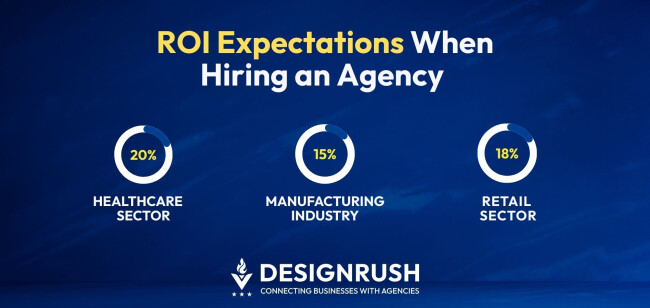
Depending on your business’ industry, you can expect the following ROI, according to Gartner, Deloitte, and McKinsey:
- Healthcare sector average ROI: 20%
- Manufacturing industry average ROI: 15%
- Retail sector average ROI: 18%
What red flags should businesses watch for when evaluating potential partners?
Many technology projects, including those involving wearables, fail due to poor planning, unclear requirements, and weak partner evaluation.
Up to 66% of technology projects fail to meet objectives or deliver value, according to industry research on IT and software development failures.
A significant share of these project failures stems from unclear requirements, unrealistic expectations, or poor vendor alignment, all of which trace back to inadequate partner evaluation upfront.
Key red flags include:
- Vague experience or case studies
A wearable technology agency that cannot show relevant examples or measurable performance results lacks the context needed to succeed. A company should have between 5 and 10 successfully completed projects if it’s an entry-level provider. 20–50 projects is a common number for established firms, whereas industry leaders tend to have 75+ wearable deployments. - Unclear development processes
Wearable technology companies that give high-level promises without specific methodologies or milestones often fail to execute reliably. - Lack of transparency on requirements
Wearable development is complex; partners who don’t actively clarify and document requirements early are far more likely to encounter scope creep and delays. - Weak communication and governance
Poor communication between teams is a leading contributor to IT project failures, especially when vendors fail to engage business stakeholders consistently.
Monitoring these indicators early helps you avoid the common patterns seen in broader project failures and protect your wearable initiative from avoidable setbacks.
How can businesses measure whether one of these companies is delivering value?
Value should be assessed based on measurable outcomes, not just whether deliverables were completed.
Key indicators include:
- Data quality and consistency
Collected wearable data should be reliable, stable, and usable for decision-making across different users, environments, and usage conditions. - Operational impact
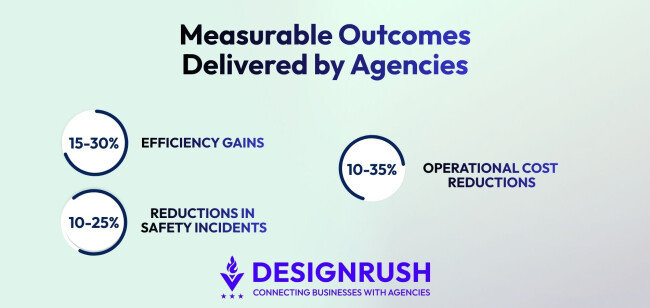
Value can be measured by whether the wearable solution improves defined outcomes, such as workflow efficiency, safety monitoring, health tracking, or cost reduction, depending on the use case. Across common deployments, wearable solutions are associated with 15–30% efficiency gains, 10–25% reductions in safety incidents, or 10–35% operational cost reductions within the first 12 months. - Security and risk reduction
Security performance represents direct business value, especially since the global average cost of a data breach reached $4.4 million, according to IBM, highlighting the financial risk of poor data protection practices. Enterprise-ready wearable platforms typically enforce 100% encryption in transit and at rest, report 0–0.2 security incidents annually, and reduce breach likelihood by an estimated 30–60% compared to poorly secured systems. - Compliance performance
For products operating in the United States, meeting regulatory and data protection requirements without incidents or delays is a key indicator of partner effectiveness. Compliance requirements commonly increase development timelines by 20–50% and costs by 40–90%. - Post-launch improvement cadence
Regular firmware, software, and security updates indicate whether the wearable technology company is delivering sustained value beyond initial deployment.
What should businesses prepare before reaching out to a development partner?
Preparation reduces misalignment, cost overruns, and delays. Businesses should prepare the following:
- Clear use cases and target users
Define who the wearable is for and what problem it solves, since consumer, medical, and enterprise wearables require different technical and regulatory approaches. Shifting a project’s target user group mid-development can increase costs by 25–50% and add 8–16 weeks to delivery timelines. - Functional and technical requirements
Outline expected features, data outputs, battery life expectations, and system integrations to prevent scope creep later in development. Numerous studies and reports say that, on average, poorly defined requirements account for 30–45% of scope changes in wearable projects, often increasing total project cost by 15–35%. - Regulatory considerations
Identify whether the product will need FDA clearance, FCC certification, or compliance with healthcare and data privacy requirements in the United States. Regulatory readiness can add up to 9 months to development timelines and increase total costs by 40–90%, depending on the device classification. - Budget range and timeline expectations
Establish realistic constraints early, as hardware-led projects typically require longer planning and iteration cycles than software-only initiatives. - Data privacy and security expectations
Define data ownership, storage, access controls, and security standards upfront to avoid costly redesigns and compliance risks later. According to various reports, addressing security requirements late in development can increase engineering effort by20–40%, while remediation after launch can cost 3–5× more than building secure architectures from the outset.
Sources
DesignRush sustains a directory of over 40,000 agencies categorized by service category, location, expertise, and reviews. We build our database in two ways:
- Our dedicated team of agency experts actively searches the web for top-performing companies. We then pull information from their websites, online presence, and client testimonials to verify their status and qualifications prior to listing.
- The agencies listed get notified of their profiles on the website and they can choose to claim it or not, which suggests their availability for more collaborations.
Agencies can also reach out to DesignRush and must go through the verification process prior to being listed.

Why companies trust DesignRush
Every agency is independently vetted before it can be listed or ranked
 4.8
4.8 4.8
4.8Some agencies pay for sponsored placement, clearly labeled and held to the same vetting standards.
FAQs About Wearable Technology Companies
What industries do these companies work with the most in the US?
They work across multiple industries, with healthcare and consumer applications accounting for the majority of demand.
- Healthcare and medical services: The largest and fastest-growing segment, fueled by remote patient monitoring, chronic disease management, and clinical data collection. The U.S. wearable medical devices market was valued at $10.73 billion in 2023 and is expected to grow at a 23.4% CAGR from 2024 to 2030.
- Consumer electronics: US brands partner on smartwatches and fitness trackers, which represent the largest share of wearable device shipments.
- Sports and fitness: Professional teams, gyms, and wellness platforms use wearables for performance analytics and injury prevention.
- Enterprise and industrial: Manufacturing, logistics, and construction firms deploy wearables for worker safety, location tracking, and productivity monitoring.
What types of solutions do these companies typically offer?
In the United States, wearable technology companies focus on distinct solution categories that serve different user needs and markets.
- Wrist-worn devices: Smartwatches and fitness trackers make up the largest product segment by revenue in the US wearable technology market, with a revenue share of 54.31% in 2024, according to Grand View Research.
- Health and medical monitoring solutions: These include ECG monitoring, glucose tracking, fall detection, and remote patient monitoring used in clinical and at-home care settings.
- Enterprise and industrial wearables: Worker safety sensors, smart badges, and AR headsets support productivity, compliance, and real-time operational visibility.
- Software and data platforms: Companion mobile apps, cloud analytics dashboards, and APIs enable data visualization, reporting, and integration with enterprise systems..
How much does it cost to develop a wearable technology product in the US?
Developing a wearable technology product for the US market typically involves hardware engineering, firmware, and supporting software, which together determine total development cost.
According to Nimble App Genie, the software component of a wearable product, including companion apps and backend systems, typically costs $30,000 to $150,000+, depending on complexity and integrations.
Typically, for US-based wearable technology agencies, that means +$50–$150/hour. Hardware development and prototyping add cost, with functional prototypes and iterative testing often requiring tens of thousands of dollars before mass production.
Taken together, end-to-end wearable product development in the US commonly extends well beyond software costs due to hardware iteration and device-level engineering requirements. Additional factors such as regulatory requirements, manufacturing preparation, and security or compliance needs can further increase total costs depending on the product and market.
What additional costs should you expect during the development process?
Beyond core engineering, wearable technology development in the US includes several cost factors required to prepare a product for approval, manufacturing, and launch.
- Regulatory testing and certification can add significant expense, $5,000-$30,000, particularly for medical or wireless wearables that require FDA clearance, FCC approval, or other compliance testing.
- Manufacturing preparation costs include tooling, molds, supply chain setup, and quality assurance processes before mass production begins.
- Intellectual property expenses, such as patent filing, legal review, and trademark protection, can increase upfront investment.
- Ongoing costs may also include cloud hosting, data security, maintenance updates, and customer support after launch, which can cost between $2,000 and $20,000.
How long does it usually take to bring a product from development to market?
Bringing a wearable technology product to the market typically takes 12 to 24 months for consumer devices with standard features and limited regulatory requirements. The timeline usually includes design, engineering, prototyping, testing, and manufacturing preparation.
- Wearable products with complex hardware, custom sensors, or advanced firmware often require 18 to 36 months due to extended iteration and validation cycles.
- Medical or regulated wearable devices can take 3 to 7 years to reach the market because of clinical testing, regulatory review, and compliance approvals.
Timelines vary significantly based on product complexity, regulatory scope, and supply chain readiness.