Everything You Need to Know Before Hiring the Best Denver Accountant Table of Contents
What can top accounting firms in Denver do for your business?
Top accounting firms in Denver help businesses navigate Colorado’s specific tax climate, optimize cash flow, and ensure compliance.
Denver firms specialize in Colorado-specific incentives, such as the Enterprise Zone Program and the Job Growth Incentive Tax Credit . They ensure you aren't just filing taxes but actively reducing what you owe. Numbers confirm that:
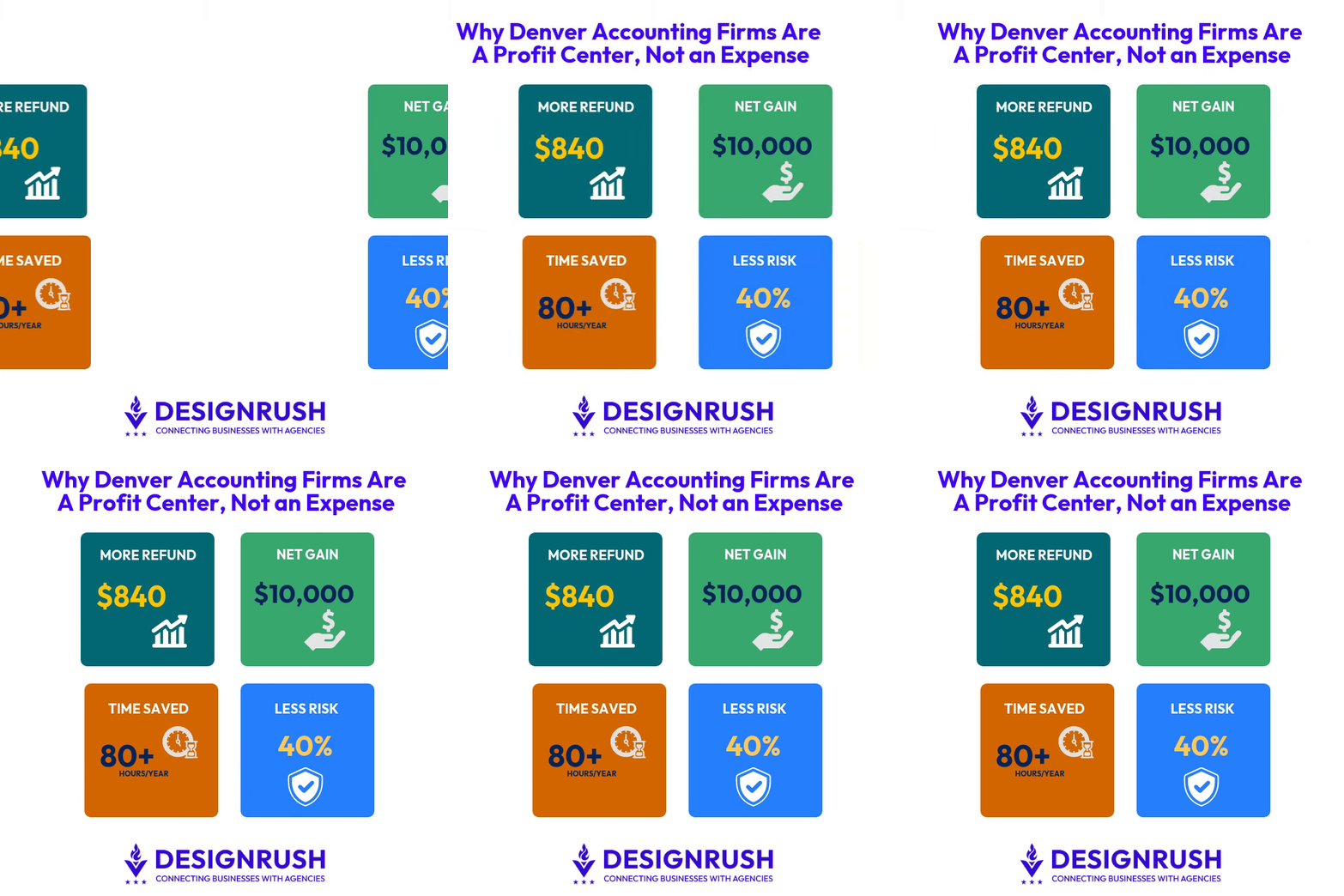
Taxpayers who use a professional receive an average refund of $2,615 , compared to $1,775 for self-filers, a difference of $840.
Accounting firms can help businesses tap into the Job Growth Incentive Tax Credit, which provides a state income tax credit equal to 50% of the FICA paid by the business on net job growth.
Firms help claim the Work Opportunity Tax Credit (WOTC) , which can reduce federal tax liability by $2,400 to $9,600 per qualifying new hire.
For many business owners, the "cost" of accounting is actually the opportunity cost of their own time. Small business owners spend an average of 80+ hours per year on federal taxes alone. While an individual return takes about 8–13 hours, a business return typically takes 24 hours to complete accurately.
By outsourcing these 80+ hours to a local firm, owners can redirect that time to revenue-generating activities such as sales or product development.
Top-tier firms provide "Fractional CFO" services, helping you manage the gap between earning money and having it in the bank.
A common industry benchmark suggests that if a firm incurs $5,000 in costs but realizes $15,000 in tax savings or cash flow improvements , it realizes a net gain of $10,000. Professional management can reduce accounts receivable by up to 30%, freeing up significant working capital.
Denver’s high-growth sectors, like tech, cannabis, and aerospace, are often under higher scrutiny.
The likelihood of an IRS audit triples for individuals and business owners earning over $200,000 annually . Roughly 40% of small businesses incur IRS penalties each year, often due to late or incorrect filings, which is a risk that professional oversight virtually eliminates.
How can you choose the best Denver accountant? Choosing the best Denver accounting firm requires looking past basic tax filing and finding a partner that understands the specific "Mile High" business climate.
1. Match the designation to your need In Denver, you’ll encounter three main types of professionals. Choosing the right one depends on the complexity of your situation:
CPA (Certified Public Accountant): Best for businesses that need a "full-picture" advisor. They handle audits, complex business valuations, and strategic financial planning beyond just taxes.EA (Enrolled Agent): Best for tax-specific issues. They are federally licensed and often more affordable than CPAs if your primary need is tax resolution or IRS representation.Tax Attorney: Necessary only if you are facing criminal tax charges or need attorney-client privilege for high-risk legal disputes.2. Verify "Home Rule" and local expertise Denver and many of its suburbs (like Aurora and Lakewood) are "Home Rule" jurisdictions.
Ask a potential firm: "How do you handle the separate sales tax filings for the City of Denver versus the State of Colorado?"
If they don't mention that Denver requires its own local return (separate from the state portal), they may not be local enough for your needs.
3. Industry specialization Denver has unique economic hubs. Look for a firm with a "niche" in your sector:
Look for firms in RiNo or LoDo that understand R&D tax credits and venture capital accounting. Look for firms familiar with CCIP/OCIP insurance accounting and Denver’s specific development tax incentives for construction and real estate. Cannabis and hemp are highly specialized areas in Colorado due to IRS Section 280E . Do not hire a generalist if you are in this industry. 4. Communication & tech stack Don't settle for a firm that only answers the phone in April.
Ask if they offer Tax Planning (proactive) or just Tax Compliance (reactive). A good firm should meet with you in Q3 or Q4 to lower your bill before the year ends.
In 2026, firms should use secure portals (like TaxDome or Karbon) rather than email for sensitive documents.
A firm's website is its "sales pitch," but the real story is often hidden in the details.
The "Niche" Test: Look for a dedicated "Industries" page. If you are a real estate developer and their blog only talks about general tax tips for individuals, they likely aren't specialists.Security Signals: Check if they have a prominent Client Portal link. In 2026, any firm still asking you to email PDFs is a security risk.Social Proof Check: Go beyond the testimonials on their site (which are hand-picked). Check Google Maps and Trustpilot reviews specifically for mentions of "responsiveness" and "deadlines."Red Flag: A firm that doesn't respond to their 1-star reviews or has a sudden burst of 5-star reviews in a single week.5. Verify credentials Use the Colorado Division of Professions and Occupations search tool to verify their CPA license . It will show if the license is Active and if there have been any public disciplinary actions. Use CPAverify.org to check if they are licensed to practice in other states, which is crucial if you have out-of-state income.
6. The Interview: Ask "The Reference Question" When you narrow your list to 2-3 candidates, schedule a 15-minute consultation. High-quality firms will provide references upon request once they’ve determined you are a serious prospect.
Ask the firm's references (ex-clients) the following questions:
How does the firm handle 'urgent' questions in the middle of the summer vs. during tax season? Have you ever been audited or received a notice from the CDOR while using them? How did they handle it? Do they proactively suggest ways to save money, or do they only talk to you when taxes are due? 7. The decision Use the following criteria before signing an engagement letter:
Does it handle Denver-specific sales tax? Do they use your software (QuickBooks/Xero)? Do they charge flat monthly fee vs. hourly "surprise" bills? Did they respond to your inquiry within 24 hrs? Lastly, ask who will actually be doing the work. Many large Denver firms have a Senior Partner "sell" you the service, but then pass your files to a junior staffer or an overseas contractor. You want to know exactly who is looking at your private data.
What should clients bring to a tax appointment? Whether you are meeting a Denver CPA in person or uploading to a secure portal, having your documents organized can save you billable hours and ensure you don't miss out on deductions.
Here is a comprehensive checklist for your appointment:
1. The Essentials (ID & Logistics) Photo ID: A valid driver’s license or passport.Social Security Cards: For you, your spouse, and all dependents (the IRS is strict about exact name matches).Bank info: A voided check or your routing/account numbers for direct deposit of your refund.Prior year's return: Your 2024 tax return (federal and state) helps your accountant spot carryover credits or depreciation schedules.2. Income Documents (The "Incoming" Money) W-2s: From all employers you worked for in 2025.1099-NEC / MISC: If you did freelance, gig work, or contract labor.1099-INT / DIV / B: For bank interest, stock dividends, or capital gains from sold investments.1099-R: If you took distributions from an IRA, 401(k), or pension.K-1s: If you have ownership in a Partnership, S-Corp, or Trust.SSA-1099: For Social Security benefits.3. Deduction & Credit Proof (The "Outgoing" Money) Form 1098 (Mortgage Interest): Sent by your lender; often includes property taxes paid.Charitable Receipts: Lists of cash donations and receipts for non-cash items (Goodwill, etc.).Education Expenses: Form 1098-T for tuition or 1098-E for student loan interest.Medical Expenses: A summary of unreimbursed doctor visits, prescriptions, and dental work (only if they exceed 7.5% of your income).Childcare Records: Total paid to providers plus their Tax ID number (EIN) or Social Security number.4. Special Colorado & Small Business Items Colorado Property Tax/Rent/Heat Rebate (PTC): If you qualify, bring rent receipts or heating bills.Business Expenses: If you're self-employed, bring a Profit & Loss statement or a categorized list of expenses (home office square footage, mileage logs, equipment purchases).Energy Credits: Receipts for solar panels, heat pumps, or an Electric Vehicle (EV) purchased in 2025.If you received any Identity Protection PIN (IP PIN) from the IRS via mail, you must bring that letter. Your return cannot be e-filed without that six-digit code.
What red flags should you avoid when hiring an accounting firm? When hiring an accounting firm in Denver, red flags generally fall into three categories: credential fraud, shady pricing, and operational incompetence. Being able to spot these early can save you from a "ghost preparer" or a costly IRS audit.
1. Not showing PTIN By law, anyone paid to prepare a federal tax return must have a PTIN (Preparer Tax Identification Number) and must sign the return. If the firm prepares your return but asks you to sign it as "Self-Prepared," or they refuse to provide their PTIN, don’t work with them.
This allows them to walk away from any errors or fraud they commit on your return, leaving you 100% liable for the fallout.
2. Unethical fee structures A legitimate CPA or EA will charge a flat fee or an hourly rate based on the complexity of the work. If they base their fee on a percentage of your refund or promise a "guaranteed" refund amount before reviewing your documents, that’s a red flag.
Be extremely wary of firms that guarantee they can settle your debt via an "Offer in Compromise" without deeply exploring your financial assets. Only a small fraction of taxpayers qualify for this program.
3. Operational and security gaps Accounting involves your most sensitive data. If their internal processes are sloppy, your data is at risk. If you are a Denver business and the accountant seems confused when you ask about the Denver Occupational Privilege Tax (Head Tax) or Denver-specific sales tax filings, they aren't equipped for local work.
Also, avoid firms that ask you to email Social Security numbers or sensitive PDFs as attachments. They should provide a secure, encrypted client portal
4. Rounded numbers If you see too many rounded numbers (e.g., $5,000 for travel, $1,000 for supplies) on your final return, that’s not a good sign.
The IRS’s automated "Discriminant Function" (DIF) algorithm specifically flags returns with too many zeros, as it suggests the preparer "guessed" rather than using actual receipts.
5. Poor continuity of service You need an accountant who is a partner all year long, not just a seasonal laborer. Avoid accounting firms that use a temporary "retail" location or only respond to emails from February to April. Tax notices from the City of Denver or the IRS often arrive in the fall. If your accountant has closed up shop for the summer, you'll be defending yourself alone.
6. Suspicious marketing Social media is flooded with accounting companies that mention "tax secrets", "secret loopholes," "IRS-proof strategies," or "guaranteed settlements."
The real tax strategy is based on the Internal Revenue Code , not secrets. If they suggest filing a Fuel Tax Credit (usually for off-highway farm equipment) or a Sick and Family Leave Credit when you don't qualify, they are putting you at high risk for a "frivolous return" penalty of $5,000.
What questions should I ask before hiring an accounting firm in Denver? To help you vet a Denver accounting firm, use these targeted questions to ensure they have the local expertise and operational capacity to handle your needs.
Relevant Background Are you a licensed CPA or Enrolled Agent in good standing with the Colorado Board of Accountancy? How many years of experience do you have specifically managing Denver's "Home Rule" city sales tax and occupational privilege tax (Head Tax)? Do you have active clients in my specific industry (e.g., cannabis, tech, construction, real estate)? Have you ever been subject to disciplinary action by the IRS or the State of Colorado? What is your experience level with Colorado-specific tax credits, such as the Enterprise Zone or R&D credits? Services and Processes Will my primary point of contact be a senior partner or a junior staff accountant? Do you use a secure, encrypted client portal for document transfers, or do you rely on email? What is your standard turnaround time for responding to emails and phone calls during and outside of tax season? How do you stay updated on mid-year changes to Colorado Department of Revenue regulations? Do you offer proactive tax planning sessions in Q3/Q4, or is your service strictly focused on tax compliance (filing)? What is your policy for handling and billing for an IRS or State audit notice? Related to Your Project What specific accounting software (QuickBooks Online, Xero, Sage) do you require me to use to work with your firm? Can you provide a flat-fee quote for this project, or do you bill strictly by the hour? How will you handle the multi-state filing requirements if my business has income sourced outside of Colorado? What specific documentation will you need from me to begin the onboarding process? If I have unfiled back taxes, what is your specific process for obtaining my IRS and State transcripts to verify what is owed?
Sources DesignRush sustains a directory of over 40,000 agencies categorized by service category, location, expertise, and reviews. We build our database in two ways:
Our dedicated team of agency experts actively searches the web for top-performing companies. We then pull information from their websites, online presence, and client testimonials to verify their status and qualifications prior to listing. The agencies listed get notified of their profiles on the website and they can choose to claim it or not, which suggests their availability for more collaborations. Agencies can also reach out to DesignRush and must go through the verification process prior to being listed.




 Proposals