
ChatGPT for Accounting: Key Points
- Firms using AI in financial operations have reduced costs by 20% to 30% and sped up processing times by 25%. It’s a clear win for accounting teams looking to boost efficiency.
- 71% of accounting firms say that tools like ChatGPT are essential for retaining clients, thanks to faster responses and smoother workflows.
- Relying solely on ChatGPT can lead to errors. Human oversight is needed to validate outputs, especially in compliance-heavy tasks like GAAP adherence and tax documentation.
AI-driven automation boosts efficiency and cuts costs in financial operations. As a result, many accounting leaders now see adopting new technologies as essential for delivering great client service. Embracing generative AI like ChatGPT is becoming key to improving workflows and maintaining an edge in the industry.
Below, we explore high-impact ways accounting teams can use ChatGPT today, along with sample prompts you can adapt to your own practice.



15 High-Impact Use Cases and Sample Prompts for ChatGPT in Accounting
As AI in accounting continues to grow, professionals are discovering practical ways to streamline their workflows using ChatGPT.
Below, you'll find high-impact use cases and sample prompts to help you get the most out of ChatGPT in your accounting practice:
- Financial statements & analysis
- Tax & compliance
- Bookkeeping & reconciliation
- Forecasting & advisory
- Client communication & admin
1. Financial Statements & Analysis
AI in accounting is moving fast, with almost two-thirds of CFOs expecting it to reshape everyday financial operations, as per Gartner’s survey. In one 2024 survey, 71% of firms said that seamless use of innovative digital tools is essential for client retention.
This shows that ChatGPT is already making an impact, especially in financial statements and analysis.
1.1. Generate Income Statements and Balance Sheets
Generating accurate financial statements is essential but often time-consuming and error-prone. ChatGPT streamlines the process by transforming trial balances into draft income statements and balance sheets that align with standards and internal formats.
| Sample ChatGPT prompt for income statements |
You are the financial reporting assistant for VertexLine Solutions. Based on the trial balance data below, generate a draft income statement and balance sheet for the month ending April 30. Inputs: Provide both statements in markdown or table format, clearly labeled and separated. |
Instead of waiting days for initial report drafts, your finance team can automatically generate clean, formatted financial statements from raw data.
1.2. Accelerate Month-End Close
Month-end close is often delayed by manual checklist tracking and data validation. ChatGPT streamlines these tasks by summarizing financial activity, flagging issues, and accelerating workflows, so you can close faster with greater accuracy.
| Sample ChatGPT prompt for month-end close |
You are the virtual controller for SummitPath Logistics. Help accelerate the May month-end close by: Inputs: Output in a structured summary format with action items. |
With a prompt like this, ChatGPT can serve as a month-end command center, helping your team cut days off the close cycle, reduce errors, and give leadership quicker access to trusted financials.
1.3. Automate Variance Reports With Exec Summaries
Variance analysis is key to understanding performance shifts, but building reports and crafting executive-ready summaries can eat up hours of analyst time each month.
ChatGPT simplifies this by scanning financials, identifying key variances, and generating clear, high-level narratives tailored for stakeholders, freeing your team to focus on strategic insights instead of formatting spreadsheets.
| Sample ChatGPT prompt for variance reports |
You are the financial analyst for BrightAxis Media, a fictional digital advertising agency. Analyze the P&L data for April vs. March and generate a variance report that highlights line items with changes over ±10%. Inputs: The output should be a clean table of variances followed by a bullet-pointed exec summary per item. |
Given this prompt, ChatGPT can transform raw comparisons into polished, insightful variance reports, improving communication with leadership and elevating the strategic role of finance in your organization.
2. Tax & Compliance
Tax season doesn’t have to mean stress and spreadsheets — accounting AI agents and ChatGPT can change the game. From surfacing deductions to summarizing IRS rules and drafting compliance policies, these tools help accounting teams stay fast, accurate, and audit-ready.
2.1. Identify Deductible Expenses by Business Type
ChatGPT can help you quickly surface relevant deductions tailored to your business structure, minimizing tax liability and reducing the risk of oversight.
| Sample ChatGPT prompt for deductibles |
You are the tax advisor for LumaCraft Interiors, an LLC operating in the commercial design services sector. Provide a comprehensive list of allowable federal tax deductions under IRS guidelines that are commonly applicable to design-focused service-based LLCs. Structure the output into clear categories, including but not limited to: For each category: Tailor the output to LumaCraft’s LLC structure and typical business activities, ensuring all recommendations are current with the latest IRS guidelines for the 2025 tax year. |
This kind of AI-driven guidance enables your team to identify commonly missed deductions, align expenses with IRS rules specific to your business type, and streamline tax preparation with greater confidence and accuracy. It’s a smarter, faster way to optimize tax strategy and stay compliant.
2.2. Summarize IRS Form Differences and Deadlines
ChatGPT can cut through IRS (Internal Revenue Service) complexity by distilling which forms matter to your business and exactly when they’re due, so filings never slip through the cracks.
| Sample ChatGPT prompt for IRS compliance |
You are the compliance officer for OrionWave Robotics, a U.S.-based C-corporation that employs W-2 staff, engages 1099 contractors, and offers ISO (Incentive Stock Options) to employees as part of its compensation package. Then, determine which forms are required for OrionWave Robotics based on the following profile: Highlight any overlapping deadlines (e.g., 1099-NEC and 3921 due Jan 31) and suggest a compliance calendar for 2025 that integrates filing dates, prep timelines, and cross-departmental responsibilities (e.g., payroll, legal, HR). Conclude with brief audit-readiness tips specific to each form. |
Armed with this at-a-glance summary, finance teams can schedule filings, avoid penalties, and brief executives in minutes instead of hunting through IRS instructions for hours.
2.3. Draft Policy Explanations for Compliance Reviews
When auditors or regulators come calling, clear documentation of your company’s accounting policies can make all the difference. ChatGPT can help accounting teams quickly draft plain-language explanations for internal controls, tax treatments, and expense classifications, ensuring your policies are both defensible and easy to understand during compliance reviews.
| Sample ChatGPT prompt for policy explanations |
You are the compliance documentation lead for ApexCircuit Technologies, a company undergoing a routine internal audit. Draft clear, professional explanations for the following accounting policies: Each explanation should reference relevant accounting standards and be written in plain language suitable for auditors and internal stakeholders. |
Equipped with this level of clarity, your team can respond confidently to audits, reinforce internal policy awareness, and reduce the friction often associated with compliance documentation.
3. Bookkeeping & Reconciliation
Tedious bookkeeping chores — from reconciling bank statements to updating records — can be handled by AI operating inside your tech stack. The result is a more continuous process with far less need for human intervention in routine tasks.
3.1 Categorize Transactions Automatically
Manually categorizing transactions is time-consuming and error-prone, but ChatGPT streamlines the process by applying consistent logic based on your account chart.
| Sample ChatGPT prompt for categorizing transactions |
You are a financial assistant for BlueHawk Digital. Here are 15 transaction records for the month of April. Use the company’s chart of accounts, which includes categories like 'Software Subscriptions', 'Client Revenue', 'Contractor Expenses', and 'Marketing – Events'. Categorize each transaction accordingly and flag any items that require human review. Transactions:
|
This prompt helps your team save hours of categorization work and ensures financial consistency across departments. ChatGPT can be trained over time on your company’s unique rules and exceptions, making it a scalable solution as your transaction volume grows.
3.2 Flag Anomalies Above a Threshold
With ChatGPT, anomaly detection becomes both dynamic and context-aware, ideal for fast-moving organizations with evolving spend patterns.
| Sample ChatGPT prompt for flagging anomalies |
You are an internal auditor for NovaEdge Solutions. Below is a list of departmental expenses for the month of May. Flag any transactions that: Also, flag any entries that appear significantly out of place based on typical monthly spend patterns (use a 3-month average if available). Sample Data:
|
ChatGPT will return a structured list of flagged items, along with the reasoning for each alert. This allows teams to prioritize reviews and investigate discrepancies faster, turning financial oversight from a reactive chore into a proactive advantage.
3.3 Draft Journal Entries From Receipts
ChatGPT simplifies the repetitive task of turning receipts into compliant journal entries by extracting key data and aligning it with your chart of accounts.
| Sample ChatGPT prompt for financial journal entries |
You are the accounting assistant for HelixCore Technologies. Based on the receipts below, draft journal entries that align with our chart of accounts, using the standard double-entry format. Receipts:
Format:
|
This prompt allows finance teams to generate polished journal entries in seconds, freeing up time for higher-level analysis while maintaining audit readiness and financial accuracy.
4. Forecasting & Advisory
According to Business Insider, when prompted to reason like a human, GPT-4 accurately predicted earnings 60% of the time, outperforming professional analysts, who scored just above 50%. Its ability to spot financial patterns and interpret business data, even with limited input, points to a strong future role in executive decision-making.
4.1. Project Cash Flows Based on Seasonality
For many businesses, cash flow ebbs and flows with seasonal trends, yet forecasting often relies on static models that miss these fluctuations. ChatGPT can analyze historical data, identify recurring patterns, and project future inflows and outflows with greater nuance, helping finance leaders prepare for lean periods and capitalize on peaks.
| Sample ChatGPT prompt for cash flow projections |
You are the senior financial analyst for Solterra Outdoor Living, a company specializing in high-margin patio furnishings with high seasonal sales patterns (peak demand from March to July, low activity in Q4).Using historical monthly cash flow data from 2022 to 2024, build a 12-month forward-looking cash flow forecast starting January 2025. Account for: Present the output in a table with monthly inflows, outflows, and net cash position, followed by a sensitivity analysis showing the impact of a 15% sales shortfall during peak season. Include a short executive summary with key risk flags and working capital recommendations. |
This level of forward-looking insight empowers teams to manage working capital more effectively, time investments wisely, and ensure operational stability year-round, even in businesses where cash flow isn’t constant.
4.2. Model Pricing Profitability
ChatGPT can assist by modeling gross margin scenarios, incorporating fixed and variable costs, and forecasting breakeven points across products or service tiers, giving finance teams the clarity needed to set profitable pricing strategies.
| Sample ChatGPT prompt for modeling profitability |
You are the finance strategist for AeroVista Drones, a company that sells enterprise-grade aerial imaging solutions and offers service contracts. Build a profitability model for three pricing tiers—Standard, Pro, and Enterprise—each with different hardware bundles, support levels, and contract terms. Inputs: Calculate: |
By simulating different pricing and cost combinations, you can make confident, margin-focused decisions and avoid underpricing that erodes long-term value. It’s a strategic upgrade that turns pricing from guesswork into a financial advantage.
4.3. Build Investor or Board-Level Summaries
Financial presentations for investors or the board demand clarity, narrative context, and strategic relevance. ChatGPT distills complex financials into sharp, executive-ready summaries that highlight key performance drivers, risks, and outlooks, all in a format that aligns with stakeholder expectations.
| Sample ChatGPT prompt for executive summaries |
You are the head of finance at CoreNova Biotech, a venture-backed growth-stage company focused on therapeutic development. Prepare a Q2 board-level financial summary that synthesizes complex data into actionable insights for a non-technical audience of investors and board directors. Use the following financial datasets and business context: The summary should include: Deliverable Format: Ensure accuracy and consistency with GAAP reporting and reflect investor priorities such as scalability, cash efficiency, and milestone progress. |
With support like this, your finance team can deliver strategic communication that informs high-stakes decisions, builds stakeholder confidence, and saves hours of formatting and wordsmithing while staying laser-focused on the numbers that matter.
5. Client Communication & Admin
With ChatGPT, you can maintain clear, timely communication while reducing the manual workload, freeing up more time to focus on high-value interactions. Here’s how AI can support and elevate your client communication and admin tasks:
5.1. Create Polished Invoices and Receipts
Professional-looking invoices and receipts reflect your brand, reduce confusion, and speed up collections. ChatGPT can help generate clean, well-structured billing documents that include all necessary tax and legal details, customized to your company’s style and client needs.
| Sample ChatGPT prompt for client invoices |
You are the billing coordinator for Veridian Studio, a boutique architecture and interior design firm. Generate a professional invoice template for project-based billing with the following specifications: Also, generate a matching receipt template that automatically populates once payment is received. |
This kind of intelligent support lets your team standardize client-facing documentation, avoid missed details, and reinforce professionalism while freeing up time typically spent formatting spreadsheets or copy-pasting from templates.
5.2. Automate Reminder Emails for Payments
Draft professional, courteous, and personalized payment reminder emails based on due dates, client profiles, and past communications while saving hours of manual outreach.
| Sample ChatGPT prompt for payment reminders |
You are the accounts receivable coordinator at ClarityWell Analytics, a B2B data services firm. Create three payment reminder email templates: A gentle reminder sent 5 days before the due date A firm reminder sent on the due date A past-due notice sent 10 days after the due date with late fee terms Each template should: Provide the final output in copy-paste-ready format, with placeholder fields for client name, invoice number, and amount. |
This detailed prompt streamlines the collections process, minimizes delays, and helps your team maintain positive client relationships, ensuring your AR follow-up stays consistent and on-brand.
5.3. Draft Month-End Summaries Tailored to Client Type
Each client expects financial updates presented in a way that speaks to their priorities. With ChatGPT, you can easily generate customized month-end summaries that highlight relevant insights (like cash position, expense trends, or budget variances) tailored to each client’s business model and financial literacy.
| Sample ChatGPT prompt for client summaries |
You are the client account manager at LedgerBridge Advisors, an outsourced accounting firm serving a mix of small businesses and nonprofit organizations. Draft two month-end financial summary templates—one for a retail e-commerce client and one for a grant-funded nonprofit. Each summary should include: Output should be client-ready and editable for use in monthly email updates or client portals. |
This empowers your team to deliver personalized, professional-grade insights to every client without rebuilding summaries from scratch each month. It’s a smarter way to scale client service while keeping communication clear and value-focused.
6 Tips & Best Practices for Responsible ChatGPT Adoption
Adopting ChatGPT in your accounting workflows can unlock major efficiencies — but only if it’s used responsibly. Follow these best practices to ensure accuracy, compliance, and long-term value:
- Use prompt templates for consistency: Create reusable prompts for common tasks to ensure reliable, repeatable results across your team.
- Validate all AI-generated outputs before filing: Always review AI responses for accuracy and compliance before submitting financial documents or reports.
- Pair with spreadsheets or APIs for structured input: Connect ChatGPT to spreadsheets or accounting APIs to reduce manual data entry and improve precision.
- Train staff on prompt engineering and data privacy: Equip your team with skills to write effective prompts and handle sensitive financial data securely.
- Define when AI can assist vs. when human review is required: Set clear boundaries. You can use AI for drafting and analysis but reserve final decisions for licensed professionals.
- Develop an internal “AI Use Policy” for governance: Outline when, how, and by whom AI should be used to ensure consistent and compliant adoption firm-wide.
When using ChatGPT for client communication, be upfront about AI involvement to build trust and transparency. Highlight how it enhances speed, accuracy, and responsiveness, positioning it as a value-add, not just a way to cut costs.
What ChatGPT Can’t Do (Yet)
Brad Garlin, Founding Partner at Jumpfly, emphasizes the importance of human guardrails for AI: “Relying on AI without adequate oversight often leads to unintended consequences. [It] can be incredibly powerful, but it must be carefully guided to maximize its effectiveness.”
It’s important to remember that ChatGPT requires oversight on the following:
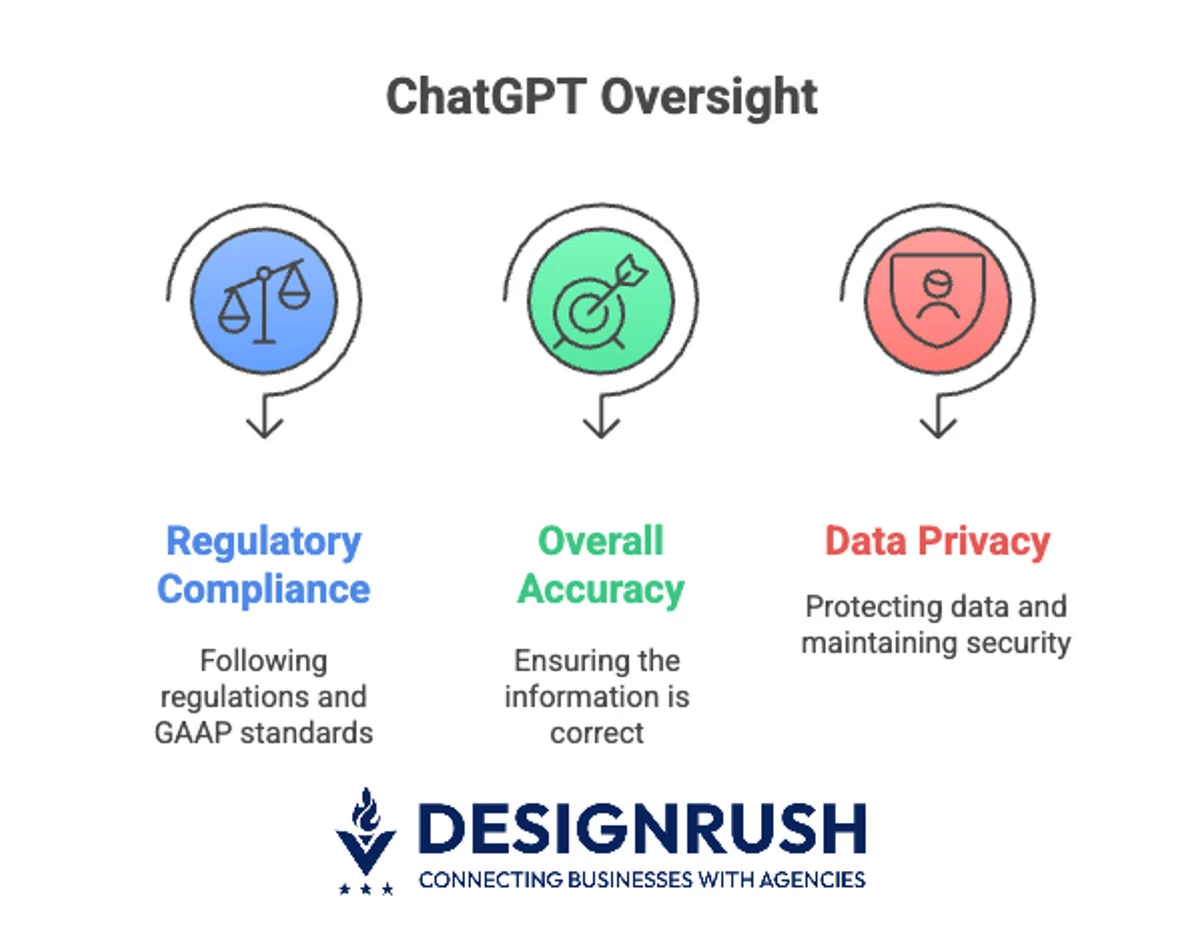
1. Regulatory Compliance and GAAP Adherence
ChatGPT does not inherently “know” a firm’s specific accounting policies or the full nuances of GAAP (Generally Accepted Accounting Principles) and IFRS (International Financial Reporting Standards) rules unless explicitly trained or prompted with that information. There is a risk that an AI-generated entry or financial statement draft might appear plausible but actually violate an accounting standard.
In practice, this means maintaining internal controls: if ChatGPT drafts a section of a financial report or a footnote disclosure, a human should verify it against the relevant GAAP criteria. If the AI suggests an accounting treatment, it should be vetted just as you would review a junior staffer’s work.
2. Overall Accuracy
By design, large language models can sometimes produce incorrect or “fabricated” information, a phenomenon known as hallucination. OpenAI’s own usage policies advise users to “evaluate the accuracy of any output…including by using human review.”
A prudent approach is to use ChatGPT to do the first pass of work and then have staff audit its output. In an audit context, if the AI flags 20 transactions as suspicious, auditors still need to examine those and confirm which are truly issues.
If ChatGPT drafts a memo on internal controls, the reviewer must ensure all statements in it are factually correct and supported. By building verification steps, you can enjoy AI’s efficiency benefits without letting errors slip through.
3. Data Privacy and Security
Perhaps the most immediate concern for CPA firms is protecting sensitive financial data when using AI tools. Entering client-confidential data into a public AI service can violate confidentiality laws and professional standards if not handled properly.
When you prompt ChatGPT with details from a client’s ledger or tax return, that data is essentially being transmitted to a third party (the AI provider) and could reside on their servers. A data breach at the AI provider could expose client information if proper safeguards aren’t in place.
Here's how privacy issues are being mitigated:
- Larger firms are opting for enterprise versions of ChatGPT where data can be isolated and usage governed. PwC’s alliance with OpenAI is specifically to use a version of ChatGPT within a secure environment so that client data isn’t commingled with the public AI service.
- Smaller firms should at minimum use features that opt out of data sharing. OpenAI allows users to turn off conversation history to avoid using inputs for training.
- Firms are establishing AI usage policies: for instance, banning input of personal identifiable information (PII) or client names into any AI prompt.
While generative AI adoption in finance has reached parity with classical machine learning, only 49% of GenAI adopters report increased profitability from AI, compared to over 70% of firms using more specialized methods such as reinforcement learning, graph models, and causal inference.
Firms using specialist AI systems for forecasting, fraud detection, risk analysis, and financial operations reported better profitability outcomes than organizations relying mainly on general-purpose GenAI tools.
For accounting teams, ChatGPT works best as a productivity tool, complementing specialized financial systems built for high-accuracy analysis, compliance, and operational decision-making.
In practice, you can find the best results when accountants and AI collaborate: the AI handles the heavy lifting of data processing and initial analysis, and the accountants focus on interpreting results, making judgments on complex transactions, and providing strategic guidance. This symbiosis can elevate both the accuracy and strategic value of the accounting function.
ChatGPT for Accounting: Wrap-Up
By combining AI’s strengths with human judgment, oversight, and ethical standards, your organization can safely unlock the considerable benefits of generative AI. The path forward is one of augmentation, not total automation: firms that strike the right balance will likely see improved accuracy, faster cycles, happier clients, and more empowered finance teams.
Partnering with a top accounting firm ensures you’re guided by experts who can integrate these tools strategically, maximizing ROI while maintaining compliance and trust.

Our team ranks agencies worldwide to help you find a qualified partner. Visit our Agency Directory for the top accounting firms, as well as:
- Top Accounting Agencies in Atlanta
- Top AI Companies
- Top Big Data Companies
- Top ERP Consultants
- Top BPO Companies
ChatGPT for Accounting FAQs
1. Is it safe to use ChatGPT with client financial data?
Only when proper safeguards are in place. To protect sensitive information, use secure API connections, avoid entering personally identifiable information (PII), and ensure all AI outputs are reviewed by qualified professionals before being used or shared.
2. Can ChatGPT integrate with QuickBooks or Xero?
Yes, ChatGPT can be connected to platforms like QuickBooks or Xero through APIs or automation tools like Zapier. This allows it to help with tasks like summarizing reports, categorizing expenses, or generating draft insights, significantly speeding up routine workflows.
3. Will AI replace accountants?
AI won’t replace accountants, but it will handle many of their repetitive, time-consuming tasks. Forward-thinking firms are using this shift as an opportunity to reskill their teams, allowing professionals to focus more on strategic advising, analysis, and high-value client engagement.