
Augmented Reality (AR) is not just a futuristic concept; it's a technology that has already found its way into our daily lives. By overlaying digital elements onto the physical world, AR provides an enriched experience that engages our senses in new and exciting ways.
AR isn't limited to high-tech or specialized industries; many of us interact with it more frequently than we realize, primarily through mobile apps. In this article, we will explore some of the most intriguing and impactful augmented reality examples in use today.
1. Snapchat
Social media filters are among the most popular AR examples in everyday life. Whether you use them to beautify yourself or just for fun, you are using augmented reality!
It all started back in 2015, when Snapchat, a social media app, introduced its first filters, also known as "Lenses." Filters overlay digital images or effects onto the user's face in real-time. Users can turn their face into an animal or a vampire, wear a virtual flower crown, change eye color, or even change the sky's color in a photo or video.
These AR features have made Snapchat incredibly popular, especially among younger audiences, as they add an interactive and fun element to social communication.
2. Pokémon GO
We can’t talk about augmented reality examples without mentioning Niantic’s Pokémon GO, a world-famous phenomenon downloaded over one billion times!
Pokémon GO is a mobile game that combines the real world with the virtual world of Pokémon. Using your smartphone's GPS, the game identifies your location and populates the area around you with Pokémon creatures. When you find one, the game uses AR to display the Pokémon in your real-world view through your phone's camera. This creates an interactive experience where you can "catch" Pokémon as if they were in the real world around you.
If you wondered why you see so many young people wandering around as if they lost something, now you have the answer! The game encouraged people to explore their neighborhoods and even trade Pokémon with other players.
3. Xvision Spine System
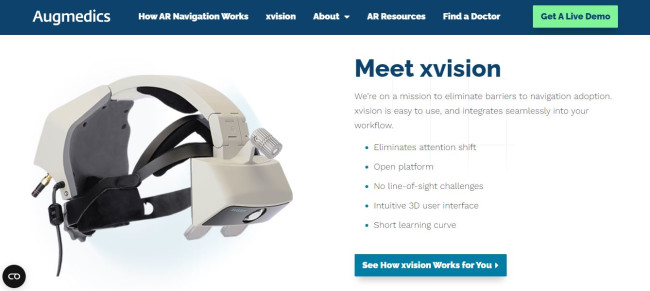
While it's easy to associate AR solely with entertainment and gaming, its applications are far more diverse, extending into fields like healthcare. One of the best examples of augmented reality in the medical field is the xvision Spine System.
Xvision uses a type of augmented reality known as superimposition-based AR, which overlays digital images onto the user's view of the real world, effectively replacing or augmenting certain aspects of it. Xvision superimposes a digital rendering of the patient's spinal anatomy over the surgeon's view of the actual surgical site. This way, surgeons can "see through" skin and tissue and know precisely where to place instruments and implants during spine procedures.
The Xvision Spine System is very accurate and has been used successfully in thousands of surgeries across the U.S. It also helps reduce the need for traditional X-rays, which means less exposure to radiation for both doctors and patients.
4. Home Depot
In 2015, Home Depot introduced the ProjectColor app, designed to simplify the often daunting task of choosing the right paint color for your home. Powered by AR, the app allows you to visualize different paint colors in your actual living space.
You can take a picture of a room, and the app will overlay your chosen paint color onto the walls, taking into account the room's lighting and shadows for a realistic view. This way, you can see exactly how a color will look in your home before you purchase and use it. The app offers features such as color matching with furnishings in your room, sharing your choices with friends and family, and curated suggestions of popular color trends from Pinterest.
The ProjectColor app is available for both Android and iOS, and it is free to download.
5. IKEA
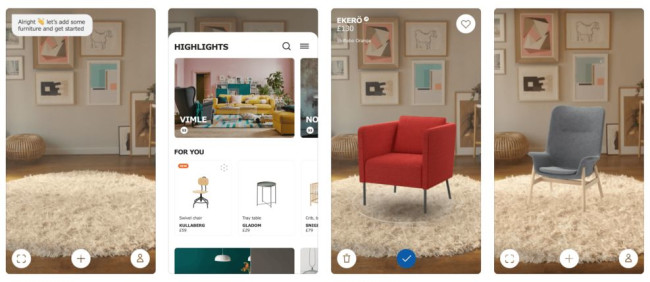
IKEA, the Swedish giant well-known for fun furniture names, is also one of the AR pioneers. Its mobile app, IKEA Place, makes furniture shopping easier and more interactive.
Using your smartphone's camera, place any furniture items from IKEA's catalog into your living space. You can see how a new sofa, table, or bed would look and fit in your room before purchasing and avoid mistakes. The app is user-friendly, with easy navigation and a chatbot to guide you if you need help. It even allows you to share your virtual setups on social media.
IKEA’s use of augmented reality technology makes the shopping experience more engaging and helps you make more informed decisions.
6. L’Oréal
Acquired by L'Oréal in 2018, ModiFace has become a leader in utilizing augmented reality and artificial intelligence for the beauty industry. The technology lets users virtually try various makeup products in real time, from lipsticks to eyeshadows. It also provides a complete look recommendation based on the user's skin tone, facilitating the choice of the right shades.
One of the unique aspects of ModiFace is its skin diagnostic feature, which analyzes the user's skin condition and suggests a customized beauty routine through scientific research and ModiFace's AI algorithms. The technology is designed to cater to all skin tones and provides a real time view of the makeup from different angles. Whether shopping in-store or online, ModiFace aims to offer a personalized and immersive customer experience.
7. Sephora
Sephora found its deserved place among our augmented reality examples due to its Virtual Artist app, which uses AR technology to enhance the online shopping experience for beauty products.
Initially, customers could upload a selfie to virtually test beauty products. However, a recent update has taken this a step further by enabling live 3D facial recognition. Now, users can see how the makeup looks on their faces in real-time as they move, making the virtual try-on more accurate and engaging.
Virtual Artist app improves the user experience by making the virtual products align correctly on the user's face. The update is designed to make the shopping process as simple as possible, requiring fewer clicks to complete a purchase, which has been shown to improve conversion rates. The technology behind this feature also comes from ModiFace, a company specializing in augmented reality for the beauty industry.
Wondering how much a similar augmented reality app would cost? Check out our AR pricing guide.
8. Gucci
Gucci has embraced augmented reality (AR) to offer a unique shopping experience for its customers. Through its iOS app, the Italian luxury brand allows users to virtually try on sneakers from its Ace collection. The technology behind this feature is provided by Wannaby, a Belarus-based startup specializing in AR commerce experiences.
In the app, users can select the Ace sneakers and point their phone's camera at their feet. The app then displays a virtual model of the sneakers on the user's feet, allowing them to see how the shoes would look in real life. The app also includes a photo feature, enabling users to capture and share images of themselves "wearing" the virtual sneakers.
9. Burberry
Burberry has introduced an AR feature on its website to enhance the shopping experience for its Lola bag. Developed in collaboration with Vertebrae, a Snap Inc. company specializing in 3D and AR solutions, this feature allows customers to virtually place a 3D model of the Lola bag in their real-world environment using their smartphones.
The AR tool serves multiple purposes. First, it helps customers understand the size of the bag by placing it next to other items in their space. Second, it provides a detailed view of the bag's features, including its Thomas Burberry Monogram clasp and interior pockets. Users can explore these details with a 360-degree view, simulating the in-store experience.
Burberry's AR feature is not just limited to its website; the brand has also integrated AR into its marketing campaigns. For instance, it launched an AR Instagram filter as part of its outerwear campaign and, most recently, used AR to animate the exterior facade of its flagship store on Rodeo Drive.
10. Adidas
Last but certainly not least of our AR examples is Adidas. The sports company has joined AR with its iOS app, offering a virtual try-on feature for its iconic shoe models. The AR feature was developed in collaboration with Vyking, a company specializing in eCommerce and digital retail solutions.
To use this feature, customers simply go to the product page for the shoes they want in the Adidas app. After they point their smartphone camera at their feet, the virtual shoe models will appear, tracking the foot movements in real time.
The primary goals behind integrating this AR technology are to increase sales conversions, reduce returns due to style or look issues, and attract new customers. The AR feature is expected to reshape how consumers shop for shoes online and in future retail stores.
Augmented Reality Examples: Final Thoughts
Apple’s CEO, Tim Cook, believes that soon, AR will become a significant part of daily life, akin to "eating three meals a day." If you ask us - the future is here. As you can see from our examples of augmented reality, this advanced technology already transforms the way we shop, learn, and interact with the world around us. From retail giants to beauty brands and tech companies, various industries have recognized its potential and are adopting it to provide immersive and personalized experiences for consumers.
Want to learn more about AR or have an interesting project in mind? Check out the top VR & augmented reality companies to find the right partner to merge your vision into real life.

Our team ranks agencies worldwide to help you find a qualified partner. Visit our Agency Directory for the top AR/VR companies, as well as:
- Top AI Consulting Companies
- Top Custom Software Development Companies
- Top Mobile App Development Companies
- Top IT Services Companies
- Top VR & Augmented Reality Companies in San Francisco
Our design experts also recognize the most innovative design projects across the globe. Visit our Awards section to see the best in VR website design.
Augmented Reality Examples FAQs
1. What is augmented reality?
Augmented reality (AR) is an advanced technology that displays digital information, such as images, videos, or 3D models, onto the physical world in real time. Users can interact with the real world and the digital elements displayed in it. For example, you can use the IKEA app on your smartphone to visualize how a piece of furniture would look in your living room. Or, you can play a game like Pokémon GO, where digital characters appear in the real world around you.
2. What are the types of augmented reality?
Types of augmented reality are:
- Marker-based AR
- Markerless AR
- Projection-based AR
- Superimposition-based AR
- Location-based AR
3. Where is AR used the most?
AR is used the most in retail and eCommerce, entertainment, education, healthcare, real estate, the automotive industry, and tourism.