IKEA Place App Design
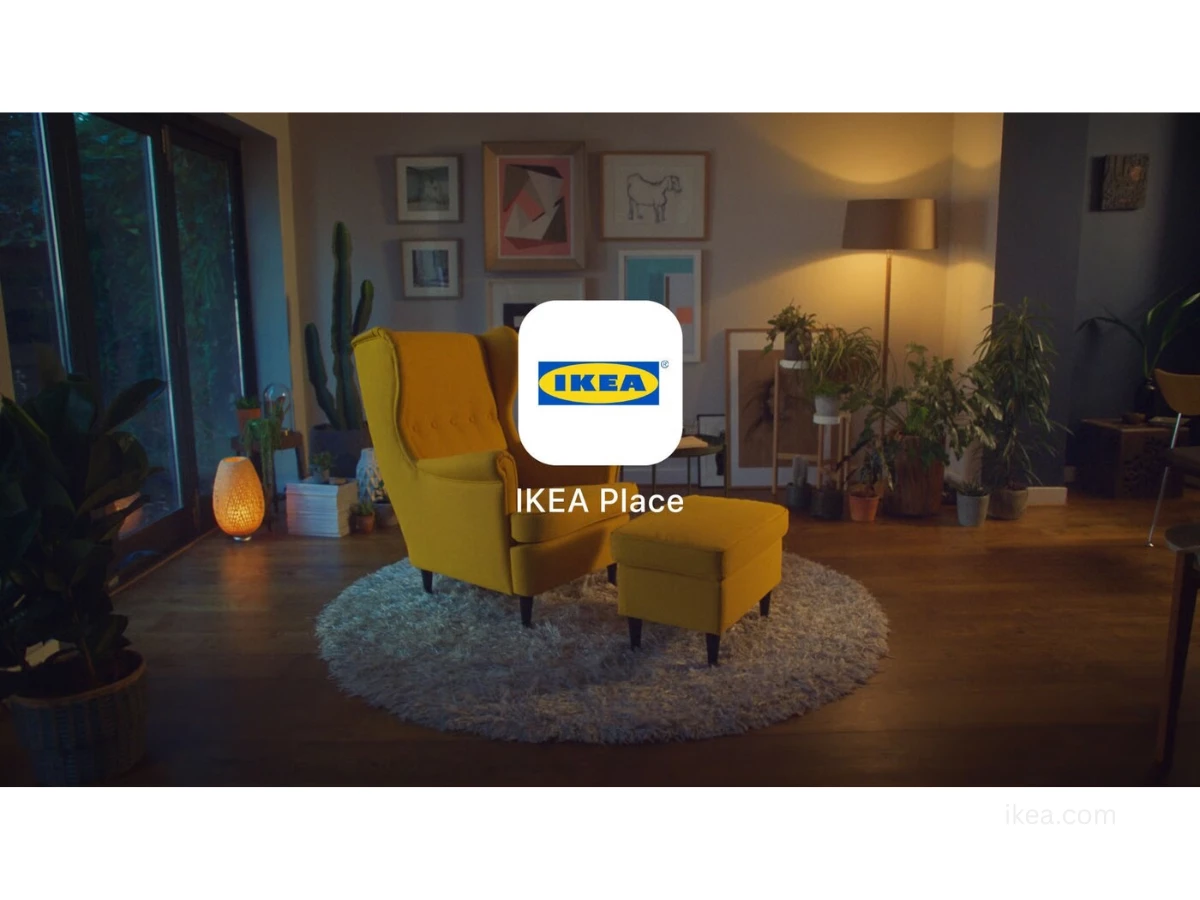
IKEA Place: The AR App That Let You Test-Drive Furniture At Home
"Will it fit?" has stalled more furniture purchases than price ever has.
In September 2017, IKEA Place answered it with nothing but a phone camera. As one of the first consumer apps built on Apple's ARKit, it dropped true-to-scale sofas, beds, and bookcases onto your living room floor, sized to the room within roughly 98% accuracy.
Walk around a piece, hold it against your wall color, and decide before you spend a cent.
Here is the part to know before you go looking for it.
IKEA has folded the standalone IKEA Place app into its single unified IKEA app, which now carries the room-visualization tools directly, with the listing promising to "scan your room and add products to visualise them in your space."
Search for "IKEA Place" in 2026 and you land on the main IKEA app, not a separate download. That makes the original worth studying: it is the blueprint for the AR shopping features now baked into IKEA's core app and its in-app design tool.
Here is why the first version worked, and what it started.
How IKEA Place Started: A Frog Prototype At WWDC 2017
The app traces back to design consultancy frog, which built the first working prototype using ARKit for Apple's Worldwide Developers Conference in June 2017.
The demo ran live on stage, and Apple CEO Tim Cook name-checked the IKEA work during the keynote, positioning the retailer as an early leader in AR commerce.
The frog team used rapid prototyping to settle the core interactions, including how a user grabs, rotates, and repositions a virtual object, and IKEA shipped a production version a few months later.
That origin matters for anyone studying the design. The interaction model shoppers still use today, tap a product, place it on the floor plane, then move around it, was largely locked in during that early prototype work rather than bolted on afterward.
The AR Experience And Interface Design

IKEA Place kept the interface deliberately quiet so the room could do the talking. The camera view fills the screen, product thumbnails sit in a low bottom tray, and the app scales each item automatically to the dimensions of the space, measured at roughly 98% accuracy at launch.
A shopper selects a chair, taps to anchor it, then drags and spins it against their real floor and walls.
The visual system leans on IKEA's brand palette rather than heavy custom chrome. The identity pairs IKEA Blue (hex #0058A3, approximately CMYK 100, 58, 0, 0, Pantone 300 C) with IKEA Yellow (hex #FFDA1A, approximately CMYK 0, 15, 100, 0, Pantone 116 C), the same two colors drawn from the Swedish flag.
Typography follows the brand's custom IKEA Sans wordmark, with small sans-serif product labels that never compete with the live camera feed.
High-resolution product renders and full-bleed imagery carry the browsing screens, and the interaction pattern stays consistent throughout: large tap targets, minimal text, and a camera-first layout that assumes the phone is already pointed at a room.
That restraint separates strong augmented and virtual reality companies from teams that treat AR as a bolt-on gimmick, and it rewards a close read from any UI/UX design agency working on camera-first interfaces.
Navigation That Stays Out Of The Way
Furniture browses by category, with IKEA-curated highlights surfaced first, and the app lets users save items, take a photo of a staged room, and share it.
A later release added visual search built on GrokStyle technology, a Cornell University spinout: point the camera at a piece of furniture you already own, and the app returns the closest matching IKEA products, ready to place.
Early versions also built in a guidance layer. On-screen prompts told users where to aim the camera and corrected them when tracking drifted, which lowered the intimidation factor for anyone who had never touched AR before.
The result read less like an experimental tech demo and more like a normal shopping app that happened to use the camera. It is the kind of polish that sets apart the better mobile app development companies from the rest.
The App's Technical Evolution

IKEA Place did not sit still after launch, and the upgrade path is worth tracing because each step widened the audience or deepened the utility.
In March 2018, IKEA brought the app to Android through Google's ARCore, opening it to more than 100 million additional devices and folding in the GrokStyle visual search noted above.
The catalog grew past 3,200 products, from sofas and lighting to beds and wardrobes. That cross-platform reach is exactly what the strongest iPhone app developers and Android app developers plan for from the first sprint.
In September 2019, IKEA added an AI-powered update that let users furnish an entire space with multiple items at once rather than placing a single object at a time, along with smart recommendations based on room context and browsing behavior.
The kind of on-device intelligence that specialist AI companies now build as standard started showing up here first.
In June 2022, IKEA launched Kreativ, an AI and mixed-reality experience developed by its Ingka-owned studio Geomagical Labs. Kreativ scans a full room using LiDAR (or a series of photos on devices without it), builds a 3D replica, and lets shoppers erase their existing furniture before dropping in IKEA pieces.
That capability now lives inside the main IKEA app and on IKEA.com, which is where the original IKEA Place features ultimately landed.
Usage And Business Impact
The adoption numbers back up the design. IKEA Place reached roughly 1.4 million downloads in its first month and ranked as the second most popular free ARKit app of that early period, ahead of most games. Later estimates put cumulative downloads at more than eight million.
The commercial case is just as clear. IKEA has said customers who use its AR visualization are about 11% more likely to complete a purchase, and the tool directly targets a long-standing retail cost: a meaningful share of furniture returns trace back to size and fit surprises that AR helps prevent.
For a category where returns are expensive to process, a double-digit lift in purchase confidence is a real return on the design investment, and a strong argument for any brand weighing what the best app design studios can deliver.
How IKEA Place Compares To Other AR Shopping Apps

IKEA was early, but not alone. The direct competitive set is worth knowing for context.
Wayfair shipped its "View in Room 3D" feature on both iOS and Android in 2018 and has since layered on Interactive Photo, a Room Planner 3D tool, and refinements like real-time lighting and object occlusion, so virtual pieces can sit behind real ones.
Amazon's "AR View," built into its main shopping app, covers a far broader product range than furniture and lets users save AR snapshots of a staged room. Houzz offers "View in My Room 3D" across a very large home-goods catalog paired with visual matching.
The through line: IKEA Place stood out less for having AR and more for how tightly it fit IKEA's own catalog and brand experience. Where Amazon optimized for breadth and Wayfair pushed hardest on rendering fidelity, IKEA optimized for a focused, low-friction path from "will it fit" to "add to bag."
That same discipline shows up across the strongest e-commerce and retail app designs, from home goods to marketplaces like eBay's mobile app.
What IKEA Place Teaches About Retail AR Design
IKEA Place is a useful case study because it shows AR working as a decision tool rather than a novelty.
The strongest design choices were restraint choices: a camera-first interface, automatic scaling so users never fought with dimensions, a guidance layer that removed first-time friction, and an interaction model settled early and kept consistent through every later update.
Those principles carried straight into IKEA's unified app and its Kreativ experience, which suggests the original team got the fundamentals right.
For retailers planning their own build, the takeaway is that AR earns its place when it shortens the distance between doubt and purchase, and when it disappears into a familiar shopping flow instead of demanding attention for itself.
That is the standard set by the best e-commerce development companies, and it is worth studying before scoping a project of your own.
Frequently Asked Questions
Is IKEA Place Still Available?
Not as a separate app. IKEA folded the standalone IKEA Place product into its single unified IKEA app, which now includes the room-scanning and product-visualization features directly, alongside the Kreativ design experience on IKEA.com.
Searching for "IKEA Place" today points you to the main IKEA app rather than a distinct download.
What Technology Powers IKEA Place?
The original app was built on Apple's ARKit for iOS in 2017 and added Google's ARCore for Android in 2018, using markerless AR to place true-to-scale 3D product models. It also included visual search from GrokStyle.
The current Kreativ experience goes further, using LiDAR scanning and AI (developed by IKEA's Geomagical Labs studio) to build a full 3D replica of a room and remove existing furniture.
How Does IKEA Place Compare To Wayfair's AR Tool?
Both let shoppers place true-to-scale furniture in a live camera view and buy from inside the app. Wayfair's "View in Room 3D" has invested heavily in rendering realism, including real-time lighting and occlusion, and added a Room Planner 3D tool.
IKEA's approach favored a tighter, lower-friction flow built around its own catalog and brand system, prioritizing quick fit-checking over broad rendering features.

Our team ranks agencies worldwide to help you find a qualified partner. Visit our Agency Directory for the Top Logo Design Companies as well as: