How to Hire BPO Companies in the Philippines Table of Contents
When should you consider hiring BPO companies in the Philippines versus elsewhere? Consider hiring BPO companies in the Philippines if your primary needs fall into one of two categories: customer-facing roles that require strong English communication, or high-volume back-office work that demands familiarity with global business standards .
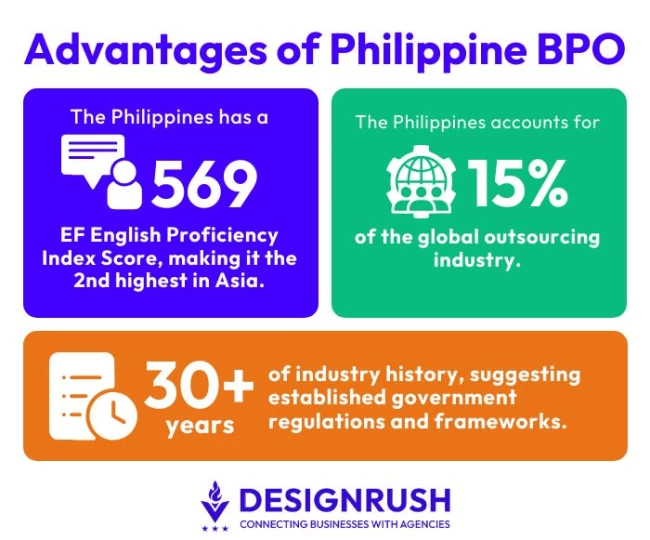
On English proficiency, the Philippines holds an EF EPI score of 569 against a global average of 488, placing it among the strongest outsourcing destinations for voice and written communication work.
On global experience , Philippine BPO providers account for 10%-15% of the global outsourcing industry, meaning most established providers have direct experience with the compliance requirements, reporting standards, and operational expectations of international clients.
The industry's 30-year history also matters for a different reason: regulatory maturity. The Philippines has developed government frameworks and industry associations specifically governing BPO operations, giving buyers more legal and operational recourse than they would have in younger outsourcing markets.
Use this as your decision filter:
If the work is primarily software engineering or high-complexity IT development, India has a deeper and more established talent base. If real-time collaboration during North American business hours is a hard requirement, Latin American providers offer a time-zone alignment that the Philippines cannot match. If you need English-language communication, customer service, or back-office processing at scale, the Philippines remains one of the strongest options at its price point. What should you prepare before outsourcing business functions to BPO companies in the Philippines? Prepare your process, stakeholder, baseline, access control, project scope, and non-negotiables before outsourcing functions to BPO companies in the Philippines. Without these, you face higher business risks and a higher likelihood of a failed engagement.
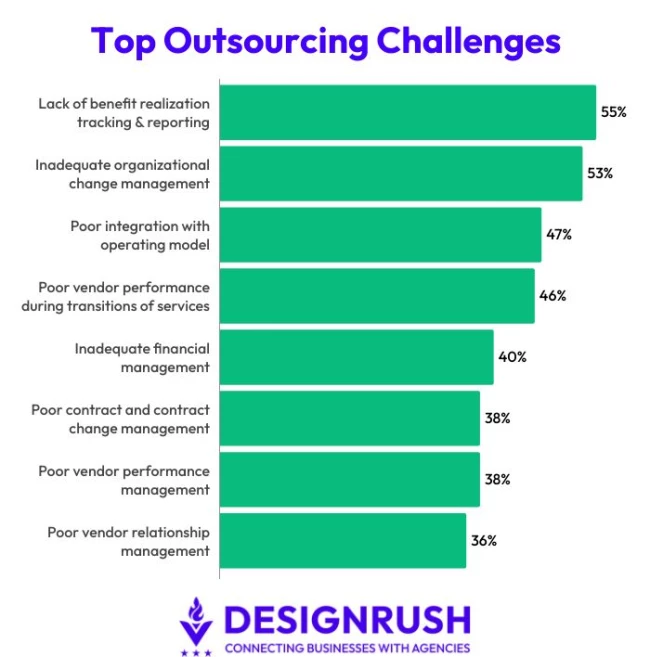
According to Deloitte , the top outsourcing challenges include a lack of benefit realization (55%), inadequate organizational change management (53%), poor vendor integration (47%), and poor vendor performance (46%) .
The following preparation can help mitigate these outsourcing challenges by ensuring that you have the proper processes and frameworks in place to enforce accountability and transparency:
Documented process . A step-by-step standard operating procedure (SOP) detailing inputs, outputs, decision points, exceptions, and escalation paths. Without this, the BPO may act on assumptions that contradict your business policies or strategies.Internal ownership . An internal point of contact who will manage the relationship, answer questions, and make judgment calls.Realistic baseline . Your current performance numbers, such as weekly volume, average handle time, error rate, and cost per transaction. These metrics help you objectively assess the BPO's performance.System access control . Outline the internal tools and technologies that the BPO will use, and their access level, as approved by your internal IT security team.Defined scope . Specify the BPO's function, work volume, hours, expected output or deliverables, goals, and qualifications that you require from the outsourced team.Non-negotiable . Data security requirements, compliance obligations, tool preferences, and communication protocols should be stated upfront to ensure that the BPO has the capabilities to fulfill these.What are the red flags in a Philippine BPO proposal or sales call that signal operational immaturity? Red flags that signal operational immaturity include generic, price-led proposals, no verifiable client references and team members, vague contracts, and weak security, QA, and business continuity strategies.
Skips the discovery process Price-led proposal No named team members No verifiable industry experience Missing processes Vague SLAs and contracts No business continuity plans What contract terms protect you if quality drops, timelines slip, or the team assigned to you keeps turning over? A service level agreement with defined consequences, staffing continuity clause, training and transition obligations, exit clause, and governance escalation plan can protect your business when the BPO provider in the Philippines underperforms.
Ensure the following terms and conditions are included in your BPO contract :
Terms What it should include Service level agreements (SLAs) The specific services, tasks, and processes covered by the agency Expected performance metrics (e.g., minimum accuracy rate and maximum handle time) Out of scope coverages Remedies tied to SLA breaches Actions to be taken when the agency does not meet agreed targets:
Service credits Required remediation plans within a set timeframe Right to exit without penalty after sustained underperformance Staffing continuity clause Advance notice of key personnel changes BPO is obligated to provide equally experienced replacements Limitation to the frequency of core team reassignment Training and transition obligations The BPO is responsible for the re-training costs and transition time during turnover Exit clause Termination clause with a defined wind-down period of 30-60 days. Watch out for auto-renewal clauses that roll into another full term unless you terminate before the renewal period. Data ownership and return You own all the data and engagement deliverables Prohibits BPO from using your data other than the services contracted States how your data will be returned or destroyed on the provider's database once contract ends Governance escalation plan The named escalation structure of people you can contact when your daily account manager cannot resolve your issue.
How do you set the right KPIs and reporting cadence from day one so you're not flying blind for the first quarter? Establish key performance indicators (KPIs), baseline, ramp period, and reporting format from the first day. With these in place, you easily determine if the issue is temporary due to the adjustment period or a fundamental one that should make you walk away.
Deloitte's Global Outsourcing Survey reports that businesses adopting an outcome-based delivery model experience higher satisfaction (88%) compared to those implementing a traditional staff augmentation model (71%).
Follow the steps below to avoid navigating the first quarter blind:
#1 Set 3-5 outcome metrics Select outcome metrics that directly tie to business results, such as:
Customer satisfaction score Resolution rate Order accuracy SLA compliance rate NOTE: Do not select activity metrics (e.g., calls handled, tickets clocked, hours logged), as they will show you what the Philippine BPO team is doing, instead of their tangible business impact.
#2 Define your baseline Measure your current performance before the BPO company in the Philippines takes over your account. These numbers serve as your benchmark for the next few months of your partnership.
#3 Agree on a ramp period with adjusted targets Hold the BPO to a reduced performance threshold during the first four to six weeks, typically 80 to 85% of full-target metrics. This reflects the legitimate learning curve, while still protecting you from a team that never improves.
#4 Specify reporting format, frequency, and ownership Below is an example plan:
Weekly reports , covering the prior week’s volume, quality scores, SLA adherence, and flagged exceptions. Attendees should include your team leads and Ops manager.Monthly reports , discussing high-level trends, process improvements, and situations that require strategic thinking. Attendees should include the BPO operations manager and your lead.Quarterly business reviews , assessing if the scope, staffing model, and target reports still reflect your actual needs. Attendees should include the BPO account director and your executives.NOTE: Require access to the raw data, so you can audit the BPO's service quality independently and not rely on the curated reports of the provider.
Sources DesignRush sustains a directory of over 40,000 agencies categorized by service category, location, expertise, and reviews. We build our database in two ways:
Our dedicated team of agency experts actively searches the web for top-performing companies. We then pull information from their websites, online presence, and client testimonials to verify their status and qualifications prior to listing. The agencies listed get notified of their profiles on the website and they can choose to claim it or not, which suggests their availability for more collaborations. Agencies can also reach out to DesignRush and must go through the verification process prior to being listed.

-preview-webp.webp)


 Proposals