
Generative AI: Key Points
- Generative AI cuts breach costs significantly, with organizations adopting AI and automation saving an average of $2.22 million per breach compared to those without such technologies.
- Generative Adversarial Networks (GANs) enable safer system testing, allowing businesses to simulate real-world attacks, uncover vulnerabilities faster, and reduce remediation times.
- Eastman Chemical Company accelerated threat response by integrating Microsoft Security Copilot into its defenses.
As cyber threats grow more sophisticated, traditional cybersecurity methods are struggling to keep up. Let’s see in what ways are businesses turning to generative AI solutions to anticipate attacks, respond in real time, and protect their most valuable data.
The Role of Generative AI in Modern Cybersecurity
In 2024, we witnessed several costly breaches and cybersecurity threats happening to some of the big players in the market.
- National Public Data lost 2.9 billion records tied to 1.3 billion individuals, exposing sensitive personal information across the dark web.
- Telecom giant AT&T suffered two breaches impacting over 110 million customers, including leaked call metadata and encrypted passwords.
- Patelco Credit Union experienced a ransomware attack that compromised more than 726,000 individual records.
These incidents highlight the rising scale and speed of modern cyberattacks — and the growing need for more advanced cybersecurity methods. The global average breach now costs a staggering $4.88 million.
Traditional defenses, while still important, are no longer enough to counter evolving threats.
Generative AI offers a new layer of protection, helping businesses predict, detect, and stop attacks before they cause lasting damage. Instead of relying only on known threat patterns, generative AI learns from large amounts of data to predict new threats, create possible attack scenarios, and suggest early defense strategies.
In modern cybersecurity strategies, generative AI plays several critical roles, including:
- Continuous monitoring: Scans digital environments in real time to detect unusual behaviors and early-stage threats which helps businesses catch issues before they escalate.
- Real-time alerts: Flags suspicious activities instantly, enabling faster threat response and minimizing damage.
- Automated response: Launches immediate actions such as quarantining compromised systems or enforcing MFA resets to contain threats quickly.
- Attack simulation: Generates potential threat scenarios to stress-test defenses and uncover hidden vulnerabilities before real attackers can exploit them.
- Compliance support: Helps companies maintain regulatory compliance by improving detection speed, reporting accuracy, and audit readiness.
- Client trust reinforcement: Strengthens brand reputation by proactively protecting sensitive data and assuring customers of a secure digital experience.
Let’s take a closer look at how organizations are applying these capabilities in real-world business settings.
Top 5 Use Cases for Generative AI in Business Security
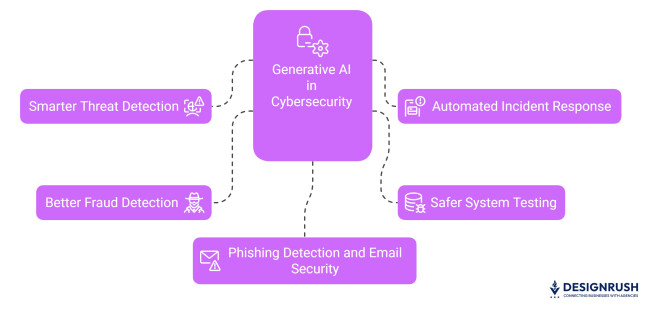
Organizations are turning to generative AI for stronger defenses and more efficient security operations. It helps uncover blind spots, simulate real-world attacks, and make large-scale monitoring faster and more manageable.
Below are some of the most effective ways enterprise teams are putting it to work:
- Smarter threat detection
- Automated incident response
- Safer system testing
- Better fraud detection
- Phishing detection and email security
1. Smarter Threat Detection
Generative AI can scan huge amounts of network and cloud data in real time, spotting threats that traditional systems might miss. This helps security teams find risks faster and gives executives better information when making cybersecurity decisions.
AI models can also prioritize alerts by severity, helping teams focus on the most dangerous issues first. Platforms integrating generative AI, like Microsoft’s Copilot for Security, use advanced models to summarize threats, recommend investigation steps, and speed up incident triage.
Eastman Speeds Up Threat Response with AI

One example of smarter threat detection in action is Eastman Chemical Company, which uses Microsoft Security Copilot to quickly identify and assess unfamiliar cyberattack patterns.
As a global specialty materials company, Eastman’s ability to respond quickly to new cyberthreats is critical for protecting its intellectual property and operational systems.
According to David Yates, Senior Cybersecurity Analyst at Eastman, the platform enables their team to quickly interpret unfamiliar attack patterns and make faster, more informed decisions during incidents. With the help of generative AI, Eastman’s cybersecurity team can now respond faster to unfamiliar threats, reducing the window of exposure and strengthening their overall defense posture.
2. Automated Incident Response
Generative AI allows security systems to respond automatically when an attack is detected, without waiting for human intervention. It can isolate compromised endpoints, lock suspicious user accounts, reset authentication credentials, and block malicious network traffic within seconds. These actions are based on predefined policies and real-time risk analysis.
According to IBM’s 2024 Cost of a Data Breach Report, organizations that adopted security AI and automation saved an average of USD 2.22 million compared to those that did not deploy these technologies. Faster containment not only limits financial losses but also helps companies meet strict regulatory reporting deadlines.
Amazon Scales AI to Fight Daily Threats

To manage nearly a billion cyber threats daily, Amazon has scaled its AI capabilities to automate detection and response across its global infrastructure.
The company uses advanced AI systems such as graph databases and MadPot honeypots to rapidly analyze threats and trigger automated defenses, minimizing delays and strengthening resilience in the face of AI-powered attacks. This shift toward AI-driven protection is helping Amazon stay ahead of fast-evolving threats and safeguard its critical infrastructure and customer data.
3. Safer System Testing
Generative AI, particularly through technologies like Generative Adversarial Networks (GANs), is helping businesses test their cybersecurity defenses under real-world conditions. GANs create realistic simulations of how hackers might breach systems, identifying vulnerabilities that traditional scripted tests often miss.
This approach lets companies uncover weak points before attackers do, significantly strengthening their security posture.
IBM’s X-Force Red team, for example, uses AI-based penetration testing to mimic advanced attack techniques and stress-test organizational defenses. Companies that adopt AI-driven testing can reduce remediation times and lower the cost of breach prevention by catching critical issues earlier in the development or deployment stages.
4. Better Fraud Detection
Generative AI is helping organizations detect fraud faster and more accurately by analyzing massive volumes of behavioral and transactional data in real time.
Unlike traditional systems that rely on predefined rules, generative AI models learn patterns over time and can adapt when fraudsters change tactics. They can spot subtle anomalies — such as slight changes in login behavior, purchasing patterns, or device fingerprints — that older systems might overlook.
While financial institutions remain a primary target, fraud detection is also critical for industries like e-commerce, healthcare, insurance, and retail, where stolen identities, fake claims, and payment scams are rising.
Detecting threats earlier and reducing false positives helps you protect your revenue, strengthen customer trust, and maintain compliance in a world where financial crime is getting harder to detect.
5. Phishing Detection and Email Security
Phishing attacks are growing rapidly in both volume and sophistication. Recent reports reveal that credential phishing attacks jumped by 703% and overall email-based threats rose by 202% in the second half of the year.
Even more concerning, 80% of embedded malicious links were previously unknown zero-day threats, meaning they bypassed traditional signature-based detection methods.
Generative AI makes email security more effective by analyzing email content, sender behavior, and language patterns in real time to detect subtle signs of phishing. It can identify anomalies such as spoofed domains, suspicious phrasing, and abnormal reply-to addresses before a malicious email reaches a user's inbox.
As phishing tactics increasingly leverage AI and target multiple communication channels beyond email, businesses need flexible, AI-driven defenses to protect their employees, vendors, and customers from financial loss, data breaches, and reputational damage.
Risks and Ethical Concerns of Using Generative AI in Cybersecurity
While generative AI strengthens cybersecurity defenses, it also introduces new challenges that organizations must address carefully. As Sray Agarwal, Head of Responsible AI at Fractal Analytics, puts it, "Ethical AI functions like a seat belt in a car — it's essentially a safety feature." It ensures that AI doesn't discriminate among people and operates in a transparent and explainable manner, making it critical for mitigating risks introduced by advanced AI technologies.
Here are some of the key risks and how you can mitigate them:
Adversarial Attacks on AI Systems
Hackers are increasingly trying to "trick" AI models by feeding them manipulated or poisoned data designed to confuse or mislead. In cybersecurity settings, this could cause AI systems to misclassify malware, overlook insider threats, or recommend ineffective defenses.
How To Mitigate
You should invest in continuous model retraining with curated, trusted datasets, and apply AI explainability frameworks that allow security teams to audit how critical decisions are made.
Explainability and Compliance Risks
Generative AI models often act like "black boxes," making decisions without clear reasoning trails. In highly regulated industries such as healthcare, finance, and government, this opacity creates major compliance risks.
How To Mitigate
You should adopt explainable AI (XAI) solutions that provide human-understandable insights and maintain audit trails for all AI-generated security decisions.
Bias and Data Integrity Threats
AI models trained on incomplete or skewed datasets risk making inaccurate threat classifications, leaving organizations vulnerable to emerging attacks. The NIST AI Risk Management Framework emphasizes the importance of managing training data quality, model validation, and bias mitigation strategies to enhance AI trustworthiness.
How To Mitigate
You should apply regular model validations, curate diverse datasets, and monitor evolving threats to maintain accuracy and fairness.
Why Businesses Must Embrace AI-Driven Cybersecurity Now
Generative AI enables faster threat detection, smarter defenses, and greater resilience against evolving attacks. Companies that adopt AI early will not only minimize risks but also build stronger reputations, unlock new revenue opportunities, and gain a decisive edge in a high-stakes digital economy.
The organizations that act now will lead tomorrow.

Our team ranks agencies worldwide to help you find a qualified partner. Visit our Agency Directory for the Top Cybersecurity Companies as well as:
- Top AI Cybersecurity Companies
- Top Cybersecurity Marketing Agencies
- Top Cybersecurity Incident Response Companies
- Top Cybersecurity Companies in Virginia
And don’t miss our Awards section, where we celebrate the most innovative projects in design — from logo and app design to print and packaging.
Generative AI in Cybersecurity: FAQs
1. What industries benefit most from AI-powered cybersecurity?
AI-driven cybersecurity benefits industries handling sensitive data or critical infrastructure, including finance, healthcare, retail, and government.
2. Can generative AI cybersecurity systems be customized?
Yes. AI models can be tailored to specific organizational needs, risk profiles, and compliance requirements.
3. What are the first steps to adopt generative AI cybersecurity?
Start with an AI-readiness cybersecurity audit, identify high-value assets and vulnerabilities, and partner with AI experts to implement and deploy solutions.


-preview.jpg)