
Legacy businesses are your family clinics, regional retailers, or decades-old brands that built their success offline, on trust, reputation, and knowing their customers.
Digitize carelessly, and you risk creating distance instead of making those relationships stronger. These ten best practices are how you avoid that.
Small Business Digital Transformation: Key Findings
- Keep human support available alongside new digital channels. 86% of consumers say human interaction is still important to their brand experience.
- Be transparent about customer data from day one. 82% of consumers will share personal information for personalization when companies clearly explain how it's collected and protected.
- Modernize in phases instead of overhauling everything at once. Domino's transformed just its ordering experience first and drove roughly 70% of sales through digital channels.
Why Legacy Businesses Have the Most to Gain From Digital Transformation
A digital transformation for small businesses lands differently than it does for a startup.
Family-owned manufacturers, healthcare providers, retailers, hospitality groups, and professional service firms have decades of customer trust, established processes, and reputations to protect
They already have a base of customers who chose them for reasons that have nothing to do with an app.
Many of these industries also have the most to gain from digital transformation:
- Construction: Autodesk found 77% of organizations believe digital transformation will improve their industry, yet the sector still struggles with disconnected workflows and legacy processes.
- Healthcare: Deloitte reports healthcare organizations are accelerating investment in AI and digital health while still contending with fragmented legacy systems and interoperability challenges.
- Agriculture: The World Bank found investment in digital agriculture solutions in East Asia quadrupled between 2020 and 2022.
- Hospitality: Deloitte says hotels are investing in AI, mobile, and contactless technologies to modernize guest experiences and stay competitive.
McKinsey Global Institute's 2025 research estimates that about $2.9 trillion of economic value will be available in the United States by 2030 if organizations redesign workflows around people, AI agents, and robots working together.
Most of that untapped value sits in these slower-moving industries.
Best Practices for Digitizing a Legacy Business Without Losing Customer Trust
These best practices help you modernize in phases, improve customer experience, and protect the relationships that made your business successful in the first place.
- Don't try to transform everything
- Audit relationships before systems
- Map the customer journey before you digitize a single step
- Bridge the physical and digital
- Communicate the benefit in plain language
- Digitize in phases
- Be transparent about customer data
- Bring your team along
- Track and measure relationship health
1. Don't Try to Transform Everything – Domino's Started With Just Its Ordering Experience
The first step in any small business digital transformation is understanding the scope of the change you're making.
Three terms are often used interchangeably, but they describe different approaches:
- Digitization is converting analog to digital, like scanning paper invoices or putting your customer list into a database.
- Digitalization is using digital tools to run the processes you already have, like online bookings instead of a phone log or a payment terminal. The process is the same, but the tool is faster.
- Digital transformation is rethinking the business model and the customer relationship itself, so the company can operate in ways that weren't possible before.
Most legacy businesses only need transformation in one or two places and digitalization everywhere else. The trap is treating everything as a transformation and detonating processes that were working fine.
Example: Domino's picked one place to transform first: its ordering experience.
After its stock bottomed near $3 in 2008, the company rebuilt its ordering experience around digital with mobile apps, real-time order tracking, and one-click reordering.
This drove roughly 70% of sales through digital channels and the stock price past $300.
2. Audit Relationships Before Systems – BlackBerry Protected Features While Customers Moved On
Most transformations fail because companies buy tools before identifying their process gaps and mapping where trust resides.
Identify the three to five things customers trust your business for, and put a name to each – the person or process that delivers it. These are the foundations of your business. Every digital initiative should be checked against them.
Example: BlackBerry owned over 50% of the U.S. smartphone market and 20% globally at its peak, then audited its features instead of its relationships.
It kept perfecting the keyboard and enterprise security it was known for while its customers' actual relationship with their phones shifted to apps and everyday life, and its share fell to zero.
3. Map the Customer Journey Before You Digitize a Single Step – Best Buy Cut 40+ KPIs Down to the Moments That Mattered
Walk every touchpoint from first contact to post-purchase and digitize the friction points.
According to Chop Dawg, an agency that has built personalization layers for legacy brands, draw the line between "data that sits in a database and data that changes the [customer's] actual [experience]."
Digitize what changes the experience, and skip what merely accumulates.
Example: When Hubert Joly took over a near-dead Best Buy in 2012, store managers were tracking 40-50 KPIs.
He cut them to a handful, started measuring Net Promoter Score, and ran what he called a "pain point elimination approach", walking the customer journey and fixing the exact moments driving people away.
The share price went from about $11 to $110.
4. Bridge the Physical and Digital – Netflix Ran DVDs and Streaming Side by Side for Years
Keep your familiar channels open while you layer in digital and run them side by side.
In 2026, the bridge could be connected commerce that extends the in-store experience online, like buy-online-pickup-in-store or digital loyalty tied to the physical shop.
Preserve the personal touch digital can't replicate and let digital handle the coordination around it.
In fact, peer-reviewed research on 76 manufacturers found that competitive advantage comes from fusing it with existing, hard-to-imitate strengths.
Example: Netflix ran DVD-by-mail and streaming side by side for years. They let subscribers choose their own pace and grew from about 4 million subscribers in 2005 to 18.6 million by 2010.
Blockbuster, which passed on buying Netflix for $50 million, lurched into digital late and forced its model onto a changing base, filing for bankruptcy in 2010.
5. Communicate the Benefit in Plain Language – Deloitte's CEO Study Says You Can't Delegate the Story
When you change how customers interact with you, you owe them a story, and it has to lead with what they get.
Deloitte's study of 23 CEOs who led major transformations found the constant across successful ones is that the CEO owns the narrative personally rather than delegating it to PR, because a confused team delivers a confusing experience.
Introduce the new channel as an invitation. Talk about outcomes the customer cares about, like faster service, convenience, and shorter wait times, instead of listing features.
6. Keep a Human Fallback on Every Digital Channel– 86% of Consumers Say Human Interaction Still Matters
Keep a human, non-digital path permanently available, like a phone line or a person on chat, and let customers migrate when they're ready instead of when you are.
Earned adoption sticks better, whereas a forced switch breeds resentment. The teams that migrate decades-old customer bases successfully are emphatic on this point.
PwC's 2025 survey found that 86% of consumers say human interaction is still important to their brand experience. The goal is to extend the in-person experience.
7. Digitize in Phases – Hershey's Big-Bang Launch Cost $100 Million in a Single Season
Replacing old systems overnight is often the riskiest approach. Once real customer data and transactions are running through a new platform, rolling back is rarely an option. If the rollout goes wrong, customers feel it first.
The practical move is drawing a hard line between customer-facing systems and core record systems:
- Customer-engagement systems like your booking flow or anything customers touch are safe to iterate on quickly.
- Record systems like the core database or billing should be changed slowly and carefully.
Begin where customers won't feel disruption, like invoicing, scheduling, inventory, and digital payments. And when a core system already works, build onto it instead of gutting it.
Example: Hershey's compressed a recommended 48-month rollout into 30, went live with three enterprise systems simultaneously in July 1999, right before Halloween, and couldn't fulfill roughly $100 million in orders it had sitting in warehouses.
As a result, quarterly profit fell 19%.
8. Be Transparent About Customer Data – 82% Will Share Willingly When They Trust You
When a longtime customer decides whether to trust your new digital channel, they’re weighing whether their information is safe with you. A breach costs customer relationships, and often permanently.
40% of consumers have pulled their business from a company over careless data handling (McKinsey). Yet 82% will share personal data willingly for a more personalized experience.
Decide what you collect and how you protect it before you launch, and say both plainly to customers: here's what we keep, here's why, here's how it's protected, and here's how to have it removed.
As the experts at Chop Dawg explain:
"The real secret sauce is education. When you tell a guest exactly what you're collecting, why, and that every bit of it is in service of giving them more value and a better experience, they trust you and opt in willingly.
The businesses that get burned on data are the ones that hide what they're doing with it, the ones quietly using it just to monetize you without ever telling you."
Treating data care as a visible promise turns your biggest digital risk into a trust signal.
9. Bring Your Team Along – Resistance Kills Transformation
People are the usual failure point. McKinsey says that the most common causes are a lack of organizational engagement and insufficient investment in building the capabilities needed to sustain change.
Your frontline staff is the first group you have to bring on board. An employee who doesn't understand or believe in the new tool transmits that doubt to every customer they touch.
Train and upskill your frontline staff early before customers encounter any change, and put your most respected long-tenured employees on the rollout early.
If your veterans are skeptical, fix that first. They're a preview of how your loyal customers will react.
10. Track and Measure Relationship Health – Digital's Biggest Payoff Is Finally Seeing Your Customers
The previous practices preserve customer relationships. This one gives you visibility into them for the first time.
An offline business runs on instinct. Owners know their regulars, notice when someone stops coming in, and learn what works through experience.
This can’t be handed to a new hire, and it disappears the day a veteran retires. Digital channels turn all that into data you can act on.
Define what relationship health looks like before launch and track a few key signals from day one, like:
- Retention: Are longtime customers still coming back?
- Channel adoption: Are customers choosing digital at their own pace?
- Customer satisfaction: Use a simple metric like Net Promoter Score (NPS).
- Support trends: What complaints or recurring questions reveal friction?
Review these regularly and treat any decline as an early warning sign.
Example: Chop Dawg, a Philadelphia-based app development agency, digitized Suburban Shopper's direct-mail advertising into an app, unlocking analytics that simply never existed in print.
“For the first time ever, Suburban Shopper could see which ads got looked at, how often, whether they got clicked or not, who clicked them, where those people were located, how many times they came back to the same ad, and which categories and types of content different audiences gravitated toward.
From there they could build a real picture of who their audience actually is, and start serving more targeted, more direct advertising that those people would genuinely care about.”
Three Legacy Businesses That Turned Best Practices Into Winning Digital Transformation Strategies
The following companies show what these best practices look like in action:
- Suburban Shopper by Chop Dawg: A decades-old mailer that let readers set the pace
- John Lewis: A century-old retailer that made stores more valuable through digital
- John Deere: A 180-year-old manufacturer that layered software onto what farmers already trusted
1. Suburban Shopper by Chop Dawg: A Decades-Old Mailer That Let Readers Set the Pace
Chop Dawg digitized Suburban Shopper, a southeastern Massachusetts direct-mail advertiser, using a trust-first method that checked off most of the best practices above.
In this case, the trust lived in a physical object landing in the mailbox, in a format the audience had relied on for years.
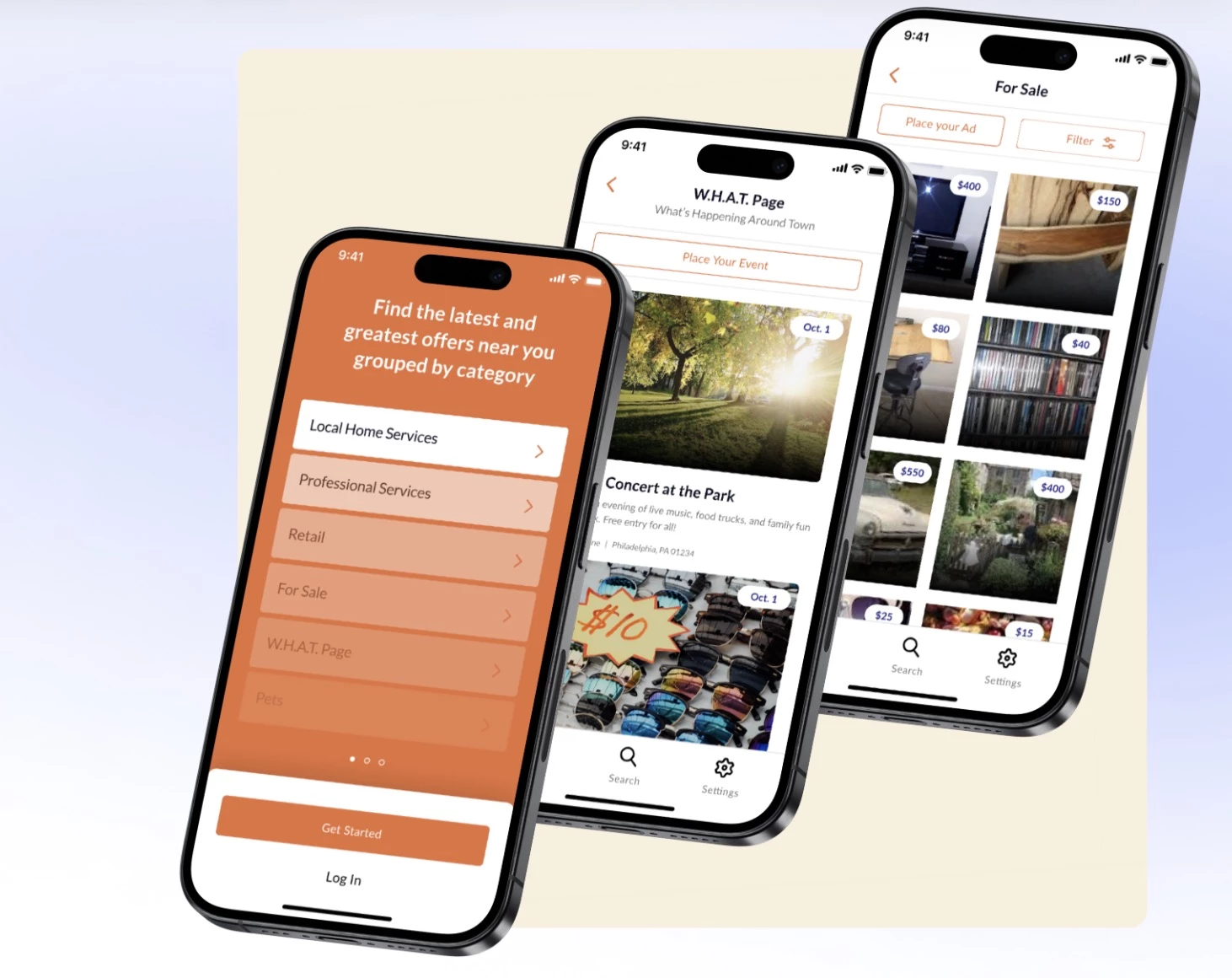
So, the thing the agency guarded most carefully was the simplicity and not to bury that access under features or software.
“The hardest part wasn't technical at all; it was educating a customer base that had trusted a print format for decades.
People were used to something physical landing in their mailbox, and we were introducing a brand-new form factor to an audience that hadn't asked for one.”
As the team that built the app puts it, "the app had to feel as easy as flipping through the mailer always did, just faster and in your pocket."
Chop Dawg worked closely and intimately with Suburban Shopper on a transition that respected that trust. The company promoted the app inside the mailers themselves, which served as the perfect bridge, running right next to the thing people already trusted.
The message was an invitation to use the app. They highlighted the benefits with something as simple as:
"We have an app now. It brings you this stuff instantly, so you no longer have to wait every month for the mail. Now you've got digital coupons and digital ads, and you don't need to go to your mailbox anymore.”
For two years, the two channels ran a deliberate cross-bleed. Mailers continued going out while the audience gradually shifted toward the app as the primary channel.
A business that had run on direct mail for decades was able to teach its own base at its own pace, in a format that they already understood.
2. John Lewis: A Century-Old Retailer That Made Stores More Valuable Through Digital
Founded on London's Oxford Street in 1864, John Lewis could have treated e-commerce as a replacement for its department stores.
Instead, it spent years rebuilding the machinery underneath them. It built a new point-of-sale system, a web platform, an order management system that could track a purchase across any channel, and a supply chain rebuilt from single-channel to cross-channel.
What that groundwork made possible was Click & Collect, which John Lewis pioneered in 2009 and which became an industry standard.
Customers could browse online, buy online and pick up in-store, return online purchases at nearby locations, or get the same service however they chose to shop.
By Christmas 2014, more than half of online orders were being collected in shops, overtaking home delivery. The stores became the anchor of the digital experience while digital removed the friction around them.
3. John Deere: A 180-Year-Old Manufacturer That Layered Software Onto What Farmers Already Trusted
Since 1837, John Deere has built its reputation on dependable farm equipment. Its digital transformation made the machines farmers used smarter, one layer at a time.
- Connected equipment and the cloud-based Operations Center gave farmers access to maps, machine data, and agronomic insights.
- Then came AI: the See & Spray system, launched in 2021, mounts cameras on sprayer booms that scan over 2,500 square feet per second and trigger individual nozzles only where a weed is detected.
Much of this ships as retrofit upgrade kits for sprayers farmers already own, so adopting the technology never meant replacing the fleet or changing how the farm works overnight.
In the 2025 season, farmers ran See & Spray across more than five million acres, saving 31 million gallons of herbicide mix and cutting non-residual herbicide use by nearly half.
Digital Transformation for Small Businesses: Final Words
What made your business successful is the thing transformation exists to protect.
The legacy businesses that win, like Suburban Shopper, John Lewis, and John Deere, modernize in phases, keep human support alongside digital channels, and treat customer trust as the foundation of every decision.

Our team ranks agencies worldwide to help you find a qualified partner. Visit our Agency Directory for the Top Digital Agencies as well as:
- Top New York City Digital Agencies
- Top Digital Strategy Agencies
- Top AI Digital Services
- Top Digital Design Agencies
And don’t miss our Awards section, where we celebrate the most innovative projects in design — from logo and app design to print and packaging.
Digital Transformation for Small Businesses FAQs
1. What is digital transformation for a legacy or traditional business?
Digital transformation for small businesses means using technology to improve how an established, relationship-driven company operates, without losing the trust and personal service it was built on.
Most legacy businesses only need true transformation in one or two areas and simpler digitalization everywhere else, such as online booking, digital payments, and better record-keeping. The goal is to make the experience customers already love faster and easier.
2. How do digital transformation services for small businesses differ from those for enterprises?
Smaller is an advantage. Businesses with fewer than 100 employees are 2.7 times more likely to succeed at digital transformation because they have fewer systems and closer customer relationships (McKinsey).
Enterprises often spend years modernizing, while a small business can achieve most of the value by rolling out a handful of well-chosen tools in phases.
3. Will digitizing my business alienate my existing customers?
Only if digital replaces the human experience instead of supporting it. Consumers still value human interaction, so the businesses that lose customers are usually the ones that force a switch.
Keep familiar channels open, offer a human fallback, and let customers adopt digital at their own pace.
4. What should a legacy business digitize first?
Start with back-office work like invoicing, scheduling, inventory, and digital payments, where customers won't feel any disruption.
From there, map the customer journey and digitize the biggest friction points, such as booking or ordering. Save core systems like billing and customer records for last and build onto what already works.
5. How long does digital transformation take for a small business?
Individual improvements like online booking or digital payments can go live in weeks. A phased transformation typically takes one to three years, especially if customers need time to adapt.
The customer-migration portion, however, shouldn't be rushed. Suburban Shopper, with Chop Dawg’s support, ran its print mailers and new app side by side for two years while its audience shifted at its own pace.
6. What's the difference between digitization, digitalization, and digital transformation?
Digitization converts analog information into digital form, like scanning paper records. Digitalization uses digital tools to improve existing processes, such as replacing a phone log with online booking.
Digital transformation goes further by rethinking how the business operates and serves customers. Most legacy businesses need plenty of the first two and only targeted doses of the third.
7. Can you keep in-person or phone service while going digital?
Yes, and you should. Most customers still want the option to speak to a person.
Keep phone and in-person support available while customers adopt digital naturally. The goal is earned adoption. Customers should use digital because it's better.
8. How do I choose the right software for my digital transformation?
Look past marketing claims and evaluate tools against your actual workflows.
Must-haves include an all-in-one foundation, an intuitive interface your team can adopt without heavy training, scalability to grow with you, and built-in AI.
Some warning signs that a tool won't scale include per-feature pricing that balloons as you grow, poor integration with the systems you rely on, and vendors who can't show examples of businesses like yours using it successfully.