
Many businesses treat branding and marketing as synonyms — though they’re not. This common misstep leads to diluted messaging and inefficient spending, causing growth to suffer.
Branding vs Marketing: Key Points
- Branding builds long-term trust and differentiation; marketing drives short-term demand and measurable growth.
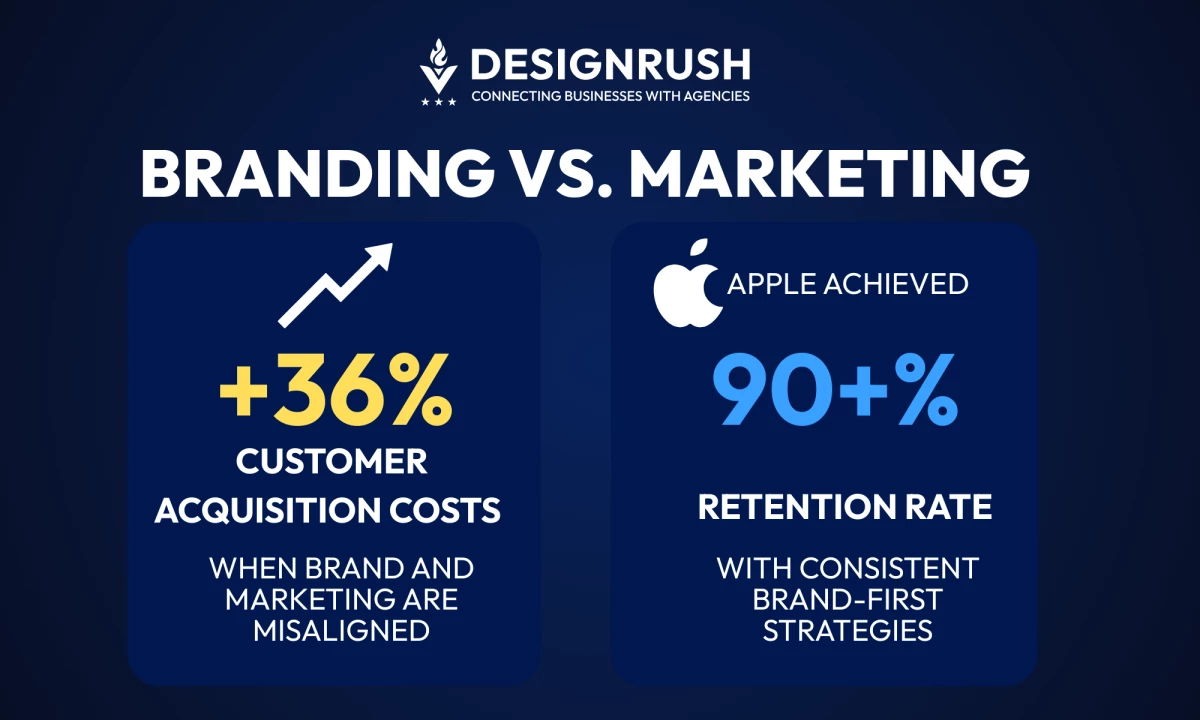
- Misaligned brand–marketing efforts can increase customer acquisition costs by up to 36% and reduce ROI.
- Apple and Airbnb proved that brand-first strategies reduce spend and build loyalty, with Apple sustaining 90%+ retention and Airbnb cutting ads by 58% without losing traffic.
Lead With Branding, Scale With Marketing
Poor branding and marketing alignment can raise customer acquisition costs by up to 36%.
To help fix that, you must first understand the core difference between branding and marketing, then apply the right strategy to align them.
The Real Difference Between Branding and Marketing
Understanding branding vs. marketing is more than semantics. It's a revenue-critical distinction for leadership.
It creates meaning.
It defines your identity, shapes perception, and builds long-term trust.
A strong brand drives pricing power, customer loyalty, and resilience — it’s the foundation of market differentiation.
Branding is also a business asset that builds pricing power, investor trust, and customer loyalty.
As Steve Forbes famously said, “Your brand is the single most important investment you can make in your business.”
Strong brands create an equity that translates to customer lifetime value and resilience in the market.
Marketing is how you grow.
It’s a performance engine that activates demand generation, lead nurturing, and channel efficiency to drive revenue.
Marketing campaigns turn brand equity into action – filling the funnel and accelerating conversions.
As Ann Handley puts it: “Brand is the promise. Marketing is the delivery.”
The table below outlines their distinctions at a glance, so leaders can align teams around the right strategy at the right time.
Element | Branding | Marketing |
Core Role | Defines who the business is | Drives how the business grows |
Visual Identity | Logo, typography, color palette, packaging | Applied across campaigns and content formats |
Verbal Identity | Tone of voice, taglines, messaging pillars | Used in copywriting, ads, emails, and landing pages |
Perception Layer | Culture, purpose, emotional connection, values | Reinforced or weakened through campaign execution |
Channels | N/A (Not a channel-based function) | SEO, PPC, email, events, social, etc. |
Tactics | Strategy-led: Positioning, values, storytelling | Execution-led: Lead gen, lifecycle marketing, promos |
KPIs | Brand equity, trust, recognition, loyalty | CAC, ROAS, CTR, funnel velocity |
Primary Goal | Build memorability, trust, and differentiation | Activate brand equity to drive demand and revenue |
Why Business Leaders Must Treat Them Separately
Too often, leaders lump branding and marketing into a single budget line or team function. But here’s why they must be managed as distinct but connected disciplines:
- You’ll prioritize the wrong goals.
Branding builds equity; marketing activates it. Treating them as one risks over-focusing on short-term metrics (like clicks and leads) at the expense of long-term brand value.
The result: stalled growth and declining loyalty.
- Budgets get misallocated.
If branding and marketing are bundled, funds often tilt toward measurable outputs (ads, campaigns) and starve foundational brand work.
This leads to inconsistent messaging and underperforming campaigns that lack emotional pull.
- Teams pull in different directions.
Brand and marketing teams require different mindsets. If they’re merged without clarity, creatives get buried in performance pressure, and marketers end up guessing the brand narrative.
Execution becomes disjointed, wasting time and talent.
- Measurement becomes muddled.
You can’t improve what you can’t isolate. Blending brand and marketing efforts makes it hard to track what’s driving what.
Leaders may misattribute wins (or failures), skewing strategy decisions moving forward.
- Customer experience suffers.
A disjointed brand–marketing approach creates inconsistent touchpoints — slick ads that don’t match the product experience, or content that contradicts your values. This erodes trust and drives up churn.



The Brand-Marketing Alignment Matrix
When branding and marketing work in sync, they amplify each other. In high-growth companies, this synergy is a performance multiplier.
Research shows that businesses with strong brand–marketing alignment see 25–100% higher ROI, with an average uplift of around 90%.
To help you pinpoint where misalignment exists and what to do about it, we’ve created the Brand–Marketing Alignment Matrix for you.
This 2x2 framework evaluates companies across two axes:
- Branding maturity (strategic clarity, consistency, and identity strength)
- Marketing execution (campaign effectiveness, channel reach, ROI)
The matrix reveals four common brand–marketing states, each with specific risks and remedies:
Stage | Branding Maturity | Marketing Execution | Risk Level | Recommended Action |
Misaligned | Inconsistent or outdated | High spend, low return | Critical |
|
Marketing-Led Only | Weak brand foundation | High activation, low loyalty | High |
|
Brand-Led Only | Strong identity, poor reach | Low visibility, low ROI | Moderate |
|
Aligned | Unified and consistent | Efficient spend, strong ROI | Low |
|
Use the matrix above to assess where your organization stands and identify the next best move to align branding and marketing.
When to Focus on Branding vs. Marketing
The balance between branding and marketing can shift depending on your company’s life stage or situation:
1. Startup / Seed Stage
Prioritize branding when you’re establishing your:
- Mission
- Story
- Trying to attract early adopters who believe in your vision
Prioritize marketing when you need to:
- Validate product-market fit
- Acquire those first customers
Avoid leading with paid ads before your brand story is clear. It can confuse your audience and waste budget.
2. Growth Stage
Prioritize branding when:
- Expanding to new geographies o
- Launching into new verticals
You need a coherent brand story as you scale.
Prioritize marketing when:
- Scaling lead generation
- Optimizing CAC as you push for rapid customer acquisition
Avoid scaling campaigns without a clear brand foundation. This weakens long-term loyalty.
3. Enterprise / Established
Prioritize branding during major shifts like:
- Post-merger rebrands
- Repositioning
- Market shifts
Realign how the market perceives you. Brand clarity drives trust at scale.
Prioritize marketing when:
- Defending market share against competitors
- Launching big go-to-market campaigns for new offerings
Avoid relying on legacy brand perceptions, Outdated narratives can undermine marketing effectiveness.
4. Crisis / Pivot
Prioritize branding when:
- Rebuilding trust post-crisis
- Changing your company’s direction
A clear brand narrative is essential to regain control of the story. Only after brand clarity is restored should you ramp marketing back up.
In other words, during a major pivot, rebrand first to set the narrative, then market to communicate it.
Case Studies: Brands That Nailed the Balance
These companies offer powerful illustrations of how branding and marketing in harmony can fuel consistent growth, loyalty, and financial performance.
Apple: A Masterclass in Unified Execution
View this post on Instagram
Apple’s marketing reinforces a brand narrative built around simplicity, innovation, and premium quality.
Every product launch, retail experience, and campaign aligns with its minimalist brand identity.
For example, campaigns like Shot on iPhone highlight lifestyle and creativity rather than specs, reinforcing emotional connection over features.
This consistency fuels exceptional brand loyalty.
Apple has maintained an iPhone retention rate above 90% for years. Its branding allows minimal reliance on discounts or aggressive marketing spend.
Trust in the brand does the heavy lifting.
This means a brand-first strategy ensures every marketing dollar amplifies equity instead of compensating for weak positioning.
Airbnb: Investing in Brand to Drive Performance
In 2020, Airbnb slashed performance marketing by roughly 58%, yet retained 95% of its previous year’s traffic, primarily through strong brand trust and organic visibility.
This data-led confidence enabled Airbnb to shift toward emotional storytelling and purpose-driven campaigns — such as “Made Possible by Hosts” — and see skyrocketing engagement, brand awareness, and profitability even amid global uncertainty.
Branding vs. Marketing: Conclusion
If your brand and marketing aren’t working in sync, you’re leaving efficiency and growth on the table. Misalignment leads to waste, weak performance, and messaging that doesn't stick.
Strong companies build brand clarity first, then scale with focused marketing.
If you need support aligning both sides, work with a branding agency that understands strategy as much as design.

Our team ranks agencies worldwide to help you find a qualified partner. Visit our Agency Directory for the best branding agencies, as well as:
Our design experts also recognize the most innovative design projects across the globe. Visit our Awards section for the best & latest in logo design.
Branding vs. Marketing: FAQs
1. Can a marketing agency also handle branding?
Some can, but not all. Branding requires strategic thinking, not just design or promotion. Look for agencies with a track record in both brand strategy and execution, not just campaign delivery.
2. How often should we revisit our brand strategy?
At minimum, review it annually or whenever there’s a major shift in your business, audience, or market. Brand relevance needs upkeep just like any product or campaign.
3. Is rebranding always a full overhaul?
No. A rebrand can be a simple refresh of visuals or a deeper repositioning exercise. The scope depends on what’s outdated or misaligned. Sometimes, small shifts make a big difference.

-preview-webp.webp)