
A branding agency that answers questions clearly and confidently, with data, examples, and real insight, is likely one you can trust.
Conversely, vague promises or reliance on creativity alone often lead to frustration down the road.
What To Ask a Branding Agency Before You Hire: Key Findings
- Ask for clear milestones for discovery, design, and launch. A full branding project should typically take 8–12 weeks.
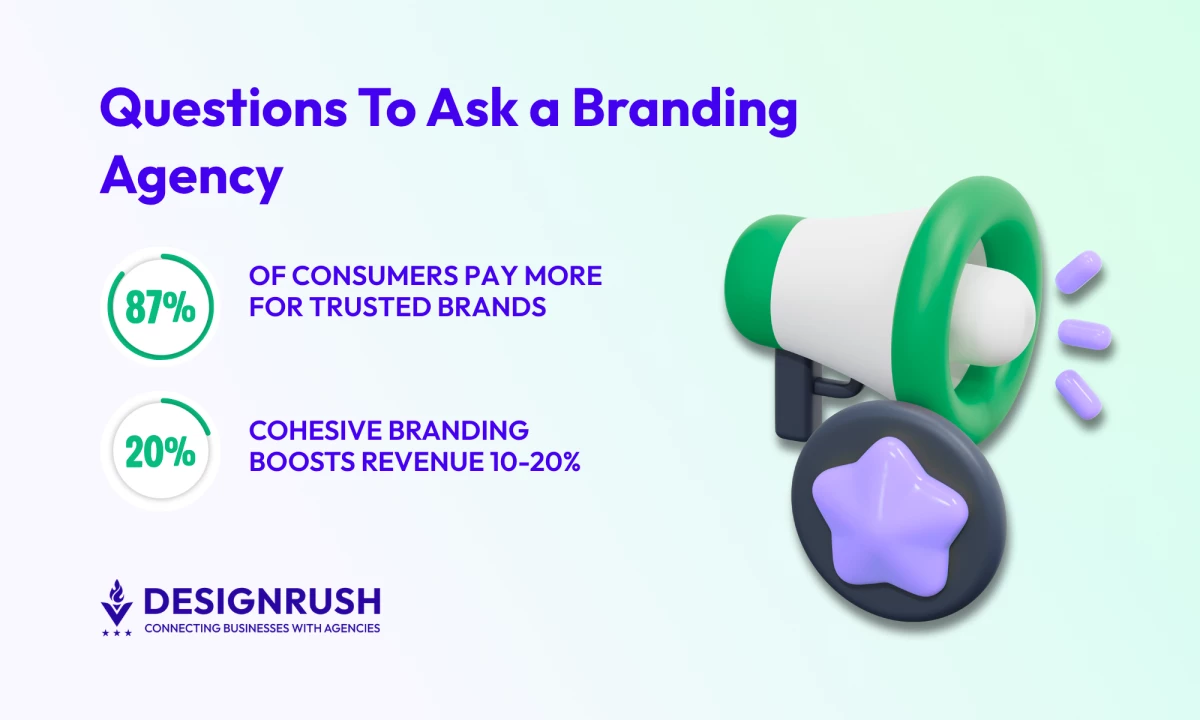
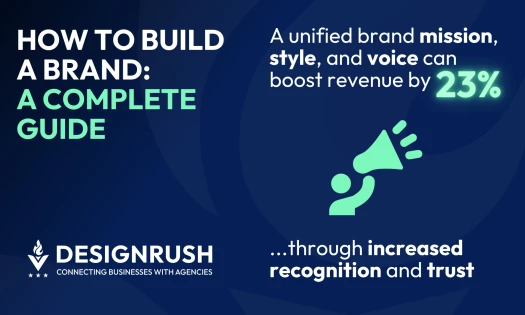
- Ask for a complete brand system covering digital, print, and social. Cohesive branding can increase revenue 10–20%.
- Ask how the agency measures brand success, including awareness, perception, engagement, and business impact. 87% of consumers pay more for trusted brands.
Questions To Ask When Hiring a Branding Agency: Overview
Before I ever sign a contract, I ask 10 questions that reveal how an agency really works and whether they’re worth my trust.
1. How Do You Research Our Market and Audience Before Design Starts?
I always ask, “How will you understand our customers and competition?” A top agency doesn’t rely on creative intuition alone; it should present a structured research plan.
If an agency talks about those concrete steps, I feel confident they’re using evidence.
- Ideal Answer:
“We start by mapping your customer journey using sales and support data, then conduct interviews with 5–10 key customers.
We combine that with a competitive audit and trend analysis to identify gaps in messaging.
Finally, we build 3–4 personas that guide visual and verbal identity decisions and test them with small focus groups before design begins.”
- Red Flag:
“We usually skip research until we have a feel for the brand; too much data can stifle creativity.”


2. What’s Your Timeline for Discovery, Design, and Launch?
I always press agencies for a detailed timeline and milestones. In my experience, a clear 8–12 week roadmap is reasonable for a full branding engagement, depending on scope.
If they can’t outline rough durations for each phase, I worry they lack structure. I insist on timelines, milestones, and sign-offs to avoid projects dragging on indefinitely.
- Ideal Answer:
“For a full branding engagement, we plan roughly 10 weeks: discovery (2w), concept development (3w), review and iteration (2–3w), and rollout with guidelines and templates (3w).
We schedule checkpoints at every stage to ensure decisions are aligned and avoid surprises.”
- Red Flag:
“We don’t usually plan fixed timelines; we move as fast as the client can respond.”
As Gabriel Shaoolian, Founder and CEO of Digital Silk, points out:
“A brand has to be ready to allocate time. This is collaboration. When you hire an agency, the agency doesn't go away and do everything. You want to collaborate with them on a weekly basis.”
3. How Do You Ensure Consistency Across All Touchpoints (Digital, Print, Social)?
I expect agencies to deliver a comprehensive system.
They should show examples across digital, print, and social channels. Studies show it can boost revenue by 10–20%, proving that cohesion directly impacts the bottom line.
- Ideal Answer:
“We produce a comprehensive brand system covering logos, typography, color palettes, iconography, photography, copy style, and templates.
Each element is applied across web, social, packaging, and presentations. We often run audits to catch inconsistencies before launch.”
- Red Flag:
“We provide a logo and a PDF guide on how the brand is used elsewhere is up to the client.”
4. How Do You Define and Measure Brand Success (KPIs)?
I expect quantifiable KPIs that cover awareness, perception, engagement, and business impact.
In my experience, brands that establish credibility can command higher prices, and research shows 87% of consumers are willing to pay more for trusted brands (Salsify).
Any agency citing only likes or impressions without context is a red flag.
- Ideal Answer:
“We track brand awareness through surveys and social listening, engagement via email CTRs, click-throughs, or repeat visits, and perception via sentiment analysis.
For example, after a rebrand for a B2B SaaS client, we increased organic traffic by 32% and customer survey scores improved by 18% in 6 months.”
- Red Flag:
“We gauge success through internal feedback. If most stakeholders are happy with the design, we consider it a win.”
5. How Do You Integrate Brand Strategy With SEO and Content Architecture
Branding and SEO must be developed in parallel, not sequentially. I look for:
- Early keyword research integrated into messaging.
- Content hierarchy mapped to user intent and search volume.
- Pages optimized with brand-consistent headers, meta titles, and copy.
A strong agency demonstrates how content structure, copy, and messaging work together to drive organic discovery.
- Ideal Answer:
“We map messaging to user intent and perform keyword research early, then integrate it into content architecture.
For a recent client, we created a content hierarchy aligned with search trends while keeping brand voice intact, resulting in a 40% increase in organic page visits within the first quarter post-launch.”
- Red Flag:
“SEO is separate. Design first, content and SEO come later.”
6. What’s Your Approach When a Campaign or Visual Underperforms?
Agencies that treat campaigns as “set and forget” fail fast. The best use of underperformance is as an opportunity to optimize.
In one project, quick A/B testing improved social ad performance by 50%.
I expect data-driven iteration like analyzing metrics (CTR, engagement, bounce) or testing new creative variants (headlines, visuals, messaging).
- Ideal Answer:
“We treat underperformance as insight. Recently, a social media visual had low engagement, so we ran two A/B variants with updated copy and imagery.
Engagement jumped 50%. We log every iteration in a shared dashboard so lessons feed back into future campaigns.”
- Red Flag:
“We stick with our original design. It takes time for branding to sink in, so we don’t change midstream.”
7. How Do You Adapt Brand Identity for Different Cultures or Markets?
When expanding into new regions, I always insist on cultural adaptation.
Brands that localize messaging and visuals report revenue growth 84% of the time, which shows the tangible payoff of thoughtful localization.
For example, we adapted imagery and tone slightly for Latin America, and engagement doubled.
- Ideal Answer:
“We run local market tests with focus groups, adjust flexible brand elements as needed, conduct cultural sensitivity reviews, and translate copy idiomatically while keeping the core identity intact.”
- Red Flag:
“We believe a truly strong brand maintains absolute consistency globally, so we rarely adjust visuals or messaging for local markets.”
8. Can I Speak With a Past Client or See a Live Brand in Action?
I press for specifics: “What was the challenge, what solution did you design, and what were the outcomes?” Good answers often cite actual clients (or at least “in X industry, we helped boost [metric]”).
They’ll also happily share the live brand: “Take a look at the new website/app/packaging we launched.”
Every agency has at least a few clients who are public or willing to chat. So, I insist on at least one reference or demo. At one point, I even arranged a call with a previous CEO who verified the agency delivered on the agreed KPIs.
- Ideal Answer:
Yes, we can connect you with a CEO from a past project and give live access to a brand we launched six months ago, including website, social, and collateral.
You can speak with them to understand outcomes and see how our work performs in the real world.”
- Red Flag:
“Most of our work is under NDA,” or “Most clients don’t like us talking to prospects, so we usually avoid references.”
My rule: No reference or case history means walk away.
9. How Do You Manage Testing, Iteration, and Post-Launch Optimization?
I expect a “launch, measure, refine” approach. That means they should have tools and processes in place to collect feedback and analytics after rollout.
For instance, after one recent brand launch, we held a lessons-learned meeting: the team reviewed Google Analytics data (bounce rates, click paths) and social engagement.
We discovered our key message wasn’t coming through on mobile, so we quickly adjusted the homepage banner. Small tweaks like that can vastly improve results.
- Ideal Answer:
“Our launch includes built-in measurement: we track engagement, conversion, and feedback for 3–6 months.
In one recent project, we found the hero messaging didn’t convert on mobile, so we tested alternate headlines and layouts and increased mobile leads by 27%.”
- Red Flag:
“We hand over everything and don’t touch it again. Post-launch is up to the client.”
10. What Deliverables and Brand Assets Will We Own After Completion?
Finally, I get very specific about handover. Branding projects must define deliverables and ownership in writing, and I won’t sign until that’s clear.
The answer should be: all final assets transfer to me. That includes editable source files (vector logos, design templates), color and font specifications, the brand guideline document, and any other art created.
In other words, everything we need to use and adapt the brand going forward.
- Ideal Answer:
“All final deliverables, including editable logos, templates, fonts, imagery, and full guidelines, transfer to you.
You also retain rights to use and adapt assets across future campaigns and channels.”
- Red Flag:
“We keep the original files; you get final exports only.”
Questions To Ask Before Choosing a Branding Agency: Final Words
These 10 questions are my litmus test for brand agencies. Ultimately, building a brand is a partnership. Come prepared and listen for evidence, not just enthusiasm.
A good agency will push back constructively, guide you strategically, and back up their work with measurable outcomes
Find More Agency Hiring Resources:
- How To Onboard A Digital Marketing Agency
- How to Define SEO Goals Before Hiring an Agency
- Full-Service Marketing vs. Niche Marketing Agency
In my experience, companies (from startups to Fortune 500s) that ask these questions up front avoid wasted budget and misfires.
Our team ranks agencies worldwide to help you find a qualified partner to implement the latest AI solutions. Visit our Agency Directory for the Top Branding Agencies, as well as:
- Top Brand Strategy Agencies
- Top Brand Positioning Firms
- Top B2B Branding Agencies
- Top Corporate Branding Agencies
- Top Small Business Branding Agencies
And don’t miss our Awards section, where we showcase the top agencies recognized for exceptional creativity and impact.
Questions To Ask a Branding Agency FAQs
1. How is brand success measured?
Brand success is measured using KPIs tied to business outcomes, such as:
- Brand awareness (surveys, search volume, social mentions)
- Brand perception and sentiment
- Engagement and loyalty metrics (repeat purchases, NPS scores)
- Traffic, lead generation, or conversions linked to brand campaigns
2. What should I expect as deliverables from a branding agency?
Key deliverables include:
- Brand strategy and positioning document
- Logo and visual identity files (vector and raster formats)
- Color palette and typography guidelines
- Brand voice and messaging guidelines
- Templates for business cards, social media, and presentations
- Brand guidelines document or online style guide
3. How long does it take to build a brand?
It depends on the scope, but a full branding project usually takes 8–12 weeks for research, strategy, design, and rollout.
Larger or global projects may take longer due to additional market research and localization.

-preview-webp.webp)