Our directory of product design agencies in the USA allows you to connect with 700+ verified specialists, renowned for turning product ideas into buildable solutions. Each agency is reviewed for real-world design experience and has been evaluated by 12 industry experts.
Organic rankings are determined by five factors: top services, reviews, portfolio, awards/press, and team expertise. Sponsored listings pay for a placement that appears above organic positions. Sponsorship does not affect star ratings or review content - read more on our methodology page.
Building Brands With Purpose And Precision
Build a bold, cohesive brand identity with Aurum Creative a design studio specializing in logos, branding, and web design for modern entrepreneurs and startups...
Top Services:
- Design Services
- Logo Design
- Print Design
- Creative Services
- Package Design
- Show more
- Location
- St. Petersburg, Florida
- Number of Employees
- Under 49
- Average Hourly Rate
- $45/hr
- Minimal Budget
- Under $1,000
- Portfolios Count
- 8 Projects Listed
Data sourced from the agency's DesignRush profile, its website, and other relevant accountsAurum Creative Services
Data sourced from the agency's DesignRush profileCarrabba’s Goons and Galaxies Cigar City CrossFit Aussie Grill City National Bank Farmer Focus Bonefish Grill Webcheck Security V4V Social Network Helladonna
Your Software Product Development Partner
Velotio Technologies is an outsourced software product development partner for technology startups and enterprises. We combine innovative ideas with business expertise and the latest transformational technologies to drive business success for our customers, help them put their customers' needs at the core...
Top Services:
- Mobile App Development
- UI/UX Design
- Product Design
- Software Development
- Software Testing
- Show more
- Location
- San Ramon, California
- Number of Employees
- 250 - 499
- Minimal Budget
- Under $1,000
Data sourced from the agency's DesignRush profile, its website, and other relevant accountsVelotio Technologies Services
Data sourced from the agency's DesignRush profileFinance Industry Cororate Services Industry Software & IT Services Industry
Velotio Technologies Reviews & Testimonials
Saurav Dey's Review Sourced from Google
Waste of an organization. Wastes time on interviews. Relative had all 3 rounds and final round the interviewer told that all went well and would get back. But later the HR emailed a different statement which contradicted everything. Strange on why they waste people’s time.Seems unprofessional culture still.
Chirag Panchal's Review Sourced from Google
What are you thinking when it comes to conducting interviews? Why waste someone’s precious time? This behavior from interviewers and HR departments is really frustrating. It’s infuriating when there’s little to no response, and if someone inquires about the outcome, you simply say it was negative. On what basis are you assessing someone’s capabilities?I feel strongly—and I'm 100% sure—that I have shared everything you wanted regarding my experience. It's disappointing to see that you're just keeping a record of the interview without any real engagement. Everyone who attends interviews is spending their valuable time, and it feels like that time is being wasted.I've never encountered anything like this with a company before.I want to determine whether you are genuinely looking to hire someone or if you are simply wasting people's time. For those who are working and interviewing, how capable do you think your interviewers are? I don't see any technical knowledge; it seems like they are just pretending to know everything.I need a response from the CEO who is overseeing the situation.
Amey Kulkarni's Review Sourced from Google
Please change your number I tried calling the call is picked up by your security. Thanks.
Reviews verified by DesignRush and sourced from the agency's profile View All Reviews


Product Design Companies by City
Product Design Companies by State
Product Design Specializations in the US
Popular Services
Hiring Guide: How to Choose the Best Product Design Company in the US
What can custom product designers in the USA do for businesses?
They can help businesses turn ideas into market-ready products that attract users and improve usability, aesthetics, and strengthen brand value.
These specialists ensure the customer needs are central to the business, which directly supports branding efforts.
If the product is well-designed, it’s easier to sell the vision for the brand and get the company name known across the niche.
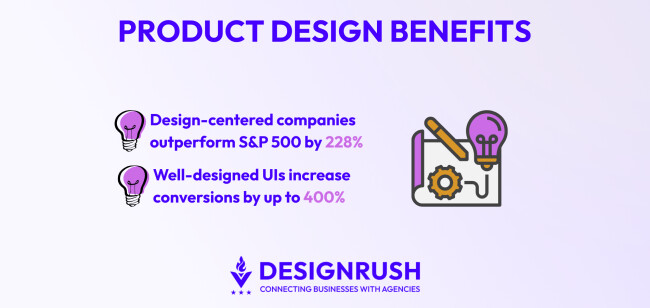
Namely, companies that put design at the center of decision-making have outperformed the S&P 500 by 228% over a ten-year period, indicating a link between design quality and business performance.
On a product level, well-designed user interfaces can increase conversion rates by up to 400%, while improved usability alone can double conversions by making products easier to understand and faster to use.
How is a product design agency different from a UX/UI design agency?
UX and UI designare subsets of product design, focusing on the usability, functionality, look, and feel of the product itself.
In essence, UX designers’ core responsibilityis theexperience a user has while interacting with a product or service. It seeks to identify the end user’s problem(s) and provide them with a functional, easy-to-use solution.
Product design, on the other hand, takes a broader, more holistic view of the product, considering not only the usability of the product, but also where the product fits into the market and how it relates to business goals.
How to choose the best product design agency in the USA?
We prepared a mini guide to help you choose the best product design company in the United States.
These considerations can help you avoid common hiring mistakes and set clearer expectations:
- Set a clear scope
Determine whether the service you are seeking entails full product ownership or support for a specific phase, such as UX audits or a prototype. - Seek product design firms with problem-relevant experience
When researching candidates, inquire about their user research, trade-offs, and constraints in past projects, especially those similar in complexity or business model to yours. - Ask about their research and decision-making process
An experienced product designer should be able to explain why they design something, not just what the solution constitutes of. - Inquire about collaboration with engineering and stakeholders
Ensure the team can work within real technical limits and document design decisions neatly. Consider asking how they manage design systems, feedback cycles, and changes during development. - Request a detailed proposal
The proposal should outline activities, deliverables, timelines, ownership of design assets, and communication channel and frequency. - Choose a partner
Select an agency that understands your vision behind the product and can its long-term consistency.
How to find the best product design agency on DesignRush that fits my budget?
Our directory of top US-based product design firms profiles agencies across multiple price points, so you can identify a vendor that's within your budget.
| High budget: $50,000+ |
|
| Low budget: $25,000-$50,000 |
|
Beyond budget, our agency directory allows you to filter agency profiles by location, area of expertise, agency reviews, client types, team size, and hourly rates.
What questions should be asked before hiring a product designer?
Before hiring a product design agency, you should ask some of the following questions to assess its fit for the project:
Relevant Background
- What types of products have you designed and at what scale?
- How much of your work is focused solely on product design vs. branding or marketing?
- Have you worked on products whose target users, purpose, constraints, or business models were similar to ours?
Services and Processes
- How do you structure pricing and what’s typically excluded?
- How do you balance user research, business goals, and technical feasibility when making design decisions?
- What methods do you undertake for usability testing and validation before final delivery?
Related to Your Project
- How many people will work on our product, and what roles will they cover?
- What assumptions would you challenge early in this project?
- What risks or limitations should we be aware of before starting?
- Realistically, what timeline can we expect until design handoff?
Sources
DesignRush sustains a directory of over 40,000 agencies categorized by service category, location, expertise, and reviews. We build our database in two ways:
- Our dedicated team of agency experts actively searches the web for top-performing companies. We then pull information from their websites, online presence, and client testimonials to verify their status and qualifications prior to listing.
- The agencies listed get notified of their profiles on the website and they can choose to claim it or not, which suggests their availability for more collaborations.
Agencies can also reach out to DesignRush and must go through the verification process prior to being listed.

Why companies trust DesignRush
Every agency is independently vetted before it can be listed or ranked
 4.8
4.8 4.8
4.8Some agencies pay for sponsored placement, clearly labeled and held to the same vetting standards.
Product Design Agency FAQs
What services do product design companies in the USA provide?
Product design companies in the USA provide a spectrum of services aimed at creating new digital or physical products that solve particular user problems. Their expertise is often sought after for assessing whether a proposed solution is feasible from both a technical and a business perspective.
As part of their portfolio, product design firms offer product/user research services, user experience (UX) design, user interface (UI) design, industrial design, prototyping, usability testing, manufacturing, and launch support.
In terms of demand, the research, strategy, and conceptgeneration segment remains dominant, accounting for over39% of the revenue share. As for applications on the rise, the consumablesand accessories segment is projected to witness a CAGR of 11.06% over the forecast period until 2030.
How much does a product design agency charge in the US?
Product design can cost from $5,000 to over $40,000, depending on the project type and how much detail goes into it. When it comes to price per project type, the cost starts around $2,000 for research and can exceed $50,000 for detailed development.
Based on these estimations, here’s what price ranges businesses can anticipate:
| Phase | Estimated cost range |
| R&D | $5,000-$20,000 |
| Conceptual design | $10,000-$30,000 |
| Prototyping | $15,000-$40,000 |
Product designers typically charge in one of three ways:
- By the hour: Charging for each hour spent on the project
- A fixed project fee: A single charge for the whole project, regardless of the time spent
- A retainer fee: A pre-agreed sum paid regularly to reserve the designer's services over a certain period
What timelines does the service typically follow?
The timeline will depend on the product type and its complexity, and it will vary from product to product. Typically, product design can take from a few weeks to several months and up to 1 year.
The breakdown by phases usually looks like this:
- Discovery phase: Between a few days to over 2 weeks
- Wireframing: 30-80 days
- Iterative design: Depends on the wireframing, it typically takes as 1.5x longer
- Responsive design: Depends on the iterative design time, it typically takes as 0.63x longer
What does a typical product design process look like?
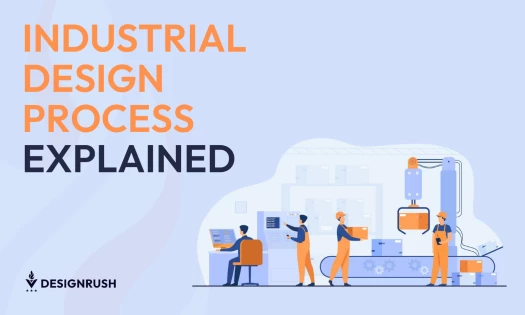
A typical product design process follows a structured set of 10 steps to turn an idea into a high-quality, market-ready product.
The process usually looks like this:
- Brainstorming: Teams generate and evaluate ideas to solve a specific problem, encouraging creativity before selecting the most viable concept.
- Defining the product: The team clarifies the product’s purpose, core problem, and key features, focusing on what matters most and avoiding unnecessary complexity.
- User and market research: Designers and analysts study users, competitors, and market trends to ensure the product meets real user needs and has long-term value.
- Sketching concepts: Early sketches explore design directions and layouts before committing significant time or resources.
- Prototyping: A basic version of the product is created to show structure, functionality, and user interaction, helping catch issues early.
- Specifications and requirements: Detailed documentation defines features, technical requirements, timelines, costs, and responsibilities for development.
- Pre-production samples/MVP: Initial samples (or MVPs for software) are built to test feasibility, usability, and readiness for production.
- Testing and validation: The product is tested with users and stakeholders to identify flaws, gather feedback, and make improvements.
- Development and production: The product is fully built using defined specifications, often with agile methods to manage tasks and priorities.
- Quality assurance: Final checks ensure the product meets quality standards, works as intended, and aligns with requirements before and after launch.
What kind of results can businesses expect from a product designer?
If a product features a top design, businesses can achieve 32% faster revenue growth and 56% higher total returns. Design-led organizations are also twice as likely to outperform industry benchmarks on innovation and customer satisfaction.
In addition, well-designed products are shown to reduce development and support costs by improving usability and lowering error rates. Studies show that fixing usability issues early can cost up to 10× less than addressing them after launch.
Latest Trends Related to Product Design