Connect with trusted React.js developers who deliver conversion-focused digital products that support long-term business growth. Compare providers by budget and team size to find the right partner.
Discover the top React.js Development Companies for Your Project
52 Companies - Rankings updated: April 02, 2026
Each agency undergoes DesignRush evaluation for professional expertise and genuine client satisfaction to assist your search. Some featured placements are paid.
- PulseSpark AI: Pioneering AI marketing and web design in Pittsburgh. We boost businesses with tailor-made AI solutions. [... view PulseSpark AI profile ]
- Location
- Pittsburgh, Pennsylvania
- Number of Employees
- Under 49
- Average Hourly Rate
- $100/hr
- Minimal Budget
- $1,000 - $10,000
We Turn Your Idea into Reality
IBC Mobile, as a leading software development company, has been transforming businesses with innovation-led services. Our mission is to not only develop software but to build dynamic digital experiences that engage, inspire, and empower users. Our software solutions are designed to redefine industry standards [... view IBC Mobile Inc profile ]- Location
- Coatesville, Pennsylvania
- Number of Employees
- 50 - 99
- Average Hourly Rate
- $40/hr
- Minimal Budget
- Under $1,000


Everything You Should Know Before Hiring React.js Development Companies
How can React.js development companies benefit your business?
React.js development companies can help translate your product vision into fast, scalable, and engaging applications that improve user experience, support lead generation, increase conversion, and facilitate long-term growth.
Increase online presence
React.js can support strong search performance when implemented with SEO-friendly rendering approaches such as server-side rendering or prerendering. In practice, many agencies use React-based frameworks to improve crawlability, page speed, and overall discoverability.
According to industry statistics, React-based websites render 15%-20% faster and rank 20% higher on search engine results pages than JavaScript-based applications.
Personalized user experience
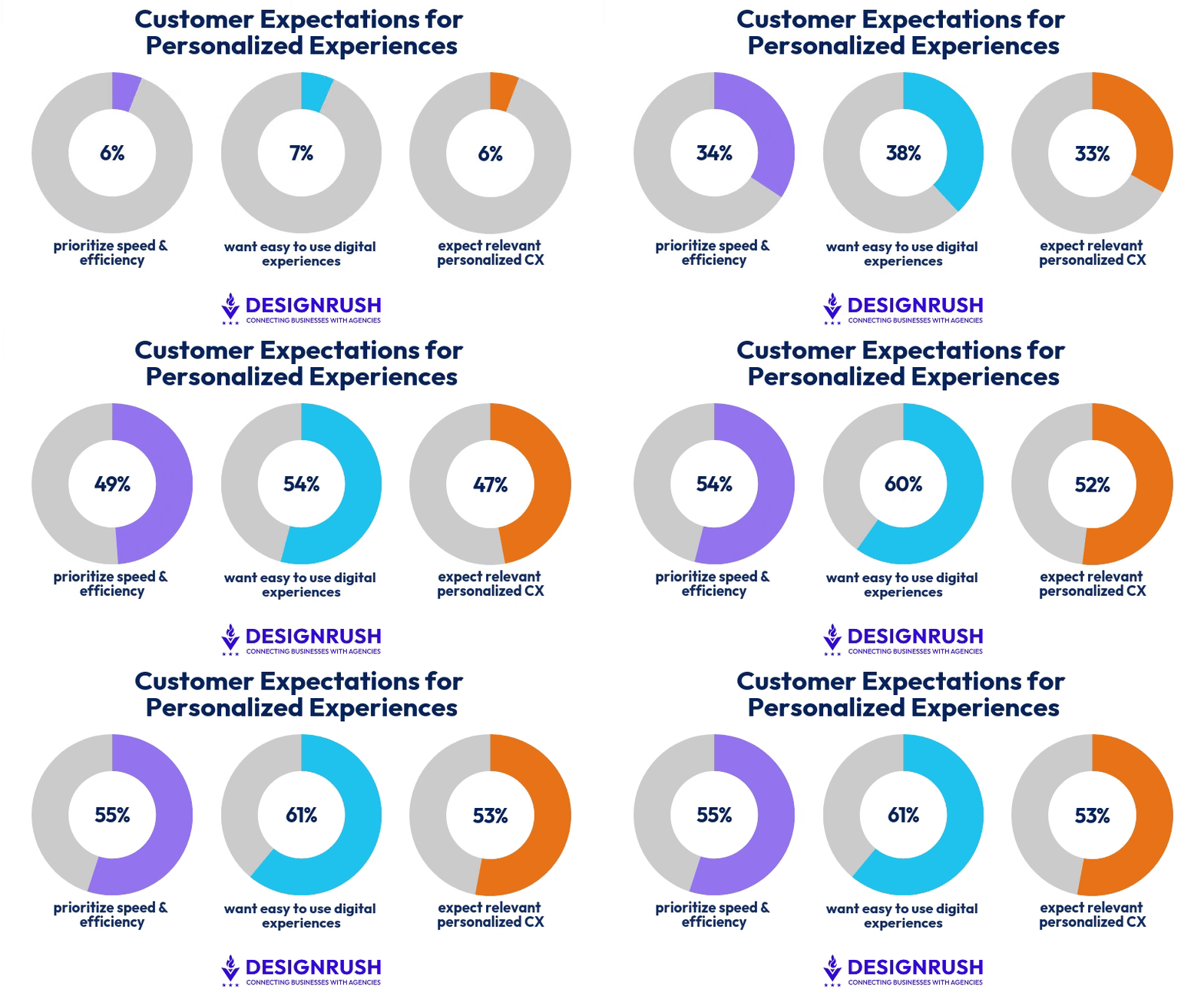
React.js developers can help create dynamic and responsive user interfaces that support smoother customer journeys and more engaging product experiences. When paired with strong analytics and AI-driven personalization, these applications can improve customer satisfaction and strengthen loyalty over time.
Cornerstack's survey reveals that digital consumers want personalized experiences that are intuitive (61%), efficient (55%), and relevant (53%). Additionally, 46% of respondents are more loyal to a brand after a positive digital experience.
Reduce development costs
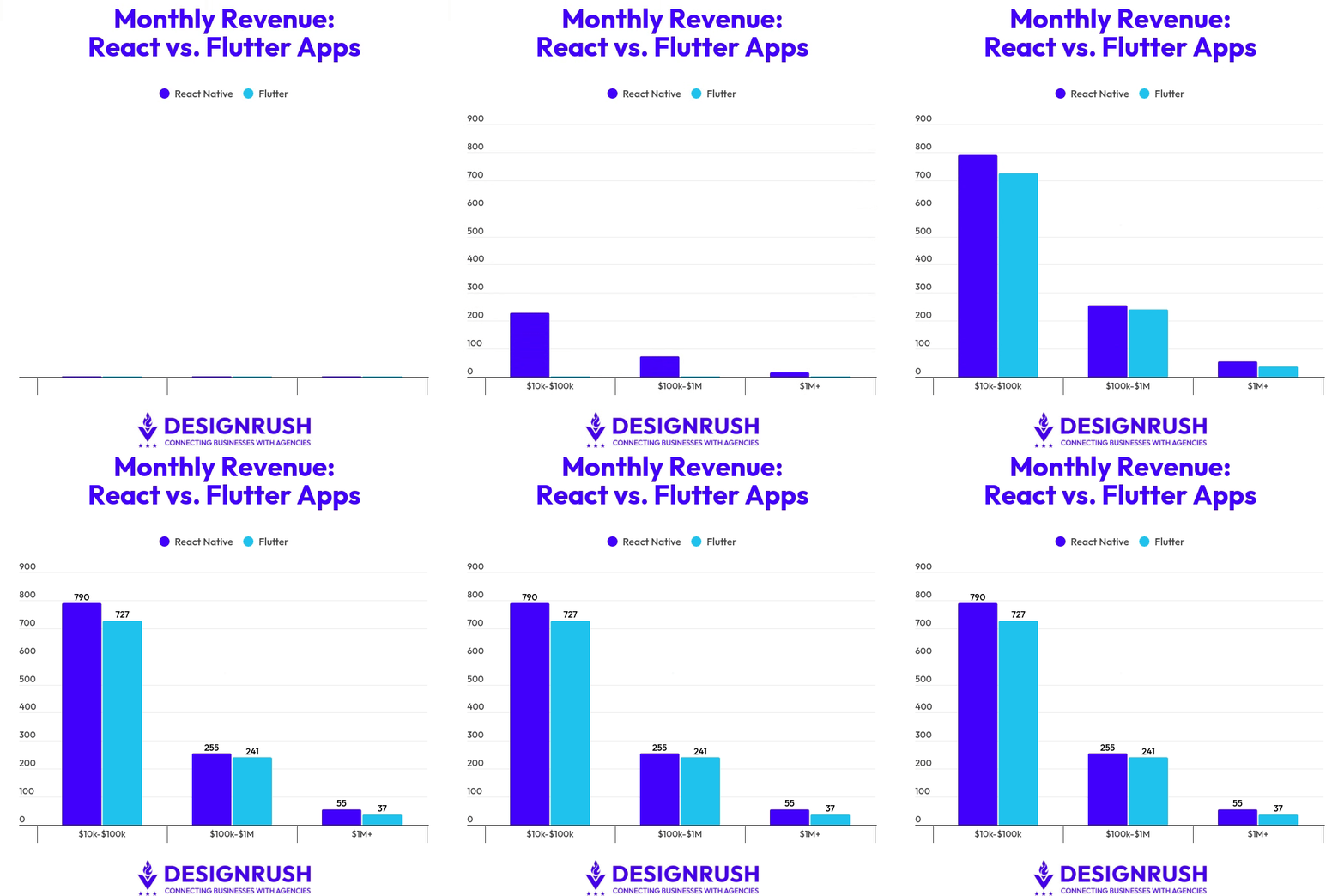
If the company also offers React Native services, it can help you build cross-platform mobile apps for iOS and Android using shared logic and components, while still allowing platform-specific customization. As a result, you reduce development effort and accelerate time to market compared with building two separate native apps from scratch.
Studies reveal that 70%-90% of React Native's codebase can be reused across iOS and Android platforms, leading to 40% lower development costs.
Additionally, Statista suggests that React Native apps outperform Flutter solutions, with more React products recording higher revenues compared to Flutter-based apps.
What is the typical cost of a React.js project?
A simple React.js solution costs $5,000-$15,000, while more complex applications can cost over $250,000. The final price will depend on the core features, integrations, technical components, and complexity of the app, as well as the turnaround time and developer expertise.
Below is the hourly rate of each region:
| Junior React.js developer | Senior React.js Developer | |
| Asia | $25-$35 per hour | $55-$80 per hour |
| Central and Eastern Europe | $30-$45 per hour | $60-$85 per hour |
| Latin America | $40-$50 per hour | $60-$80 per hour |
| UAE | $40-$70 per hour | $80-$150 per hour |
| Western Europe | $70-$100 per hour | $120-$210 per hour |
| North America (United States and Canada) | $50-$100 per hour | $100-$200 per hour |
Based on these hourly rates, here is how much you can expect each React.js project to cost:
- Simple websites using prebuilt libraries and reusable components cost $5,000-$15,000
- Custom MVPs with basic features, like user roles, simple forms, or email integration, start at $15,000-$40,000
- Medium-complexity apps can range from $20,000 to $60,000 in lower markets and $45,000 to $90,000 in premium markets
- Enterprise builds start at $75,000, but can reach beyond $300,000 for highly complex projects, such as autonomous AI agents and role-based flows
How long does a React.js project usually take to build?
React projects can take between 1 month and over 1 year to build, depending on your project's complexity, goals, and technical requirements. Below are approximate timelines:
- Simple projects, such as landing pages and static sites, take 2-4 weeks
- Basic MVP projects require 4-10 weeks to build, with AI MVP solutions taking up to 3 months
- Medium-sized projects with payment and analytics integrations and features like push notifications and admin console can take 3-6 months
- React.js projects with AI capabilities may need 6-9 months to build, but enterprise applications may take over 12 months
- Enterprise builds typically require at least 6 months, but often last over 12 months
How to choose the best React.js development company for your business?
Consider these steps when choosing a React.js developer for your business to ensure it has the experience and expertise to execute your requirements:
- Specify project requirements and goals, including key functionalities, success indicators, target users, integration requirements, security needs, and target completion date.
- Search for developers with experience in your application type, project complexity, and specific sector by evaluating their previous work and looking for measurable business impact.
- Examine client reviews and testimonies to gain insight into the developer's project management approach, communication style, and service quality.
- Send a request for proposal to your top 5 candidates and include expected deliverables, project constraints, and evaluation criteria to receive an accurate proposal that aligns with your needs and expectations.
- Interview the React.js developer to discuss their development process, QA practices, security and IP policies, and SLA guarantees.
- Choose a developer that has a track record of being reliable, transparent, efficient, and professional. Also, consider starting a pilot project before signing a long-term development contract to further assess fit.
What questions should you ask before hiring?
Ask these questions before hiring a React.js development company to learn more about its processes and experience:
Relevant Background
- What React.js frameworks and applications do you specialize in?
- Can you share 3-5 case studies and client references similar to our project type and complexity?
- What is your experience in my industry? How do you ensure sector-specific compliance?
Services and Processes
- What is your end-to-end React.js development process?
- How do you ensure code quality, maintainability, and scalability?
- What is your approach to data privacy and security?
Related to Your Project
- Who will be on our team, and what are their qualifications?
- How will you ensure that the React.js application integrates with our existing ecosystem (e.g., CRM and data analytics tools)?
- What is your approach to testing and quality assurance for our project? How will you report issues and project updates?
- What is your handover process? Do you also offer post-launch maintenance and support services?
Why Companies Trust DesignRush
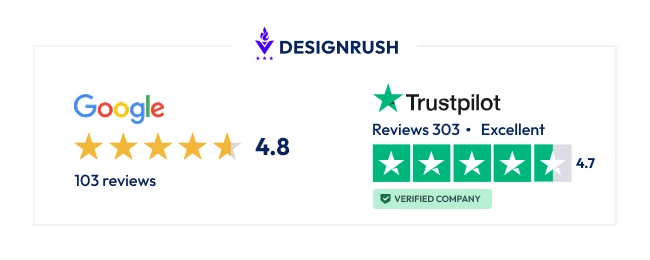
Rated 4.8 on Google and 4.7 on Trustpilot, DesignRush Agency Directory is a reliable resource for finding top React.js developers. We owe this to our executive selection team, which follows a strict screening process when featuring agencies on the platform, assessing key performance indicators, like portfolio, client reviews, and industry reputation.
Learn more about DesignRush Agency Ranking Methodology.
Sources
DesignRush sustains a directory of over 40,000 agencies categorized by service category, location, expertise, and reviews. We build our database in two ways:
- Our dedicated team of agency experts actively searches the web for top-performing companies. We then pull information from their websites, online presence, and client testimonials to verify their status and qualifications prior to listing.
- The agencies listed get notified of their profiles on the website and they can choose to claim it or not, which suggests their availability for more collaborations.
Agencies can also reach out to DesignRush and must go through the verification process prior to being listed.
Frequently Asked Questions About React.js Developers
What are the typical React.js development services?
React.js development companies provide end-to-end services that span the entire software development lifecycle, from strategy and design to development and launch. Core services include:
- React.js consulting: Guiding businesses on building and optimizing their React applications through component selection, architecture design, and roadmap development.
- Custom React.js development: Engineering applications tailored to a business's specific needs, goals, and existing IT infrastructure, and typically include web design and web development.
- UI/UX design: Delivering intuitive interfaces, clear user flows, and standardized design systems that align with a brand and its target users.
- API integration: Connecting the React frontend to back-end systems, third-party tools, and external data sources to support seamless functionality and user experiences.
- Platform migration: Rebuilding or migrating legacy frontends to React to improve maintainability, usability, and performance, often with minimal disruption.
- Maintenance and support: Providing post-launch monitoring, debugging, performance optimization, and technical support.
Many React.js developers also offer specialized expertise, including SaaS products, web application development, customer portals, eCommerce solutions, and minimum viable products (MVPs).
Some React.js development companies may also offer digital marketing services, such as content marketing, search engine optimization (SEO), and branding.
What is the difference between React and React Native?
The main difference is that React is used to build web user interfaces, while React Native is for developing mobile applications. Here are more details on their differences:
| React | React Native | |
| Primary platforms | Websites, web applications, and single-page applications | iOS and Android mobile apps |
| Tech base | JavaScript/TypeScript with React for web UI | JavaScript/TypeScript with React, rendered through native UI components |
| Best for | Businesses building browser-based products, customer portals, dashboards, eCommerce sites, and SEO-focused web experiences | Businesses building cross-platform mobile apps for both iOS and Android with shared logic and accelerated development time |
| Examples | Facebook, Instagram, Netflix web | Microsoft Teams and Shopify |
What are the typical React developer tools?
React.js developers typically choose their stack based on a client's product goals, technical requirements, and existing systems. For example, they may use Formik for complex forms and validation, Storybook for developing and testing components in isolation, and MUI for production-ready UI components and design systems.
Common React developer tools:
- Core front-end: React, JavaScript, TypeScript, HTML, CSS
- State and data fetching: Redux, TanStack Query
- UI and styling: Tailwind CSS, MUI, Storybook
- Testing: Jest, React Testing Library, Cypress
- Back-end options: Express, Laravel, Rails, ASP.NET
- Databases and infrastructure: PostgreSQL, SQL Server, Redis
Can React.js developers build AI-powered features into web applications?
Yes. A React.js developer can build AI-powered features into a web application by integrating model APIs, SDKs, and AI workflows into the product experience.
Depending on your goals, this may include providers such as Google Gemini or Anthropic Claude, along with React developer tools, like Vercel's AI SDK for building chat, search, recommendation, and automation experiences in React-based apps.
These companies can help you build features such as:
- Personalized content and recommendations based on user behavior
- Chatbots and virtual assistants for real-time customer support
- Smart search with autocomplete, semantic search, and related-result suggestions
- AI-assisted dashboards that generate summaries, reports, forecasts, and insights from business data
When should you hire a React.js development company instead of using an in-house team?
The right choice depends on your project goals, internal capacity, timeline, and need for control. You may want to hire a React.js development company if:
- You have a short-term or time-sensitive project, but your internal team is already at capacity.
- You do not have the specialized expertise required for the project, such as React architecture, performance optimization, migration, or AI feature integration.
- You need to accelerate delivery without hiring and onboarding a full internal team.
- You want access to a broader range of skills, such as design, front-end engineering, QA, and post-launch support, through a single external partner.
- You need temporary support to fill skill gaps or expand delivery capacity.
Use an in-house team when:
- The application is a core business product that requires long-term ownership and deep institutional knowledge.
- The project involves highly sensitive systems, proprietary logic, or strict security and compliance requirements.
- You need close day-to-day collaboration, faster internal feedback loops, and direct control over priorities.
- The product requires continuous iteration and alignment with multiple internal teams over time.
Latest Trends Related to React.JS
-preview.jpg)