Finding a web design company in California that delivers a high-performing site and measurable business impact takes more than a quick search. Browse our vetted web designers in California. Use the filters below to narrow your search by budget, team size, and capabilities.
Your Truth, Beautifully Designed.
We create designs that capture the truth of your brand so you make stronger connections with your customers. Our passion is to dive joyfully into your passion & create a unique authentic meaningful visual expression to attract your ideal audience. [... view UZIMEDIA profile ]Top Services:
- Web Design
- WordPress Website Design
- Branding
- Location
- Berkeley, California
- Number of Employees
- Under 49
- Average Hourly Rate
- $100/hr
- Minimal Budget
- $1,000 - $10,000
- Portfolios Count
- 1 Project Listed

Related Services in California
Web Design Specializations in California
Web Design Companies in California
- Anaheim
- Antioch
- Beverly Hills
- California City
- Carlsbad
- Chula Vista
- El Segundo
- Encinitas
- Folsom
- Fremont
- Fresno
- Fullerton
- Glendale
- Huntington Beach
- Irvine
- Laguna Beach
- Long Beach
- Los Angeles
- Mountain View
- Newport Beach
- Oakland
- Orange County
- Oxnard
- Palo Alto
- Pasadena
- Pleasanton
- Riverside
- Roseville
- Sacramento
- Salinas
- San Diego
- San Francisco
- San Jose
- Santa Barbara
- Santa Clara
- Santa Clarita
- Santa Monica
- Santa Rosa
- Sausalito
- Sunnyvale
- Temecula
- Torrance
- Vista
- Walnut
- Walnut Creek
- West Hollywood
How to Hire Web Designers in California
How do I know if I'm ready to hire a California web design agency?
You're ready to hire a California web design agency when you can answer three questions clearly:
- What does the site need to do?
- Who is it for?
- What does success look like after launch?
Without those answers, you're not ready to brief an agency. You need to do discovery work first. Most failed projects start with a client who hasn't defined the problem yet.
California's tech economy contributes approximately $620 billion to the U.S. economy, which means web design companies in California work with high expectations and fast-moving clients. Agencies here are used to moving quickly, and they will, even if your brief isn't solid. That speed works against you if you haven't done the groundwork.
Before reaching out to any California web design firm, work through these:
- Goals
Is this a redesign to improve conversions, a new build, a rebrand, or a performance fix? Be specific. “We want a better website” isn't a brief. - Audience
Who uses the site, on what device, and what do they need to do there? If you don't know, commission a short UX audit before briefing designers. - Budget range
You don't need an exact number, but you need a realistic range. Agencies typically charge between $1,000 and $6,000 for web design, while redesigning a large site with more than 150 pages can reach $36,000 to $75,000. Knowing which bracket you're in filters out the wrong agencies immediately. - Timeline
Is there a hard deadline (product launch, campaign, event) or is this flexible? Hard deadlines change how agencies scope and price the work. - Content
Do you have copy, photography, and brand assets ready, or does the agency need to source or create these? Missing content is the most common cause of project delays.
If you can answer all of the above, you're ready. If you're missing two or more, spend another two to three weeks on internal alignment before contacting web design firms in California.
The agencies worth working with will ask these questions anyway. Showing up with the answers puts you in a stronger negotiating position and shortens the project timeline.
How do I shortlist the best web design companies in California?
Shortlisting web design firms in California comes down to filtering fast on four criteria: industry fit, process transparency, measurable results, and communication style, before you spend time on calls or proposals.
With thousands of web and digital interface designers working in California alone, the pool is deep enough that you should never settle for an agency that doesn't check all four.
Start by narrowing down the category fit. A California web design firm that has built five SaaS onboarding flows understands conversion in a way a generalist agency doesn't, even if the generalist has a stronger portfolio overall. Look for case studies in your industry, not just your aesthetics.
Once you have a longlist of six to eight agencies, apply these filters to get to three:
- Portfolio outcomes
- Does the case study mention what changed after launch? Traffic, bounce rate, conversion, and load time. If the answer is only “the client loved it,” move on.
- Process documentation
- Can they send you a one-page overview of how they run a project? Agencies with a defined process have one ready. Those without one will improvise yours.
- Proposal quality
- Send a brief and see what comes back. A generic deck means they didn't read it. A proposal with specific questions means they did.
- Reference accessibility
- Can they connect you with a past client in a similar category? Not a testimonial, an actual conversation.
One thing worth doing before any agency call: run their own website through Google PageSpeed Insights. Web design firms in California that don't maintain their own site's performance are unlikely to prioritize yours. It takes thirty seconds and tells you something a portfolio never will.
Get to three agencies, send the same brief to all three, and compare how they respond; not just what they propose, but how fast, how specific, and what they ask. That process alone will tell you more than hours of research.
What should a good case study from a California web designer show?
A strong case study from a California web designer shows the problem that existed before the engagement, the specific decisions made to solve it, and what changed after launch - all in numbers. If any of those three elements is missing, the case study is a portfolio piece, not evidence of competence.
Most web design companies in California present case studies as visual showcases: before and after screenshots, a client quote, maybe a list of deliverables. That's not enough to evaluate whether an agency can solve your problem. What you're actually trying to learn from a case study is whether their thinking process aligns with your situation.
When reviewing case studies, look for:
- A defined problem
A vague brief, “the client needed a new website,” tells you nothing. “Checkout abandonment was at 74% on mobile” tells you everything you need to know about what the project was trying to fix. - Decisions with rationale
Why did they make the structural or visual choices they made? Agencies that can explain their reasoning are easier to work with and less likely to go in circles during revisions. - Metrics before and after
Look at load time, conversion rate, bounce rate, and organic traffic to understand which numbers matter in UX-driven projects. - Timeline honesty
Did the project run on schedule? If it didn't, does the case study acknowledge why? Agencies that only show clean wins are hiding something. - A client you can contact
Not a logo, not a testimonial. An actual person at the company who was involved in the project.
One more thing worth checking: how old are the case studies? Web design has changed significantly in the past three years; mobile-first performance standards, Core Web Vitals, and AI-assisted workflows are now baseline expectations.
A California web design firm whose most recent case study is from 2021 may not be keeping pace with how the industry builds today.
How do I evaluate web designers in California if I don't have a technical background?
You don't need a technical background to evaluate web designers in California, but you do need the right questions. Most of what separates a strong agency from a weak one is visible in how they communicate, how they handle uncertainty, and whether they can explain their decisions in plain language. If they can't explain it to you clearly, they probably haven't thought it through clearly either.
Ask these 15 questions in any agency conversation or proposal review:
- Who will work on my project?
- Can I meet them before signing?
- Why are you recommending this platform (Webflow, Shopify, or custom) for my specific situation?
- What does your discovery process look like, and what do you deliver at the end of it?
- How do you handle scope changes? What triggers a change order?
- What does your revision process look like, and how many rounds are included?
- Can you walk me through a project that didn't go as planned?
- What does a handoff look like? Will I be able to manage the site myself after launch?
- Who owns the design files and code when the project is complete?
- What happens if the site has bugs or issues in the first 30 days after launch?
- How do you measure whether the project was successful?
- What information or assets do you need from me, and when?
- What's the most common reason your projects run over the timeline or budget?
- Can you connect me with a past client in a similar industry for a short call?
- What would you do differently on this project if budget weren't a constraint?
The last question is particularly useful. It reveals how an agency actually thinks about your problem versus how they've scoped it to fit your budget. Web designers in California who thoughtfully answer that question have already considered your project beyond the brief. Those who struggle with it probably haven't.
Web design companies in California operate in one of the most competitive design markets in the world, and the best ones are used to working with non-technical decision-makers. If an agency makes you feel like an obstacle rather than a client, that's the answer you need.
When is it time to switch agencies vs give them more time?
Switch when the problem is structural: missed milestones with no credible recovery plan, communication that requires you to chase, or deliverables that don't match what was scoped. Give more time when the problem is a single incident, a difficult phase, or something that a direct conversation could resolve.
The distinction matters because switching mid-project is costly and disruptive, but staying with the wrong agency costs more.
The clearest signal that something is structural rather than temporary is a pattern. One missed deadline with a clear explanation is a project problem. Three missed deadlines with shifting reasons are an agency problem.
The same applies to quality: a round of revisions that misses the brief once is normal. Revisions that repeatedly miss it suggest the agency either didn't understand the scope or isn't prioritizing your project.
Switch immediately and don't give more time if any of the following are true:
- You don't own your domain, hosting, or design files, and the agency is unresponsive about transferring access
- The project timeline has slipped more than 25%, with no written recovery plan from the agency
- The person who sold you the project is no longer involved, and their replacement clearly doesn't know your brief
- You've raised the same concern more than twice, and nothing has changed
- The agency is billing for work outside the original scope without a signed change order
Before switching documents, everything. Send a written summary of the issues, the agreed scope, and what you need resolved, and give a specific deadline for a response. This protects you contractually and sometimes prompts a genuine course of correction. If it doesn't, you have the paper trail you need to exit cleanly.
When you switch, secure your assets first: domain credentials, hosting access, all design files, and code repositories. Web design firms in California that have handled transitions before will be familiar with this checklist; if your new agency doesn't walk you through it, that's worth noting.
Why People Trust DesignRush
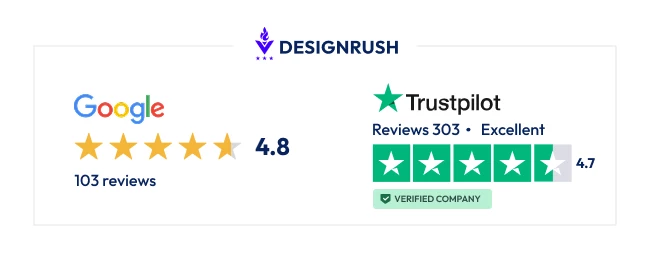
Rated 4.8 on Google and 4.7 on Trustpilot, DesignRush Agency Directory is a reliable resource for finding web design companies in California. We owe this to our executive selection team, which follows a strict screening process when featuring agencies on the platform, assessing key performance indicators, like portfolio, client reviews, and industry reputation.
Learn more about DesignRush Agency Ranking Methodology.
Sources
DesignRush sustains a directory of over 30,000 agencies categorized by service category, location, expertise, and reviews. We build our database in two ways:
- Our dedicated team of agency experts actively searches the web for top-performing companies. We then pull information from their websites, online presence, and client testimonials to verify their status and qualifications prior to listing.
- The agencies listed get notified of their profiles on the website and they can choose to claim it or not, which suggests their availability for more collaborations.
Agencies can also reach out to DesignRush and must go through the verification process prior to being listed.
Frequently Asked Questions About Web Design Companies in California
What red flags should I watch for when evaluating web design firms in California?
The most common red flags when evaluating web design firms in California are vague contracts, portfolios with no performance data, and agencies that can't explain their process before you sign. If something feels unclear in the sales stage, it won't get clearer once the project starts.
Pay attention to:
- Portfolios with no measurable outcomes, only visuals, no conversion or performance data
- Vague contracts without milestones, revision limits, or a defined handoff process
- No post-launch support plan, or support billed at surprise hourly rates
- Designs that look templated across clients, same layout, different logo
- Pressure to sign before receiving a detailed proposal
What do California web design agencies charge that most buyers don't expect?
Most California web design agencies quote a project price that doesn't include content migration, platform licensing, or post-launch support — costs that can add thousands to the final invoice. Always ask for a line-item breakdown before signing.
- Content migration: Moving existing pages, copy, and SEO data is rarely included by default
- CMS licensing: Platforms like Webflow or Shopify carry ongoing subscription fees
- Hosting and domain management: Often invoiced separately after launch
- Extra revision rounds: Anything beyond the contracted limit is typically billed hourly
- Post-launch fixes: Many web design companies in California treat these as a separate retainer
How do I know if a California web design firm has real eCommerce or SaaS experience?
Ask for evidence, not examples. A California web design firm with genuine eCommerce or SaaS experience can show you conversion rate improvements, platform-specific expertise (Shopify, Magento, custom builds), and decisions they made about checkout UX or onboarding flows, not just what the site looks like.
If their case studies only show visual redesigns with no business metrics attached, their experience is likely surface-level. Ask for a reference you can actually call.
When does it make sense to hire a local California web design agency?
When proximity adds real value to the work. That means in-person discovery sessions, brand shoots, or ongoing collaboration that benefits from being in the same room.
It also makes sense if you're in a regulated industry, like healthcare, legal, or finance, where a California web design agency familiar with state compliance standards reduces your risk.
For fully remote projects with a clear brief and defined deliverables, geography matters far less than process and expertise.
What does a bad web design engagement look like, and how do I avoid it?
Most failed projects fail because of misaligned expectations that nobody caught early. The pattern is usually the same: no staged delivery, no named point of contact, and scope changes handled informally until costs spiral.
- Require milestone-based delivery so you're reviewing work in stages, not at the end
- Get a named project lead in writing before work starts
- Make sure the contract defines what triggers a change order
Should I start with a pilot project or commit to a full engagement upfront?
A pilot makes sense when you haven't worked with the agency before, and the full scope is large or high stakes. A smaller paid task, such as a landing page, a design audit, or a single feature, tells you how they communicate, how they handle feedback, and whether their process matches what they promised in the proposal.
That said, not every California web design firm offers pilots, and some projects don't lend themselves to it. If the agency has strong references from similar projects and a contract with clear milestones and exit clauses, committing upfront is a reasonable call.
How do I compare two web designers in California who look equally qualified on paper?
Send both a detailed brief and watch how they respond: what they ask, what they miss, how long it takes. That tells you more than their portfolio.
Then ask each one how they handle scope changes mid-project. Vague answers here become expensive problems later.
The designers who ask better questions during the proposal stage almost always run better projects.
What should I expect week by week in the first 60 days after hiring?
A well-structured engagement with web design companies in California follows a clear arc: discovery first, structure second, visuals third. Agencies that skip straight to design generate the most expensive revision cycles.
| Timeline | Phase | What Happens |
| Week 1-2 | Discovery and kickoff | Goals defined, audience clarified, technical requirements mapped, content audited |
| Week 3-4 | Wireframes and site architecture | Page structure and user flows created and approved before design starts |
| Week 5-6 | Visual design | High-fidelity mockups of key pages delivered, first feedback round collected |
| Week 7-8 | Design refinement and handoff | Final designs approved, assets prepared, development phase begins |
About The Author and Expert Reviewer

Robert de Wit has a diverse background in advertising, marketing, IT, and healthcare. With a history as both a copywriter and a video game journalist, he specializes in SEO, long-form content creation, and crafting compelling copy that drives results. Currently, he writes about website and interface design at DesignRush, delivering the latest industry insights and analysis.

Sergio is a technology leader with over six years of experience managing global teams and delivering projects across fintech, sportstech, and B2B platforms. At DesignRush, he drove product growth and development execution, building tools that speed up processes by 95% and cut costs by 35% while maintaining full uptime.
Latest Trends Related to Web Design