
Blend&Frame Creative Studio built The Custom Chef – Trade Show Director's Cut as a study in restraint. Instead of documenting the literal forging process, the film uses material transformation and measured pacing to express craftsmanship. Every frame reinforces the same idea: when you're selling precision, the film itself has to be precise.
Industry Insight: Video now anchors modern marketing, with 91% of businesses using it in 2025, making high-impact booth visuals essential for trade show ROI.
The Custom Chef Video Design: Key Findings
Material Abstraction Replaces Literal Process
The Custom Chef - Trade Show Director's Cut opens with a stone-like mass that gradually refines into polished metal.
By sidestepping literal forging sequences, Blend&Frame avoids the problem of showing what can't be shown effectively in abstract form.
Real knife-making involves heat, hammering, grinding which are processes that require context to read clearly. Instead, the film uses material change as shorthand for transformation through skill.
Stone is shown as raw, unrefined, heavy. Metal is presented as finished, precise, light. The transition between these states becomes the story.
You don't need to see a forge to understand that something crude became something refined through deliberate effort.
This approach works particularly well for trade show environments where audio may be inconsistent and viewers might join mid-loop. The visual language stays legible without sound or exposition.
Motion Control Reflects Manufacturing Precision
Particle simulations move with restraint. Dust doesn't explode. Fragments don't scatter chaotically. Droplets fall with intention.
This measured pacing mirrors the patience required in precision knife-making. When motion feels controlled, it signals control in the product.
Fast, aggressive animation would suggest industrial mass production. Slow, deliberate movement suggests hand-crafted attention.
The choice to avoid dramatic particle effects also keeps the film from feeling overworked. In premium categories, restraint often reads as confidence.
The brand doesn't need excessive bells and whistles because the work speaks for itself.
"This was a beautiful piece that held my attention from start to finish. The slow motion shots combined with the immersive sound design sucked me in and piqued my interest. In the end, I wanted to know more about the product without the ad overselling it."
— Marc Strong, DesignRush Awards Jury
Line, Flow & Rhythm Create Visual Structure
Thin metallic lines and flowing paths introduce lightness into compositions dominated by stone and steel.
These lines function as visual guides, leading the eye through the frame without forcing movement.
The contrast between heavy materials and light linework creates breathing room. Everything feels deliberate. Nothing feels accidental.
This rhythm supports the film's role as looping trade show content. Strong compositional structure allows viewers to enter at any point and understand the visual language immediately.
The film doesn't require a beginning, middle, or end to communicate value.
Product Reveal Through Radial Repetition
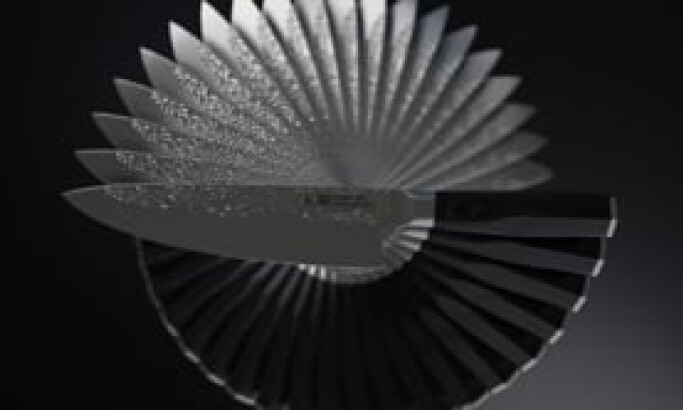
The knife appears through radial repetition rather than hero framing. Multiple blades arranged in a circular pattern shift focus from "look at this product" to "look at this object."
Texture, silhouette, and hammered metal surface take precedence. The blade transforms into something sculptural.
By avoiding traditional product photography conventions, the film reinforces the brand's positioning: these are kitchen tools but they're also precision instruments made by craftspeople who care about detail.
As video marketing delivers strong ROI across metrics—with 83% of video marketers reporting direct sales increases and 93% saying video helps increase brand awareness—The Custom Chef's restrained approach demonstrates how craft-focused brands can use video to signal quality without overselling.
See the latest video marketing statistics shaping how brands capture attention, convert, and scale.
What Brands and Agencies Can Learn from The Custom Chef
1. Use Abstraction to Show Craftsmanship
Material-led metaphors can express skill and precision with more impact than literal process shots, especially in premium categories.
Showing transformation rather than documentation lets viewers focus on outcome quality rather than manufacturing mechanics.
2. Let Restraint Do the Signaling
Measured motion, limited color, and controlled pacing often read as confidence. In premium categories, restraint helps brand films feel refined rather than overworked.
When every element shows discipline, the overall effect is elevated.
3. Design for How the Film Will Be Watched
For trade shows and installations, repeatable visuals with strong rhythm can hold attention without relying on dialogue or plot.
The film needs to work as a loop, be legible with inconsistent audio, and communicate value to viewers who join mid-sequence.
Strong compositional structure and clear visual metaphors solve all three problems.
About DesignRush Featured Designs
At DesignRush, we review hundreds of digital projects each month across video design, branding, and visual storytelling. Featured works are selected for clarity, creativity, and strong alignment with brand goals.
Only the most distinctive submissions progress to our Monthly Design Awards, which highlight global excellence in design.
See more creative projects across categories:
- Best Video Designs
- Best Website Designs
- Best App Designs
- Best Logo Designs
- Best Print Designs
- Best Packaging Designs
For a full list of top creative agencies and digital partners, visit our Agency Directory.