

I’ve generated and tested multiple AI prompts specific to affiliate marketing to discover what worked. I’m also sharing tips and tricks on further refining your results. Here’s how you can use AI in your strategies:
ChatGPT Prompts for Affiliate Marketing: Key Points
- Given the right context and prompts, AI can help discover opportunities and foster customer relationships through customer service scripts, competitor analysis, market research, and listing affiliate programs.
- AI can streamline tasks and accelerate research, content production, ad creation, and outreach processes.
- AI enhances decision-making and compliance by conducting data analytics and reviewing your content.
10 Ways You Can Use AI in Your Affiliate Marketing
AI is rapidly changing affiliate marketing, and you risk falling behind if you’re not using it. However, getting good results depends on using the right prompts, which can be hit or miss. I’ve tested dozens of affiliate marketing prompts and picked the ones that work. This list will help your brand get better results faster.
Related Articles:
1. Bullet-Proof Affiliate Marketing Strategies
2. Top 5 AI Affiliate Marketing Tools
3. Strategic Guide to Gen AI
1. Prepare ChatGPT with Contextual Information
While ChatGPT can browse the internet and learn about any topic within a split second, it isn’t familiar with your business. Before asking it to do anything, I suggest providing a brief overview of your brand, product, target audiences, and current platforms. You can also provide details about your current struggles and overall business goals. That way, its answers will be more specific to your niche and goals.
Example prompts:
- “I am a [what you do], publishing on [your online platforms, such as website, podcast, and LinkedIn]. I want to [state your business goals]. Can you help me build an affiliate program for my business?”
- “I am a [your focus], and I'm targeting [audience type, e.g., US-based SaaS companies]. I want to build an affiliate program for my business, but I don’t know where to start.”
- “I [what you do, e.g., write book reviews for fantasy literature] and my audience are mainly [audience type]. I’m looking for ways to improve my affiliate marketing model. Based on this information, please answer my questions below.”
Bonus tip: Explore more tips and tricks on how to start your affiliate marketing program in our recent blog.
2. Research Your Niche Market
An affiliate marketer’s success lies in understanding their audience’s pain points, behaviors, and preferences. Using this information, you can create more targeted strategies that increase online traffic, conversion rates, and revenue.
ChatGPT excels at conducting comprehensive research, helping you learn more about your target audiences, uncover niche markets, and stay updated with the latest trends. I find it especially useful for affiliates who are just starting and don’t have first-party audience data.
Example prompts:
- “List profitable sub-niches within [broad category] and suggest examples of products to promote.”
- “Suggest ten high-value niches about [broad category]”
- “What are trending affiliate niches in [year] with low competition and high earning potential?”
- “Identify and analyze emerging trends in the [broad category] niche.”
- “Give me a breakdown of the target audience for [niche/product], including demographics, pain points, and top platforms they use.”
Bonus tip: Paid users can turn on ChatGPT’s deep research tool for a more comprehensive output.
3. Analyze the Competition
ChatGPT can provide insights into your competitors’ marketing campaigns, identifying what has worked in your niche and market gaps you can capitalize on. It can also help define your unique selling proposition to differentiate your brand in a highly saturated market.
Example prompts:
- “Please identify leading competitors in the [broad category] niche and develop an in-depth analysis of their promotional strategies, strengths and weaknesses, and campaigns.”
- “Can you analyze 3 successful affiliate programs in the [your industry] space and break down what they’re doing right (commissions, messaging, platforms, etc.)?”
- “What are the pricing strategies and product offerings of my top 5 competitors in [niche]?”
- “What are the different ways I can differentiate my brand from my top 5 competitors in the [niche].”
4. Find Affiliate Programs in Your Niche
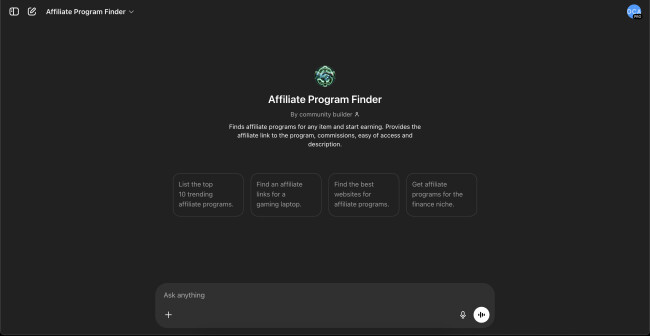
Use ChatGPT’s powerful search function to scan the internet and find top programs for your niche. You can also ask it to list details like commission, primary focus, ease of access, and links to partner programs and present it in a table or Excel sheet format. It saved me hours of manual research and will help you, too.
Example prompts:
- “List the best affiliate programs for [niche/product type] that are high-paying and have a high volume of customers.”
- “What’s the easiest affiliate program to enter for a beginner like me in the [niche/product type].”
- “Compare Amazon Associates vs. Shopify Affiliate vs. Impact for [niche] offers.”
- “What are some affiliate programs for [specify product, e.g., organic peanut butter].”
- “Suggest recurring commission affiliate programs for [specific niche or product].”
Bonus tip: Use a pre-built ChatGPT affiliate program finder to quicken your search.
5. Automate and Personalize Outreach Strategy
Outreach is key to building strong business partnerships, but it can quickly become time-consuming and divert you from what matters most — nurturing real community relationships.
Therefore, I recommend using ChatGPT to reduce the manual workload and help you create more personalized messages.
Example prompts:
- “Suggest three unique angles I can use to pitch myself to [target partners] as an affiliate partner, based on the fact that I run [insert platform].”
- “Give me a template for tracking affiliate outreach in a spreadsheet. Include columns like brand name, contact email, outreach date, response, notes, and status.”
- “Write a short, professional follow-up email for an affiliate partnership pitch sent one week ago. Keep it friendly and reaffirm the benefits for the brand.”
- “Write a cold DM pitch I can send on [Instagram] to a DTC [target partner] asking if they have an affiliate program. My tone should be casual but credible.”
- “Write a warm and persuasive outreach email to a [target partner] proposing an affiliate partnership. I run a [platforms] focused on [niche] and want to include them in an upcoming roundup.”
- “Generate a table of affiliate programs in the [niche] with details: company name, commission rate, cookie duration, affiliate platform, and best products to promote.”
[Source: ChatGPT]
6. Develop Engaging Content
ChatGPT’s generative AI model accelerates my writing process and helps me overcome creative blocks. It can also help find ways to monetize content. I even used it to implement search engine optimization (SEO) best practices.
I've found that the most effective way to get high-quality content from ChatGPT is by including these instructions along with my prompts:
- Be as concise and specific as possible to the topic
- Write like an 11th grader (if you’re writing for a more general audience) or from the point of view of a marketing professional
- Specify your brand’s writing style and target audience
- Keep the text to 160 characters (for meta descriptions), 1,500 words (for entire articles, etc.
- Provide examples of previously written articles and ask it to copy the style and tone
Example prompts for content strategy:
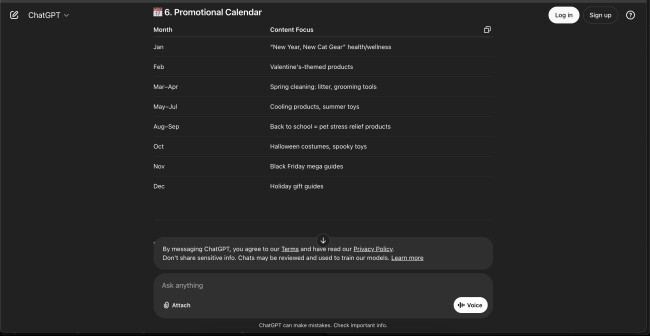
- “Create a promotional calendar for my [brand] targeting the [niche]. The calendar must contain globally celebrated holidays.”
- “Generate a list of content ideas about [product].”
- “Recommend ten compelling and engaging titles for a blog post about [product].”
- “Suggest social media content for the [insert your platforms] based on the latest trends.”
Example prompts for SEO:
- “Suggest keywords for the product description and title of [product] to improve its search engine ranking.”
- “Create a comprehensive on-page SEO strategy for my affiliate marketing website.”
- "Suggest long-tail keywords and semantically relevant phrases for my content to improve search engine rankings: [copy-paste content].”
Example prompts for blogs and articles:
- “Write a product comparison blog post for [Product A] vs. [Product B], with pros, cons, and affiliate links. Make sure to highlight their core features and provide different points for each.”
- “Write a product review post for [product], including benefits, how it works, and a CTA. Be as specific as possible to the product and make sure it targets [audience] and speaks to their pain points.”
- “Suggest a structure for a [topics] affiliate blog post optimized for SEO and conversions. Include where to insert affiliate links and how to make brand placement feel natural.”
- “Suggest ways I can naturally insert affiliate links in this article: [copy-paste your article].”
- “Analyze this copy: [insert text] — and suggest how to make it more persuasive for conversions.”
Example prompts for email marketing:
- “Develop catchy and appealing email messages for [affiliate product], underscoring its unique features and unparalleled benefits.”
- “Generate an email sequence for new [affiliate product] users.”
- “Write a compelling follow-up email for recipients who showed interest in [affiliate product].”
- “Create a 5-part email sequence to promote [affiliate product] to active subscribers.”
- “Write a re-engagement email for inactive subscribers with an affiliate offer.”
- “Suggest ten strategies for improving email open rates in my digital marketing campaign.”
Example prompts for social media:
- “Please create a convincing Facebook post to encourage users to buy [product].”
- “Write a set of engaging Tweets about the benefits and advantages of using [product].”
- “Generate a persuasive post to inspire Facebook users to share their thoughts and experiences with [product].”
- “Please suggest trending hashtags and catchy captions for an Instagram post about [product].”
- “Create a series of engaging posts for [social media platform], highlighting the features and benefits of [product] to users.”
- “Write 5 Instagram captions to promote [product] with soft-sell CTA.”
- “Generate a Twitter thread explaining the value of [product], ending with your affiliate link.”
7. Create Thumb-Stopping Ads
ChatGPT can help you outline a monetization strategy, write persuasive copy that resonates with your target audiences, and provide an interesting angle to your promotions to stand out from competitors. It can also suggest copy and headline options to assist A/B testing.
Example prompts:
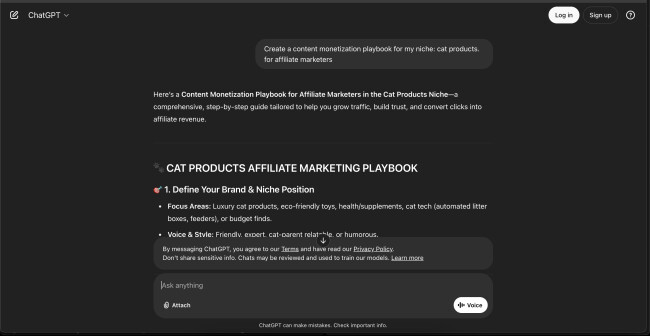
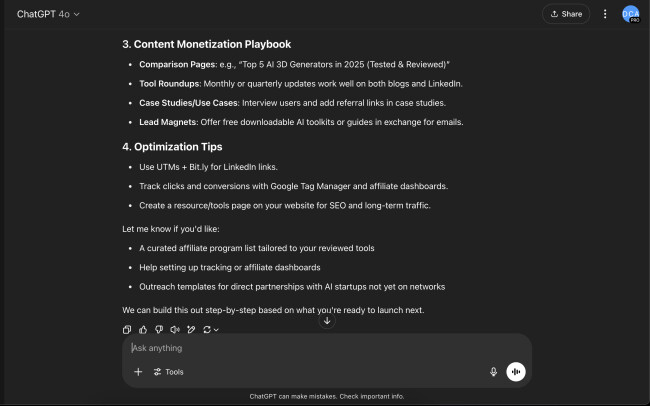
- “Develop a content monetization plan for affiliate marketing for the niche: [market].”
- "Write a thumb-stopping ad copy for the Black Friday sale of my [product], which I want to advertise on [platform]. I’m targeting [specific target audience, such as cat owners living in apartments],”
- “Provide five Facebook ad variations for my content writing class on digital marketing. Make sure each variation is different so I can select the top two and test their performance.”
- "Produce an ad targeting plan for our affiliate product. [Insert details.]”
- “Suggest how to improve my ad targeting strategy to convert my ideal customers better. [Copy-paste your strategy.]”
- “Give me a YouTube video script to review [product] with a strong affiliate CTA.”
- “How can I use TikTok to promote affiliate products and make sure it’s different from my competitors.”
8. Improve Data-Driven Decisions
Leverage ChatGPT’s advanced AI to turn complex data into digestible and actionable insights. You can also use it to identify cross-selling opportunities, craft more personalized and targeted ads, and understand shortcomings in your current strategies.
Example prompts:
- “List ways for boosting user experiences across [product + niche] audience segments.”
- “Enumerate the most plausible explanations for the low page views in my Product X review.”
- “Summarize what customers say about [topic] and provide insight on how it can be improved.”
- “Analyze the purchase history of my customers who recently purchased [product] and suggest items I can cross-sell to them. [Copy-paste your customer data]”
- “What insight can I gain from my customer data? How can I use it to improve my marketing strategies? [Copy-paste data]”
- “What are my customer segments? How can I create more personalized experiences for them based on this data: [copy-paste data].”
- “Help me understand why my content on Instagram isn’t performing as well as last week. Is there a new policy I don’t know about?”
9. Ensure Legal Compliance
Keeping up with industry regulations and platform policies can be challenging when I produce content at scale across multiple platforms. That’s where ChatGPT comes in.
It can review blog posts, social media captions, and YouTube scripts to ensure compliance. It can also assist in drafting legal documents like terms of agreement, privacy policies, and affiliate link disclosures.
Example prompts:
- “Write a clear and compliant affiliate disclosure for a blog post.”
- “How do I make sure my YouTube affiliate links meet FTC guidelines?”
- “What should I include in my website’s affiliate disclosure and privacy policy?”
- “Review my content and optimize it for [platform], following the latest guidelines on affiliate links and promotions.”
10. Elevate Customer Support
ChatGPT can also support your affiliate program by creating chatbot scripts, community support responses, FAQ content, and online community guidelines. It’s especially helpful for crafting thoughtful replies to negative feedback, ensuring your tone stays polite, professional, and empathetic.
Example prompts:
- “Please generate a respectful reply to a customer with a negative experience about [product].”
- “Write a step-by-step guide for troubleshooting issues with [product].”
- “Create a detailed response to a customer asking how to use [product].”
- “Generate a courteous reply to a potential customer making an invalid comparison between [product] and [competitor product].”
- “Write a reply to someone requesting expedited shipping and a discount on [product].”
- “What are the frequently asked questions about [product]? Please write brief and concise answers to each one.”
Ready to scale your affiliate strategy? Book a strategy session today with one of the best affiliate marketing agencies.
Alternatively, visit our Agency Directory for expert guidance in the following categories:
- Top Digital Marketing Agencies
- Top Email Marketing Agencies
- Top SEO Agencies
- Top Advertising Agencies
- Top Affiliate Marketing Companies in Miami
AI Affiliate Marketing FAQs
1. What is AI-powered affiliate marketing?
AI-powered affiliate marketing, or AI affiliate marketing, is when an individual, team, or business uses AI tools and models in any part of their affiliate marketing process. They can also use it for research, content generation and optimization, and data analytics.
2. What are the risks and limitations of using AI for affiliate marketing?
While AI is multifunctional, it often produces overly generic output that is misaligned with your brand or inaccurate. There are also ethical concerns, as it can be misusing private user data. As such, it’s important to review and edit the content to add personal human touches.
3. What additional AI tools can be helpful in affiliate marketing?
Aside from ChatGPT, affiliate marketing companies and affiliates can benefit from AI tools for email marketing, local SEO, and lead generation. Other interesting AI tools include web design, especially for building landing pages, branding, and design.


