Our directory of leading VR companies and AR companies in the USA is built on five main ranking criteria and reviewed by a team of 12 experts, supported by 1,000+ verified client reviews. This gives you a clear and reliable way to choose the best AR companies for your project.
Organic rankings are determined by five factors: top services, reviews, portfolio, awards/press, and team expertise. Sponsored listings pay for a placement that appears above organic positions. Sponsorship does not affect star ratings or review content - read more on our methodology page.
United States × Industrial × Sort by: Avg Hourly Price: High to Low ×Clear Filters
Binary Pulse Studios, a premier video production agency, creates engaging videos that move, motivate, and educate. Its expert team elevates brands through rich, cinematic imagery and polished post-production visuals. Leveraging versatile studio spaces and cutting-edge technologies, Binary Pulse Studios...
Top Services:
Video Production
Video Marketing
Content Marketing
VR/AR
Digital Marketing
Show more
Location
Newport Beach, California
Number of Employees
Under 49
Average Hourly Rate
$199/hr
Binary Pulse Studios Services
Video Production
Video Marketing
Content Marketing
VR/AR
Digital Marketing
WordPress Website Design
Web Development
Web Design
Design Services
Creative Services
Data sourced from the agency's DesignRush profile, its website, and other relevant accounts
Business software with AI inside, built in Houston since 2004.
Espresso Moon is a Houston custom software company that builds AI-enabled business applications, mobile apps, and cloud platforms for B2B clients, and hosts and supports everything it delivers. We also own and operate GageList, a calibration management SaaS with AI built into the product...
Top Services:
AI Development
Software Development
Mobile App Development
Software Testing
UI/UX Design
Show more
Location
Spring, Texas
Number of Employees
Under 49
Average Hourly Rate
$150/hr
Minimal Budget
$25,000 - $50,000
Espresso Moon Services
AI Development
Software Development
Mobile App Development
Software Testing
UI/UX Design
VR/AR
Web Development
WordPress Website Design
Web Design
eCommerce Development
Data sourced from the agency's DesignRush profile, its website, and other relevant accounts
DistributionNOW
Tesla
Nucor Steel
Everest Funeral Concierge
Flexitallic
Solvay Dental
Stream Realty
Wilson Perumal
Neuhaus Academy
SafeFleet
Data sourced from the agency's DesignRush profile
Espresso Moon Reviews & Testimonials
Bradley Collins Review from Google
5.0★
Bradley Collins's Review Sourced from Google
Working with the guys at Espresso Moon (Scott, Doug, Tim and Dwayne) was truly a great collaboration and experience. They didn't just throw a website together for us, they helped us to reinvent ourselves. They go out of their way to get to know you and your business to the fullest extent, and that is a quality that is not often seen. If I were to recommend a web design/hosting company to anyone, Espresso Moon would be the one and only name I give. Thank you for your service and support!
Meredyth Jones Review from Google
5.0★
Meredyth Jones's Review Sourced from Google
I worked primarily with Scott, Tim and Doug to build a fairly complicated site: Paypal/credit card payments, video training modules, a graded quiz, and issuance of a completion certificate. They were the only website company that invited me to an in-person meeting and that was tremendously helpful in me understanding how they work and them understanding my goals. Large Animal Consulting & Education launched 2 days ago and the site is running smoothly. I'm very happy with the site they designed (they also designed my logos) and am looking forward to using them to support and add to the site down the road.
Caleb Schallert Review from Google
5.0★
Caleb Schallert's Review Sourced from Google
Doug Wheeler is the owner of Espresso Moon and he has provided my small business excellent IT technical support for our website. His team helped me out by removing malicious code that was affecting my site right after the Heart Bleed epidemic last year. He got my site back up and running so i could continue business and save my online reputation. I would recommend Espresso Moon LLC to anyone in need of a new website or mobile application because they follow through with what they promise to do, on time and on budget. They are truly a pleasure to work with!
Reviews verified by DesignRush and sourced from the agency's profile View All Reviews
VerifiedVerified by the DesignRush team for authenticity and credibility.
Portland-based digital product studio building web, AI, and interactive experiences.
A Portland based design & development studio creating digital-first solutions across mobile, web, and virtual/ augmented reality...
Top Services:
Web Design
UI/UX Design
VR/AR
Web Development
Mobile App Development
Show more
Location
Portland, Oregon
Number of Employees
Under 49
Average Hourly Rate
$130/hr
Minimal Budget
$1,000 - $10,000
Portfolios Count
12 Projects Listed
SLIDEFACTORY Services
Web Design
UI/UX Design
VR/AR
Web Development
Mobile App Development
Branding
SEO
AEO
AI Development
Data sourced from the agency's DesignRush profile, its website, and other relevant accounts
1
2
3
Data sourced from the agency's DesignRush profile
SLIDEFACTORY Reviews & Testimonials
Ben Lee Review from Google
5.0★
Ben Lee's Review Sourced from Google
My engagement with SLIDEFACTORY has been one of the best working experiences of my career. After launching multiple SaaS products as a product manager, I've worked with a fair number of technical teams ranging across a variety of tech stacks. SLIDEFACTORY has proven to be one of the most competent, agile, and customer obsessed teams I've worked with. After launching my own business and needing a detail oriented tech arm to execute, Mark and Tom were the people I needed to bring my vision to life. I owe them a lot and I look forward to the things we'll accomplish together.
Leisa Raymond Review from Google
5.0★
Leisa Raymond's Review Sourced from Google
I had a fantastic experience working with Mark at The Slide Factory. He was incredibly helpful throughout the entire process, asking thoughtful questions to ensure every detail was just right. His attention to detail and commitment to getting it perfect really stood out. The final product turned out beautifully, and I couldn’t be happier with the results. On top of that, Mark was kind, professional, and a pleasure to work with. Highly recommend his services!
Peter Kirwan Review from Google
5.0★
Peter Kirwan's Review Sourced from Google
The Slide Factory is one of those companies you don't often have the privilege of working with. It's not just that they do high-quality work, listen to the client, meet your deadlines, and bring insights that may not have been on your radar. Those are important, of course. I think I value most that they are nice people to work with. They sincerely want you to succeed, and that can make all the difference. They are part of your team, and to me, that makes all the difference in the long run. They truly are a partner, not a company working for you.
Reviews verified by DesignRush and sourced from the agency's profile View All Reviews
HLP Studios is a creative technology studio helping brands turn products, ideas, and digital needs into high-quality visuals, websites, apps, animations, and custom software solutions...
Top Services:
Digital Services
Creative Services
eCommerce Development
Web Development
Mobile App Development
Show more
Location
St. Petersburg, Florida
Number of Employees
Under 49
Average Hourly Rate
$75/hr
Minimal Budget
$1,000 - $10,000
HLP Studios Services
Digital Services
Creative Services
eCommerce Development
Web Development
Mobile App Development
Software Development
Video Production
Product Design
Branding
VR/AR
Data sourced from the agency's DesignRush profile, its website, and other relevant accounts
Prominence home
Bulbrite
Bison
Versadesk
Data sourced from the agency's DesignRush profile
HLP Studios Reviews & Testimonials
olivier gousset Review from Google
5.0★
olivier gousset's Review Sourced from Google
A huge thank you to Baptiste and the entire HLP Studio team for their professionalism, responsiveness, and the quality of their support. Our collaboration was smooth and efficient, demonstrating a genuine understanding of our needs. We are delighted with this experience and recommend HLP Studio without hesitation.
Gokhan Subasi Review from Google
5.0★
Gokhan Subasi's Review Sourced from Google
I had an excellent time at HLP Studio during an AI training course led by the manager himself. The training was high-quality, very well presented, and held in excellent conditions.Thank you, Baptiste, for the great advice on AI, and thank you for sharing your knowledge and engaging in discussions.I highly recommend this company.
Benjamin REVERBERI Review from Google
5.0★
Benjamin REVERBERI's Review Sourced from Google
AI workshop at HLP Studio last December: fantastic experience! 👍 We learned so much about Artificial Intelligence, all in a great atmosphere—simple, clear, and friendly.Thanks to Baptiste and the whole team for the warm welcome, the sharing of knowledge, and the high quality of the workshop.See you soon for the next one! 🚀
Reviews verified by DesignRush and sourced from the agency's profile View All Reviews
Virtual Verse Studio is an XR product studio building VR, AR, WebGL and metaverse experiences that ship. Since 2021 our 20+ specialists have delivered 50+ immersive projects across banking, museums, healthcare, education and retail from a gamified onboarding world for the National Bank of Kuwait, to an AI...
Top Services:
VR/AR
Mobile App Development
AI Development
Software Development
Show more
Location
Lewes, Delaware
Number of Employees
Under 49
Average Hourly Rate
$50/hr
Minimal Budget
$1,000 - $10,000
Portfolios Count
9 Projects Listed
virtual verse studio Services
VR/AR
Mobile App Development
AI Development
Software Development
Data sourced from the agency's DesignRush profile, its website, and other relevant accounts
We empower businesses / non-profits / communities with powerful technology solutions that shape their future...
Top Services:
Mobile App Development
Software Development
AI Development
eCommerce Development
Blockchain
Show more
Location
Bakersfield, California
Number of Employees
50 - 99
Average Hourly Rate
$50/hr
Minimal Budget
$10,000 - $25,000
Turnkey Digital Media Services
Mobile App Development
Software Development
AI Development
eCommerce Development
Blockchain
IoT
VR/AR
Staff Augmentation
DevOps Consulting
Cloud Consulting
Data sourced from the agency's DesignRush profile, its website, and other relevant accounts
DMG Media
RogerDyson
Outpost
Castro.fm
Arabian Naizak Oil and Gas Company
AGF Employment
Data sourced from the agency's DesignRush profile
Turnkey Digital Media Reviews & Testimonials
James Litchfield Review from Google
5.0★
James Litchfield's Review Sourced from Google
I have worked with TurnKey Digital for two years on projects in my role at Valley Hi Nursing Home in Woodstock, IL. Rob and his team are very professional, prompt, and creative in the way they approach marketing, logo development, digital mapping, and beyond. Rob has helped Valley Hi take its marketing efforts in newer and higher levels, thanks to their field knowledge and customer support. Thanks, Rob & Team!
ReVive Elite Care Review from Google
5.0★
ReVive Elite Care's Review Sourced from Google
We began working with TurnKey Digital in October, and our website officially launched in April. During our initial search, we spoke directly with the owner, who was knowledgeable and made us feel confident moving forward.Their team was responsive, professional, and highly collaborative throughout the process. As detail-oriented partners, we appreciated their patience and willingness to refine everything until it was exactly right.They delivered a beautiful logo and a cohesive website that truly reflects our brand. We’re extremely happy with the result and would highly recommend Turnkey Digital.
John Tanenbaum Review from Google
5.0★
John Tanenbaum's Review Sourced from Google
My experience began in the planning stages back in the early spring of 2025 and every two weeks during the first 2 months we were in contact as the project took shape to develop the website. As the project progressed, we were having either weekly meetings or emails which accelerated the process. The last 6 weeks we were in constant contact, and the final end product was better than what we originally had hoped for our website. I can highly recommend Turnkey Digital to plan and execute your projects too. I am sure we will be utilizing their services in the future. John M. Tanenbaum, Castle Bay Management Services, LLC.
Reviews verified by DesignRush and sourced from the agency's profile View All Reviews
Frequently Asked Questions About VR & AR Companies
What services do these companies typically provide?
Virtual reality (VR) and augmented reality (AR) companies in the US provide end-to-end development to deliver custom, reliable, and user-friendly solutions. Their core services include:
Strategy and consultation: Guiding businesses on planning, building, and optimizing their AR/VR technology to maximize return on investment (ROI).
UI/UX (user interface and user experience) design: Creating seamless, intuitive, and context-aware user interactions in spatial environments.
AR development: Building experiences that overlay and anchor digital content onto a physical environment in real time, often using spatial tracking and mapping.
VR development: Developing simulated 3D environments that users can interact with. It can include spatial audio and haptic feedback for a more realistic experience.
Mixed reality development: Engineering spatially aware experiences where digital objects are anchored to and can interact with the real environment.
Computer vision and spatial computing: Using computer vision and artificial intelligence (AI) to enable accurate tracking, context awareness, and real-world interaction.
How much do these companies usually charge in the USA?
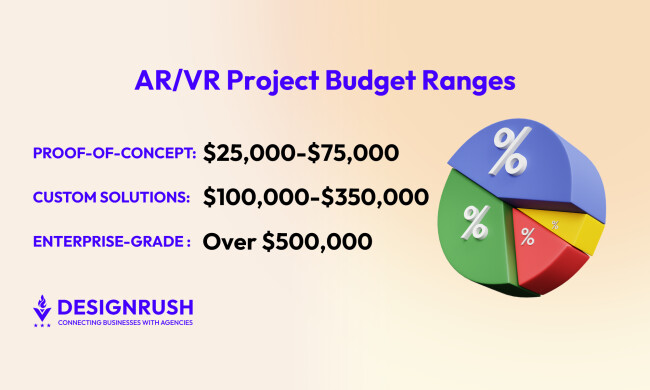
AR and VR companies in the USA charge between $25,000 for the simplest solutions to over $500,000 for enterprise-grade products, with hourly rates starting at $100-$250.
Total cost varies based on project complexity, platform requirements, and the level of customization involved.
Below is a general breakdown of typical project types and their associated cost ranges:
Project type
Typical cost range
Description
Simple AR experiences
$25,000-$60,000
WebAR campaigns or marker-based mobile AR applications with limited interactivity and standard assets.
Entry-level VR experiences
$60,000-$120,000
Basic VR simulations, commonly used for training or demonstrations, with predefined environments and interactions.
Mid-complexity AR/VR projects
$150,000-$350,000
Custom 3D assets, real-time interactions, backend integrations, and tailored user experiences.
Enterprise-grade AR & VR Platforms
$500,000+
Large-scale deployments with multi-user functionality, analytics, system integrations, and advanced security; costs can reach seven figures.
What are the maintenance costs of VR and AR solutions?
Industry benchmarks indicate that annual maintenance costs typically range from 15% to 20% of the initial development cost.
This typically covers bug fixes, engine updates, content enhancements, performance optimization, security patches, and compatibility work for new operating systems and platforms.
However, major upgrades can increase AR/VR maintenance spending to 20%-30% of the initial costs. Examples of these cases include adding a new device, engine migration, and architectural refactoring.
Additionally, complex AR/VR solutions, like multiplayer online role-playing games (MMORPG), can incur a 20%-30% maintenance fee tied to hosting, server operations, and more rigorous regression testing.
Ongoing support helps ensure long-term stability, performance, and adoption, particularly for enterprise-level VR and AR applications.
How long does it take to build a custom VR or AR experience?
Building a custom experience can take weeks to years, depending on its complexity.
Simple breakdown:
Simple prototype: 1 to 2 months. Basic demo or proof of concept.
Basic app or training experience: 3 to 6 months. Limited features, clear goal.
Moderate app or simulation: 6 to 12 months. Custom environments, more interaction.
What industries do VR and AR companies usually work with?
They work across a wide range of industries, with the strongest adoption in sectors where immersive technology improves training, visualization, and decision-making.
Video gaming (27%): Video gaming integrates AR/VR to create more immersive and interactive gameplay that increases user adoption and retention.
Workforce development and training (21%): AR/VR provides hands-on experience in a low-risk environment, improving worker safety while instilling confidence.
Healthcare (19%): Healthcare uses immersive technologies for medical training, surgical simulation, therapy, and rehabilitation.
Retail and eCommerce (16%): AR/VR boosts customer experience through product visualization, virtual showrooms, and interactive marketing content.
Architecture and design (15%): XR is often used to visualize concepts prior to execution, helping reduce risks and errors and accelerate decision-making.




















 4.8
4.8 4.8
4.8