Our directory of leading VR companies and AR companies in the USA is built on five main ranking criteria and reviewed by a team of 12 experts, supported by 1,000+ verified client reviews. This gives you a clear and reliable way to choose the best AR companies for your project.
Organic rankings are determined by five factors: top services, reviews, portfolio, awards/press, and team expertise. Sponsored listings pay for a placement that appears above organic positions. Sponsorship does not affect star ratings or review content - read more on our methodology page.
Ali Tarhan Digital Workshop is an Istanbul-based creative studio crafting strategy-led, minimal digital experiences that combine strong visual design, thoughtful interaction, and clear brand focus...
Top Services:
Graphic Design
Web Design
Branding
Web Development
Digital Marketing
Show more
Location
Bethesda, Maryland
Number of Employees
Under 49
Average Hourly Rate
$120/hr
Minimal Budget
$50,000 & Up
Ali Tarhan Digital Workshop Services
Graphic Design
Web Design
Branding
Web Development
Digital Marketing
Social Media Marketing
Product Design
Creative Services
VR/AR
Data sourced from the agency's DesignRush profile, its website, and other relevant accounts
Frequently Asked Questions About VR & AR Companies
What services do these companies typically provide?
Virtual reality (VR) and augmented reality (AR) companies in the US provide end-to-end development to deliver custom, reliable, and user-friendly solutions. Their core services include:
Strategy and consultation: Guiding businesses on planning, building, and optimizing their AR/VR technology to maximize return on investment (ROI).
UI/UX (user interface and user experience) design: Creating seamless, intuitive, and context-aware user interactions in spatial environments.
AR development: Building experiences that overlay and anchor digital content onto a physical environment in real time, often using spatial tracking and mapping.
VR development: Developing simulated 3D environments that users can interact with. It can include spatial audio and haptic feedback for a more realistic experience.
Mixed reality development: Engineering spatially aware experiences where digital objects are anchored to and can interact with the real environment.
Computer vision and spatial computing: Using computer vision and artificial intelligence (AI) to enable accurate tracking, context awareness, and real-world interaction.
How much do these companies usually charge in the USA?
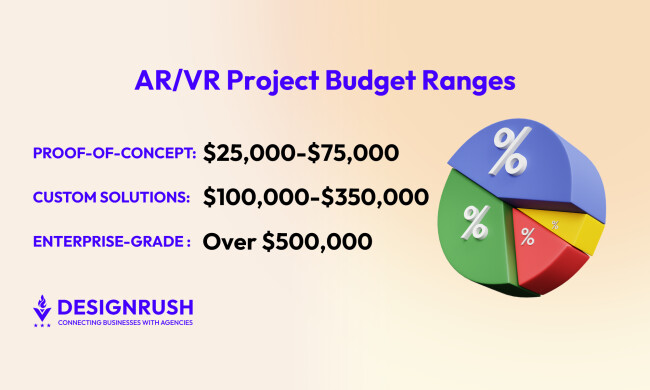
AR and VR companies in the USA charge between $25,000 for the simplest solutions to over $500,000 for enterprise-grade products, with hourly rates starting at $100-$250.
Total cost varies based on project complexity, platform requirements, and the level of customization involved.
Below is a general breakdown of typical project types and their associated cost ranges:
Project type
Typical cost range
Description
Simple AR experiences
$25,000-$60,000
WebAR campaigns or marker-based mobile AR applications with limited interactivity and standard assets.
Entry-level VR experiences
$60,000-$120,000
Basic VR simulations, commonly used for training or demonstrations, with predefined environments and interactions.
Mid-complexity AR/VR projects
$150,000-$350,000
Custom 3D assets, real-time interactions, backend integrations, and tailored user experiences.
Enterprise-grade AR & VR Platforms
$500,000+
Large-scale deployments with multi-user functionality, analytics, system integrations, and advanced security; costs can reach seven figures.
What are the maintenance costs of VR and AR solutions?
Industry benchmarks indicate that annual maintenance costs typically range from 15% to 20% of the initial development cost.
This typically covers bug fixes, engine updates, content enhancements, performance optimization, security patches, and compatibility work for new operating systems and platforms.
However, major upgrades can increase AR/VR maintenance spending to 20%-30% of the initial costs. Examples of these cases include adding a new device, engine migration, and architectural refactoring.
Additionally, complex AR/VR solutions, like multiplayer online role-playing games (MMORPG), can incur a 20%-30% maintenance fee tied to hosting, server operations, and more rigorous regression testing.
Ongoing support helps ensure long-term stability, performance, and adoption, particularly for enterprise-level VR and AR applications.
How long does it take to build a custom VR or AR experience?
Building a custom experience can take weeks to years, depending on its complexity.
Simple breakdown:
Simple prototype: 1 to 2 months. Basic demo or proof of concept.
Basic app or training experience: 3 to 6 months. Limited features, clear goal.
Moderate app or simulation: 6 to 12 months. Custom environments, more interaction.
What industries do VR and AR companies usually work with?
They work across a wide range of industries, with the strongest adoption in sectors where immersive technology improves training, visualization, and decision-making.
Video gaming (27%): Video gaming integrates AR/VR to create more immersive and interactive gameplay that increases user adoption and retention.
Workforce development and training (21%): AR/VR provides hands-on experience in a low-risk environment, improving worker safety while instilling confidence.
Healthcare (19%): Healthcare uses immersive technologies for medical training, surgical simulation, therapy, and rehabilitation.
Retail and eCommerce (16%): AR/VR boosts customer experience through product visualization, virtual showrooms, and interactive marketing content.
Architecture and design (15%): XR is often used to visualize concepts prior to execution, helping reduce risks and errors and accelerate decision-making.








 4.8
4.8 4.8
4.8