
Find blockchain development companies that build secure, scalable solutions for real business use. Choose from vetted experts in smart contracts, dApps, and enterprise blockchain integration.
Organic rankings are determined by five factors: top services, reviews, portfolio, awards/press, and team expertise. Sponsored listings pay for a placement that appears above organic positions. Sponsorship does not affect star ratings or review content - read more on our methodology page.
Home Services ×
Passionate to Code Your Success
Zealous System is an AI-powered technology partner delivering custom software, AI solutions, web and mobile apps, and enterprise platforms. As a software solutions provider, we serve startups and enterprises across healthcare, FinTech, logistics, education, manufacturing, and more...
Top Services:
- Software Development
- Product Design
- Web Development
- eCommerce Development
- WordPress Website Design
- Show more
- Location
- Ahmedabad, India
- Number of Employees
- 50 - 99
- Average Hourly Rate
- $20/hr
- Minimal Budget
- $1,000 - $10,000
- Portfolios Count
- 22 Projects Listed
Data sourced from the agency's DesignRush profile, its website, and other relevant accountsZealous System Services
Data sourced from the agency's DesignRush profileKerson Wallaw Consulting Firm Inc Neil Patel Digital Barber's Connect
Zealous System Reviews & Testimonials

Software Development Review from Grzegorz Grabczak
We worked with Zealous System on an AI-powered fraud triage solution for one of our clients in the Europe financial services sector. The project involved a complex fraud investigation workflow where analysts were handling a large number of alerts and gathering information from multiple systems. Zealous System worked closely with us to understand the requirements, existing processes and expectations of the end client before moving into development. The team developed an AI-powered fraud triage agent that brings relevant information together, helps prioritise alerts and provides explainable recommendations while keeping human analysts involved in important decisions. What I appreciated was the team's ability to understand both the business and technical sides of the project. Communication was consistent, and they were responsive when requirements evolved during development and testing. The solution helped streamline the investigation process and reduce the amount of repetitive manual work involved in reviewing fraud alerts. Overall, we had a positive experience working with Zealous System. They were a reliable technology partner for us on this project, particularly given the complexity of introducing AI into a financial services environment.
DIPAK VAIDH's Review Sourced from Google
I visited Zealous System on 16th June 2025 for the walk-in interview announced on LinkedIn for interns/freshers in Python, PHP, WordPress, .Net, and QA roles. Despite clearly stating it was open for freshers, upon arrival, all Python candidates, including myself and my sister, were told they only accept those with prior experience, as interns are directly placed on live projects. This information was never mentioned in the post. The company blamed the marketing team for the misleading post. This experience wasted our valuable time, energy, and travel expenses. I urge the company to coordinate better internally and post accurate job/internship information to avoid misguiding freshers who genuinely seek opportunities.
Ravi Prajapati's Review Sourced from Google
Zealous System is outstanding when it comes to AI development! Their team helped us build a smart, AI-powered software solution that completely transformed how we manage data and customer interactions. They explained complex AI concepts in simple terms and delivered a solution that works flawlessly. From planning to post-launch support, everything was smooth and professional. Highly recommended if you're looking for reliable AI experts!
Reviews verified by DesignRush and sourced from the agency's profile View All ReviewsBuilding Smarter, Faster, Better Softwares
Tekbyt is a digital product studio that designs and develops websites, SaaS platforms, web and mobile apps, e-commerce solutions, and AI-powered business systems for startups and growing companies...
Top Services:
- Mobile App Development
- Software Development
- Blockchain
- AI Development
- Web Design
- Show more
- Location
- Seattle, Washington
- Number of Employees
- Under 49
- Average Hourly Rate
- $50/hr
Data sourced from the agency's DesignRush profile, its website, and other relevant accountsTekbyt LLC Services
Data sourced from the agency's DesignRush profileSpec Books Care Box Foley Reece Mex Vikar Pacific Park Casita Home Builders
Tekbyt LLC Reviews & Testimonials
Marc Härtel's Review Sourced from Google
I recently worked with Tekbyt for web design and development, and they exceeded my expectations. Their expertise in Figma and web development was outstanding, and they made the entire process seamless. They kept me informed every step of the way and delivered results that perfectly represented my business. I highly recommend them for any website design or development needs, whether CMS-based or custom projects.
Reviews verified by DesignRush and sourced from the agency's profile View All ReviewsFast,Risk-Free Custom Software Development
We turn messy ideas into working software fast, simple and risk-free.From AI solutions to web and mobile apps to custom platforms. Exaverse builds what real businesses actually need. No fluff, no delays just clean code, clear communication and revisions until you love it.Your vision, our passion...
Top Services:
- Web Development
- Mobile App Development
- Blockchain
- Software Development
- IT Services
- Show more
- Location
- Lahore, Pakistan
- Number of Employees
- Under 49
- Average Hourly Rate
- $30/hr
- Minimal Budget
- $1,000 - $10,000
- Portfolios Count
- 1 Project Listed
Data sourced from the agency's DesignRush profile, its website, and other relevant accountsExaverse Services
Data sourced from the agency's DesignRush profileGumnam FacilityFirst Pockit





Blockchain Specializations
Services Related to Blockchain
Popular Services

Why companies trust DesignRush
Every agency is independently vetted before it can be listed or ranked
 4.8
4.8 4.8
4.8Some agencies pay for sponsored placement, clearly labeled and held to the same vetting standards.
7 Frequently Asked Questions About Blockchain Development Companies
What services do blockchain development agencies offer?
Blockchain development agencies design, build, and support blockchain-based solutions that automate processes, improve transparency, and enable secure digital transactions.
Common services include:
- Smart contract development and auditing: Writing self-executing code and reviewing it to prevent bugs, exploits, or costly failures
- dApp development: Building decentralized apps that run on blockchain networks instead of centralized servers
- Token development and NFT platforms: Creating digital tokens, cryptocurrencies, and marketplaces for trading assets
- Blockchain integration: Connecting blockchain with existing systems like web apps, enterprise software, or cloud platforms
- Private and enterprise blockchain solutions: Setting up custom networks for businesses that need control, privacy, and scalability
- Blockchain consulting: Advising on use cases, architecture, and whether blockchain is the right fit
- Wallet development: Building secure wallets for storing and managing digital assets
- Maintenance and support: Monitoring performance, fixing issues, and updating systems after launch
What platforms do blockchain developers use?
Blockchain development firms use a mix of public networks, enterprise platforms, and developer tools to build, deploy, and manage blockchain solutions. They choose platforms based on speed, cost, scalability, and whether the project needs a public or private network.
Key platforms and networks:
- Ethereum: The most widely used platform for smart contracts and decentralized applications
- Solana: Built for high speed and low fees, often used for scalable dApps and marketplaces
- Avalanche: A flexible platform that supports custom blockchain networks and fast transaction finality
- Hyperledger Fabric: Designed for private, permissioned systems used by enterprises
- Corda (R3): Common in finance and regulated industries where data privacy is critical
- IBM Blockchain: Enterprise-grade solution built on Hyperledger for secure business use cases
Development tools and infrastructure that blockchain development agencies use:
- Node providers (e.g., Alchemy, Infura, QuickNode): Give developers access to blockchain networks without running their own nodes
- Smart contract tools (e.g., Remix IDE): Used to write, test, and deploy contract code
- Frameworks and CLIs (e.g., Ignite CLI): Help set up and manage blockchain projects faster
How much do blockchain companies charge for their services?
Blockchain development companies typically charge from $40,000 to $300,000+ for a full solution, depending on complexity, features, and security requirements.
Cost by project complexity
The biggest cost driver is the solution's complexity, from basic smart contracts to full-scale platforms.
- Simple blockchain apps: $40,000 to $60,000
Basic features like simple smart contracts or payment functionality - Mid-level applications: $60,000 to $150,000
dApps with user roles, integrations, and moderate decentralization - Complex blockchain systems: $150,000 to $300,000+
Enterprise platforms, advanced security, custom architecture
Cost by solution type
Different blockchain products have different price ranges based on functionality.
- dApps: $35,000 to $150,000
- NFT marketplaces: $55,000 to $125,000
- Crypto wallets: $125,000 to $200,000
- Crypto exchanges: $135,000 to $190,000
- DAO platforms: $10,000 to $30,000
Cost breakdown across the project
Your budget is split across multiple phases, not just development.
- Consulting and planning: 5%
- UI/UX design: 10%
- Core development: 45%
- Testing and QA: 25%
- Deployment and maintenance setup: 15%
Final pricing depends on scope, security level, integrations, and whether you build on an existing blockchain or create a custom one.
What are the ongoing costs of maintaining a blockchain solution?
Ongoing blockchain costs typically range from 15% to 25% of the initial development cost per year, depending on system complexity and usage.
Key ongoing costs include:
- Maintenance and updates: Bug fixes, performance improvements, and feature upgrades
- Infrastructure: Node providers, cloud services, and storage as usage grows
- Security: Regular audits, monitoring, and protection against vulnerabilities
- Transaction fees: Ongoing network or gas fees for processing transactions
- Support and operations: Technical monitoring, DevOps, and user support
- Compliance: Legal, regulatory, and data protection requirements
Costs increase as the system scales, handles more transactions, or requires higher security.
How long does it take to build a blockchain solution?
The best blockchain development company typically needs 3 to 9+ months to build a blockchain solution, depending on complexity, features, and security requirements.
Typical timeline by complexity:
- Simple solutions: 1 to 2 months
Basic wallets or simple smart contract apps - Mid-level projects: 2 to 4 months
dApps with integrations and user functionality - Complex systems: 4 to 9+ months
DeFi platforms, marketplaces, or enterprise solutions
Blockchain development agencies build products in stages, and each is adding time:
- Planning and requirements: 1 to 2 weeks
- Architecture and design: 2 to 4 weeks
- Development: 1 to 6 months
- Testing and QA: 2 to 4 weeks
- Deployment: 1 to 2 weeks
Factors that affect the timeline include scope and feature set, choice of blockchain platform, team experience, and whether you build from scratch or use existing tools.
What is the difference between public and private blockchains?
Public blockchains are open to anyone, while private blockchains are restricted to approved users and controlled by an organization.
You can see the main differences in the following table:
| Feature | Public blockchain | Private blockchain |
| Access | Anyone can join | Permission required |
| Control | Decentralized | Controlled by one entity or group |
| Transparency | Fully transparent | Limited visibility |
| Speed | Slower | Faster |
| Cost | Higher (transaction fees) | Lower |
| Security | High through decentralization | High, but depends on governance |
| Use cases | Crypto, DeFi, NFTs | Enterprise systems, internal operations |
How do blockchain development agencies ensure security?
Blockchain development firms ensure security by combining secure coding, testing, and continuous monitoring to prevent vulnerabilities and protect data and transactions.
Key security practices include:
- Smart contract audits: Reviewing code to detect bugs, exploits, and logic flaws before deployment
- Secure development practices: Using proven frameworks, code standards, and peer reviews
- Encryption and key management: Protecting data with cryptography and secure storage of private keys
- Testing and simulation: Running stress tests and attack scenarios to identify weaknesses
- Access control: Limiting permissions and enforcing authentication for users and systems
- Ongoing monitoring: Tracking activity, detecting threats, and applying updates or patches quickly
Security is built into every stage, not added after deployment.
Latest Trends Related to Blockchain Development
Artificial Intelligence
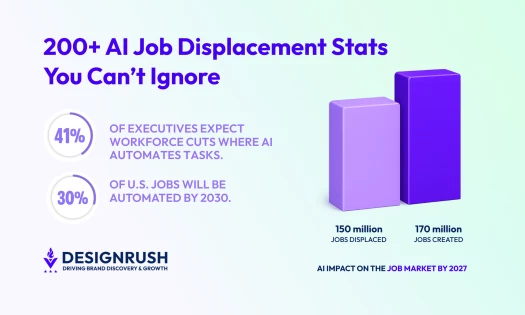
Who’s Most Vulnerable to AI? 200+ Job Displacement Stats and What to Do About It
12,389