The leading digital strategy agencies strengthen brand impact with data, technology, and business acumen. Partner with top digital strategy firms for content and integrated campaigns tailored to your target audiences.
Organic rankings are determined by five factors: top services, reviews, portfolio, awards/press, and team expertise. Sponsored listings pay for a placement that appears above organic positions. Sponsorship does not affect star ratings or review content - read more on our methodology page.

Goji Labs
VerifiedVerified by the DesignRush team for authenticity and credibility.AI LeaderRecognized for strong visibility across AI-powered search and answer engines.+1Award WinnerRecipient of a Best Design Award for outstanding work.We Define the Right Build Before We Start It.
Goji Labs approaches digital strategy from the product side, validating market fit, sharpening positioning, and defining go-to-market plans before launch. With 162+ products launched and clients raising significant funding, it has worked with brands like KCRW and Hard Assets Alliance...
Top Services:
- Mobile App Development
- Software Development
- UI/UX Design
- AI Development
- Web Design
- Show more
- Location
- Los Angeles, California
- Number of Employees
- 50 - 99
- Average Hourly Rate
- $150/hr
- Minimal Budget
- $25,000 - $50,000
- Portfolios Count
- 23 Projects Listed
Data sourced from the agency's DesignRush profile, its website, and other relevant accountsGoji Labs Services
Data sourced from the agency's DesignRush profileWorld Wildlife Fund K-ID City of Los Angeles TGS Kangarootime World Health Organization Prediction Strike American Kennel Club Youth on Their Own Root Insurance
Goji Labs Reviews & Testimonials

Web Design Review from Michael Krone
We partnered with Goji Labs for a complete app build, and they delivered exactly what we needed. Their team handled the entire project professionally and with great care from start to finish. I would highly recommend Goji Labs to anyone seeking a skilled and dependable development partner.

Software Development Review from Wilson Rapp
We brought Goji Labs on board for a major migration project, and the entire experience was smooth and well-managed from start to finish. We could not be happier with the results. Their expertise gave us confidence throughout the process, and we would not hesitate to work with them again.

Mobile App Development Review from Sheila Reddy
As a founder with just an idea and a business model, I needed a partner who could turn that vision into a real product. Goji Labs guided me through every step of the process and built exactly the app we needed. Their expertise and patience made the entire journey manageable and rewarding.
Reviews verified by DesignRush and sourced from the agency's profile View All Reviews
Popular Services
How to Hire a Digital Strategy Company
Do I have a defined business outcome, or just the project?
Ask yourself: Can I finish this sentence, "We need to [specific outcome] by [timeframe] because [consequence of not doing it]", without describing an activity like "build a strategy" or "improve our digital presence"?
If you can't answer that question, no digital strategy agency can help you yet.
Agencies are skilled at filling vague briefs with visible work.
If you walk in asking for "a digital strategy," you'll get a document, not a result.
The most common root cause of failed agency engagements isn't a capability gap on the agency's side.
It's a client who didn't define a measurable expectation before signing.
The agency becomes a cost center the moment the brief stays vague.
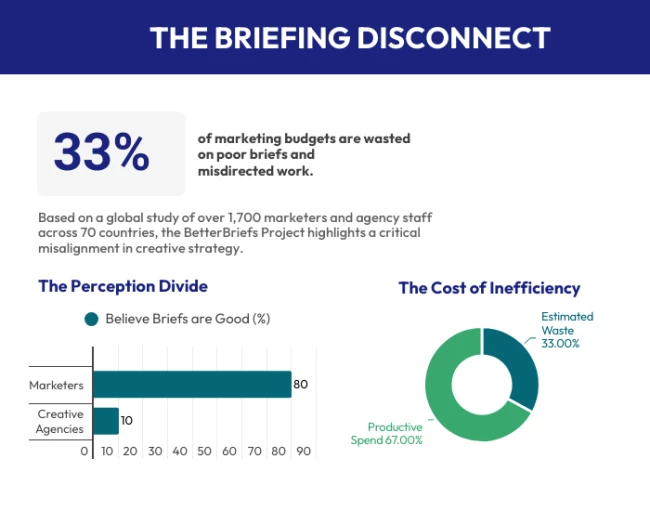
The BetterBriefs Project global study, published by the IPA and based on responses from over 1,700 marketers and agency staff across 70 countries, found that 80% of marketers believe they write good briefs, while only 10% of creative agencies agree.
The same study found that respondents estimated 33% of marketing budgets are wasted on poor briefs and misdirected work.
Meanwhile, the ANA's "Enhancing Client/Agency Relations" survey found that just 27% of agencies believe clients provide clear assignment briefs, and not a single agency respondent strongly agreed.
Write your one-sentence outcome and pressure-test it with your CFO or a board member before briefing digital strategy agencies.
If neither of them can connect it to a line on a P&L, rewrite it.
Does the agency's experience match my specific problem or just my industry?
Shortlisting by industry vertical is one of the most common and most costly mistakes in hiring digital strategy companies.
An agency that has produced results for three eCommerce brands has not necessarily solved a B2B lead generation problem.
An agency that grew a DTC brand's organic traffic hasn't necessarily navigated the compliance constraints of a financial services company.
When reviewing agency profiles and case studies, filter for problem match, not sector match.
The question isn't "have they worked in my industry?" It's "have they solved the specific problem I have, in a comparable context, with measurable results?"
Despite this, 89% of companies say "experience in our industry" is a major factor when selecting an outsourcing provider, according to a 2024 survey of business leaders compiled by Passive Secrets, making industry match the most common shortlisting criterion, and problem match the most overlooked one.
How to shortlist effectively:
- Identify the two or three most comparable case studies on each digital strategy firm’s profile, comparable by problem type, not by industry logo.
- Look for case studies that name the specific metric that moved, the timeframe, and the agency's specific contribution (not the client's, not the market's).
- Narrow to three to five agencies before requesting proposals.
What to look for in case studies:
- A named starting problem, not a generic challenge.
- A specific intervention, not a comprehensive strategy.
- A measured result with a timeframe — not significant growth or improved performance.
- Evidence that the agency's work caused the result, not just preceded it.
Red flags at this stage:
- Case studies lead with client logos instead of outcomes.
- Results are described in relative terms ("increased by X%") without a baseline or timeframe.
- Every case study sounds like it could apply to any client in any sector.
What does success look like at 30, 60, and 90 days, and who defined it?
Digital strategy agencies should write down what a successful 90-day outcome looks like from their side.
Without a shared, written definition of early success, both sides spend the first quarter doing work they believe is valuable while the other side is quietly keeping score on different metrics.
By month four, the client is frustrated by the absence of visible results, and the agency is frustrated that the client doesn't appreciate the foundational work they've completed.
This pattern is common enough to have a name in the consulting industry: the expectation gap.
The financial consequences of getting this wrong are significant.
According to the ANA and 4As joint study, The Cost of the Pitch, based on 300+ interviews with U.S. brand marketers and agency executives, the average cost of an agency review when no incumbent is involved is $408,500. That’s the cost for the client alone, before accounting for the digital strategy company’s own pitch costs.
When expectations break down and a review becomes necessary, that is the price of a poorly aligned start.
The 30-day milestone should cover access, audit, and alignment.
The 90-day milestone should include at least one deliverable that tests the quality of the agency's strategic thinking before you're locked into a full year.
What to do: Send the agency your written version of the 90-day success before the kickoff call. Ask them to do the same. Where they diverge is where the relationship will break first.
Who will actually work on my account, and have I met them?
The person who presents to you and the person who runs your account on a daily basis are often not the same.
This gap between the seniority of the pitch team and the seniority of the delivery team is one of the most predictable sources of post-signature disappointment in agency relationships.
Before signing, identify who will be doing the actual work on your account. Ask to meet them.
Ask digital strategy firms what percentage of their time will be dedicated to your engagement. Then assess whether that person has the experience level the engagement actually requires.
Your relative budget matters here. An agency billing $6M annually will prioritize a $150K retainer differently from one billing $900K annually.
The smaller agency may be the higher-priority client, which means more senior attention, faster response, and more accountable work.
The table below shows how staffing typically plays out by agency size, and what it means for how you'll be treated.
| Agency size | Who pitches | Who delivers | Your likely priority |
| Boutique (under 15 people) | Founder or principal | Often the same person | High, but capacity is finite |
| Mid-size (15-75 people) | Senior partner | Account director + specialist | Moderate, senior input is scheduled |
| Large (75+ people) | Business development director | Rotating account team | Depends on your budget's rank in their portfolio |
What happens if the strategy isn't working?
Most buyers evaluate digital strategy agencies on what they'll do when things go well.
Fewer think through what will happen when things don't go well, which, in any honest engagement, they sometimes won't.
The way an agency handles underperformance tells you more about the health of the relationship than any pitch or proposal.
Top digital strategy agencies identify problems before the client does. They come with a diagnosis and propose a course correction.
An agency that waits for the client to notice and then explains why the results weren't their fault is an agency that will cost you more than the retainer.
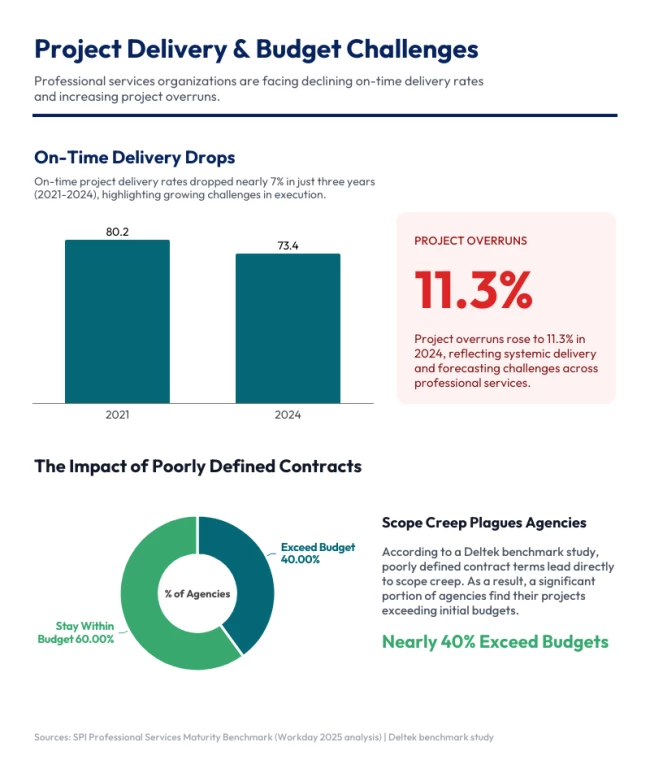
The data supports taking this seriously upfront. The SPI Professional Services Maturity Benchmark, a survey of thousands of professional services organizations, cited by Workday's 2025 industry analysis, found that on-time project delivery rates dropped to just 73.4% in 2024, down from 80.2% in 2021.
The same research found that project overruns rose to 11.3% over the same period.
In agency engagements specifically, a Deltek benchmark study found that nearly 40% of agenciesexceedprojectbudgets due to scope creep from poorly defined contract terms.
These aren't edge cases. They're the statistical norm, and they almost always go unaddressed until the client notices the invoice.
Before you sign, understand the digital strategy firm’s process for flagging underperformance: how often they review results against baseline, what triggers an internal review, and how they communicate bad news.
Sources
DesignRush sustains a directory of over 30,000 agencies categorized by service category, location, expertise, and reviews. We build our database in two ways:
- Our dedicated team of agency experts actively searches the web for top-performing companies. We then pull information from their websites, online presence, and client testimonials to verify their status and qualifications prior to listing.
- The agencies listed get notified of their profiles on the website and they can choose to claim it or not, which suggests their availability for more collaborations.
Agencies can also reach out to DesignRush and must go through the verification process prior to being listed.

Why companies trust DesignRush
Every agency is independently vetted before it can be listed or ranked
 4.8
4.8 4.8
4.8Some agencies pay for sponsored placement, clearly labeled and held to the same vetting standards.
7 Frequently Asked Questions About Digital Strategy Agencies
How do I know if the digital strategy company I'm evaluating will execute the strategy or just sell me one?
Ask in the first meeting who will be on your account after the contract is signed. The most consistent structural flaw in agency sales models is pitch-and-switch staffing: senior operators close the deal, junior operators execute the engagement. The senior judgment that persuaded you to sign is often not what you're buying for the next 12 months.
To protect against this, require that the Statement of Work name the specific individuals responsible for your account, along with their seniority level and the number of other accounts they carry simultaneously. Many digital strategy agencies overload account managers with 30 to 50 clients each. At that volume, no individual client gets meaningful strategic attention, and monthly "strategy calls" become status updates where someone reads your own analytics back to you.
What are the clearest red flags that an agency is not a serious digital strategy partner?
The clearest red flag is a digital strategy firm that arrives at the first meeting with a proposal already written.
A serious digital strategy partner asks about your margins, customer acquisition costs, competitive positioning, and internal constraints before it proposes anything. Additional red flags that signal execution-only thinking include:
- Generic proposals that could apply to any company in your sector.
- Reporting decks that track activity (impressions, posts published, hours logged) rather than business outcomes.
- Unwillingness to show the full timeline and revenue impact behind their case studies.
Agencies that cannot explain their week-by-week decision-making process either don't have one or don't want you examining it.
What costs typically appear after signing that weren't in the original proposal?
The three most common post-signature cost surprises in digital strategy engagements are: change orders for work outside the initial scope, consulting hours billed separately from retainer fees, and technology or platform costs that the digital strategy agency treats as pass-through charges.
A $10,000 project can easily grow to $13,000-$15,000, and a six-week timeline may stretch to twelve weeks. All that can lead to financial overruns, reduced quality, and team burnout. Before signing, request a complete list of every line item not covered by the retainer, including: additional revision rounds beyond those specified, stakeholder workshops, tool subscriptions, third-party data licenses, and any work triggered by internal changes on your side (a rebrand, a product launch, a new market entry).
A well-run agency will provide this list without hesitation. One that deflects is signaling a billing model that depends on scope expansion to improve its own margins.
How much should a digital strategy company services cost?
A credible digital strategy agency engagement in 2025 runs $3,000 to $25,000 per month on retainer, or $5,000 to $150,000+ for a defined project. According to a pricing study drawing on data from 1,200+ agencies, monthly retainer costs span $3,000 to $25,000, with median spending at $7,500 for mid-market companies.
Hourly consulting rates range from $100 to $350 per hour, with senior strategists commanding rates above $250.
On the global side, the 2025 Global Digital Marketing Report by DesignRush puts the worldwide average agency rate at $97 per hour, with U.S.-based agencies averaging $124 per hour.
Should I worry about a digital strategy agency that locks me into a long contract before showing any results?
Yes, a 12-month lock-in with no performance milestone clauses is a structural risk, not a standard industry practice. Long contracts without exit provisions protect the digital strategy firm’s revenue, not your outcomes. A confident agency with a proven process should be willing to build in milestone-based reviews, typically at 90 days and 6 months. There, both parties assess whether the engagement is generating the agreed-upon indicators of progress.
At a minimum, any long-term contract should specify: what deliverables are due at each quarter, what performance benchmarks trigger a strategy review, and what the exit mechanism is if those benchmarks are not met.
How do I know if an agency's strategy is custom to my business, or a repackaged template?
Ask the shortlisted digital strategy agencies to show you two proposals from different clients in different industries and explain the strategic differences between them. Agencies with a genuine strategy capability will have fundamentally different recommendations for a D2C consumer brand versus a B2B SaaS company. They’ll offer a different channel mix, different measurement frameworks, and different competitive positioning approaches
Agencies that apply templated thinking will show cosmetic differences: the same services with different company names on the header. A generic proposal signals generic execution. The right strategy depends on your stage, competitive landscape, and ideal customer profile. During evaluation, also listen for how quickly the digital strategy company moves to tactics. Legitimate strategists spend the first conversation asking questions; agencies selling repackaged work move quickly to talking about what they do.
At what point in the sales process should I walk away, even if the agency seems capable?
Walk away immediately if the agency makes performance guarantees, refuses to name your day-to-day account team, or cannot explain how it measures strategic success independent of vanity metrics.
These three signals do not indicate inexperience, but a business model designed to obscure accountability. Digital strategy firms that make guarantees like "first page rankings in 30 days" or "500% ROI for everyone" either don’t understand how digital marketing works or are overstating certainty to close the deal.
Separately, if an agency's reporting vocabulary consists exclusively of reach, impressions, and engagement rate with no connection to revenue, pipeline, or customer acquisition cost, the strategy layer is missing, regardless of how sophisticated the pitch sounded. If a digital strategy firm avoids sharing analytics dashboards, performance reports, or access to your own ad accounts, that's a serious warning sign. A successful digital strategy relies on data-driven decisions, and access to those numbers is how you verify you're on the right track.
Latest Trends Related to Digital Strategy