
Companies targeting healthcare professionals rely on accurate data, but having contact data alone does not move campaigns forward. The real challenge is getting that data into CRM systems and keeping it up to date through API integrations so teams can actually use it.
The solutions in this list connect healthcare data directly to CRM workflows so you can build, target, and launch campaigns without continuous manual work.
Healthcare Data Solutions: Key Findings
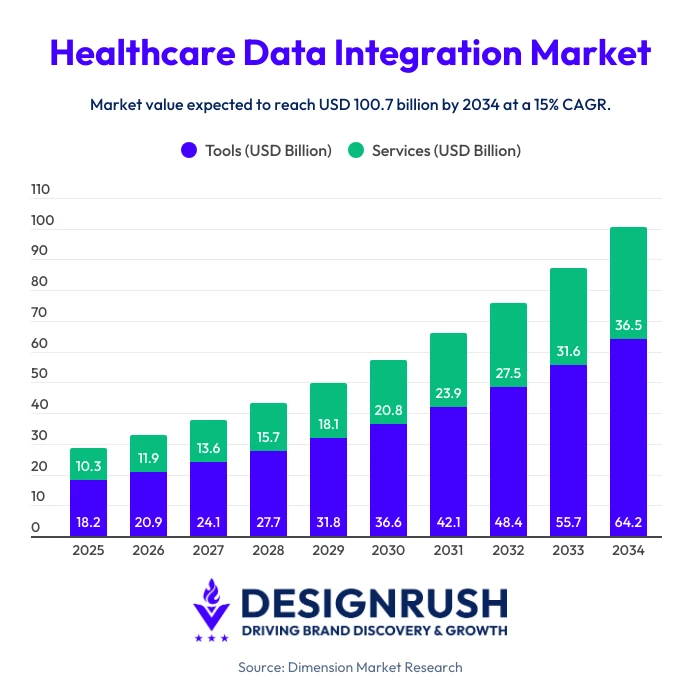
- The healthcare data integration market is projected to grow from $28.5 billion in 2025 to $100.7 billion by 2034.
- Static lists are being replaced by platforms that keep CRM records updated through APIs, cloud syncs, and recurring data feeds.
- The best options stand out for how quickly you can segment healthcare audiences, refresh records, and launch campaigns.
Healthcare Data Integration Market Set to Reach $100 Billion
The demand for connected healthcare data is growing fast, prompted by the need to unify fragmented systems and make data usable within CRM platforms.
The healthcare data integration market is expected to grow from $28.5 billion in 2025 to $100.7 billion by 2034.
This growth is part of a broader shift toward API-driven infrastructure. Markets and Markets reports that the healthcare and life sciences segment is expected to see the highest growth in the data integration market, impacted by increased demand for real-time data exchange and interoperability.
At the same time, integration is still a practical challenge. About 95% of IT leaders struggle to integrate data across systems, while only 29% of applications are connected, leaving large gaps between tools and datasets.
In healthcare-focused campaigns, that disconnect directly impacts execution. Poor data sync leads to outdated CRM records, unreliable segmentation, and slower campaign launches. API-driven integration solves this by keeping data current, connected, and ready to use.
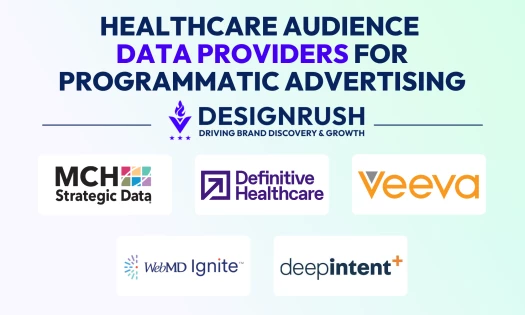
 1. MCH Strategic Data: Best for Healthcare Professional Contact Data Activation via API & Cloud-Hosted Weekly Updated Data
For marketing and sales teams targeting healthcare professionals who need campaign-ready data inside their CRM
Why Choose MCH Strategic Data
- Built specifically for healthcare professional outreach, with verified contact data across physicians, administrators, and allied roles
- API and cloud-based delivery that keeps CRM data updated without manual uploads
- Email marketing datasets and audience targeting tailored for campaign execution
- Custom cloud-hosted databases built by specialty, role, facility type, and location, updated weekly
- Flexible licensing options for ongoing campaigns
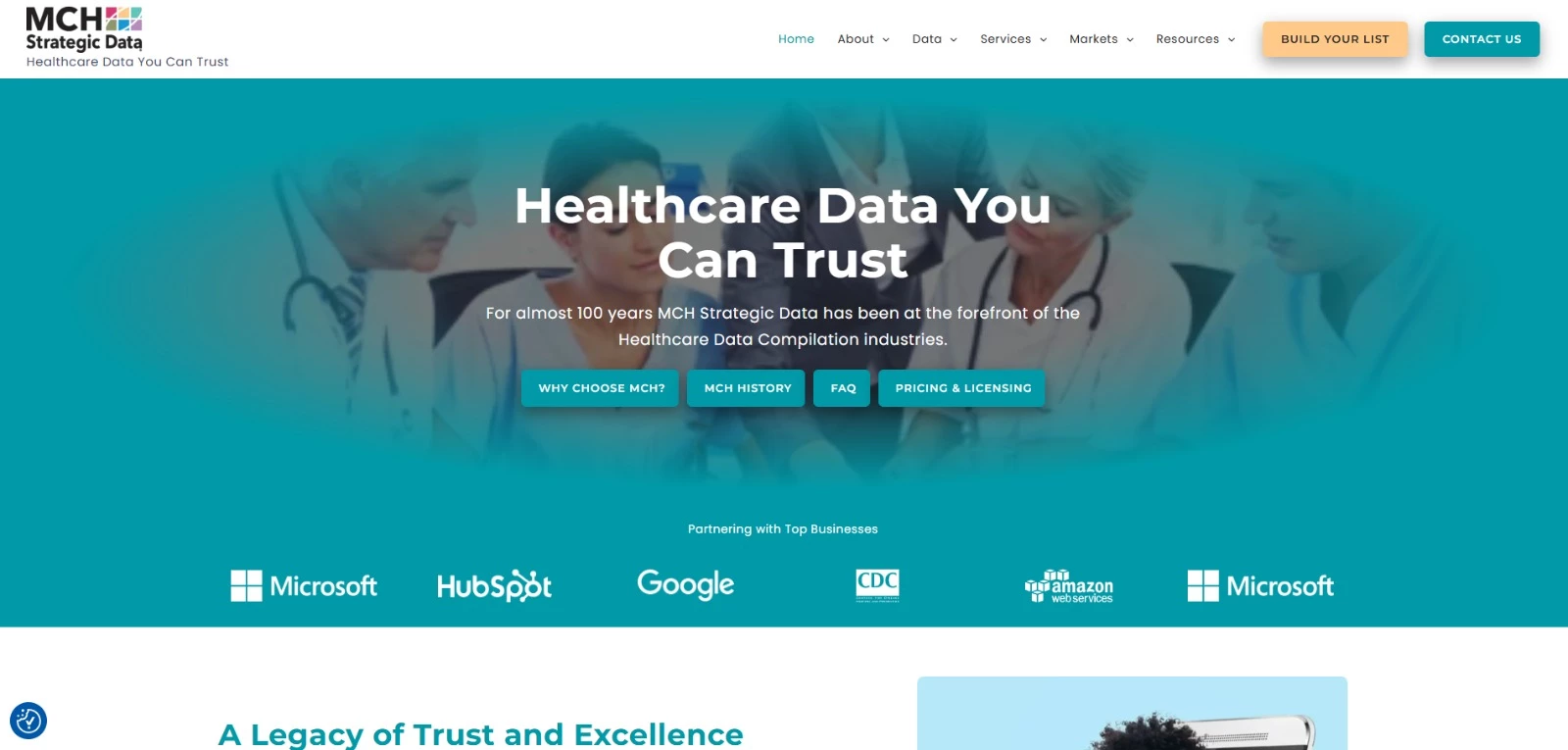
MCH Strategic Data is for companies that need a dependable way to reach healthcare professionals. It focuses on delivering ready-to-use contact data that fits directly into your CRM and campaign workflows.
You can access data through API or cloud-hosted databases, with options to customize the lists. You can define your audience and launch campaigns without rebuilding datasets every time.
Who’s It For?
This works well if you’re running campaigns for healthcare professionals and need usable data in your CRM.
It’s especially useful when your workflow depends on keeping contact data current and ready for outreach without extra preparation.
Potential Limitations
- Best suited for teams that already have CRM and campaign workflows in place
Pricing
- Pricing is typically well below that of other significant industry players
- Quotes can be customized to specific requirements and not forced one-size-fits-all subscription models



2. Definitive Healthcare: Best for Healthcare Market Intelligence & Provider-Level Targeting
For companies that need deeper context on healthcare markets before building outreach lists or targeting specific professionals
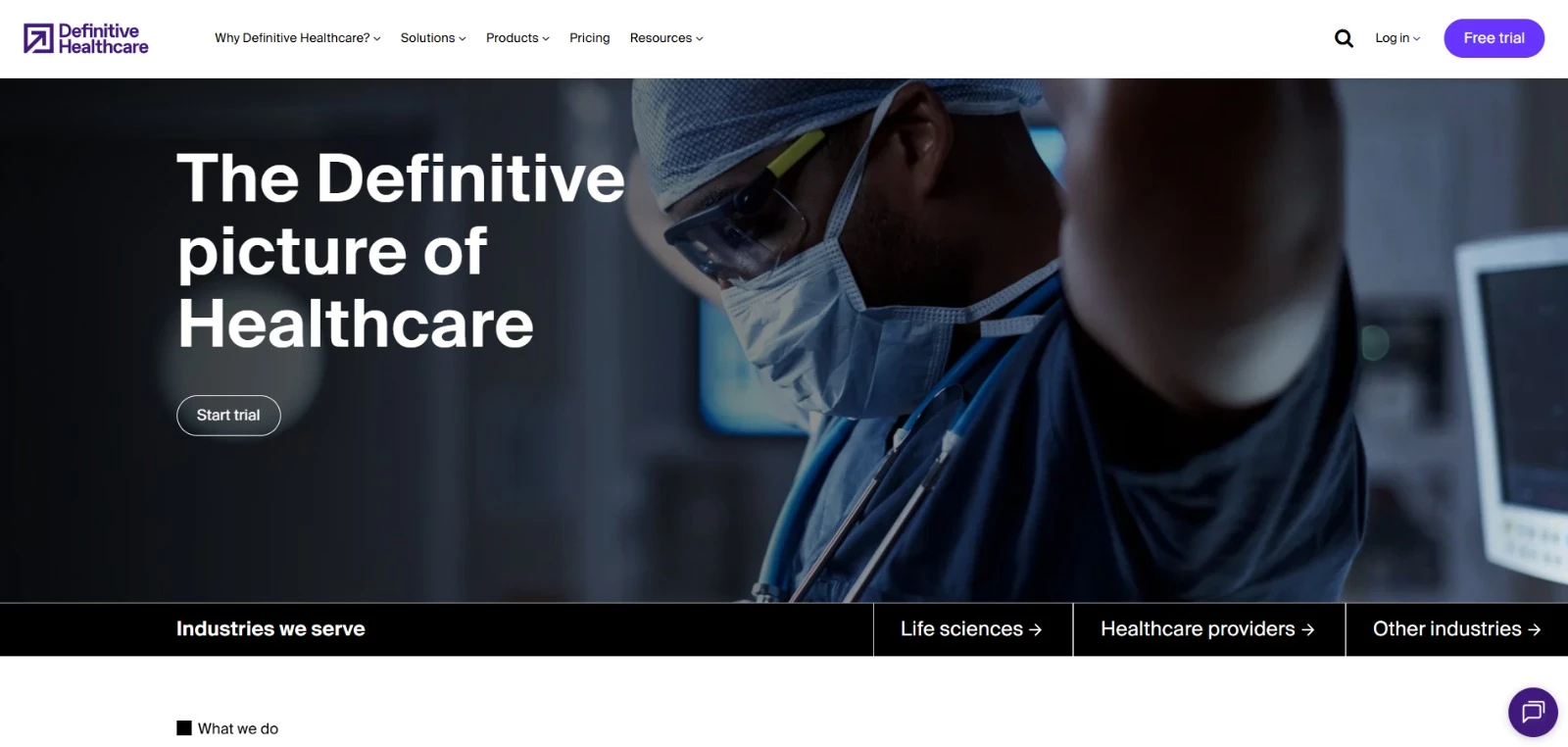
Why Choose Definitive Healthcare
- Detailed data on hospitals, health systems, physicians, physician groups, and care facilities
- Datasets covering affiliations, referrals, claims, financial, and clinical metrics
- Consumer data and expert insights
- Tools designed for market intelligence, go-to-market planning, and sales optimization
- Data management and integration support for embedding insights within workflows
Definitive Healthcare focuses on how organizations, providers, and data points connect within the healthcare ecosystem. Aside from contact-level information, it also captures relationships among facilities, referral flows, and claims activity.
This gives you more direction when narrowing target accounts, identifying decision-makers, or shaping outreach based on how organizations operate.
Who’s It For?
Teams working on account-based outreach where understanding provider relationships and organizational ties is part of the targeting process. It’s useful when your campaigns depend on how accounts are mapped and prioritized.
Potential Limitations
- Contact data may not always be fully up to date, especially for direct outreach use cases
- It can be hard to navigate if you only need simple lists or quick exports
Pricing
- Custom pricing
3. ZoomInfo: Best for Multi-Channel Healthcare Prospecting & Audience Targeting
For revenue teams and marketers who want healthcare contacts, intent signals, CRM sync, and outbound execution in one platform
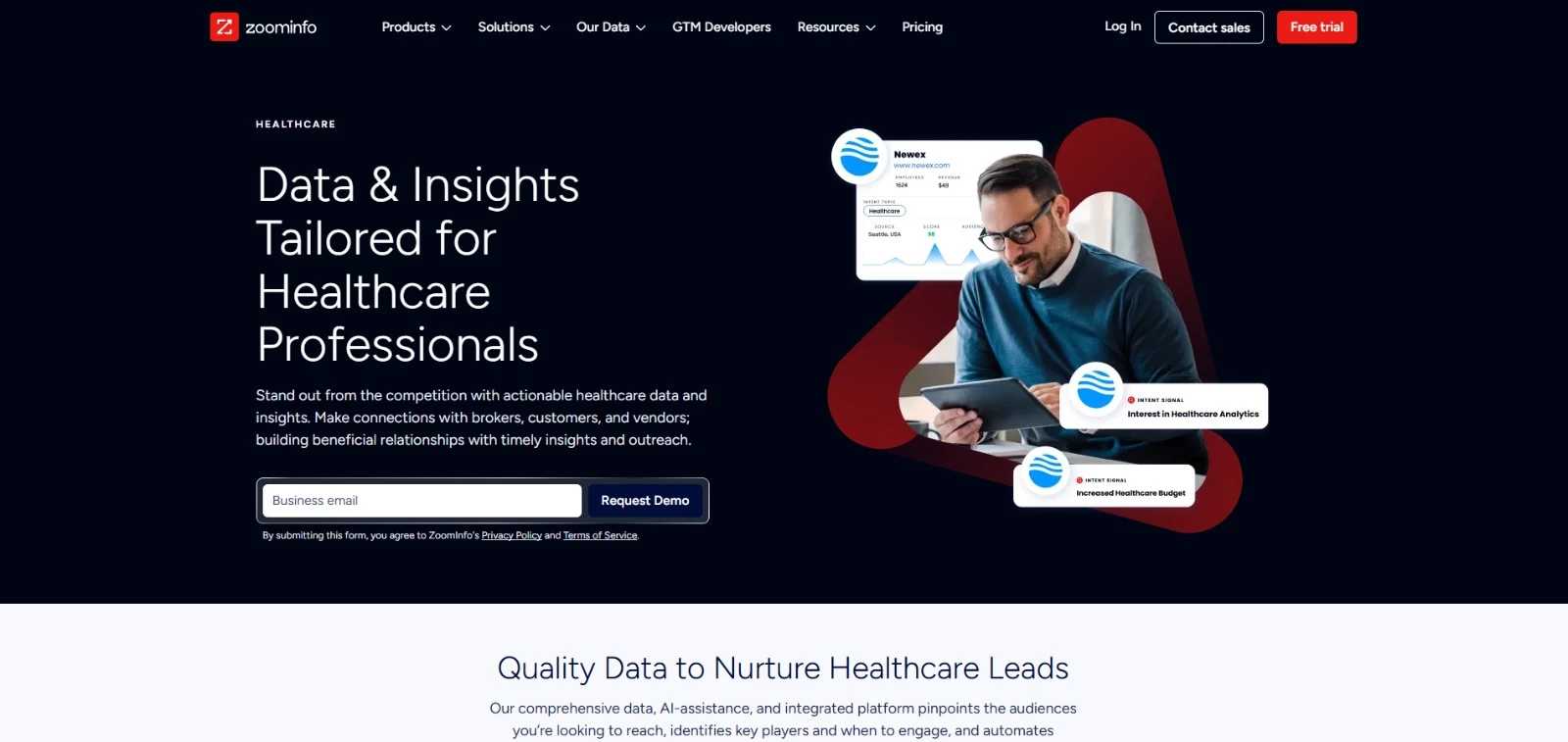
Why Choose ZoomInfo
- Healthcare-focused datasets to help you identify providers, brokers, customers, vendors, and related accounts
- Marketing plans include CRM and MAP integrations with Salesforce, HubSpot, Marketo, Eloqua, Sugar, Zoho, Dynamics, Outreach, and Salesloft
- Intent data, audience creation, retargeting, and ABM tools for timing outreach more effectively
- Prospecting features such as advanced search, exports, hierarchy data, buying-group filters, and alerts
- Broad product suite covering sales, marketing, talent, enrichment, and GTM workflows
ZoomInfo offers company and contact data with buyer intent, audience tools, and outbound workflows, which can reduce the number of separate tools you need.
That makes it useful when your healthcare pipeline depends on finding the right accounts, syncing data into CRM, and reaching prospects through email, ads, or sales outreach with shared targeting criteria.
Who’s It For?
Sales and marketing teams running active healthcare prospecting programs with multiple channels in play. It suits organizations that want a single system for list building, enrichment, campaign targeting, and outbound coordination.
Potential Limitations
- Some reviewers mention outdated contacts or missing details, so verification may still be needed before outreach
- New users can find the platform dense at first because of the number of features and menus
Pricing
- Custom pricing
4. IQVIA: Best for Enterprise Healthcare Data, HCP Reference Data, and Commercial Intelligence
For larger organizations that need healthcare professional data tied to analytics, market intelligence, and enterprise-grade healthcare systems
Why Choose IQVIA
- OneKey reference data identifies healthcare professionals (HCPs) and healthcare organizations (HCOs) for sales and marketing decisions
- Broad product portfolio covering commercial strategy, market access, patient insights, alerts, triggers, analytics, and healthcare data applications
- Global healthcare data footprint with prescription, claims, and market datasets
- Solutions for life sciences, providers, payers, and healthcare enterprises with regional and enterprise support
- Advanced analytics and AI capabilities
IQVIA is one of the most established names in healthcare data. Its strength comes from scale, as it offers reference data, commercial intelligence, market analytics, and connected products that many enterprise healthcare organizations already use.
If you’re managing provider records, market opportunities, account planning, or HCP targeting at the enterprise level, IQVIA offers more infrastructure than a typical vendor.
Who’s It For?
Healthcare enterprises, medtech companies, and commercial organizations managing large datasets, multiple business units, or regulated outreach programs.
It also suits companies that want healthcare contact data linked with larger market intelligence and internal reporting systems.
Potential Limitations
- The portfolio is extensive, which can make evaluation slower if you only need a simple data source
- Implementation can require more internal coordination than plug-and-play contact databases
Pricing
- Custom pricing
5. Veeva OpenData: Best for HCP and HCO Reference Data Inside CRM Systems
For organizations that need accurate healthcare professional records, organization data, and ongoing CRM data maintenance
Why Choose Veeva OpenData
- Global reference data covering HCPs, healthcare organizations (HCOs), and affiliations used in CRM, analytics, and data warehouses
- Country and regional datasets with broad coverage, including 12 million HCPs and 2 million HCOs in the U.S.
- 100+ attributes such as identifiers, specialties, licenses, addresses, contact details, and eligibility data
- Direct integration options through Veeva CRM, APIs, Veeva Network, and data file delivery
- Services with rapid change-request handling and proactive data quality updates
Veeva OpenData is built around customer master data for healthcare commercial operations.
It helps companies keep provider and organization records correct while making that information available inside CRM systems and connected tools.
That matters when your outreach depends on specialty data, affiliations, territory planning, compliance checks, or verified contact records that sales and marketing users can trust day to day.
Who’s It For?
Life sciences companies, medtech firms, and healthcare commercial teams managing large provider databases within CRM systems.
It’s especially useful when multiple departments rely on the same HCP and HCO records for sales, marketing, operations, or compliance.
Potential Limitations
- Best experience often comes when you already use other Veeva products, which can make it less appealing for companies outside that ecosystem
- Some data and features vary by country, which means global buyers may need to review regional coverage carefully
Pricing
- Custom pricing
6. Innovaccer: Best for Unified Healthcare Data Feeding CRM & Growth Systems
For companies that need healthcare data cleaned up, connected, and usable inside CRM
Why Choose Innovaccer
- Data platform unifying fragmented healthcare records from multiple source systems
- API connector tools that help move data into CRM and internal platforms faster
- Identity resolution and data quality layers reducing duplicate or incomplete records
- Analytics and segmentation tools that improve visibility into accounts, organizations, and market opportunities
- CRM-oriented products for engagement, communications, and commercial growth workflows
Innovaccer is useful when healthcare data is spread across multiple systems, and your CRM only reflects part of the picture.
Its platform can unify records, improve data quality, and make connected information available.
That added visibility can help with account prioritization, territory planning, audience segmentation, and outreach coordination when several internal systems feed your go-to-market efforts.
Who’s It For?
Commercial teams, growth leaders, and enterprise buyers who need healthcare data connected before it becomes useful in CRM.
It suits organizations dealing with siloed records, duplicate accounts, or limited visibility across their data sources.
Potential Limitations
- Pricing is custom and usually geared toward larger deployments
- Implementation may require internal data and IT support
Pricing
- Custom pricing
7. HealthLink Dimensions: Best for Healthcare Provider Data, CRM Enrichment, and Audience Activation
For companies that need healthcare professional data tied to outreach programs, CRM records, and digital targeting campaigns

Why Choose HealthLink Dimensions
- Healthcare-focused database covering providers, facilities, affiliations, email addresses, digital identities, and claims insights
- 95%+ MD, DO, NP, and PA email coverage, with 3.4M+ clinicians listed with validated email addresses
- Enrichment services for matching, cleansing, and validating records already stored in CRM or PRM systems
- Campaign support for email deployment, trigger email, paid social, programmatic advertising, and audience reporting
- Provider-level reporting that can feed analytics workflows and follow-up activity
HealthLink Dimensions places equal emphasis on data quality and campaign activation. Its offering connects provider records with outreach channels and helps you improve the quality of existing databases.
If email programs, paid media audiences, CRM hygiene, or response tracking are central to your processes, this platform meets those needs directly.
Who’s It For?
Marketing teams, agencies, and commercial healthcare brands running active provider outreach programs. Organizations with existing CRM records that need fresher data, higher match rates, or ready-to-use healthcare audiences will get the most value here.
Potential Limitations
- Coverage is strongest in the U.S., so multinational buyers may need to confirm international data availability
- Companies wanting a simple self-serve database may prefer lighter tools with fewer managed-service elements
Pricing
- Custom pricing
8. Optum: Best for Claims Data, Population Insights & Enterprise Healthcare Intelligence
For companies that need healthcare market data connected to CRM planning, account targeting, and commercial decision-making
Why Choose Optum
- Large healthcare data portfolio covering medical claims, pharmacy claims, lab results, provider data, and utilization trends
- Data and analytics solutions focused on market intelligence, live data management, predictive modeling, and business decision support
- Commercial use cases that help evaluate product performance, market dynamics, adherence, and launch activity
- Provider and market datasets that can support territory planning, account prioritization, and segmentation efforts
- Enterprise delivery model with integration into internal analytics environments, reporting systems, and CRM workflows
Optum is geared toward organizations that need deeper healthcare intelligence behind sales and marketing decisions.
Instead of focusing only on contact records, it offers datasets that show utilization patterns, treatment activity, provider behavior, and market movement.
That added visibility can be helpful when the CRM strategy depends on identifying growth opportunities, sizing target markets, prioritizing accounts, or tracking changes in healthcare demand.
Who’s It For?
Enterprise commercial teams, insurers, medtech companies, consultancies, and analytics-driven healthcare businesses working with challenging markets.
Potential Limitations
- Claims and market datasets often need analysts or internal data teams to turn raw information into clear commercial actions.
- It may be hard to quickly identify which Optum solution best matches a specific CRM or marketing use case
Pricing
- Custom pricing
9. InterSystems: Best for Connecting Healthcare Data to CRM and Commercial Systems
For organizations that need healthcare data from EHRs, payer systems, labs, or internal platforms delivered into CRM & analytics
Why Choose InterSystems
- Interoperability, analytics, and data management capabilities
- Supports HL7, FHIR, and other healthcare standards commonly used in legacy and modern systems
- HealthShare products focused on data exchange, unified records, and connected processes
- Delivers healthcare data into CRM platforms, BI tools, and internal business systems
- Used by providers, payers, life sciences companies, software vendors, and public sector healthcare organizations
InterSystems solves the problem of healthcare data scattered across too many systems. If customer records, provider information, claims data, or operational data are in separate systems, it can connect those sources and make them easier to use elsewhere.
For commercial teams, that means cleaner account data, better reporting, shared visibility, or healthcare intelligence reaching CRM environments without relying on manual spreadsheets.
Who’s It For?
Enterprise healthcare companies, healthtech vendors, life sciences organizations, and larger teams managing multiple data sources.
Potential Limitations
- Marketing or sales teams may need help from IT before the data is ready to use inside CRM systems
- The setup can take longer than expected
Pricing
- Custom pricing
10. Integrate.io: Best for Moving Healthcare Data Into CRM and Reporting Systems
For companies that need healthcare data pulled from multiple sources, cleaned up, and sent into CRM, dashboards
Why Choose Integrate.io
- Connects healthcare data sources with CRM platforms, warehouses, dashboards, and internal business tools through one managed pipeline layer
- Handles field mapping, record cleanup, sync schedules, and recurring transfers
- Supports Salesforce, HubSpot, NetSuite, and other systems commonly used by revenue and operations teams
- Reverse ETL features let you push modeled data back into CRM systems for segmentation, scoring, or outreach
- HIPAA readiness and other compliance standards make it easier to work with regulated healthcare data systems
Integrate.io helps turn scattered healthcare data into something commercial teams can actually use. If records live inside spreadsheets, warehouses, databases, or separate apps, the platform can organize that information and keep CRM systems current.
That can improve day-to-day execution by enabling marketing and sales teams to rely on fresher records, shared reporting, or automated updates.
Who’s It For?
Operations teams, RevOps leaders, analysts, and mid-market companies already using CRM platforms but struggling with disconnected healthcare data.
It can also work well for businesses that want faster integrations without leaning entirely on engineering resources.
Potential Limitations
- More advanced workflows can take time to troubleshoot, especially when several systems are involved
- Teams with highly custom integration needs may want a heavier enterprise platform
Pricing
- Custom pricing
Common Mistakes When Choosing a Healthcare Data Solution for CRM and API Integration
Healthcare data platforms can look similar at first glance, but the wrong choice often creates more manual work, slower campaigns, and poor CRM adoption.
Here are the common pitfalls to avoid:
Choosing data without activation options
Large datasets mean little if your team cannot easily push records into CRM, segment audiences, or launch outreach quickly.
Ignoring CRM compatibility
If the platform does not connect cleanly with Salesforce, HubSpot, or your existing stack, adoption usually slows down.
Underestimating data refresh needs
Healthcare contacts, roles, and organizations change often. Stale records can weaken targeting and waste campaign spend.
Overbuying enterprise platforms
Some companies pay for advanced analytics suites when they only need reliable healthcare contacts and straightforward integrations.
Skipping segmentation checks
Broad databases are less helpful if you cannot filter by specialty, role, facility type, location, or other campaign criteria.
Overlooking workflow usability
If exports, syncing, or audience updates require too many steps, teams often revert to spreadsheets and manual fixes.
The best solution should fit how your sales and marketing teams actually work, not just look impressive in a demo.
Final Thoughts on Top Healthcare Data Solutions
The best healthcare data solution depends on what is slowing you down most.
Choose a platform that meets your specific needs, so your data becomes something your sales and marketing teams can use every day.
| Provider | Best For | Data Focus | CRM/Integration |
| MCH Strategic Data | HCP outreach and campaign activation | Healthcare professional contact data | API + cloud delivery |
| Definitive Healthcare | Market intelligence and account targeting | Providers, hospitals, claims, affiliations | Data exports + integrations |
| ZoomInfo | Multi-channel prospecting | Contacts, intent data, company insights | Broad CRM + MAP integrations |
| IQVIA | Enterprise healthcare intelligence | HCP, HCO, claims, market data | Enterprise systems + analytics |
| Veeva | CRM master data for HCP records | HCP, HCO, affiliations | Native CRM + API options |
| Innovaccer | Unified healthcare data for growth teams | Multi-source healthcare records | APIs + CRM connectivity |
| HealthLink Dimensions | Provider outreach and enrichment | Provider contacts, email, digital IDs | CRM enrichment + campaign feeds |
| Optum | Claims and market planning | Claims, provider, utilization data | Internal systems + CRM workflows |
| InterSystems | Connecting fragmented healthcare systems | EHR, payer, lab, operational data | HL7/FHIR + downstream CRM delivery |
| Integrate.io | Moving healthcare data into business tools | Multi-source operational data | ETL/ ELT/CRM syncing |
If you need help connecting that data to CRM systems or custom healthcare platforms, working with an experienced agency can accelerate implementation.
Our team ranks agencies worldwide to help you find a qualified partner. Visit our Agency Directory for the top IT services, as well as:
- Top CRM Consultants
- Top Healthcare IT Companies
- Top Marketing Automation Consultants
- Best Cloud Consulting Companies
- Top IT Services Companies in Dallas
FAQs: Healthcare Data Solutions
1. What is a healthcare data solution for CRM integration?
It is a platform that brings healthcare data into CRM systems, enabling sales and marketing teams to segment audiences, manage records, and run outreach more efficiently.
Some tools supply provider data, and others handle syncing and automation.
2. Why are APIs important in healthcare data integration?
APIs allow healthcare data to move automatically between systems. That means fresh CRM records, fewer manual uploads, and faster campaign execution when provider details change.
3. What’s the difference between a data provider and an integration platform?
A data provider gives you healthcare professional, organization, claims, or market data. An integration platform moves that data between systems, cleans it, and keeps tools like Salesforce or HubSpot up to date.
4. How do companies use healthcare professional data in CRM workflows?
Common uses include building target lists, territory planning, lead routing, email outreach, audience creation for paid campaigns, and updating existing CRM records with new details.
5. What should I look for in a healthcare data provider for marketing campaigns?
Look for verified contact data, specialty and location filters, CRM compatibility, API delivery options, refresh frequency, and clear licensing terms.
If your campaigns move quickly, the ability to activate data quickly matters as much as the amount of data you get.