
Search engine results are a window on what people want, which competitors rank, and where advertisers are spending.
A SERP scraper API collects that data at scale and returns it in a structured format, handling rate limits, CAPTCHAs, location differences, and frequent layout changes. Before buying, it’s worth comparing the best options by pricing, output depth, AI Overview support, and use case.
SERP Scraper APIs: Key Findings
- The cheapest SERP API on paper may not remain the cheapest at production depth, as additional pages, AI Overview extraction, mobile rendering, and live delivery can change the cost per query.
- Google reports more than five trillion searches annually, creating a vast stream of intent data across organic, paid, local, shopping, and AI-generated results.
- The best provider depends on the workload: multi-engine coverage matters for global rank tracking, while GEO teams need AI Overview, AI Mode, and citation data alongside organic positions.
What Is a SERP Scraper API and What Can It Do in 2026?
A SERP scraper API, often shortened to SERP API, sends a query to Google or another search engine and returns the results as structured JSON or HTML. The provider handles proxy rotation, CAPTCHAs, location and device settings, and the page parsing that a team would otherwise need to build and maintain.
Building that stack internally usually means combining web scraping tools with a separate proxy provider and maintaining the parsing logic yourself. Teams that prioritize consistent locations and lower block rates over a large rotating residential pool may prefer the stable, ISP-assigned addresses provided by ISP proxies.
Google reports more than five trillion searches a year, and the result for each can include organic links, ads, local packs, shopping results, People Also Ask, and AI-generated answers.
Depending on the provider, a response can include ads, local packs, shopping results, People Also Ask answers, AI Overviews, and Google AI Mode responses with cited sources. An API that returns only organic positions might suit a basic rank tracker but leave important gaps in local, paid, or AI-search monitoring.
Here’s what businesses and developers can use SERP data for:
- Rank tracking: Monitor organic positions and SERP features across keywords, locations and devices.
- Competitor research: See which domains, pages and content formats gain or lose visibility for priority searches.
- Paid-search intelligence: Track the advertisers, copy and landing pages appearing for commercially valuable queries.
- Local and international SEO: Compare local packs and organic results across cities, countries, languages and devices.
- AI-search monitoring: Identify queries that trigger AI Overviews or AI Mode and, where supported, retrieve the answer and its cited sources.
- Market intelligence: See which brands, products and result types dominate searches across different markets.
- SEO and AI products: Supply current search data to rank trackers, reporting dashboards, AI agents and retrieval-augmented generation workflows.
As Rochelle Thielen, CEO of Traject Data, explains: “Think of SERP data as a blueprint for success — it doesn't just show what your competitors are doing; it reveals how they got there.”
A SERP API supplies search data rather than analysis, which means it won’t explain rankings, track post-click behavior, or provide reliable search volume. You’ll still need analytics, keyword databases, or full-page scraping for those tasks.
No provider is the best search engine API for every workload; the 10 options below are organized around the use case each handles best.
1. Bright Data SERP API
Try Bright Data if you run high-volume SEO, AI, or market-intelligence pipelines and need global coverage backed by enterprise controls.
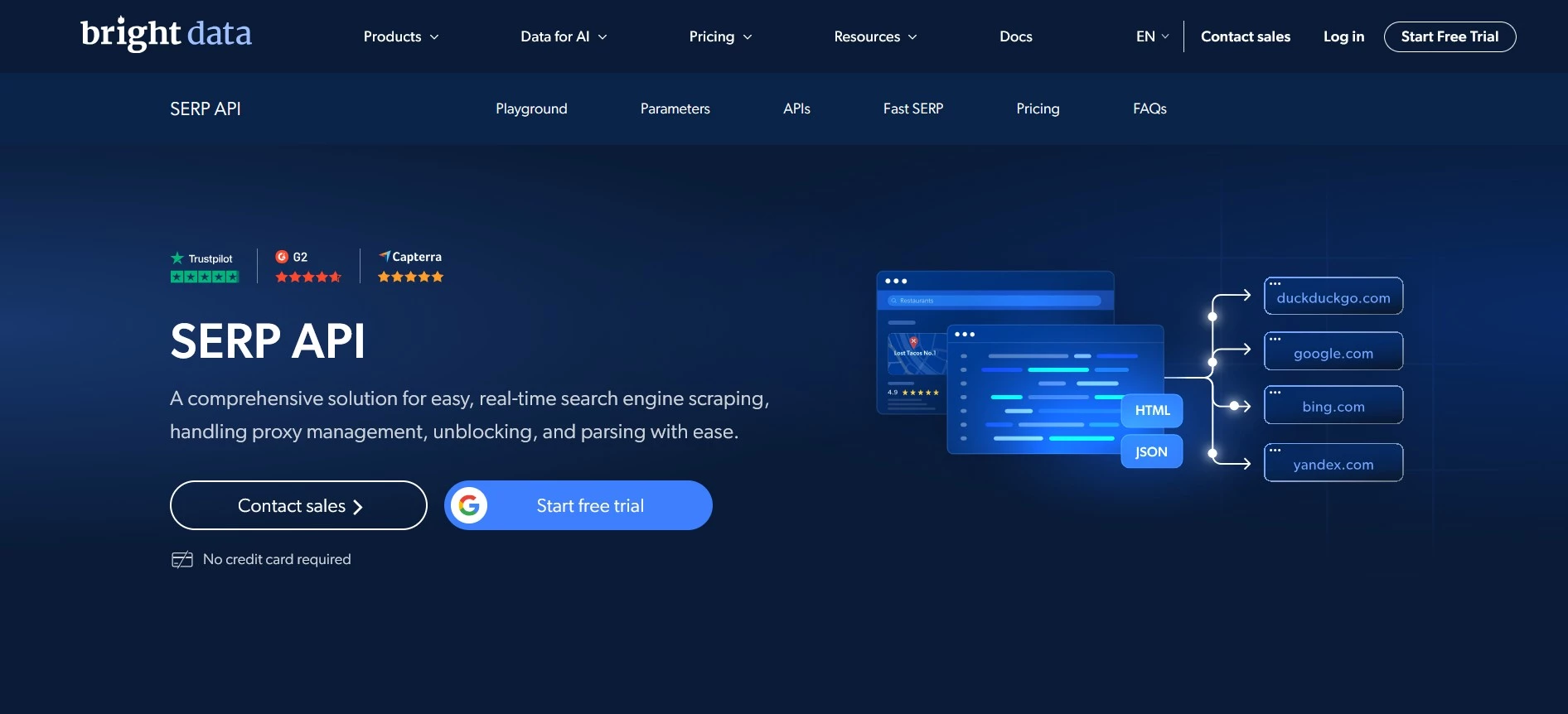
Bright Data offers an enterprise-grade SERP API for teams that need structured search data at scale, with native integration into its proxy network, scraping browser, and Dataset Marketplace, so enterprise teams can manage data acquisition through a single provider.
It supports flexible geo-targeting down to the city level and captures a wide range of SERP elements, including organic results, paid ads, maps, trends, images, and local packs through a single endpoint.
BrightData charges per successful request and handles proxy management, parsing, and CAPTCHA resolution automatically to reduce failed queries and infrastructure overhead for large-scale deployments.
Backed by a 150M+ IP network across 195 countries and trusted by 20,000+ customers globally, its infrastructure supports the reliability enterprise teams demand.
Backed by more than 400 million monthly proxy IPs across 195 countries and trusted by over 50,000 customers globally, its infrastructure supports the reliability enterprise teams demand.
Notable Features
- Cross-engine SERP support (Google, Bing, DuckDuckGo, Yandex, Baidu, Yahoo, and Naver)
- Real-time delivery with structured JSON/HTML output
- Fast SERP mode for AI agents, RAG pipelines, and latency-sensitive applications
- City- and country-level geo-targeting
- Pay-per-successful-request billing (no bandwidth fees)
- Built-in proxy management and CAPTCHA handling
- Integration into larger data pipelines and workflows
- Parsing and retries included without extra bandwidth charges
- ISO 27001, SOC 2 Type II, GDPR and CCPA compliant with a PwC-audited Trust Center
Pricing
- Free tier: 5,000 requests per month
- Pay-as-you-go: $1.5 per 1k requests
- 380k requests: $1.3 per 1k results
- 900k requests: $1.1 per 1k results
- 2M requests: $1 per 1k results
Scale your SERP data collection with 25% off for 3 months on the Scraper API using code APIS25. Claim your 25% discount.



2. cloro
Choose cloro when you need one API for traditional Google results and citation monitoring across major AI search platforms.
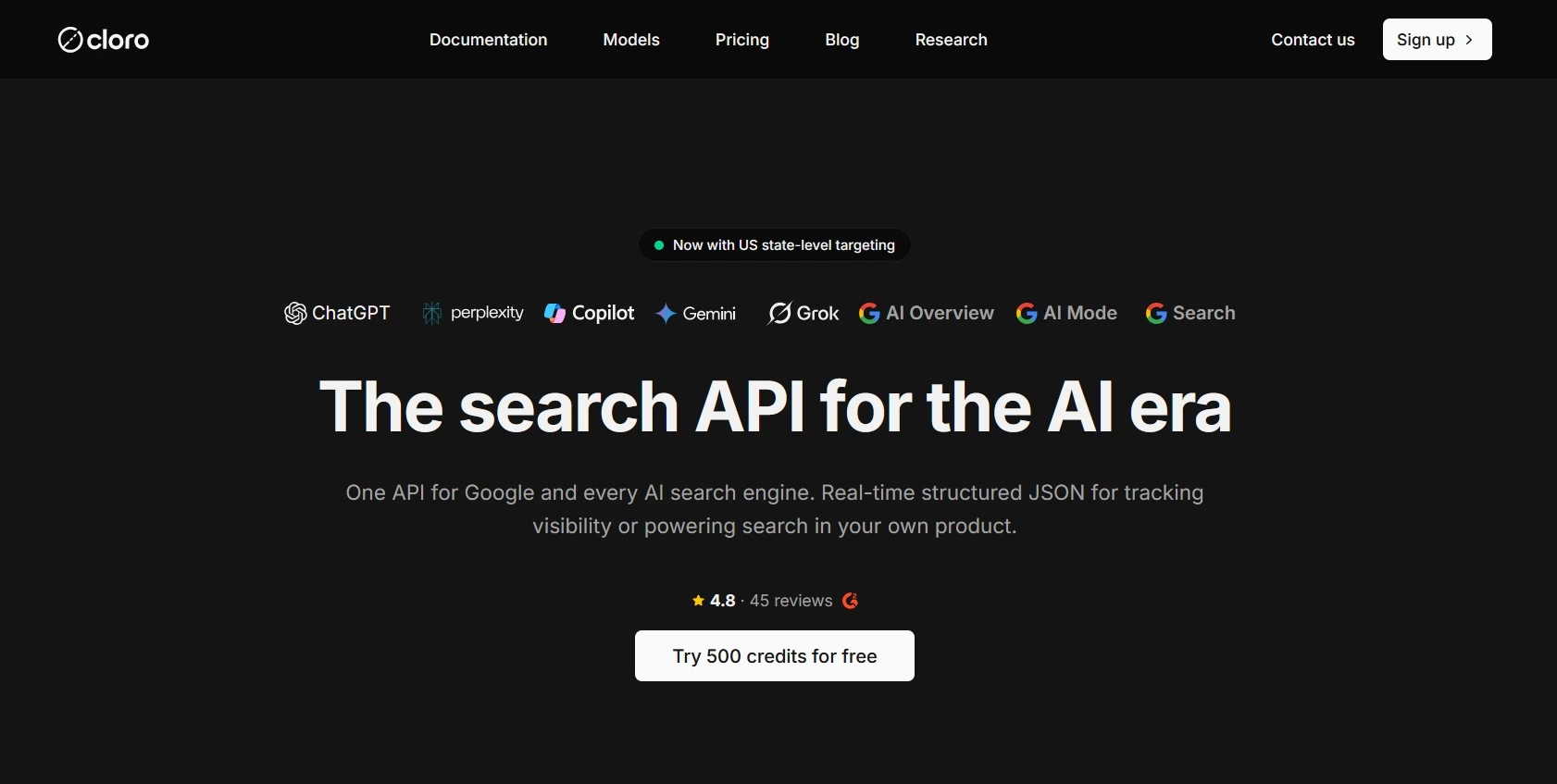
cloro combines traditional Google SERP extraction with AI search monitoring through one API. Its Google endpoint returns organic results, ads, People Also Ask questions, knowledge panels, related searches, and optional AI Overview content with cited sources.
Separate endpoints cover Google AI Mode, ChatGPT, Perplexity, Gemini, and Copilot. They return structured answer text, source URLs, citations, and surface-specific elements such as places and shopping results.
This gives SEO and GEO teams one data layer for comparing traditional rankings with visibility in AI answers, which is much easier for spotting gaps and tracking changes without separate monitoring systems.
A shared credit balance covers all endpoints, while available integrations include REST, Python and JavaScript SDKs, n8n, Zapier, LangChain, and MCP. Because pricing is credit-based, the cost of each request depends on the endpoint, result depth, and optional features used.
Notable Features
- Organic results, ads, People Also Ask, knowledge panels, and related searches
- AI Overview and AI Mode extraction with parsed sources and citations
- ChatGPT, Perplexity, Gemini, and Copilot data through one API
- Country-level targeting, with more granular location and device options on supported endpoints
- Extraction of up to 10 Google SERP pages in one request
- Python and JavaScript SDKs, plus n8n, Zapier, LangChain, and MCP integrations
Pricing
- Free: $0/month for 500 monthly credits
- Lite: $30/month for 37,500 credits
- Hobby: $100/month for 250,000 credits
- Google Search: Three credits for the first page, two additional credits for AI Overview, and two credits for each extra results page
Credit use varies by endpoint, result depth, optional features, and delivery method. Failed extractions don’t use credits, but unused monthly credits do expire.
3. SerpApi
SerpApi makes sense for products that need stable, richly parsed results across global search engines and Google search properties.
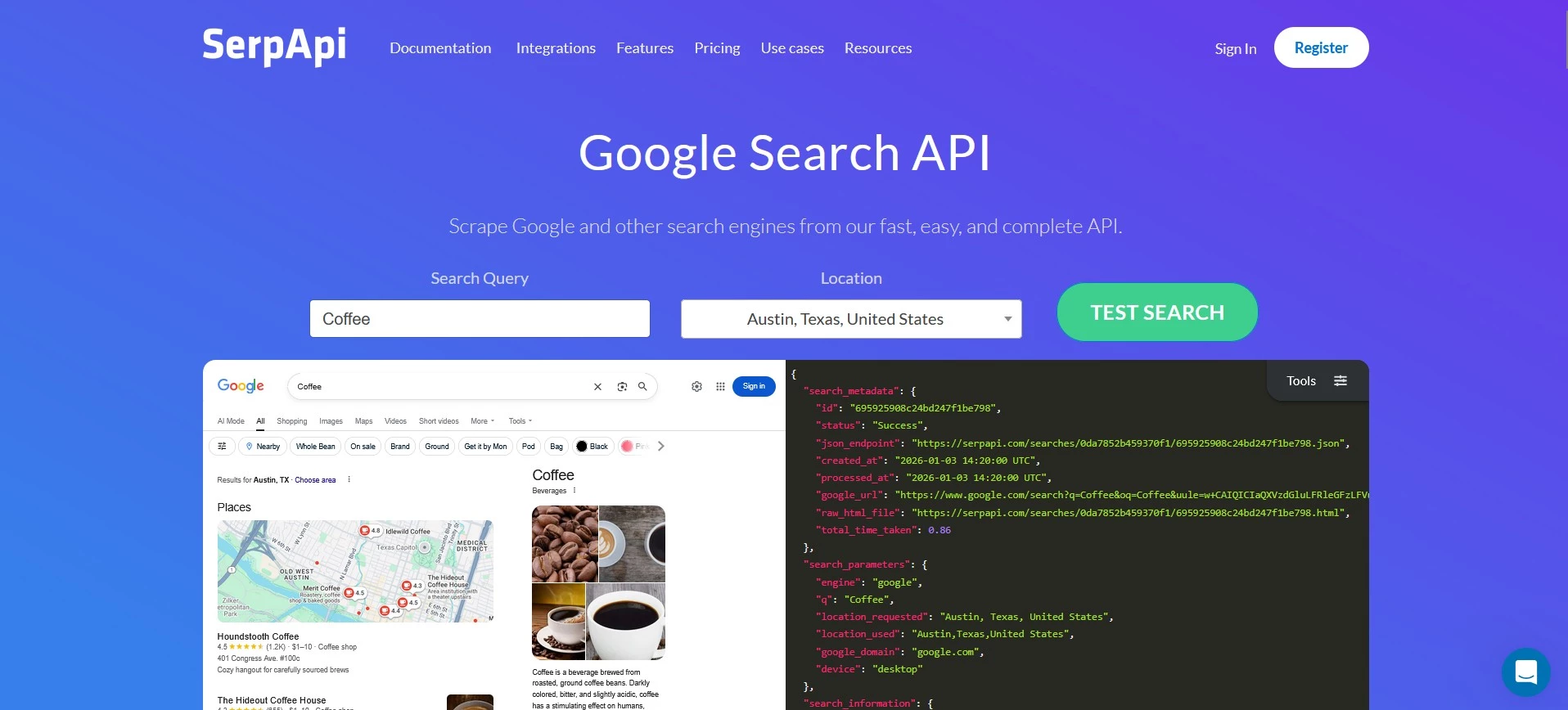
SerpApi is one of the most established SERP-focused APIs on the market, offering structured extraction from Google, Bing, Baidu, Yandex, Yahoo, DuckDuckGo, and other global engines. It parses organic results, paid ads, featured snippets, knowledge graphs, local packs, images, news, shopping listings, and additional SERP features into clean, normalized JSON responses.
The API supports advanced geo-targeting and device simulation, allowing requests to mimic searches from specific countries, cities, or devices. It also provides specialized endpoints for Google Maps, Google Shopping, Google Jobs, and other vertical search properties.
Real-time delivery, consistent schema formatting, and detailed documentation make integration straightforward for production environments.
Its long track record, high uptime, and predictable response structure make it especially reliable for SEO platforms, rank-tracking tools, and SaaS products operating at scale.
Notable Features
- Supports Google, Bing, Baidu, Yandex, Yahoo, DuckDuckGo, and more
- Structured parsing for organic results, ads, maps, shopping, news
- Advanced geo-targeting and device simulation
- Real-time API with consistent schema
Pricing
- Free trial available
- Starter: $25/month for 1,000 searches.
- Developer: $75/month for 5,000 searches.
- Production: $150/month for 15,000 searches
- Big Data: $275/month for 30,000 searches
4. Serper
Try Serper if you need fast Google results for an app, dashboard, or smaller SEO workflow without a complex setup.
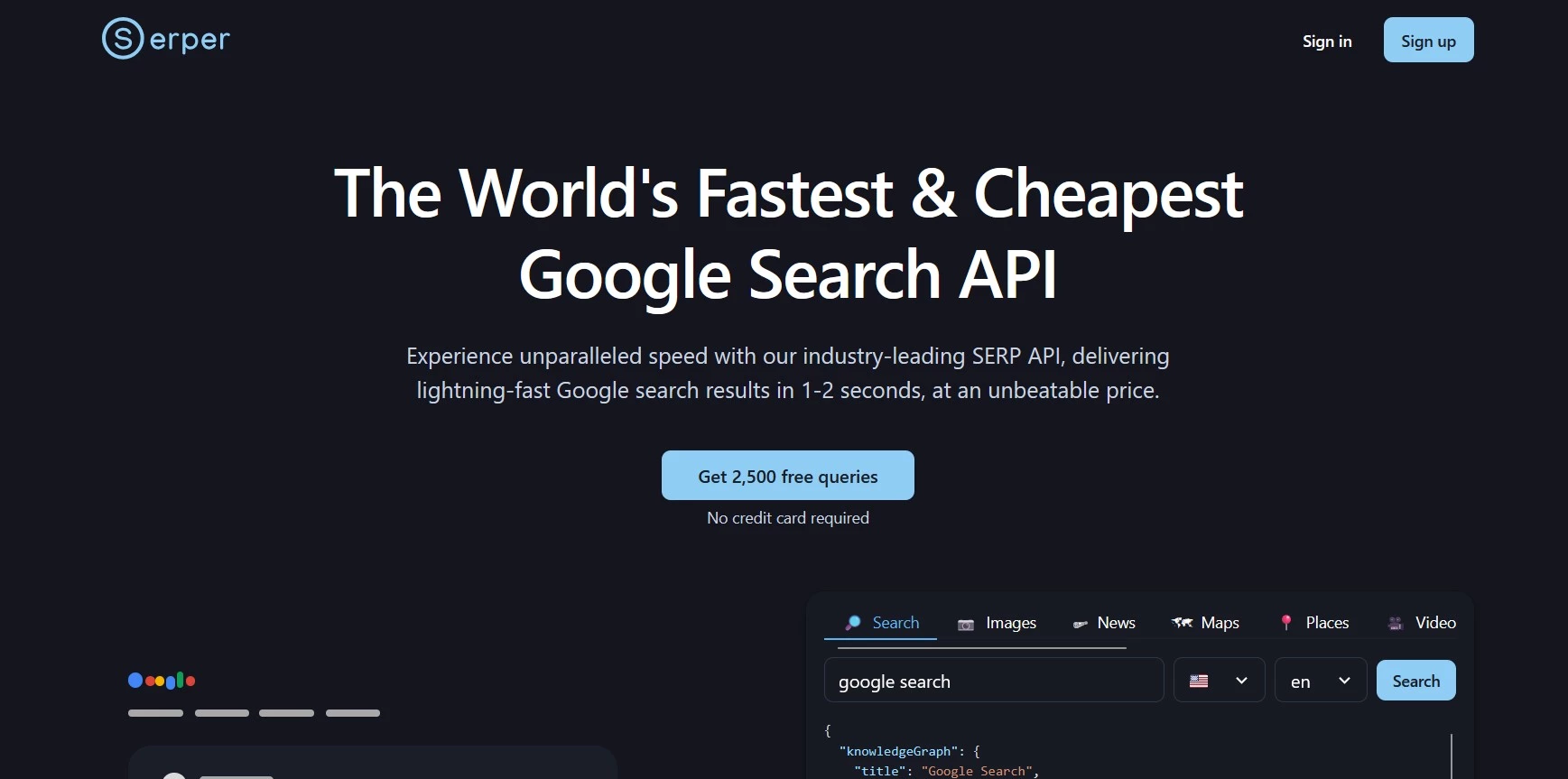
Serper focuses specifically on fast, cost-efficient Google Search API access. It supports web, images, news, maps, shopping, and autocomplete results, along with places, videos, Scholar, and Patents. It’s known for low-latency response times that make it suitable for real-time applications.
The API returns structured JSON output covering organic listings, paid ads, featured snippets, and local results, enabling straightforward integration into dashboards, monitoring tools, and automation workflows.
Serper is designed to reduce implementation overhead while maintaining consistent performance at scale, and offers simple REST endpoints, clear documentation, and predictable pricing.
Notable Features
- Real-time Google Search API
- Coordinate-level geo-targeting
- Structured JSON output (organic, ads, local, snippets)
- Dedicated endpoints for 10 Google search properties
- Simple REST API with clear documentation
Pricing
- Free tier (2,500 queries)
- Prepaid credits start at $50 for 50,000 queries
- Credits remain valid for six months
5. Scrapingdog
A practical choice for Google-heavy workflows requiring affordable access to SERPs, specialized search properties, and AI Mode.
Scrapingdog is a cost-conscious option for teams that need more than standard organic listings. Its Google SERP API returns organic results, ads, featured snippets, local results, People Also Ask questions, and AI Overviews as structured JSON while handling proxy rotation, CAPTCHAs, and parsing.
It also provides dedicated APIs for Google Maps, News, Shopping, Jobs, Trends, Scholar, Lens, and AI Mode. The AI Mode endpoint returns structured text blocks and references, which is useful to compare how sources and brands appear in Google’s conversational search results.
For broader coverage, its Universal Search API retrieves filtered results from Google, Bing, Yahoo, and DuckDuckGo in one call. This combination suits teams that want conventional SERP data, specialized Google datasets, and some AI-search coverage without enterprise-level pricing.
Notable Features
- Structured organic, paid, local, featured snippet, and People Also Ask data
- Google AI Overview and AI Mode extraction
- Dedicated APIs for Maps, Trends, Scholar, Lens, Jobs, News, and Shopping
- Universal Search API covering Google, Bing, Yahoo, and DuckDuckGo
- Built-in proxy rotation and CAPTCHA handling
- Country, language, location, and device targeting on supported endpoints
Pricing
- Free: $0 for 200 credits
- Lite: $40/month for 200,000 credits
- Standard: $90/month for one million credits
- Pro: $200/month for three million credits
- Premium: $350/month for six million credits
A standard Google SERP request consumes five credits, while advanced, mobile, and Google AI Mode requests consume 10. The Lite plan therefore covers up to 40,000 standard Google searches, equivalent to $0.001 per request.
6. DataForSEO SERP API
DataForSEO fits localized rank tracking and bulk analytics that require precise geographic targeting and flexible delivery.
DataForSEO provides a flexible SERP API suite designed for teams that need precise, location-specific search data at scale. It supports Google, Bing, Yahoo, Baidu, Naver, YouTube, and Seznam. Google requests support city-level and coordinate-based targeting, while localization options vary by engine.
DataForSEO offers live requests for real-time results and asynchronous processing for bulk jobs. Live mode suits dashboards and on-demand checks, while its standard and priority queues reduce the cost of scheduled tracking and larger keyword sets.
The API returns structured, normalized data across organic results, paid ads, featured snippets, and other SERP elements. Its architecture is particularly useful for SaaS platforms building, recurring rank monitoring tools, keyword tracking dashboards, or white-label SEO reporting systems.
Notable Features
- SERP APIs for Google, Bing, Yahoo, Baidu, Naver, YouTube, and Seznam
- Google and Baidu SERP APIs
- Hyper-granular geo-targeting
- Live and asynchronous task modes
- Pay-as-you-go pricing based on delivery mode and result depth
Pricing
- Free trial: $1 in account credit
- Standard queue: $600 per one million SERP pages
- Priority queue: $1,200 per one million SERP pages
- Live mode: $2,000 per one million SERP pages
These rates cover 10 search results per SERP page. The cost rises with greater result depth and some optional parameters.
7. SearchAPI.io
Consider SearchAPI.io for dependable real-time Google data, coordinate-level targeting, and straightforward REST integration.
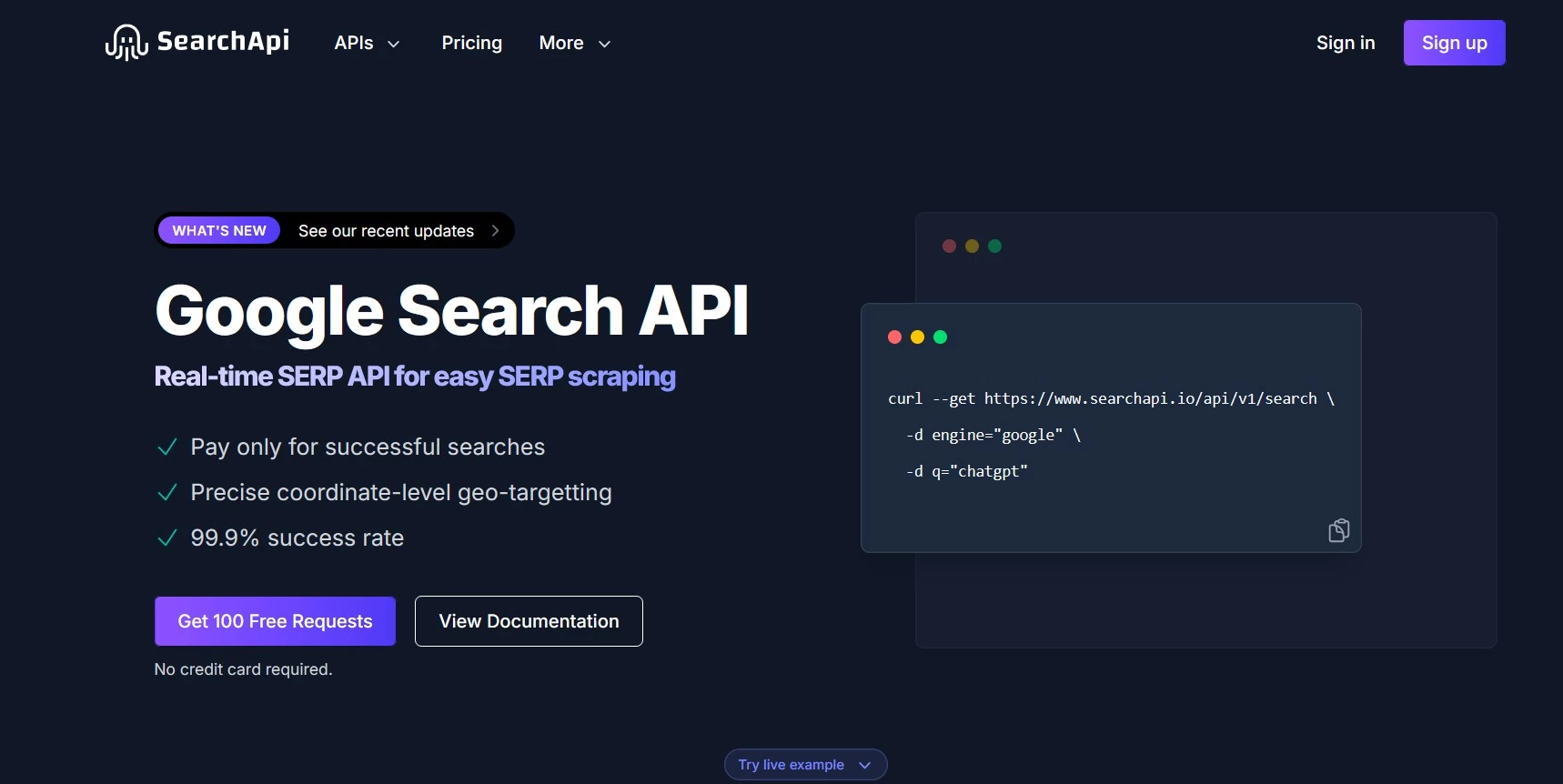
SearchAPI.io delivers a real-time Google Search API designed for developers who need consistent, production-ready SERP data without managing proxies, browser automation, or CAPTCHA handling.
It supports precise geo-targeting down to the coordinate level, enabling highly localized SERP retrieval for rank tracking, local SEO monitoring, and market intelligence use cases.
The API returns structured JSON responses covering organic listings, paid ads, featured snippets, local packs, and other common SERP features.
SearchAPI.io positions itself as a streamlined, high-availability solution for teams that prioritize uptime, predictable performance, and clean integration over complex scraping infrastructure. The vendor reports a 99.9% success rate, while paid plans include a 99.9% SLA.
Beyond Google, the platform also provides endpoints for Bing, Baidu, Yandex, DuckDuckGo, Yahoo, and Naver, as well as Google AI Mode, Gemini, Perplexity, ChatGPT, and Bing Copilot.
Notable Features
- Real-time Google Search API
- Precise coordinate-level geo-targeting
- Structured JSON output
- Simple REST integration
Pricing
- Free: 100 requests
- Developer: $40/month for 10,000 searches
- Production: $100/month for 35,000 searches
- Big Data: $250/month for 100,000 searches
8. Zenserp
Zenserp works well for smaller teams building internal ranking or monitoring tools with a lightweight API.
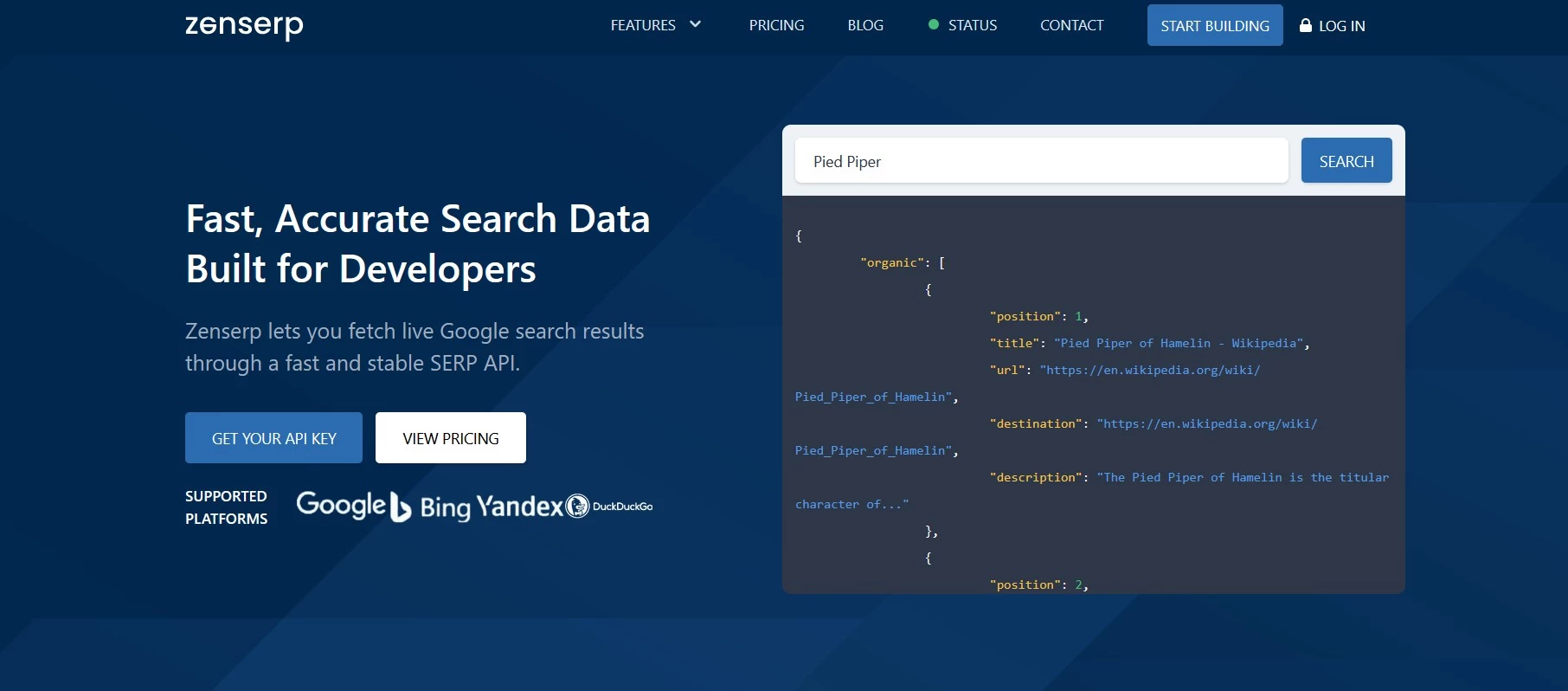
Zenserp focuses on delivering accessible Google SERP data without unnecessary complexity. It supports web, images, shopping, maps, and news endpoints, returning structured JSON designed for straightforward integration into internal tools and dashboards.
The platform is intentionally lightweight. Its documentation is clear, endpoints are predictable, and implementation doesn't require advanced scraping infrastructure knowledge. That simplicity suits teams that want reliable SERP access without overengineering their stack.
Its entry plan is aimed at smaller projects, while higher tiers add batch processing, SLAs, custom queues, and capacity for up to one million searches per month. This allows an internal tracker to grow into a larger monitoring workflow without needing a new integration.
Notable Features
- Google SERP extraction
- Localized results
- Shopping and maps endpoints
- Developer-friendly API
Pricing
- Free tier available
- Small: $49.99/month for 25,000 searches
9. Oxylabs SERP Scraper API
Oxylabs is geared toward organizations prioritizing governance, scale, and dependable delivery across large SERP workloads.
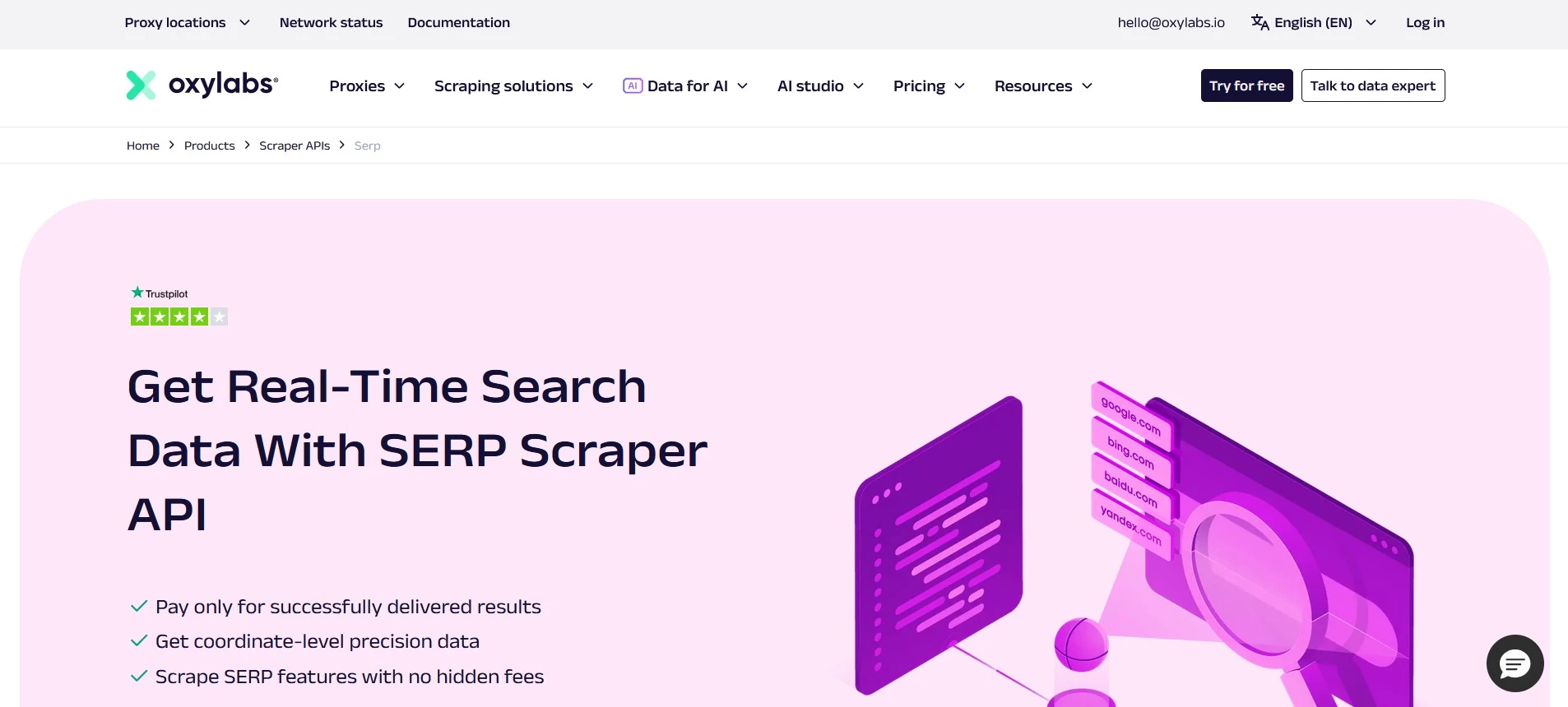
Oxylabs delivers SERP data through its broader Web Scraper API, built on the company’s established proxy and data infrastructure. It supports Google, Bing, Baidu, and Yandex, returning either HTML or structured JSON for high-volume and compliance-sensitive environments.
Oxylabs supports real-time and batch collection, coordinate-level targeting, automated scheduling, CAPTCHA handling, and JavaScript rendering. These capabilities limit the amunt of infrastructure teams need to maintain for large or recurring SERP workloads.
It's made for organizations with strict data governance, procurement requirements, and infrastructure standards. Its Web Scraper API holds ISO/IEC 27001:2022 and SOC 2 Type 2 certifications. For corporations, data providers, or analytics platforms operating at significant scale, Oxylabs provides stability and compliance assurances.
Notable Features
- Google, Bing, Baidu, and Yandex coverage
- AI targets including ChatGPT, Perplexity, Gemini, and Google AI Mode
- HTML or structured JSON output
- Coordinate-level geo-targeting
- ISO/IEC 27001:2022 and SOC 2 Type 2 certification
Pricing
- Free trial: Up to 2,000 results, with no credit card required
- Micro: $49/month; $1 per 1,000 Google results, $1.15 for other targets, or $1.35 with JavaScript rendering
10. HasData SERP API
HasData suits agencies and internal teams that need affordable multi-engine data for reporting, regional monitoring, or analytics.
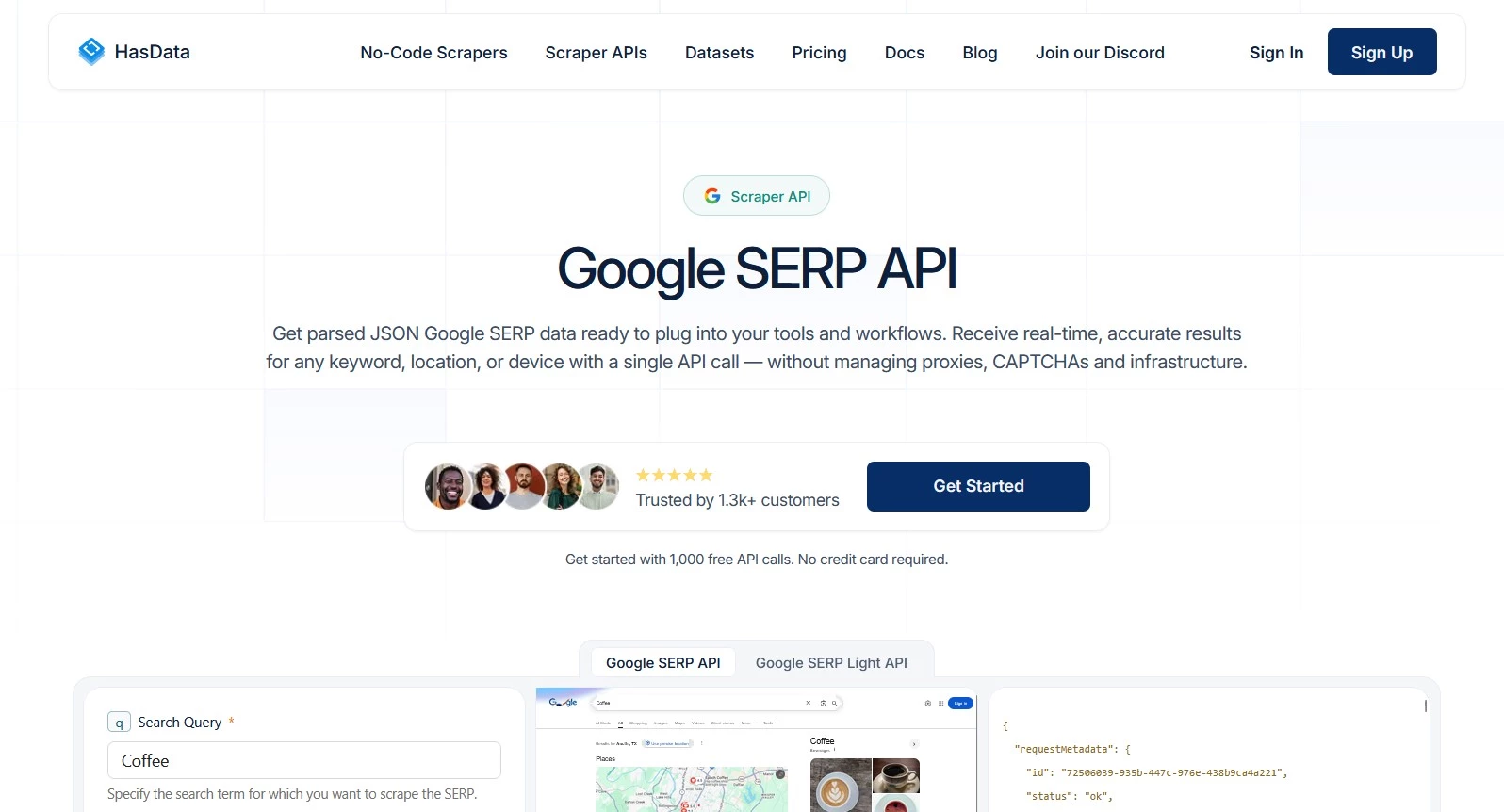
HasData offers structured SERP APIs across Google, Bing, and DuckDuckGo through one account. Its Google API parses organic results, ads, AI Overviews, local packs, People Also Ask, shopping results, and other SERP features into structured JSON.
The platform emphasizes affordability and accessibility with pricing tiers positioned to accommodate agencies and mid-sized teams that need consistent SERP data but not enterprise contracts or high minimum commitments.
HasData strikes a practical middle ground with broader engine support than single-engine APIs, but with a simpler pricing model than enterprise-focused providers. It combines multi-engine coverage with city-level targeting, batch requests, and separate APIs for Google AI Overview and AI Mode.
For agencies managing multiple client campaigns or regional search monitoring, it offers flexible multi-engine coverage without major infrastructure overhead.
Notable Features
- Google, Bing, and DuckDuckGo SERP APIs
- Google AI Overview and AI Mode support
- Structured organic and paid result parsing
- City-level and device targeting
- RESTful and batch API access
Pricing
- One-time free trial: 100 SERPs, with no credit card required
- Startup: $49/month for 20,000 SERPs
SERP Scraper APIs Compared
Here’s how 10 contenders for the best SERP API compare on search coverage, geo-targeting, delivery, published response time, and entry price.
| Provider | Search and AI coverage | Geo-targeting | Delivery | Published response time* | Starting price |
| Bright Data | Google, Bing, DuckDuckGo, and Yandex | City-level and more precise options | Real-time | 5.58s | $1.50 per 1,000 results |
| cloro | Google, AI Overviews, AI Mode, ChatGPT, Gemini, Perplexity, and Copilot | Country-level, with more precise options on supported endpoints | Synchronous and asynchronous | Not reported | Free; paid from $30/month |
| SerpApi | Google, Bing, Baidu, Yandex, Yahoo, and DuckDuckGo | City and device | Real-time | 5.49s | $25/month |
| Serper | Google Search and related properties | Coordinate-level | Real-time | 2.87s | Free; paid from $50/month |
| Scrapingdog | Google properties, plus Google, Bing, Yahoo, and DuckDuckGo through Universal Search | Country, language, location, and device where supported | Real-time | 1.83s | Free; paid from $40/month |
| DataForSEO | Google and Baidu | City and coordinate-level | Live and asynchronous | Not reported | ~$600 per million requests |
| SearchAPI.io | Google Search and related properties | Coordinate-level | Real-time | 2.96s | ~$40/month |
| Zenserp | Google Search, Images, Shopping, Maps, and News | Localized results | Real-time | Not reported | Free; paid from $49.99/month |
| Oxylabs | Google, Bing, and other search engines | Advanced geo-targeting | Real-time | Not reported | ~$1.35 per 1,000 results |
| HasData | Google, Bing, Baidu, and Yandex | Geo-targeted queries | Real-time | 3.80s | Free trial; paid from $49/month |
Note: Prices reflect different billing units. Compare costs using the same result depth, delivery method, device type, and AI Overview requirements.
Response times come from a January 2026 Scrapingdog comparison based on 50 randomized requests, with some timings drawn from individual tests. Since Scrapingdog was also evaluated and latency varies by setup, it’s best you treat the figures as directional, not independent benchmarks.
How to Choose the Best SERP Scraper API
Don’t go straight for the cheapest plan, start with the workload. Live applications, scheduled rank tracking, GEO monitoring, and enterprise data pipelines place different demands on an API.
Compare providers across these criteria:
- Coverage and accuracy: Check the required engines, SERP features, AI surfaces, locations, languages, and devices. Validate a sample against browser results from the same location and confirm that fields such as citations and source URLs are complete.
- Performance at scale: Test 50 to 100 representative queries under sustained load. Compare success rate, p95 response time, retries, and concurrency rather than relying on one fast request.
- True cost and result depth: Finding the cheapest SERP API requires pricing the same workload across vendors, including the required result depth. Factor in additional pages, live delivery, mobile rendering, AI Overview extraction, and whether billing is per task, credit, subscription, or successful request.
- Infrastructure and continuity: Ask whether the provider operates its own network or resells capacity, how residential and ISP addresses are sourced, and what happens if an upstream supplier is disrupted. Google’s 2026 actions against IPIDEA and NetNut show why this matters.
- Compliance and legal posture: Review data handling, retention, audited certifications, consent-based IP sourcing, and contract terms covering outages or service termination.
- Integration and portability: Check for REST endpoints, SDKs, webhooks, proxy mode, MCP, and LangChain support. A portable schema and access to raw responses can also reduce the cost of switching providers.
- Trial adequacy: Confirm that the trial includes the endpoints, features, concurrency, and query volume needed for a representative test.
Weight those criteria according to the workload:
| Workload | Prioritize |
| Live dashboards and AI agents | Accuracy, p95 latency, concurrency |
| Scheduled rank tracking | Geo accuracy, asynchronous delivery, cost at depth |
| GEO and AI visibility monitoring | AI-platform coverage, citation fields, result completeness |
| Enterprise and SaaS pipelines | Infrastructure, compliance, SLAs and portability |
When a Free Google SERP Scraper API Is Enough
Free plans can help you find the best search engine API for a prototype or light monitoring workflow before committing to a paid tier:
- Serper: 2,500 queries for initial testing
- SerpApi: 250 searches per month
- cloro: 500 monthly credits across its search and AI endpoints
Check what each allowance covers because credits don’t always equal requests, and free tiers may limit concurrency, features, or support. For production use, treat them as a way to compare accuracy, output, and integration before choosing a paid plan.
The Best SERP API Balances Accuracy, Depth, and Cost
SERP APIs now support both traditional rank tracking and AI-search monitoring. Depending on the provider, they can return localized organic and paid results, AI Overviews, AI Mode answers, and cited sources. The real differences come down to accuracy, result depth, latency, infrastructure, and what each request ultimately costs.
Define your workload, test the same query set across two or three providers, and go beyond advertised request limits to compare usable responses. The best choice will deliver complete, accurate data at the required speed and scale without forcing a costly rebuild.
Our team ranks agencies worldwide to help you find a qualified partner. Visit our Agency Directory for the top IT services companies, as well as: