Best Darien Mobile App Developers

3 Companies - Rankings updated: April 01, 2026

DesignRush assesses agencies using expertise standards and verified client experiences to help you make better decisions. Certain agencies have paid placements.

United States × Connecticut × Darien ×
  • Innovative Apps. Seamless Experiences.

    At Pixel Glume, we prioritize seamless user experiences, functional design, and timely project delivery. Our development process is transparent, collaborative, and results-driven, ensuring every project we undertake leads to measurable success for our clients.  [... view Pixel Glume profile ]
    Location
    Darien, Connecticut
    Number of Employees
    50 - 99
    Average Hourly Rate
    $35/hr

    Pixel Glume Services

    • Mobile App Development
    Data sourced from the agency's DesignRush profile, its website, and other relevant accounts

    Pixel Glume Reviews & Testimonials

    • Robin Thompson
      Robin Thompson Review from Google
      5.0

      Robin Thompson's Review Sourced from Google

      Starting from scratch. Been interesting. Emily has been very helpful and creative. Looking forward to see some great results for my new on line shop!

      Show more
    • Emily Foster
      Emily Foster Review from Google
      5.0

      Emily Foster's Review Sourced from Google

      Pixelglume was recommended to me by a colleague and now I know why. The process was seamless from the start and they really took the time to understand my needs. The final result was polished functional and beautifully designed. Their team knows what they’re doing. Highly recommended for any creative web work

      Show more
    • Edna White
      Edna White Review from Google
      5.0

      Edna White's Review Sourced from Google

      The technology works consistently and the web app launched successfully. Pixel Glume was professional, and responsive, maintaining a strong work ethic throughout the process.

      Show more
    Reviews verified by DesignRush and sourced from the agency's profile
    • Carowinds
    • SHELBY COUNTY
    • The Princeton Review
    Data sourced from the agency's DesignRush profile
  • Your Gateway to Next-Gen Mobile Apps.

    Appscord specializes in mobile app development, hybrid apps, PHP, Laravel, and web solutions, crafting high-performance, scalable, and user-friendly applications to drive business growth with innovation and precision.  [... view Appscord profile ]
    Location
    Darien, Connecticut
    Number of Employees
    50 - 99
    Average Hourly Rate
    $50/hr

    Appscord Services

    • Mobile App Development
    • eCommerce Development
    • Web Development
    Data sourced from the agency's DesignRush profile, its website, and other relevant accounts

    Appscord Reviews & Testimonials

    • Rebecca Wollensack
      Rebecca Wollensack Review from Google
      5.0

      Rebecca Wollensack's Review Sourced from Google

      "Working with Appscord was a smooth experience from start to finish. I had no technical background, but their team explained everything in simple terms and kept me updated throughout the app development. The final product exceeded my expectations, and even after launch, they were quick to assist with updates. Really appreciated their professionalism."---

      Show more
    Reviews verified by DesignRush and sourced from the agency's profile
    • Cloudbox
    • Finovance
    • DTDS Technology
    Data sourced from the agency's DesignRush profile
  • Transforming Ideas into Digital Reality

    540 Interactive specializes in developing cutting-edge digital products for both web and mobile platforms, delivering market-leading solutions.  [... view 540 Interactive profile ]
    Location
    Darien, Connecticut
    Number of Employees
    Under 49
    Portfolios Count
    2 Projects Listed

    540 Interactive Services

    • Web Design
    • Web Development
    • WordPress Website Design
    • Mobile App Development
    • eCommerce
    • Software Development
    • SEO
    • IT Services
    • Creative Services
    Data sourced from the agency's DesignRush profile, its website, and other relevant accounts

    Clients and Projects

    View Full Portfolio
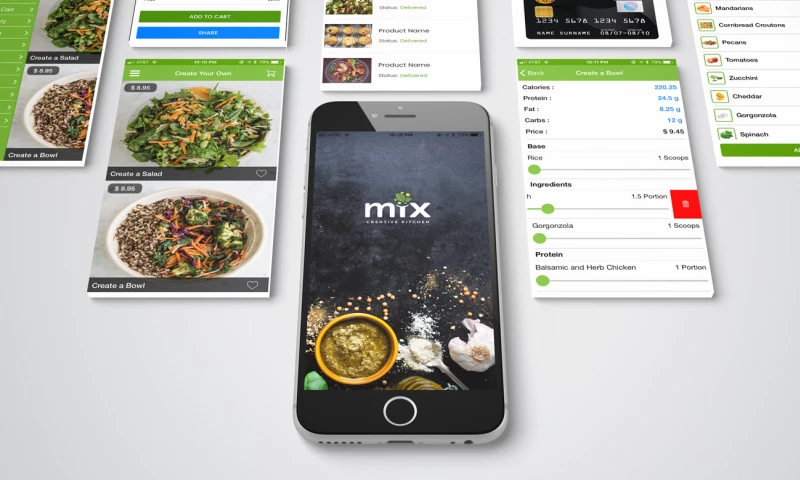
    • Myx Kitchen
      App Development Project Myx Kitchen
    Comprehensive analysis done by DesignRush Agency Experts.
    • Acsel Health
    • Mcardles
    • Alphabet Productions
    • Green & Tonic
    • Myx Kitchen
    • Allied Restoration
    • Greenwich Pharmacy
    • LMCV Ventures
    • Hana Soukupova
    • Inclusive Advisors
    Data sourced from the agency's DesignRush profile

Frequently Asked Questions

What services do app development companies provide?

App development services span the software development lifecycle: discovery and planning, mobile app design, custom software development, testing, and launch. Core services are: 

  • Product strategy and discovery: Establishing business goals, target users, technical requirements, and development roadmap. 
  • UI/UX design: Crafting the mobile solution's user flows, wireframes, information architecture, design system, and interactive elements (e.g., buttons and menus) to ensure brand consistency and frictionless user experience. 
  • Native app development: Producing mobile applications specifically for iOS or Android for maximum performance and access to device features. 
  • Cross-platform development: Building apps for iOS and Android from a shared codebase, balancing speed-to-market with app performance and maintainability. 
  • Web app development: Engineering browser-based applications that don’t require installation and can be deployed quickly across mobile and desktop devices. 
  • Hybrid app development: Packaging a web app inside a native container (WebView) to ship through app stores.  
  • QA and testing: Conducting functional, usability, performance, compatibility, security, and regression tests to ensure that the app meets industry and client standards before deployment. 
  • System integration: Connecting the app to existing systems (e.g., CRM, ERP, payments) through APIs for consistent data flow. 
  • Release and deployment: Managing app store submissions, implementing CI/CD pipelines, monitoring app performance, and providing incident response.  
  • Ongoing maintenance and support: Updating the app for OS changes, fixing bugs, optimizing performance, installing security patches, and enhancing features.  

In addition to these app development services, many companies also offer digital marketing services to support software growth. This includes app store optimization, social media marketing, and paid advertising. 

When should you choose a native app development or cross-platform app development?

The answer depends on your target users, budget, timeline, UX expectations, technical requirements, and the expertise of your chosen mobile app development company. Here is a breakdown of each one to help you in your decision: 

 Native app developmentCross-platform app development 
Advantages
  • Strong performance, security, and stability
  • Highly polished, platform native UX
  • Access to OS features, resulting in high customizability
  • Faster and more cost-effective to launch on both iOS and Android devices
  • Shared codebase simplifies feature parity
  • Easier maintenance, as you’ll only need one team to manage the app
Considerations
  • Cost and timelines double if you are targeting both Android and iOS 
  • Maintenance also doubles, as you will have to manage apps separately
  • Some features still require platform-specific work 
  • Requires extra UI/UX work for apps to feel truly native 
  • Larger digital footprint, often resulting in lower app performance 
Best For
  • Apps with heavy device integration or demanding performance (e.g., advanced AR and intensive on-device processing)
  • Apps where speed-to-market and broad reach matter most (e.g., business apps and eCommerce marketplaces)

What is the difference between a PoC, prototype, and MVP?

A proof of concept (PoC) is used to validate the technical feasibility of an application for new technologies, like AI development or complex integrations. While a PoC isn’t production-ready, it helps reduce technical risk early.  

A prototype is a clickable or interactive model that simulates functionality without the full backend. It is ideally used to test user flows, information architecture, and design direction with stakeholders or early users. 

A minimum viable product (MVP) is an early version of the final app and only has the core features and functions. Unlike a prototype, an MVP involves both software development and design, enabling developers to confirm product-market fit and conduct real user testing. 

Because an MVP involves real build, deployment, and measurement, it often requires longer timelines and bigger budgets than a PoC or prototype. 

How to choose the best tech stack?

The best mobile app development tech stack will depend on your priority (speed to market vs peak performance), required device features, UX expectations, compliance and security needs, and long-term maintainability.  

Most decisions begin with a platform approach: 

Native Development (best-in-class performance) 

  • Android app: Kotlin, Java, Android Studio, Android SDK with Jetpack Compose or Views/XML 
  • IOS app: Swift, Objective-C, Xcode, iOS SDK with SwiftUI or UIKit 

Cross-Platform and Hybrid App Tech Stack (faster multi-platform delivery) 

  • Flutter is best for a highly consistent UI across iOS and Android and fast iterations. 
  • React Native is ideal if your team is an expert in React/JS, and you want to move quickly with broad library support.  
  • Kotlin is recommended if you want to share core logic but have a native UI. It’s also often used for complex apps and features. 
  • .NET MAUI is best for internal business software that requires seamless integration with existing Microsoft systems. 
  • Ionic is often used for progressive web app developments and is best for teams with web development skills but want to ship to app stores. 

How do app development firms secure data?

A custom mobile application development company secures data by combining a secure development lifecycle with technical controls, including:  

  • DevSecOps (Shift Left): Conducting security tests throughout the development pipeline instead of a single phase, which involves threat modeling, secure coding standards, code reviews, and automated security checks in CI/CD. 
  • Dependency/SDK risk management: Vetting third-party software development kits (SDK) and open-source libraries. 
  • Strong authentication and access control: Implementing multi-factor authentication when appropriate, role-based access controls (RBAC), least privilege, and secure session/token handling.  
  • Encryption and key management: Conducting encryption in transit (TLS) and at rest when needed, with proper key handling and secrets management. 
  • Secure mobile storage: Using platform-provided secure storage (iOS Keychain / Android Keystore) and avoiding sensitive data in logs. 
  • Backend/API protection: Securing API design and running server-side authorization checks, rate limiting, and input validation. 
  • Mobile hardening (as needed): Implementing techniques like jailbreak or root detection, tamper resistance, and selective use of certificate pinning. 
  • Privacy-by-design: integrating clear permission prompts and consent flows aligned with privacy requirements and platform policies. 

About The Author and Expert Reviewer

Selina Garcia has authored 500+ articles and edited 50+ published books in economics, law, and history. Her unique blend of experiences allows her to approach content creation from a well-rounded perspective. Currently, Selina applies her expertise to producing insightful articles on IT, software, and applications for DesignRush.

Former Development Director

Sergio is a technology leader with over six years of experience managing global teams and delivering projects across fintech, sportstech, and B2B platforms. At DesignRush, he drove product growth and development execution, building tools that speed up processes by 95% and cut costs by 35% while maintaining full uptime.