-details-webp.webp)

I’ve steered teams through both in-house builds and outsourced partnerships, and I’ve seen both models succeed and fail.
Sometimes the right move is bringing in external support to meet a tight launch; other times, it’s slowing down to upskill your internal team.
In-House vs. Outsourcing Software Development: Key Points
- If internal ramp-up (hiring, onboarding, and setup) consumes over 25–30% of your timeline, outsource or go hybrid to accelerate delivery.
- Outsource specialized or high-skill modules but keep proprietary workflows, compliance-heavy systems, and customer data in-house.
- Let internal teams own architecture, UX, and security while vendors handle modular builds or QA. Enforce shared pipelines and clear ownership boundaries.
Software In-House vs. Outsourcing Overview
I’ll show how I analyze timelines, costs, and risk factors to choose the right model and when to shift as the business evolves.
How I Decide Based on Project Timeline
In one replatform project I led, the choice between inhouse vs. outsource software development made a dramatic difference:
Option | Estimated Duration | Reason |
In-house build | ~26 weeks | Hiring, ramp-up, and full QA cycles added major overhead |
Outsourced | ~15 weeks | Fully staffed team + automated CI/CD pipelines cut the timeline in half |
That’s when I realized: Time-to-Value (TtV) matters more than cost. I calculate it like this:
- In-house: TtV = time-to-hire + notice period + onboarding + ramp + build time
- Outsource: TtV = vendor selection + onboarding + build time
Rule: If ramping eats more than 25–30% of the timeline, I outsource or run a hybrid mode.
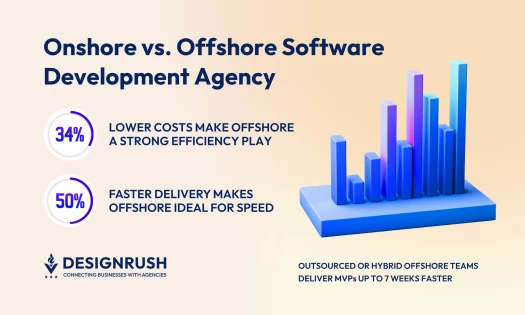
In fact, outsourcing can cut onboarding time by roughly 25% versus building an internal team.
Jason Ciment, Co-Founder and CEO of Get Visible, explains:
“When you outsource, this is the only thing we’re doing – I’ve got a team that this is all they’re doing eight hours a day.
This way, you’re getting the benefit of multiple brains looking at your situation and trying to figure out how to improve it.”
Still, even with external expertise, delays can creep in from frictions like overlooked approvals or access issues.
I mitigate that with three non-negotiables:
Risk Area | Preventive Rule |
Compliance & access | Handle both from day zero |
Decision bottlenecks | Set clear decision rights early |
Time zone gaps / Miscommunication | Schedule 3–4 hours of daily overlap with vendor leads |



Matching Project Complexity to the Right Team
Complex, multi-discipline projects often need external expertise, while iterative, domain-heavy work stays best in-house.
For example, when building a microservices platform with commerce integrations and a mobile app, my internal team had only handled monoliths. I paired them with an agency to architect the platform, set up CI/CD pipelines, and manage integrations.
Internal developers focused on content and experimentation. After a few releases, we transitioned most development back in-house under a new lead.
Outsourcing gave us instant access to skills like performance tuning and cloud optimization that would have taken months to hire.
By contrast, in regulated workflows like claims processing or financial underwriting, I keep work internal. Institutional knowledge and compliance risk make outsourcing tricky in those cases.
My actionable takeaways:
Rule | How I Apply It |
Outsource complex, high-skill modules | Bring in vendors for AI, cloud, or integrations that your team lacks experience in |
Keep core IP internal | Proprietary workflows, compliance-heavy tasks, or iterative discovery should stay in-house |
Pair and document | Embed knowledge transfer into vendor work to avoid black boxes and preserve future insourcing flexibility |
Understanding True Costs: In-House Software Development vs Outsourcing
Outsourcing can feel cheaper, but the total cost of ownership (TCO) tells a different story.
I always calculate fully loaded internal costs: salary, benefits, recruiting, training, tools, and ongoing support.
For example:
Item | In-House | Outsourcing |
Developer salary | $48–$49/hr average globally (rates vary per region) | |
Benefits & overhead | Typically included | |
Tools & training | $10–20k/year | Typically included |
Productivity ramp | 2–3 sprints (up to 8 months) | Immediate, depending on the vendor |
By contrast, even with fees and overhead, experienced agencies often deliver faster and cleaner results. Fixed-fee contracts need a small contingency (15–20%), but that’s a fraction of the cost of hiring.
63% of companies cite cost savings as a key outsourcing benefit.
- Quality & tech debt: Cheap vendors may introduce defects or shortcuts that cost 2–3× more in maintenance later.
- Cost-of-Delay: Every week your internal team takes to ramp up can delay revenue.
- Turnover risk: Recruiting new internal staff can add months of delay and hidden costs.
- Quantify quality impact. Factor in post-launch defects and tech debt when comparing options.
Managing Workload Peaks and Flexibility Needs
Engineering teams are rarely in a steady state. I’ve seen cycle times spike 40% when internal capacity hits its limits.
Outsourcing lets you scale quickly: a full external team (tech lead + 3–5 devs + QA) can start delivering in days, whereas hiring takes months.
My actionable takeaways:
Signal | Recommended Action | Reasoning |
Demand >1.5× internal capacity | Outsource modular tasks | Prevents cycle-time bottlenecks |
Short-term or modular projects | Scale external teams | Quick scaling without long-term hiring |
Complex features needing multiple skills | Outsource full teams | Access diverse expertise instantly |
Minimizing Risk: Security, Compliance, and Reliability
Vendors often bring maturity in areas internal teams haven’t built yet, including SOC2/ISO compliance, penetration testing, and secure SDLCs.
That said, internal teams still offer ultimate control. In finance, healthcare, and government, I always keep source code, production data, and audit logs in-house.
Outsourcing works best for modules that don’t touch sensitive data but still benefit from specialized skills or additional capacity.
- Sensitive data = in-house. For PII, HIPAA, and PCI, keep development internal.
- Vet vendors thoroughly. SOC2/ISO certifications, secure SDLC, access control, and architecture diagrams are non-negotiable.
- Enforce knowledge control. Have internal reviews on every critical change, even for outsourced code.
Picking the Right Model for Your Industry
Match your team model to your industry’s priority and risks:
Industry | Recommended Approach | Rationale |
Finance & healthcare | Keep core in-house, outsource non-critical work | Compliance-heavy; IP and sensitive data remain internal |
Retail & eCommerce | Outsource for spikes & rapid rollouts | Seasonal demand; agencies can spin up entire pods in weeks (e.g., Black Friday features) |
SaaS & tech | Outsource experimental features, core in-house | Speed and innovation are key; protect core IP while leveraging external talent |
Media & entertainment | Outsource trend-driven creative work | Global agency expertise provides fresh ideas and fast execution |
Manufacturing & logistics | Hybrid | Internal core systems, external teams for innovation, portals, or less critical layers |
Government & education | Mostly in-house | Procurement rules, transparency, and regulatory oversight limit outsourcing |
Creating a Hybrid Model That Combines Speed and Control
Hybrid models are the most practical: internal teams own strategy, architecture, UX, and security, while vendors execute well-defined modules, QA, and non-core features.
I once ran a project where the vendor built a design system and backend framework while internal devs coded main user flows.
Here’s my hybrid model playbook:
- Define clear ownership. Internal teams make decisions; vendors execute.
- Use shared processes and tools. Avoid integration chaos by keeping pipelines, repos, and ceremonies unified.
- Plan phased handovers. Pair internal and vendor developers, migrate modules incrementally, and enforce SLAs.
In-House vs Outsource Software Development: Final Words
The choice between software in-house vs. outsourcing is never binary. I’ve learned to take a pragmatic, data-driven approach instead of treating it as an either-or decision.
In most cases, the smartest move is a blended model: owning key parts internally and outsourcing where it buys speed and expertise.
Find More Agency Hiring Resources:
- How To Plan a Software Development Budget
- Building a Practical Budget for Mobile App Development
- In-House vs. Web Development Agency
But the real key is constant measurement and adaptation when delivery, quality, or costs start to drift.

Our team ranks agencies worldwide to help you find a qualified partner to implement the latest AI solutions. Visit our Agency Directory for the Top Software Development Agency, as well as:
- Top Enterprise Software Development Companies
- Top Custom Software Development Companies for Small Business
- Top Mobile App Development Companies
- Top AI Development Companies
- Top Software Testing Companies
Our design experts also recognize the most innovative design projects across the globe. Given the recent uptick in app usage, you'll want to visit our Awards section for the best & latest in app designs.
In-House vs. Outsourcing Software Development FAQs
1. Can I start with outsourcing and move in-house later?
Yes, that’s a common path. Plan for knowledge transfer from the start. Require the vendor to document architecture, runbooks, and tests. Gradually shadow their work, then take over modules one by one.
2. Which model supports long-term growth best?
Long-term, a hybrid usually wins. Keep your core differentiators under internal control, but use external partners to boost capacity and bring in fresh ideas when needed. Over time, an internal team will learn from the outsourced efforts and absorb what you need.