
I’ve seen too many software projects collapse before the first sprint, not because the idea was weak but because the budget was. For me, the real work starts long before code.
Software Development Budget: Key Points
- Use DesignRush data as your baseline: plan for $20K-$250K over 6-9 months to keep your software budget realistic and delivery on track.
- Add a 10-20% contingency from the start to control risk and prevent the overruns that derail nearly half of IT projects.
- Fund discovery, QA, and security in your initial scope to avoid rework and protect your ROI once development begins.
The Costly Mistakes Companies Make Before Setting a Software Budget
When I plan budgets for clients, I start with failure data, not features.
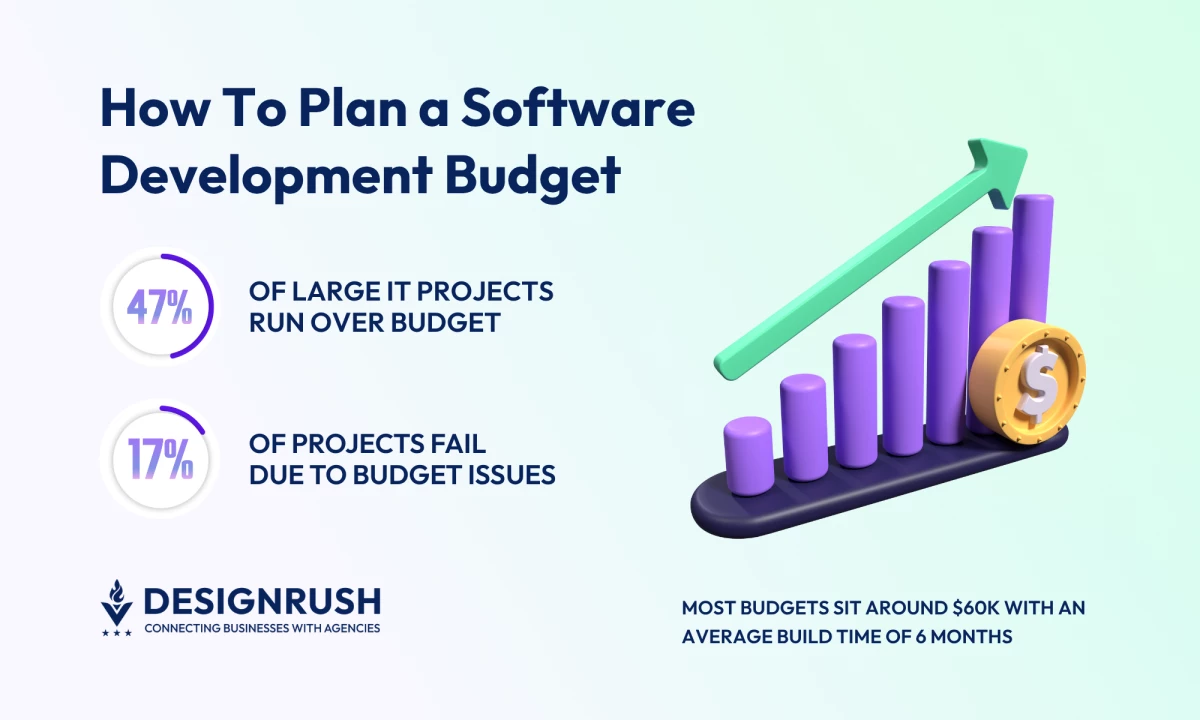
McKinsey and Oxford analyzed more than 5,400 large IT projects and found that 45% went over budget and 17% failed so badly they disrupted operations.
Those numbers remind me that every line item is a risk decision, not just a cost estimate.



Choose a Pricing Model That Matches Reality
Before you assign a single dollar, decide how you’ll pay. This shapes everything downstream, from accountability to delivery pace.
According to the same McKinsey research, projects that fail to meet their planned budget, time frame, or projected cashable benefits often miss by a wide margin.
On average, costs increase by 75%, schedules slip by 46%, and expected benefits shrink by 39%.
That is why I have gravitated toward one model for mid-sized organizations that balances predictability and flexibility. But first, let’s compare the common ones.
Common Models
Model | Predictability | Flexibility | Who Carries Change Risk | Use Case |
Fixed Bid | High (if scope fixed) | Low | Vendor (priced via margin, change orders) | Well-defined upgrades, compliance work |
Time & Materials | Medium | High | Client | R&D spikes, ill-defined problem spaces |
Agile w/ Guardrails | High at capacity level | High within timebox | Shared via NTE + change budget | Product work, evolving roadmaps |
I only use fixed bid when the scope is rock solid and change is extremely limited. I lean pure T&M for high-uncertainty or small spikes.
But 90% of product work is best done under the hybrid Agile model.
Why I Default to Agile with Guardrails
In my experience, capacity-based Agile with guardrails offers the best compromise for mid-market projects. Here’s how I structure it:
- I assign a fixed monthly pod at a blended rate.
- I enforce guardrails: a quarterly not-to-exceed (NTE) cap, 30-day rolling termination, and a change budget of roughly 10-15% of total.
- I define Definition of Ready or Definition of Done strictly, to reduce scope creep.
- Every 4-6 weeks we deliver increments (demos + release notes), not just piles of documents.
This gives the client predictability at the pod level while preserving scope flexibility inside each sprint.
Match the Model to Your Company Type
Company Type | Best Fit | Advantages | Drawbacks | Reality Check |
Startup / Small Company | Time & Materials / Agile | Maximum flexibility, easy to pivot | Weak cost discipline if not tightly managed | Fixed bids are rare; vendors add high risk buffers |
Mid-sized / Scale-ups | Agile with guardrails | Predictability + room to adapt | Pure T&M can cause scope creep | Fixed bid works only when requirements are crystal clear (e.g., regulatory module) |
Large / Enterprise | Fixed contracts with embedded Agile | Structure for compliance + ability to run sprints inside tranches | Change orders can spiral, governance slows delivery | Procurement often mandates fixed milestones regardless of project dynamics |
How Much Does It Cost To Hire a Software Development Agency?
From what I’m seeing in the market, the scale of investment in software services keeps climbing.
The industry was valued at about $499.25 billion in 2025 and is expected to hit $571.7 billion in 2026, on its way to nearly $1.94 trillion by 2035 at a CAGR of 14.51%.
Against that backdrop, let me ground things with what we track in DesignRush data and compare it with external benchmarks.
DesignRush Market Data: What Software Projects Really Cost
On DesignRush’s software development listings, most budgets sit around $60K with an average build time of six months, which is roughly $8-9K in monthly burn once you account for full-stack work, QA, and management.
Here’s how it breaks down in practice:
Scope | Typical Budget | Avg Duration | Monthly Spend |
Small business apps | $20K-$100K | ~6 months | $10K/month |
Growth-stage builds | $100K-$250K | ~9 months | $19K/month |
Enterprise platforms | $250K-$500K | ~12 months | $31K/month |
Enterprise-scale systems | $500K-$1M+ | 12-25 months | $60K-$100K/month |
Key Takeaways for CEOs
- Most scalable projects sit between $20K-$250K and complete in under a year.
- Beyond $250K, expect longer delivery cycles tied to integration depth, security, and compliance.
- If your estimate sits outside these ranges, use this data as a sanity check: it’s either a sign of underestimated scope or inflated vendor margin.
Industry Benchmarks
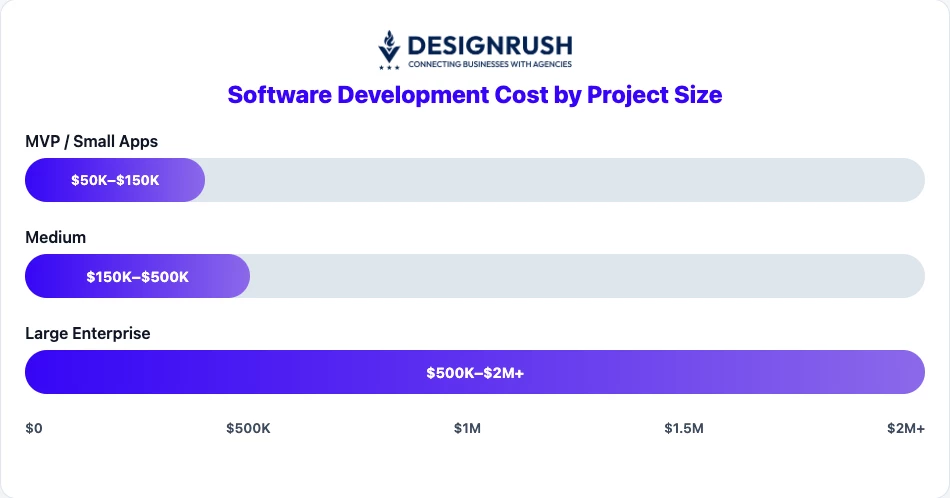 Let me share a few that I trust:
- According to Wheelhouse, “small apps” cost $50K-$150K; “medium” (CRM, eCommerce) run $150K-$500K; large enterprise $500K-$2M+.
- Cleveroad estimates new software often costs $50,000 to $250,000+, depending on complexity.
- Codica reports SaaS MVPs typically start $50,000-$60,000.
- Decode puts small-scale enterprise projects between $100K and $250K, mid-scale $250K-$500K, and large over $500K.
- Bacancy claims SaaS development anywhere from $20,000 to $500,000+ depending on features.
So real costs can differ dramatically by scope, team, region, and non-functional requirements.
Based on DesignRush’s verified project data, here’s how real software budgets and timelines align in practice.
These examples mirror how I scope first-pass estimates and communicate realistic cost structures to clients.
Scenario | Duration | Key Complexity Drivers | Estimated Build Cost | Typical Budget Levers & Risks |
~6 months | Core flows, user roles, managed billing | $60K-$100K | Lean architecture, deferred non-essentials, simple tech | |
Internal Tools for Ops | ~4-5 months | Data integrations, reporting, security | $40K-$80K | Lower UI polish, but data integrity and security essential |
Enterprise Upgrade / Module | ~9 months | Legacy integration, compliance, observability | $150K-$250K | Complexity from data migration, security, and testing scope |
Full SaaS Growth Phase | ~12-18 months | Multi-tenant, regional scaling, analytics | $400K-$750K | Multi-region, strict NFRs, long hardening and governance cycles |
As Benjamin Džaferović, Co-Founder and CEO of Outecho, puts it:
“Businesses should always make today's decisions with tomorrow's needs in mind, even if they might not be immediate nor should be immediately catered to.”
That’s how I plan: build lean for now, but architect for what’s next.
Normalizing Benchmarks
My advice: benchmarks are sanity checks, not scoping tools. Use them to check if your internal estimate is crazy high or absurdly low. Then adjust for:
- Senior/junior mix
- Non-functional features (security, performance, compliance)
- Integration complexity
- Margins & vendors’ overhead
A benchmark saying “$120/hr” doesn’t mean you can build Gigantic App X for 10 hours at $1200.
Software Development Budget: In-House vs. Hiring an Agency
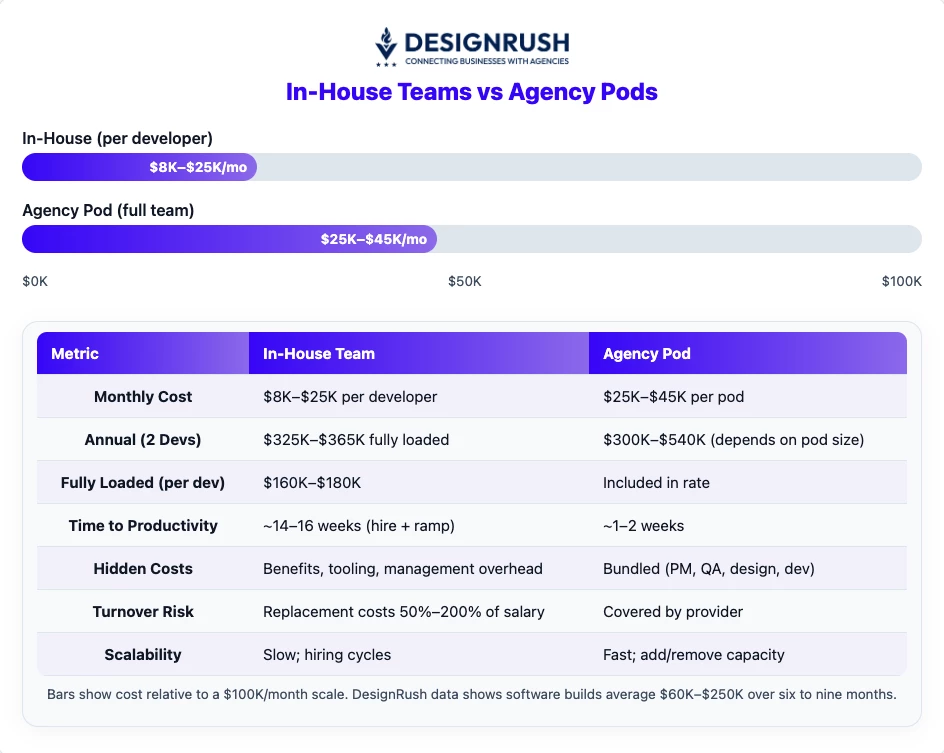 I’ve run both in-house teams and agency pods, and the math always tells the same story.
DesignRush data shows most software builds on our platform average around $60K-$250K over six to nine months, roughly $8K-$25K per month in full burn.
That’s often what one to two mid-level developers cost internally before you even account for benefits, licenses, or management overhead which cause for the true cost to usually rise 25%-40% above base pay.
A $130K developer in the US costs $160K-$180K fully loaded once benefits, licenses, and overhead are added. Hiring takes 6 weeks, onboarding another 8-10 before full productivity.
Replace that person and you lose 50%-200% of salary in attrition costs. Add $20K-$100K a year for tooling and management overhead, and two mid-level hires can quietly become a $325K-$365K annual spend.
For the same spend, I can launch an agency pod for $25K-$45K per month, fully staffed and productive from week one.
DesignRush data confirms that most projects in this range deliver predictable results within a single operating year, without the hidden costs of turnover or underutilization.
Where Software Development Budgets Go Off-Track
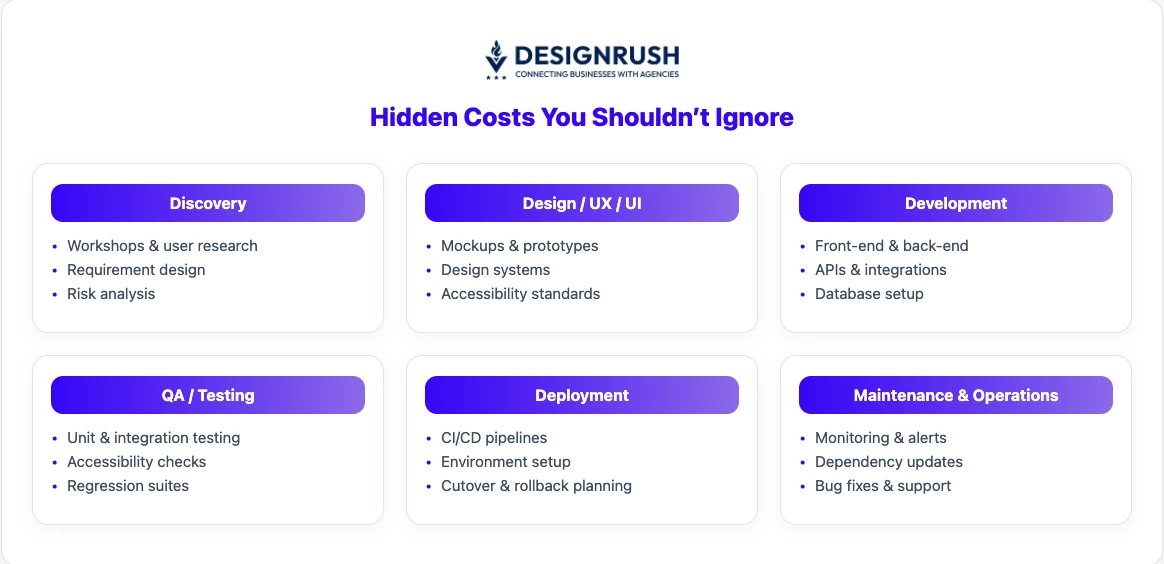
I’ve audited enough cost breakdowns to know what gets “forgotten.” These are the pieces that quietly drain budgets because teams assume they’re included or easy to handle later. They never are.
That’s why these line items are non-negotiable in my templates:
- Discovery: Workshops, user research, requirement design, risk analysis.
- Design / UX / UI: Mockups, prototypes, design systems, accessibility.
- Development: Front-end, back-end, APIs, integrations.
- QA / Testing: Unit tests, integration testing, accessibility, regression suites.
- Deployment: CI/CD pipelines, environments, cutover, rollback planning.
- Maintenance and operations: Monitoring, alerts, dependency updates, bug fixes, support.
- Non-dev overheads (often forgotten):
- Observability (logging, metrics, tracing)
- Security and compliance (SAST/DAST, pen testing, audits)
- Data migration & ETL scripts
- Integration tax (partner sandbox, contract tests)
- Knowledge transfer and documentation
- Access provisioning, onboarding legal / procurement
- Contingency reserve
I’ve seen projects fail because discovery was skipped, QA underfunded, or security left until launch. When these aren’t budgeted, they still happen, just later, under stress, and at a premium.
I always add a 10-20% management reserve, especially for new integrations or regulatory work. It’s insurance against the predictable unknowns that derail delivery.
Tools and Methods for Estimating and Tracking Costs
When I don’t have decades of project data, I lean on structured techniques:
- Three-point estimation: Optimistic / most likely / pessimistic → expected effort and variance
- Wideband Delphi/Planning Poker: Collective cross-functional estimation
- Monte Carlo simulations: Show probability distributions for delivery dates and costs
- Reference-class forecasting: Compare to similar past projects, then adjust by complexity
- Parametric models: Function points, COSMIC, or variants of COCOMO are good when you can map size predictors like #screens, API calls.
- Checklists/WBS templates: Always include activities like observability, security, deployment, cutover so nothing is “forgotten.”
These methods turn opinion into data. I track burn-up, defect escape, cycle time, and scope drift throughout execution.
When those metrics shift, I adjust immediately instead of waiting for the CFO to ask why the budget blew up.
How To Reduce Development Costs Without Compromising Quality
You don’t have to sacrifice code quality. Here are strategies I’ve used:
- Use proven, mature frameworks rather than chasing hype.
- Design systems + reusable components to reduce UI churn and testing overhead.
- Leverage managed services when they're not strategic.
- Feature flags + canary releases to limit risk and roll back gracefully.
- Automate CI/CD pipelines early: CI minutes cost less than repeated manual regressions.
- Lean admin first, build “good enough” tools first; refine later.
- Tight acceptance criteria and slicing features small reduces surprises in UAT.
- Make contract tests when you integrate with external partners, test boundaries early.
- Kill-switches / circuit breakers to help maintain uptime and reduce support cost under load.
- Strong definition of done: Require tests, security scans, docs, alerts, deployment pipelines before stories are “done.”
Find More Agency Hiring Resources:
1. Website ROI From a Web Development Agency
2. Building a Practical Budget for Mobile App Development
3. In-House vs. Web Development Agency
These controls cut hidden costs by 20-30% in my projects over time.
Setting Realistic Budget Expectations with Agencies
Too many brands fixate on hourly rates. I’ve seen teams pick the $30/hr vendor only to triple spend fixing their work later. The real cost lies in risk, rework, and lost time-to-market.
Here’s how I align expectations before contracts are signed:
- Price outcomes and capacity, not just hours.
- Expose assumptions in the SOW. Add fallback pricing if assumptions prove false.
- Make NFRs contractual (e.g. SLOs, performance budgets).
- Timebox discovery with exit criteria, then rebaseline.
- Offer dual pricing: one estimate if assumptions hold, one if they break.
- Show metrics: burn-up, defects, cycle times, velocity, so clients see progress, not just invoices.
The sooner you align on assumptions and accountability, the fewer surprises mid-flight.

Our team ranks agencies worldwide to help you find a qualified partner. Visit our Agency Directory for the top software development companies, as well as:
- Top Enterprise Software Development Companies
- Top Custom Software Development Companies for Small Business
- Top Mobile App Development Companies
- Top AI Development Companies
- Top Software Testing Companies
Our design experts also recognize the most innovative design projects across the globe. Given the recent uptick in app usage, you'll want to visit our Awards section for the best & latest in app designs.
Planning Your Software Development Budget FAQs
1. How much contingency should I budget?
Use 10–20%, leaning to 20% if the project includes novel integrations, regulatory unknowns, or third-party dependencies.
2. Why do two agencies quoting the same scope differ so much?
Because they embed risk buffers, overrun margins, senior mix, levels of testing, and assumptions differently. The lower rate might omit critical infrastructure, observability, or CI/CD prep.
3. How do I interpret benchmarks vs. my own numbers?
Use benchmarks to sanity-check only. Normalize your scope, complexity, NFRs, and team mix. If your internal estimate is 5× higher than benchmarks, dig in, but don’t ignore benchmarks when your internal math is way below what the market demands.