
Choosing between an onshore vs offshore software development agency comes down to communication, scope flexibility, and control. In my experience, the companies that win make this decision intentionally, with structure and clear priorities. Let me show you how.
Onshore vs. Offshore Software Development: Key Points
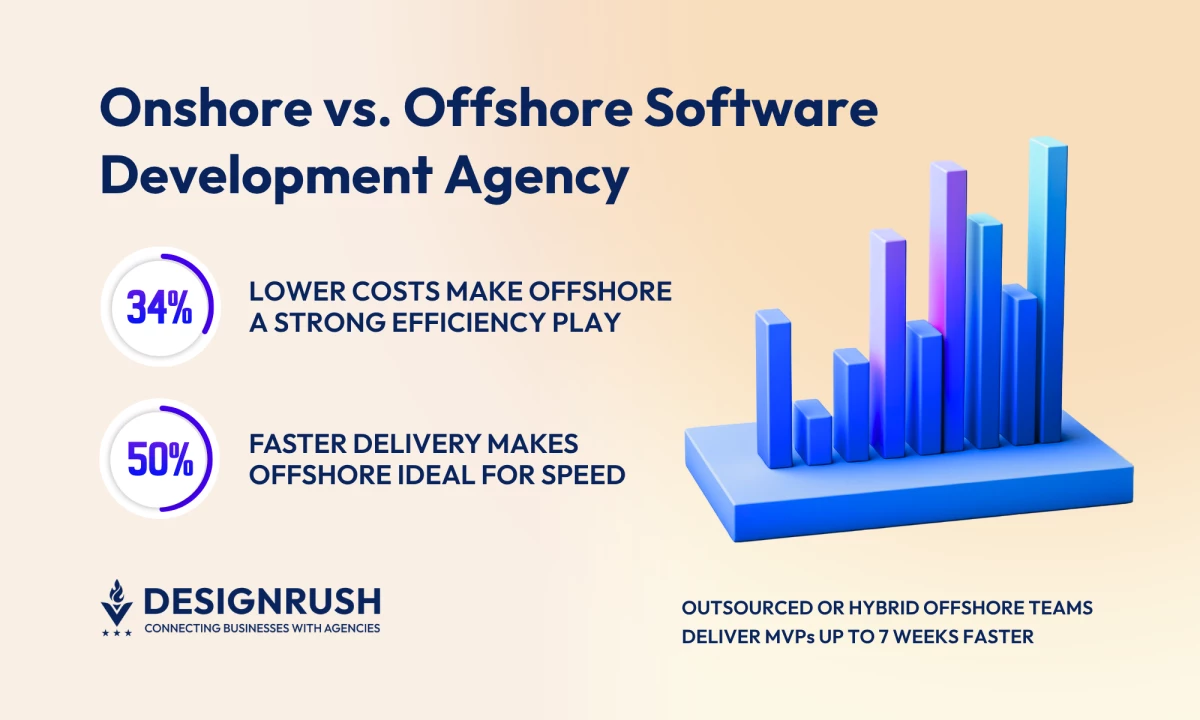
- Cost-driven outsourcing fell from 70% in 2020 to 34% in 2024. Offshore still cuts costs by up to 40% and speeds delivery by 50%, but success depends on structure, not savings.
- Offshore teams fill roles in days and deliver MVPs seven weeks faster. Keep leadership onshore to align strategy while offshore handles execution.
- With 61% of companies hit by third-party breaches, governance matters more than geography. Strong oversight turns offshore into a secure, scalable advantage.
The Wrong Model Costs More Than the Wrong Budget
Most executives fixate on hourly rates, but that’s never where the real money goes. I’ve seen companies overspend not because they went offshore, but because they went in unprepared.
According to Accelerance’s 2025 research, outsourcing can deliver up to 40% cost savings and reduce time to market by as much as 50% when executed with structure.
Choose the wrong model: unmanaged offshore or improperly governed onshore, and your “low-cost” DIY option becomes the most expensive mistake.
Factor | Onshore | Offshore |
Best for | Complex, regulated, or evolving projects needing control and collaboration | MVPs, cost-driven builds, or rapid scale-ups with strong governance |
Cost savings | ❌ | ✅ |
Speed | ❌ | ✅ |
Real-time communication | ✅ | ❌ |
Talent scale-up speed | ❌ | ✅ |
Accountability and ownership | ✅ | ❌ |
Cultural alignment | ✅ | ❌ |
Main Differences Between Onshore and Offshore Software Development
Before choosing an agency, you need clarity on what you’re buying beyond the invoice.
Most companies ask, Which costs less? when the real question should be, Which model fits how we operate?
Let’s walk through the core differences, from cost to culture, and pinpoint which model aligns with your goals.
- Cost efficiency
- Speed and iteration
- Scalability and access to talent
- Communication and time zone alignment
- Project management and accountability
- Cultural fit
- Security and compliance risks
Cost Efficiency
When I compare onshore and offshore bids, the mistake I see most founders make is fixating on the hourly rate.
In a Deloitte study done in 2020, 70% of organizations cited cost savings as the main reason for outsourcing. Two years later, that number dropped to roughly 48%, and in 2024 it was down to 34%.
That shift says it all: cost reduction is no longer the reason to outsource. Outcomes are.
- A $50/hour offshore developer looks appealing until coordination, QA, and time-zone overhead inflate the true rate to $75-$90/hour.
- Onshore teams, meanwhile, cost $140-$180/hour on paper but often win on total cost of delivery: fewer handoffs, fewer misfires, faster approvals.
Here’s the rule I follow:
If the project scope is fixed and communication simple, offshore saves money. If the scope evolves or quality is mission-critical, onshore saves you rework.
- If you’re a startup building an MVP with limited variables, offshore is viable.
- If you’re an enterprise or SaaS scaling product complexity, onshore agencies deliver better ROI over time.
Speed and Iteration

Speed depends on how fast ideas move from meeting to merge and not how many developers you can afford.
Outsourced or hybrid offshore teams deliver MVPs up to seven weeks faster, accelerating time to market without sacrificing quality.
In one product launch, an offshore team completed features overnight. Impressive, until we realized every iteration lagged a full day waiting for approvals.
By contrast, an onshore team in Chicago wrapped two sprints in half the time because decision loops happened in real-time.
- For fixed-scope execution, offshore speed wins.
- For evolving products, onshore iteration always pulls ahead.
- If you’re iterating daily, you need timezone overlap more than headcount.
Scalability and Access to Talent
Offshore models win here, hands down.
Deloitte’s report lists improved access to talent as the number one reason companies outsource services, and that advantage shows up fast once you scale.
When I built a data-heavy analytics platform, I scaled from 4 to 20 developers in three weeks using an offshore hub in Eastern Europe. No US agency could have sourced that fast.
As Ivan Dabić, Founder and CEO of BlueGrid.io, puts it,
“Outsourcing often turns out to be the smarter choice. Instead of dealing with the headache of recruitment and retention, outsourcing allows you to tap into a global pool of experts who are already equipped with the skills you need.”
However, scale without leadership is chaos.
Offshore teams scale execution, not decision-making. You’ll still need onshore or nearshore leads to enforce consistency, code review standards, and cultural cohesion.
If you plan to scale beyond 10-15 engineers, blend models:
- Onshore leadership for architecture and product direction.
- Offshore pods for execution and maintenance.
That balance keeps costs lean without losing control.
Communication and Time Zone Alignment
- With onshore teams, feedback happens within hours: sprint reviews, Slack threads, design clarifications.
- Offshore? Expect a 24-hour delay unless you set clear async processes.
In one project I led for a financial SaaS firm, every “quick question” turned into a next-day blocker because the team was 10 hours ahead. Once we introduced overlapping shifts and recorded Looms, delivery time dropped 30%.
So here’s my advice:
If your project requires daily creative or technical decisions, pick a team that shares your business hours, or prepare for delay inflation.
Project Management and Accountability
- Onshore firms often integrate with your workflow: shared dashboards, transparent sprint reports, and proactive leadership.
- Offshore teams vary widely. The strong ones operate as partners; the weak ones behave like ticket factories.
In one engagement, I asked the offshore PM who owned delivery risk. He said, “The client.” That’s when I knew we were heading for trouble.
That answer told me no one on their side felt accountable for deadlines, quality, or scope integrity.
My benchmark:
If accountability isn’t clear before kickoff, it’ll be chaos by sprint three.
Establish ownership, reporting cadence, and escalation paths early, or your “cost savings” will vanish into management overhead.
Cultural Fit
Culture dictates how teams handle ambiguity and accountability.
- Onshore developers challenge assumptions openly.
- Offshore teams, depending on region, often prioritize hierarchy and “yes culture.” Both can derail outcomes if unmanaged.
I once watched a healthcare app project burn $200K because an offshore lead hesitated to flag missing API specs. They were being polite; the client assumed progress.
My approach now:
Build a feedback culture early. Encourage dissent. Reward teams that raise issues, not those who quietly fix symptoms.
Security and Compliance Risks
Enterprises rarely go offshore without first signing off on data handling protocols, and for good reason.
- Onshore vendors operate under the same jurisdictional frameworks, like GDPR, HIPAA, SOC 2.
- Offshore agencies may follow best practices, but enforcement is weaker.
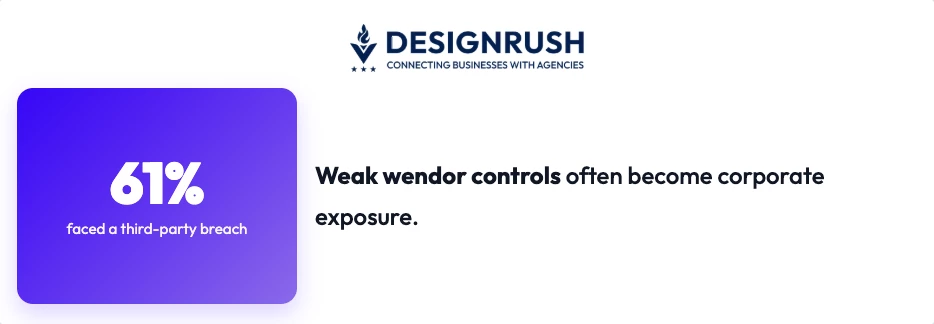
According to a 2024 Mitratech study, 61% of companies experienced a third-party data breach or security incident in the past year, underscoring how often weak vendor controls become corporate exposure.
In a fintech project I managed, offshore QA testers used personal devices for test environments.
That’s a compliance nightmare because sensitive data leaves the controlled network, exposing the company to leaks and regulatory risk.
That’s why for fintech, healthcare, or enterprise systems I recommend:
- Onshore = controlled environment, fewer unknowns.
- Offshore = cheaper, but needs stronger audits, NDAs, and encrypted workflows.
Ask every vendor for their data handling process, compliance certifications, and named security officer before signing anything.
Decision Framework: Pick the Right Model for Your Project
When clients ask me which model to choose, I show them a version of what I call the Project Decision Matrix.
It forces clarity on what matters most right now: cost efficiency, speed, or control.
You can’t maximize all three at once. The right answer depends on what’s at stake for the business:
Decision Priority | Ideal Model | Why It Works | Trade-Off |
Lowest cost and fast scale-up | Offshore | Large talent pool, extended time coverage, lower rates | Requires strong project management and clear requirements |
High control and quality | Onshore | Shared language, real-time collaboration, faster decisions | Higher hourly rates and limited capacity |
Regulated or data-sensitive projects | Onshore | Local compliance, secure environments, direct accountability | Higher cost and slower scale-up |
Agile development or MVP build | Offshore with Onshore Oversight | Fast execution with reduced burn; local PM ensures alignment | Coordination overhead; potential communication gaps |
Long-term maintenance | Offshore | Cost-effective for stable, low-risk environments | Less flexibility for evolving requirements |
How It Plays Out in Real Projects
Here are two examples with companies I worked with:
- I worked with a US client that went fully offshore to cut costs. Six weeks in, sprint velocity had dropped by half because feedback lagged overnight. Once I shifted design and product management onshore while keeping engineering offshore, throughput rose 40% without raising the budget.
- I advised a fintech team that kept everything onshore for compliance. Six months later, they moved routine maintenance offshore and saved 35% annually while maintaining full security for critical systems.
That’s how the decision matrix works in practice, helping you reassign ownership based on what drives the most value.
Find More Agency Hiring Resources:
1. How To Plan a Software Development Budget
2. Questions To Ask a Software Development Agency Before Hiring
3. In-House vs. Outsourcing Software Development
Onshore vs. Offshore: How To Make the Final Call
When I guide clients through this choice, I ask three questions:
- Where do you need control the most? Architecture, compliance, and client-facing layers usually demand onshore ownership.
- Where can you afford to optimize for cost and throughput? Execution, testing, and maintenance often fit offshore without risk.
- Who will enforce the bridge between them? Without a clear lead to connect both sides, savings disappear into coordination overhead.
Make the decision deliberately, document your reasoning, and move forward with structure.
The worst outcome is operating in limbo, where no one owns the result.

Our team ranks agencies worldwide to help you find a qualified partner. Visit our Agency Directory for the top software development companies, as well as:
- Top Offshore Software Development Companies
- Top Nearshore Software Development Companies
- Top Software Outsourcing Companies
- Top Enterprise Software Development Companies
- Top Software Development Companies for Startups
Our design experts also recognize the most innovative design projects across the globe. Given the recent uptick in app usage, you'll want to visit our Awards section for the best & latest in app designs.
Onshore vs. Offshore Software Development Agency FAQs
1. Is offshore development always cheaper?
Initially yes, but only when managed tightly. Once you add communication overhead and rework, cost gaps shrink. Track cost per completed deliverable, not hourly rate.
2. Can offshore teams match onshore quality?
Yes, but only if governance is strong. Quality gaps stem from poor requirement flow, not talent. The best offshore agencies document, review, and report like onshore ones.
3. Should I mix models?
Yes. I often recommend onshore leadership paired with offshore execution: cost-effective, accountable, and scalable.