Explore leading backend developers in the United States who create strong server systems, manage databases, and ensure apps run smoothly and securely. Our curated list features vetted experts who focus on performance, scalability, and long-term reliability across modern tech stacks.
Organic rankings are determined by five factors: top services, reviews, portfolio, awards/press, and team expertise. Sponsored listings pay for a placement that appears above organic positions. Sponsorship does not affect star ratings or review content - read more on our methodology page.
We improve conversion rate, average order value, and lifetime value for ecommerce brands.
We specialized in building high-performing, conversion-focused Shopify Plus websites and advanced email marketing solutions using Klaviyo. Our expert team is committed to creating engaging digital experiences that drive revenue and help businesses thrive...
Top Services:
- Web Development
- Web Design
- CRO
- Email Marketing
- eCommerce Development
- Show more
- Location
- Colbert, Washington
- Number of Employees
- Under 49
- Average Hourly Rate
- $175/hr
- Minimal Budget
- $50,000 & Up
- Portfolios Count
- 8 Projects Listed
Data sourced from the agency's DesignRush profile, its website, and other relevant accountsFuel Made Services
Data sourced from the agency's DesignRush profileUmbra Casamigos Pela Case Tuft & Paw Batch Smidge FIGS Peter Manning Peepers Little Sleepies

Related Web Development Specializations in the US
Popular Services
Everything You Need to Know Before Hiring US Backend Developers
Why should businesses hire United States backend development companies instead of relying only on freelancers?
For companies building revenue-critical platforms, a US backend development company often offers greater stability than a single freelance developer, as they can provide multiple specialists across architecture, QA, security, DevOps, and project management.
According to the United States Bureau of Labor, the US had about 1.69 million software developerjobs in 2024, and employment for software developers is projected to grow 16% from 2024 to 2034, with roughly 129,200 openings per year across software development, QA, and testing.
That means replacing a single junior web developer can be expensive and slow, while a backend development agency in the United States can reduce delivery risk and knowledge concentration.
Access to a full engineering team instead of a single software developer
A freelancer is typically one full-stack software engineer with a specific skill set, while a company that employs a backend developer provides a multidisciplinary team of expert developers.
A typical backend team may include:
- Backend developer or backend engineer, including C developer, Python developer, and Django developer
- Software engineer or backend software engineer
- System developer
- Frontend developer or web developer
- DevOps specialists and QA engineers
The team-based structure allows API development, database architecture, and testing to happen simultaneously, which speeds up delivery and improves quality.
Higher reliability for complex projects
Freelance backend developers in the US can be excellent specialists, but businesses often face higher delivery risk when relying on a single person. If a freelancer becomes unavailable, the project can stall.
Large development teams reduce this risk by sharing responsibilities among multiple engineers, including senior backend engineers, staff backend engineers, and software developers. US backend development companies also use structured development processes, project management tools, and documentation standards to maintain continuity.
Proven industry adoption of outsourced development teams
Outsourcing software development to specialized United States backend developers or a staff software engineer has become a common strategy for companies that lack large internal engineering departments.
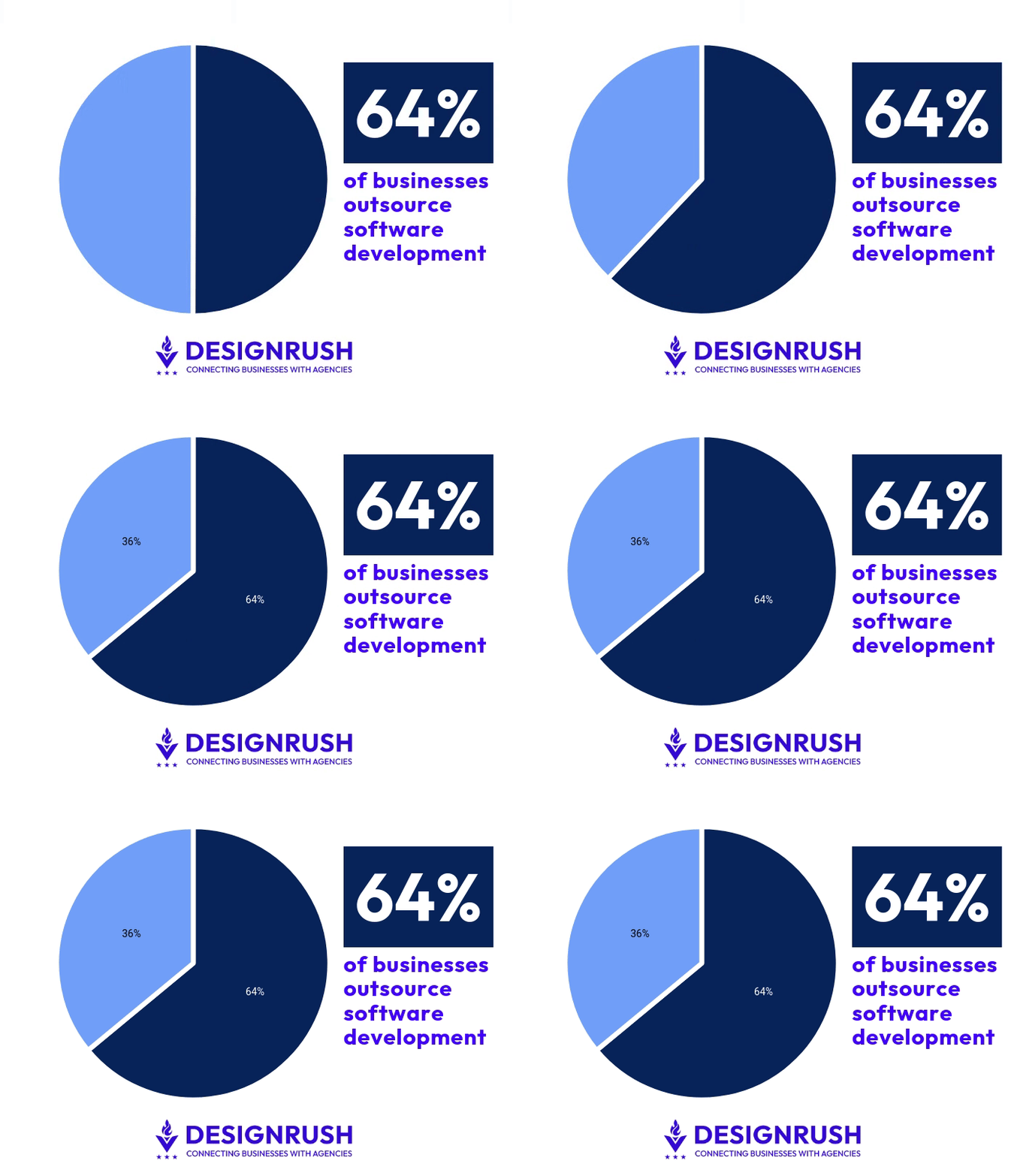
According to Statista, about 64% of companies outsource software development, demonstrating how common it is for businesses to rely on external stack developer teams rather than building everything internally.
Better scalability as the project grows
Modern digital products often expand quickly. What begins as a small backend service may eventually require multiple APIs, integrations, and distributed infrastructure.
Working with United States backend developers through an established company makes it easier to scale teams when needed. Instead of hiring another freelance stack developer and onboarding them individually, a top US backend development agency can quickly add additional engineers, such as a full-stack engineer, Java developer, or Python developer.
This scalability matters because the outsourcing and software development services market continues to grow rapidly.
The global IT outsourcing market is projected to reach $812.7 billion by 2029, reflecting companies' increasing reliance on external backend software engineering teams.
Long-term maintenance and support
Backend systems require continuous updates, security improvements, and infrastructure monitoring.
A US backend development firm typically provides long-term services such as:
- System maintenance and upgrades
- Security monitoring
- Performance optimization
- Infrastructure management
Freelancers often focus on short-term deliverables, while agencies are structured to provide ongoing support for production systems.
What experience should these developers have before working on large platforms?
A US backend developer working on these systems must understand distributed architecture, high-traffic infrastructure, and large-scale data management.
Cloud infrastructure and cloud-native systems
Gartner predicts that over 50% of enterprises will use industry cloud platforms by 2028, highlighting how central cloud infrastructure has become for modern applications.
Backend engineers working on large systems typically need experience with:
- AWS, Azure, or Google Cloud
- Containerization tools such as Docker
- Orchestration platforms like Kubernetes
- CI/CD pipelines and automated deployments
Distributed systems and microservices
Research shows that about 71% of enterprises now run microservices in production, demonstrating how common distributed architecture has become in modern software systems.
United States backend developers building these platforms need experience with:
- Microservices architecture
- Service-to-service communication
- Event-driven systems
- Message queues and streaming platforms
- API gateway patterns
Scalability and high-traffic applications
Large platforms must handle thousands or millions of requests per day. Backend engineers, therefore, need experience designing systems that scale under heavy load.
USA backend development companies working on these systems often implement:
- Load balancing
- Distributed caching
- Database sharding and replication
- Performance monitoring and observability
Well-designed microservices platforms can deliver significant performance improvements. Studies show that organizations adopting microservices architecture often experience up to a 63% increase in deployment frequency and a 70% reduction in recovery time after production incidents, improving system reliability and operational efficiency.
Expertise in database architecture and data consistency
Large platforms process enormous volumes of data, which makes database design a critical backend skill.
US backend developers working on large systems should have experience with:
- Relational and NoSQL databases
- Distributed data storage
- Data consistency strategies
- Query optimization and indexing
- High-volume transaction systems
How do these companies handle modern AI-ready and data-heavy applications?
AI applications depend on large datasets.

A US backend development agency designs data pipelines that collect, process, and store massive volumes of structured and unstructured information.
Global data creation reached about 149 zettabytes in 2024, and projections suggest worldwide data generation could exceed 527 zettabytes by 2029.
To handle this scale, developers often build data pipelines using technologies such as:
- Distributed databases and data lakes
- Real-time streaming systems
- Large-scale storage clusters
- High-throughput ETL pipelines
AI-driven products require infrastructure that can train, deploy, and run machine-learning models at scale. Backend teams build model-serving pipelines that integrate AI with existing applications.
This infrastructure market is expanding rapidly. The global AI inference market was valued at about $97.2 billion in 2024 and is expected to reach $253.8 billion by 2030, reflecting growing demand for production-ready AI systems.
Backend development teams, therefore, build systems that allow applications to:
- Run machine-learning models through APIs
- Manage GPU or high-performance compute resources
- Scale model inference across cloud infrastructure
Industry research shows that around 70% of organizations building generative AI applicationsuse vector databases and retrieval-augmented generation (RAG) to customize large language models with their own data.
Backend developers in the USA integrate these technologies into production systems so applications can:
- Search large datasets using embeddings
- Retrieve context for AI responses
- Connect proprietary company data with AI models
Research shows that organizations deploying AI at scale now run 11 times more production AI models than they did just a year earlier, reflecting how rapidly AI workloads are expanding.
To support this pace, backend teams build platforms that allow engineers to:
- Deploy new models safely
- Run A/B tests on AI features
- Automate model retraining pipelines
- Monitor model performance in real time
Should I hire a backend developer or a full-stack engineer for my project?
Choosing between these two depends on the complexity of your system and the types of features you need to build. Both roles are essential in modern software engineering, but they focus on different layers of an application.
Industry labor data suggests that the need for backend engineers is expected to grow by more than 20% between 2021 and 2031, reflecting the increasing importance of scalable server-side systems.
According to the Stack Overflow Developer Survey, about 27% of developers identify as full-stack engineers, compared with 14.2% who identify primarily as backend developers, showing how common the full-stack role has become in modern development teams.
| Factor | Backend developer/Backend engineer | Full-stack engineer |
| Primary focus | Server-side logic, APIs, databases, infrastructure | Backend and frontend development |
| Typical work | Builds APIs, manages data, integrates services, ensures performance, and security | Builds user interfaces and connects them with backend services |
| Best for | Complex systems, high-traffic platforms, heavy data processing | MVPs, startups, and smaller teams needing flexibility |
| Common technologies | Python, Java, C#/.NET, PHP, databases, cloud services | JavaScript/TypeScript, Node.js, frontend frameworks + backend tools |
| Role in teams | Designs and maintains backend architecture | Bridges frontend and backend development |
In large projects, backend work is often led by experienced engineers, such as a senior software engineer, a staff backend engineer, or a system developer responsible for platform architecture.
How do I evaluate a USA backend development company for complex API, cloud, and database work?
Software complexity is increasing rapidly, and about 78% of organizations say software systems are becoming more complex each year, according to global engineering surveys.
When evaluating a United States backend development company, businesses should focus on four main capabilities:
1. Experience building scalable APIs and integrations
The importance of API infrastructure continues to grow: the global API management market was valued at about $6.89 billion in 2024 and is projected to reach $32.77 billion by 2032, reflecting how central APIs have become in modern software ecosystems.
2. Strong cloud architecture and infrastructure expertise
According to Flexera's 2024 State of the Cloud Report, 94% of organizations already use cloud services, and 67% of enterprise infrastructure is expected to be cloud-based.
3. Advanced database design and data management skills
Global enterprise data volumes are expanding rapidly. IDC estimates that the global datasphere will grow to about 221 zettabytes by 2026, dramatically increasing the need for scalable data systems.
4. Mature engineering processes and architecture leadership
Companies should ask about:
- Automated testing frameworks
- Code review processes
- Monitoring and logging systems
- Incident response procedures
They improve reliability and reduce the risk of production failures in complex systems.
Sources
DesignRush sustains a directory of over 40,000 agencies categorized by service category, location, expertise, and reviews. We build our database in two ways:
- Our dedicated team of agency experts actively searches the web for top-performing companies. We then pull information from their websites, online presence, and client testimonials to verify their status and qualifications prior to listing.
- The agencies listed get notified of their profiles on the website and they can choose to claim it or not, which suggests their availability for more collaborations.
Agencies can also reach out to DesignRush and must go through the verification process prior to being listed.

Why companies trust DesignRush
Every agency is independently vetted before it can be listed or ranked
 4.8
4.8 4.8
4.8Some agencies pay for sponsored placement, clearly labeled and held to the same vetting standards.
5 Frequently Asked Questions About US Backend Development Companies
Which programming languages are most used by backend developers in the United States?
Backend development in the United States relies on several mature programming languages that support scalable APIs, cloud infrastructure, enterprise systems, and data-driven applications.
| Language | Properties | Commonly used frameworks/Used for |
| Python | One of the most widely used languages for backend services, data platforms, and AI-powered applications. |
|
| Java | One of the most widely used languages for enterprise backend systems, particularly in industries like finance, healthcare, and large SaaS platforms. |
|
| JavaScript/Node.js | JavaScript is traditionally associated with frontend development. |
|
| C#/.NET | Key backend language in the U.S., especially for companies building enterprise applications on Microsoft technologies. |
|
| PHP | Widely used by PHP developers building web platforms, content management systems, and eCommerce backends. |
|
The GitHub Octoverse 2024 report found that Python became the most used programming language on GitHub, overtaking JavaScript after more than a decade at the top.
According to recent hiring data, about 39.5% of recruiters are actively seeking a Java developer for their teams, making it one of the most in-demand skills in software development hiring.
The Stack Overflow Developer Survey 2025, which collected responses from tens of thousands of developers worldwide, reported that about 66% of developers use JavaScript, making it the most commonly used programming language overall.
What do US backend development companies do?
They design, build, and maintain the server-side systems that power modern digital products. The systems handle the logic, data processing, and infrastructure behind applications such as SaaS platforms, eCommerce websites, mobile apps, and enterprise software.
- Build and maintain server-side application logic: Writing the server-side code that powers applications, processes requests from users, executes business logic, and returns results to the interface.
- Design databases and manage application data: Creating and maintaining databases that store user accounts, product information, transactions, and analytics data. A backend engineer designs schemas, optimizes queries, and ensures fast data retrieval from systems such as SQL or NoSQL databases.
- Develop Application Programming Interfaces (APIs) and integrations: Building APIs that allow different systems to communicate. APIs connect web applications with mobile apps, payment gateways, cloud services, and third-party platforms.
- Build scalable cloud infrastructure: Building infrastructure that can support millions of users and large volumes of data, including cloud architecture, containerized services, microservices platforms, and automated deployment pipelines.
- Support security, performance, and reliability: Protecting data and ensuring applications run smoothly through authentication and access control, data encryption and security compliance, monitoring and error handling, and performance optimization.
- Build and maintain complex software platforms: Building the core infrastructure behind SaaS platforms, fintech and payment systems, healthcare applications, enterprise business software, and eCommerce platforms.
When should a company hire a senior backend engineer or a staff backend engineer?
Businesses usually hire a senior backend engineer or staff backend engineer when their software systems become complex enough that architecture, scalability, and technical leadership matter more than simply writing code.
At that stage, experienced engineers help companies avoid costly technical mistakes and build systems that can scale reliably.
Businesses typically start needing staff backend engineers once their team expands to 50 or more engineers or when existing architecture cannot support growth in users or product features.
Hire a backend engineer when your:
- The platform needs to scale to thousands or millions of users
- The engineering team begins to grow
- System architecture becomes a business bottleneck
- Backend systems require advanced performance optimization
Modern backend systems increasingly rely on microservices, cloud infrastructure, and container platforms. In fact, about 75% of backend roles now require proficiency with cloud platforms such as AWS, Azure, or Google Cloud, reflecting the critical role scalable infrastructure plays.
How much does it cost to hire backend developers in the United States?
The cost of working with a backend development company in the USA varies widely depending on the project scope, the engineer's seniority, and the complexity of the software system being built.
Market benchmarks suggest the following rates:
- Mid-level back-end developers: about $120-$160 per hour
- Senior full-stack or backend engineers: around $130-$190 per hour
- High-end enterprise engineering services: $300-$800 per hour for specialized projects and large consulting firms.
The mentioned rates are significantly higher than internal salaries because United States backend development companies also include project management, QA testing, DevOps, and infrastructure support within their pricing models.
Project pricing depends heavily on system complexity. Typical backend development budgets in the US market include:
- Small backend service or MVP: $20,00-$80,000
- SaaS platform backend: $80,000-$250,000
- Enterprise or large-scale platform: $250,000-$1,000,000+
How long does a backend development project usually take?
The timeline for a backend development project depends on the platform's complexity, the number of required integrations, and the size of the engineering team.
Some backend systems require up to 800 hours of backend development work for core infrastructure alone, depending on the number of APIs, integrations, and database features implemented.
| Project | Timeline | Backend scope |
| Startup MVP backend platform | 2-6 months | Core APIs, authentication, database setup, basic integrations, and initial cloud deployment |
| Mid-scale SaaS or web platform | 6-9 months | Scalable APIs, advanced business logic, database optimization, multiple integrations, and monitoring systems |
| Enterprise backend systems | 9-12 months | Distributed services, high-volume data processing, compliance features, complex integrations, and infrastructure automation |
| Large platforms with complex infrastructure | 12-18+ months | Microservices architecture, real-time processing pipelines, global cloud infrastructure, and large-scale databases |
Latest Trends Related to Backend Development
-preview-webp.webp)