Our directory features top web developers in Orlando, supporting businesses across Downtown Orlando, Lake Nona, Winter Park, and the Central Business District. These agencies work with industries such as tourism, healthcare, SaaS, retail, and real estate. Review companies by cost, team size, and client ratings to identify the right development partner.
Organic rankings are determined by five factors: top services, reviews, portfolio, awards/press, and team expertise. Sponsored listings pay for a placement that appears above organic positions. Sponsorship does not affect star ratings or review content - read more on our methodology page.
AGENCY LISTING COMING SOON.
Related Services in Orlando
Web Development Companies Near Orlando
Popular Services
Everything You Need to Know Before Hiring A Web Developer in Orlando
What can an Orlando web developer do for your business?
Orlando’s tech economy is shaped by AI, tourism, and a large HR tech sector. A local web development agency helps connect these industries to your business and supports your growth. This support produces measurable business results.
Here are the specific benefits that an Orlando web development agency can provide:
1. Taking advantage of Orlando’s Metacenter growth
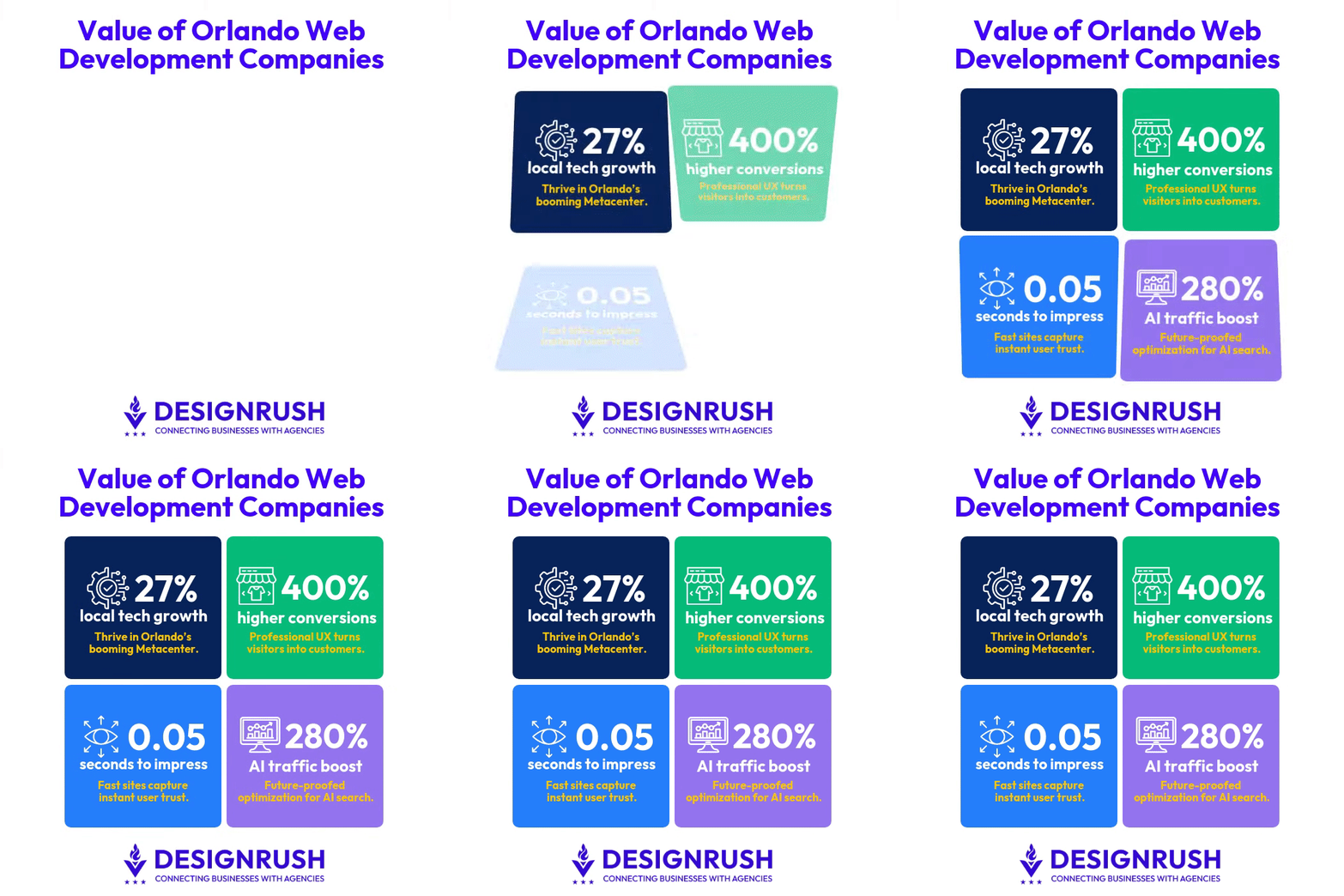
Orlando is the 8th-fastest-growing large economy in the U.S., and the tech sector added over 2,000 jobs last year alone. The local tech workforce is projected to grow 27% by 2030, and local agencies are part of this expanding ecosystem.
Hiring a web development company in Orlando gives you access to developers trained in the city’s Meta-center approach, which combines digital platforms with real-world experiences, such as the AR and VR used in Lake Nona’s Medical City and theme park mobile apps.
This expertise translates directly into business performance. Companies that invest in professional UX see conversion rates increase by up to 400%, allowing Orlando businesses to turn more visitors into customers using advanced, experience-focused design.
2. Built to handle tourism and convention traffic spikes
Orlando’s hotel market remains strong in 2026, supported by a busy convention schedule at the Orange County Convention Center.
Local agencies build websites designed for speed and stability during sudden traffic spikes. This is critical because users form an opinion about your website in just 0.05 seconds, and when load time increases from 1 to 5 seconds, the probability of visitors leaving rises by 90%.
Professional optimization prevents these losses. Retail businesses lose $2.6 billion annually due to slow websites, showing how performance directly affects revenue. Orlando agencies build infrastructure that keeps your website fast, stable, and profitable even during peak visitor periods.
3. Experience with HR tech integrations
Orlando has become a major HR tech hub, with companies like Rippling and Deel operating locally. 76% of organizations now consider HR analytics a top priority, but only 6% have reached full maturity.
Local agencies integrate HRIS, payroll, and recruiting platforms through secure APIs. This improves hiring efficiency and internal operations while also supporting business growth.
Professional technical implementation improves efficiency beyond internal systems. Even a 100-millisecond delay in website speed reduces conversions, showing how proper development directly protects revenue and operational performance.
4. Optimization for AI-driven search (GEO)
Traditional SEO is shifting toward AEO and GEO, as more people in 2026 discover Orlando businesses through AI assistants like Gemini and Alexa instead of standard search results.
Local agencies have reported up to a 280% increase in website traffic by helping clients appear in AI answers and voice results. They structure your website so AI systems can correctly understand and recommend your business to both locals and tourists.
Professional development also improves credibility. 75% of consumers judge a company’s credibility based on its website, and 94% of first impressions are design-related, meaning proper structure and design directly affect whether customers trust your business.
5. Compliance with U.S. and Florida regulations
Data privacy laws and AI regulations are becoming stricter, making compliance a critical part of web development.
A web development company in Orlando understands U.S. and Florida-specific requirements and builds your site accordingly. This protects your business from legal and financial risk.
Professional agencies also implement modern technical standards expected in 2026. With 63% of web traffic coming from mobile devices and mobile-optimized websites generating 40% higher conversion rates, proper development ensures your business remains competitive and compliant.
6. Stronger brand credibility and customer trust
Professional web development directly influences how customers perceive your business.
75% of consumers judge credibility based on website design, and 59% prefer browsing professionally designed websites over basic ones. This means your website functions as a core trust asset, not just a marketing tool.
A professionally built website improves:
- Customer confidence
- Lead generation
- Sales conversion rates
- Brand authority
This is especially important in competitive markets like Orlando, where customers compare multiple businesses online before making decisions.
What should I have ready before contacting an Orlando web developer?
To ensure your first meeting with an Orlando web developer is productive, you should move past general ideas and prepare specific business and technical assets.
1. Business foundation
- Specific conversion goals: Define your top three objectives (e.g., “increase HR software demo bookings by 20%” or “reduce customer support tickets via an AI-powered FAQ”).
- User personas: For an Orlando business, specify if you are targeting the 1.2 million residents or the 74+ million annual visitors (tourists), as this drastically changes the mobile-first and multilingual requirements.
- Competitor links: Provide 3–5 URLs of competitors (local or national). Note what they do better and where their technology feels outdated.
2. Content & Creative
- Brand assets: High-resolution (vector) logos, brand colors (HEX codes), and specific fonts.
- Sitemap draft: A simple list of the pages you know you need (Home, Services, Case Studies, Contact, etc.).
3. Technical requirements
- Integration list: Identify every third-party tool the site must talk to. Does it need to pull data from Rippling or Thrivea? Does it need to sync with Salesforce or a specific booking engine like FareHarbor?
- Domain & hosting access: Ensure you have the logins for your domain registrar (GoDaddy or Namecheap) and your current hosting provider.
- Compliance needs: Specify whether you need to meet AODA/WCAG accessibility standards (legally required for many Florida businesses) or specific data privacy laws, such as the Florida Digital Bill of Rights (FDBR).
4. Logistics & budget
- The hard deadline: Is there an event driving this? (e.g., “Must be live before the Enterprise Connect convention in Orlando next March”).
- Investment range: Be transparent about your budget. A site built for $5,000 looks and functions very differently from one built for $50,000. Knowing your range helps the developer suggest the right tech stack (e.g., custom React vs. a WordPress build).
What services do web development companies in Orlando provide?
Web development agencies in Orlando handle both the visible parts of your website and the technical systems behind it. Their work covers everything from what users see on the screen to the servers, databases, and integrations that keep your site running.
Here are the main web development services they provide:
- Front-end development
Developers build the part of the website that users interact with. They turn designs into a working site using code, ensuring pages load properly, look correct on all devices, and respond smoothly to user actions. - Back-end development
Development focuses on the server, database, and application logic. It powers features like contact forms, logins, dashboards, and anything that stores or processes data. - Full-stack development
Development combines front-end and back-end work. Many agencies provide complete builds where both the interface and the underlying system are developed together. - CMS development
Agencies build websites on platforms like WordPress, Webflow, or Shopify, allowing businesses to edit content, add pages, and manage their site without technical help. - Ecommerce development
Ecommerce services include building online stores, setting up product catalogs, integrating payments, and creating secure checkout systems. - API and third-party integrations
Developers connect websites with tools such as CRM systems, booking platforms, payment providers, and marketing software. - Web application development
Some agencies build more advanced platforms, including customer portals, SaaS products, and custom business tools. - Website maintenance and technical support
Ongoing support includes fixing bugs, updating software, improving performance, and maintaining security after launch.
How to choose the best web development company in Orlando?
Choosing a web development company in Orlando is a high-stakes process that should follow a logical sequence from internal discovery to legal finalization.
- Define your requirements
Before speaking to any vendors, define your must-haves vs nice-to-haves by auditing your current pain points and setting SMART goals (e.g., “Reduce page load time to under 2 seconds” or “Sync website leads directly to our HRIS/CRM”). - Research the agencies
Identify potential partners by searching directories like DesignRush and looking for agencies with a verified portfolio in your specific industry to make sure they understand your regulatory landscape. - Audit their portfolios
Visit the live websites of an agency’s past clients to test their real-world performance; look for mobile responsiveness, intuitive navigation, and use tools like Google PageSpeed Insights to verify that their code is fast and clean. - Issue a Request for Proposal (RFP)
Send a structured document to your top 3 to 5 candidates that details your project scope, technical stack preferences, integration requirements, and budget range to ensure you receive comparable and objective bids. - Conduct technical interviews
Meet with the actual lead developers who will be working on your project to evaluate their problem-solving approach and their ability to explain complex backend logic without over-relying on jargon. - Verify references and cultural fit
Speak directly with 2 to 3 recent clients to ask about the agency’s transparency, their ability to stay on budget, and how they handle bumps in the road or unexpected technical hurdles during the build. - Review the Statement of Work (SOW)
Examine the detailed breakdown of deliverables, including the discovery phase, UI/UX handoff, backend coding, testing protocols, and the final deployment plan to ensure there are no gray areas in what is being built. - Negotiate the contract
Make sure the final contract explicitly guarantees you 100% ownership of the source code and IP, defines clear project milestones for payment, and includes a Service Level Agreement (SLA) for post-launch maintenance and security updates. - Onboard the team
Once the contract is signed, hold a formal kickoff meeting to establish communication channels (e.g., Slack or Jira), set the meeting cadence, and confirm the immediate next steps for the discovery and wireframing phase.
What questions should you ask top Orlando web development agencies before hiring one?
Before signing a contract with an Orlando web developer, you must vet their technical capabilities, local market knowledge, and operational reliability. Use these specific questions to make sure they can handle the unique demands of the Florida tech market and your business goals.
Relevant Background
- How many years has your agency been operating within the Orlando market?
- Can you share case studies of web projects you have completed for local HR tech or B2B companies?
- What is your experience integrating platforms like Rippling, Workday, or Salesforce into custom builds?
- How does your team stay up to date on Florida-specific data privacy laws and ADA accessibility requirements?
Services and Processes
- Do you handle all development in-house, or do you use offshore contractors?
- What is your specific process for GEO to ensure visibility in AI search results?
- How do you manage project communication, and what project management tools will I have access to?
- What post-launch support and maintenance packages do you offer to handle security and plugin updates?
Related to Your Project
- Based on my specific goals, which CMS or tech stack do you recommend and why?
- How will you ensure the site remains high-performing during seasonal traffic spikes common in Orlando?
- What is the precise timeline for the discovery, design, and development phases of this project?
- Will the final contract include full ownership of the source code and all creative assets?
Sources
DesignRush sustains a directory of over 40,000 agencies categorized by service category, location, expertise, and reviews. We build our database in two ways:
- Our dedicated team of agency experts actively searches the web for top-performing companies. We then pull information from their websites, online presence, and client testimonials to verify their status and qualifications prior to listing.
- The agencies listed get notified of their profiles on the website and they can choose to claim it or not, which suggests their availability for more collaborations.
Agencies can also reach out to DesignRush and must go through the verification process prior to being listed.
Latest Trends Related to Website Development
-preview-webp.webp)