Connect with vetted headless CMS developers to drive better UX, conversions, and ROI through consistent omnichannel experiences. Filter agencies by expertise, budget, and location to find the right partner.
Organic rankings are determined by five factors: top services, reviews, portfolio, awards/press, and team expertise. Sponsored listings pay for a placement that appears above organic positions. Sponsorship does not affect star ratings or review content - read more on our methodology page.
We Make Apps We Believe In
KAMORA is a small software studio founded in 2019 and based in Da Nang, Vietnam. We are NOT an AI agency, but a real company with real people doing real work. Over the years, we have built solid and in some areas, unique experience developing apps across a range of industries, including booking, travel, event...
Top Services:
- Mobile App Development
- Software Development
- Web Development
- Branding
- Design Services
- Show more
- Location
- Da Nang, Vietnam
- Number of Employees
- Under 49
- Average Hourly Rate
- $35/hr
- Minimal Budget
- $1,000 - $10,000
- Portfolios Count
- 4 Projects Listed
Data sourced from the agency's DesignRush profile, its website, and other relevant accountsKAMORA Services
Data sourced from the agency's DesignRush profileYourSportApp Udepi RRKN WritingCats
Provide IT Solutions.
We are IT company which provides services in various domains like Logistics, Health, e-commerce, etc. We have expert-level knowledge in web development and mobile development, as well as proficient knowledge of latest IOT-based applications using various AWS services...
Top Services:
- Web Design
- eCommerce Development
- Web Development
- DevOps Consulting
- Software Development
- Show more
- Location
- Los Angeles, California
- Number of Employees
- Under 49
- Average Hourly Rate
- $25/hr
- Minimal Budget
- $1,000 - $10,000
- Portfolios Count
- 6 Projects Listed
Data sourced from the agency's DesignRush profile, its website, and other relevant accountsiCommuneTech Services
Data sourced from the agency's DesignRush profileNorth Blue Networks Rishta Matrimony Starlinq CarrierRates SKL HotelHub NCAF Vista Shades Champs Chicken JGF
Architecture-first. Production-ready.
A full-cycle software engineering partner delivering high-performance digital products and scalable infrastructure. From rapid MVP development to enterprise-grade systems, we combine technical rigor with a product-first mindset to build software that scales as fast as your business does...
Top Services:
- Software Development
- Mobile App Development
- Software Testing
- Staff Augmentation
- AI Development
- Show more
- Location
- Porto, Portugal
- Number of Employees
- Under 49
- Average Hourly Rate
- $70/hr
- Minimal Budget
- $1,000 - $10,000
- Portfolios Count
- 6 Projects Listed
Data sourced from the agency's DesignRush profile, its website, and other relevant accountsARG Software Services
Data sourced from the agency's DesignRush profileJPMorgan Interledger Mojaloop Skytracks Filecoin SEFA Hostelier
Work Of Merit provides award-winning, data-driven online services.
Work Of Merit provides award-winning, data-driven online services: Information Architecture, UI/UX Design, Creative & Functional Copywriting, Website Development, Marketing Automation Management, Search Engine Optimization, and Consulting...
Top Services:
- Digital Strategy
- UI/UX Design
- Web Design
- Graphic Design
- Print Design
- Show more
- Location
- Austin, Texas
- Number of Employees
- Under 49
- Average Hourly Rate
- $125/hr
- Minimal Budget
- $1,000 - $10,000
- Portfolios Count
- 2 Projects Listed
Data sourced from the agency's DesignRush profile, its website, and other relevant accountsWork Of Merit Services
Data sourced from the agency's DesignRush profileCircuit Of The Americas TikTok Amy's Ice Creams GoodPop Rambler Sparkling Water Bandolier Media St. David's Foundation Milk + Honey Breed & Co. Michael Hsu Office Of Architecture
We encourage our clients to succeed in digital culture
Our business model focuses on forming long-term business relationships, providing results based on goals, excellent customer experience and a constant implementation of innovative services, strategies and tactics...
Top Services:
- Digital Marketing
- Social Media Marketing
- SEO
- Digital Services
- Digital Strategy
- Show more
- Location
- Mexico City, Mexico
- Number of Employees
- 50 - 99
- Minimal Budget
- $1,000 - $10,000
Data sourced from the agency's DesignRush profile, its website, and other relevant accountsSube Agencia Digital Services
Data sourced from the agency's DesignRush profileVolskwagen Mido Pandora BBVA Mercer Skrill Renault IGC Pharma
Votre site mérite mieux que la 2ème page Google !
Easy-SEO.Agency accompagne les TPE, PME, e-commerçants et startups dans le développement de leur visibilité en ligne grâce à des stratégies SEO complètes : optimisation technique, arborescence et maillage interne, netlinking, SEO local, migration de sites, création de contenu et référencement GEO...
Top Services:
- SEO
- Content Marketing
- CRO
- Digital Marketing
- Digital Services
- Show more
- Location
- Compiègne, France
- Number of Employees
- Under 49
- Average Hourly Rate
- $75/hr
- Minimal Budget
- $1,000 - $10,000
Data sourced from the agency's DesignRush profile, its website, and other relevant accountsEasy-SEO.Agency Services
Data sourced from the agency's DesignRush profileEscualita Ombrela ForYouLab KaratéBushido Togora Easyweb SDGE Takakif LaRampie.io FreeTribu
Building value driven businesses
A digital agency building cinematic websites, apps, and AI-driven products for founders and brands who need their product to actually convert, not just look good...
Top Services:
- Software Development
- Web Development
- eCommerce Development
- Design Services
- Product Design
- Show more
- Location
- Dhaka, Bangladesh
- Number of Employees
- Under 49
- Average Hourly Rate
- $30/hr
- Minimal Budget
- $1,000 - $10,000
Data sourced from the agency's DesignRush profile, its website, and other relevant accountsOctarnal Services
Data sourced from the agency's DesignRush profileElorva Perfumes Artevic Media MyOFitness Moson Media
Custom AI Integration & Web Development for E-Commerce to Scale Daily Transactions
Codeflix Web LLC engineers high-performance digital software and automated systems. We specialize in custom AI integration (Python/FastAPI), full-stack web development (React/Node.js), and clean WordPress/Webflow setups focused on speed, secure architecture, and seamless user experience...
Top Services:
- Digital Services
- UI/UX Design
- eCommerce Development
- WordPress Website Design
- SEO
- Show more
- Location
- Ahmedabad, India
- Number of Employees
- Under 49
- Average Hourly Rate
- $50/hr
- Minimal Budget
- $1,000 - $10,000
- Portfolios Count
- 6 Projects Listed
Data sourced from the agency's DesignRush profile, its website, and other relevant accountsCODEFLIX WEB LLP. Services
Data sourced from the agency's DesignRush profileNarendra Patel tirth patel Shyam Vardhan Ravi khamar Smit Patel
CODEFLIX WEB LLP. Reviews & Testimonials
Palak Sinojiya's Review Sourced from Google
Great internship experience at Codeflix Web. I gained practical knowledge, worked on real-world projects, and learned from a supportive team. It was a valuable opportunity for both technical and professional growth
Uzma Pathan's Review Sourced from Google
I had my website developed by Codeflix, and my experience was excellent. The entire team, especially the owner, was very helpful, kind, and always available whenever I had questions or needed support. They listened to my requirements carefully, communicated clearly throughout the project, and delivered everything professionally. I truly appreciate their dedication and would definitely recommend Codeflix to anyone looking for reliable website development services.
Rajshree Ranawat's Review Sourced from Google
Codeflix Web is highly professional, reliable, and creative. They delivered our project on time with excellent quality and great support. Highly recommended.
Reviews verified by DesignRush and sourced from the agency's profile View All ReviewsSeven Blessings. Infinite Possibilities.
7Sisters Tech helps startups, SMBs, and enterprises turn ideas into scalable digital products. We specialize in AI-powered solutions, custom software, mobile apps, SaaS platforms, websites, ERP/CRM systems, and business automation...
Top Services:
- Web Development
- eCommerce Development
- IoT
- AI Development
- Software Development
- Show more
- Location
- Gota, India
- Number of Employees
- Under 49
- Average Hourly Rate
- $25/hr
- Minimal Budget
- $1,000 - $10,000
- Portfolios Count
- 3 Projects Listed
Data sourced from the agency's DesignRush profile, its website, and other relevant accounts7Sisters Tech Services
Data sourced from the agency's DesignRush profileBuddyDesk 7Stockely 7Upad
7Sisters Tech Reviews & Testimonials
Hardik Patel's Review Sourced from Google
We had a great experience working with 7Sisters Tech Pvt Ltd. Their team demonstrated strong technical expertise, professionalism, and a clear understanding of our business requirements. They were responsive throughout the project, provided valuable suggestions, and delivered quality work on time.What impressed us most was their commitment to finding practical solutions rather than simply completing tasks. Communication was smooth, and the team remained supportive during every stage of the project.We highly recommend 7Sisters Tech to any business looking for reliable web, mobile application, or custom software development services.– Dowel Infra Team
Ajay Bandhiya's Review Sourced from Google
The development team at 7sisters tech pvt ltd did an amazing job building our website. They kept us in the loop throughout the whole process and were super helpful with suggestions. The final result is exactly what we hoped for!
Ajay Bandhiya's Review Sourced from Google
7sisters tech pvt ltd exceeded my expectations with their amazing service! The team was not only professional but also very approachable, making it easy to communicate my needs. I left feeling confident and satisfied with the outcome. Looking forward to working with them again!
Reviews verified by DesignRush and sourced from the agency's profile View All ReviewsHadrus Digital is a multidisciplinary studio uniting design, DevOps, growth, build, and AI developme
Hadrus Digital is a multidisciplinary digital studio helping businesses grow through digital marketing, web and mobile app development, UI/UX design, and AI solutions. We combine strategy, creativity, and technology to build scalable digital experiences that improve online visibility, customer engagement, and...
Top Services:
- Digital Services
- Graphic Design
- Logo Design
- Web Design
- eCommerce Development
- Show more
- Location
- New York City, New York
- Number of Employees
- 50 - 99
- Average Hourly Rate
- $25/hr
- Minimal Budget
- $1,000 - $10,000
Data sourced from the agency's DesignRush profile, its website, and other relevant accountsHadrus Digital Services
Data sourced from the agency's DesignRush profilebawadi construction scenteura Marketing Eden Odulotion
Hadrus Digital Reviews & Testimonials
Scenteura Perfumes's Review Sourced from Google
Exceptional Website Design & Development Experience!We had an excellent experience working with Hadrus Digital on the development of the Scenteura Perfumes website. From the initial concept to the final execution, their team demonstrated professionalism, creativity, and a strong understanding of our brand.
Marketing Eden's Review Sourced from Google
Really happy with the work Hadrus Digital did for us. They built our Marketing Eden website and did a great job with the design and overall functionality. We’re also working with them on SEO and SMM, and the team has been professional, responsive, and easy to work with.Great experience overall. Would definitely recommend Hadrus Digital!
Mohamid So's Review Sourced from Google
I had a great experience with Hadrus Digital’s digital marketing services. Their team is professional, responsive, and genuinely focused on delivering results. They understood our goals, provided clear communication throughout the process, and implemented effective strategies that helped improve our online presence.I really appreciate their dedication, expertise, and attention to detail. Highly recommended to anyone looking for reliable and professional digital marketing services!
Reviews verified by DesignRush and sourced from the agency's profile View All ReviewsWe Build Cool Stuff
Grayhat is a high-impact engineering and design agency specializing in custom platforms and SDKs, mobile application development, AI/ML integration, and cloud architecture. We help startups in Silicon Valley and global enterprises transform complex technical ideas and challenges into scalable...
Top Services:
- Product Design
- Web Design
- UI/UX Design
- eCommerce Development
- Web Development
- Show more
- Location
- Islamabad, Pakistan
- Number of Employees
- Under 49
- Average Hourly Rate
- $30/hr
- Minimal Budget
- $1,000 - $10,000
Data sourced from the agency's DesignRush profile, its website, and other relevant accountsGrayhat Services
Data sourced from the agency's DesignRush profileOasiz Playroom Little Umbrella Upstreet FutureProof Labs ARKA Creative Antematter Garnet Redpoint Summit FindVibe Group










Explore Web Development Specializations
- Angular Development
- Backend Development
- Bubble
- CakePHP
- Casino
- Companies for Fintech
- Contentful
- Drupal
- Front End
- Jamstack Development
- Joomla Development
- Next.js
- No Code Development
- Pegasystems
- Podia
- Property Management
- React.JS
- Ruby on Rails
- Sitecore
- Small Businesses Website Development
- TYPO3
- Umbraco
- Webflow
- WordPress
- Zoho Creator
Popular Services
Everything You Need to Know Before Hiring a Headless CMS Agency
How do headless CMS companies help your business?
Headless CMS agencies help you design and implement a content platform and delivery stack that lets teams ship digital experiences faster, scale across channels, and integrate cleanly with your existing systems.
Faster iteration cycles and reduced downtime
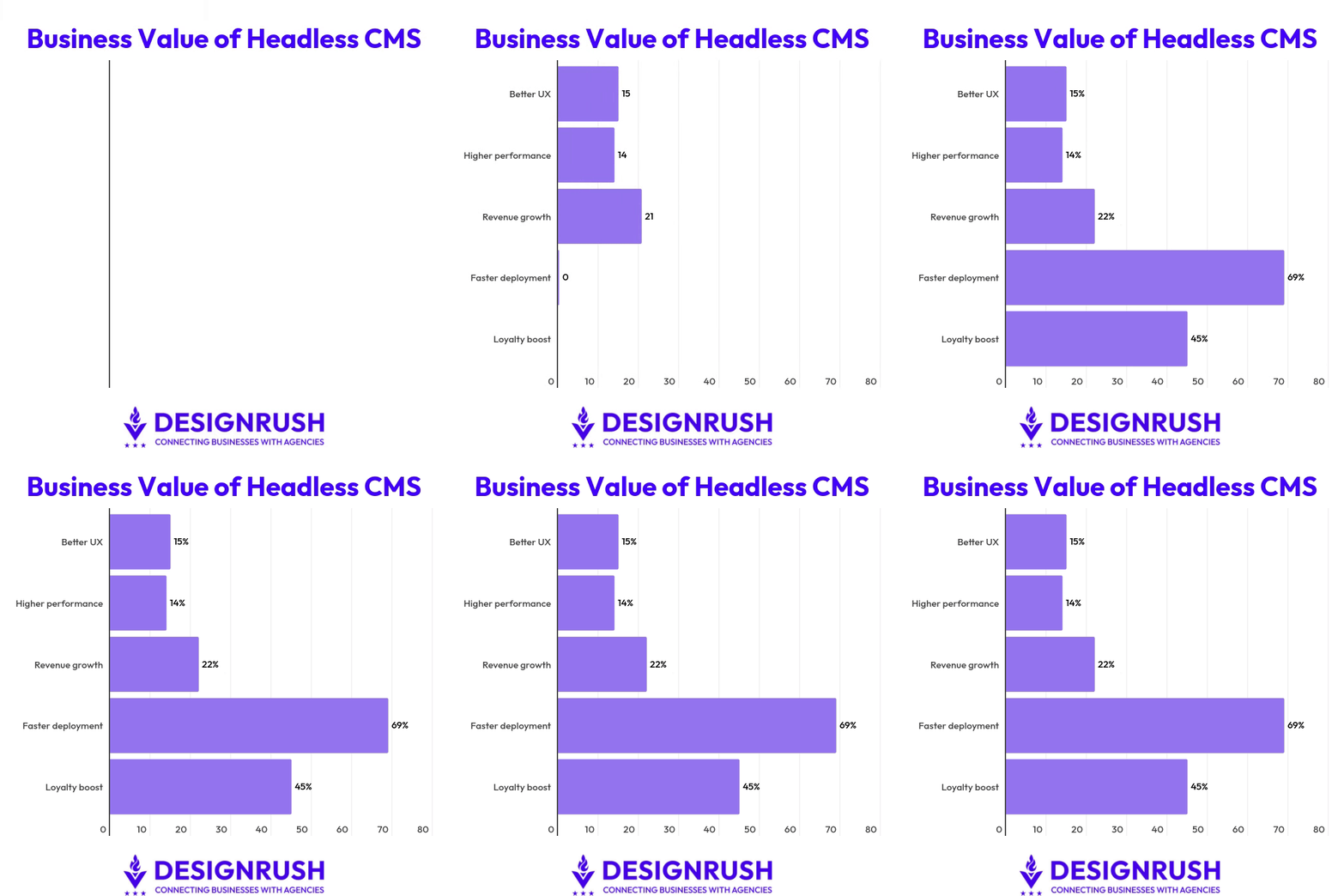
By decoupling the content platform from the front end, content teams can publish while developers ship front-end improvements on independent release cycles. In return, 69% of users report faster time-to-market and higher productivity.
Better user experiences
With 98% of mobile app users expecting consistent UX and a 123% bounce rate for slow-loading mobile sites, headless CMS companies can help you deliver unified yet personalized user experiences. They achieve this by reusing structured content across touchpoints while maintaining centralized governance.
In fact, businesses switching to headless CMS report having 15% better UX and 14% improved performance.
Stronger conversions and ROI
With more localized and personalized user experiences, businesses are reporting higher conversion rates and ROI with their headless CMS systems. According to Gitnux, headless commerce adopters experience:
- 22% year-one-year revenue growth vs. 12% for non-headless CMS stores
- 45% increase in customer retention after adopting a headless CMS
- 320% ROI in 18 months
Moreover, IDC research found that omnichannel buyers spend 15%-20% more than those purchasing on a single channel.
How much do their services cost?
The cost to build a digital solution with headless CMS architecture can range between $8,000 to over $500,000. The final billing will depend on scope, integrations, migration effort, number of channels, and build complexity.
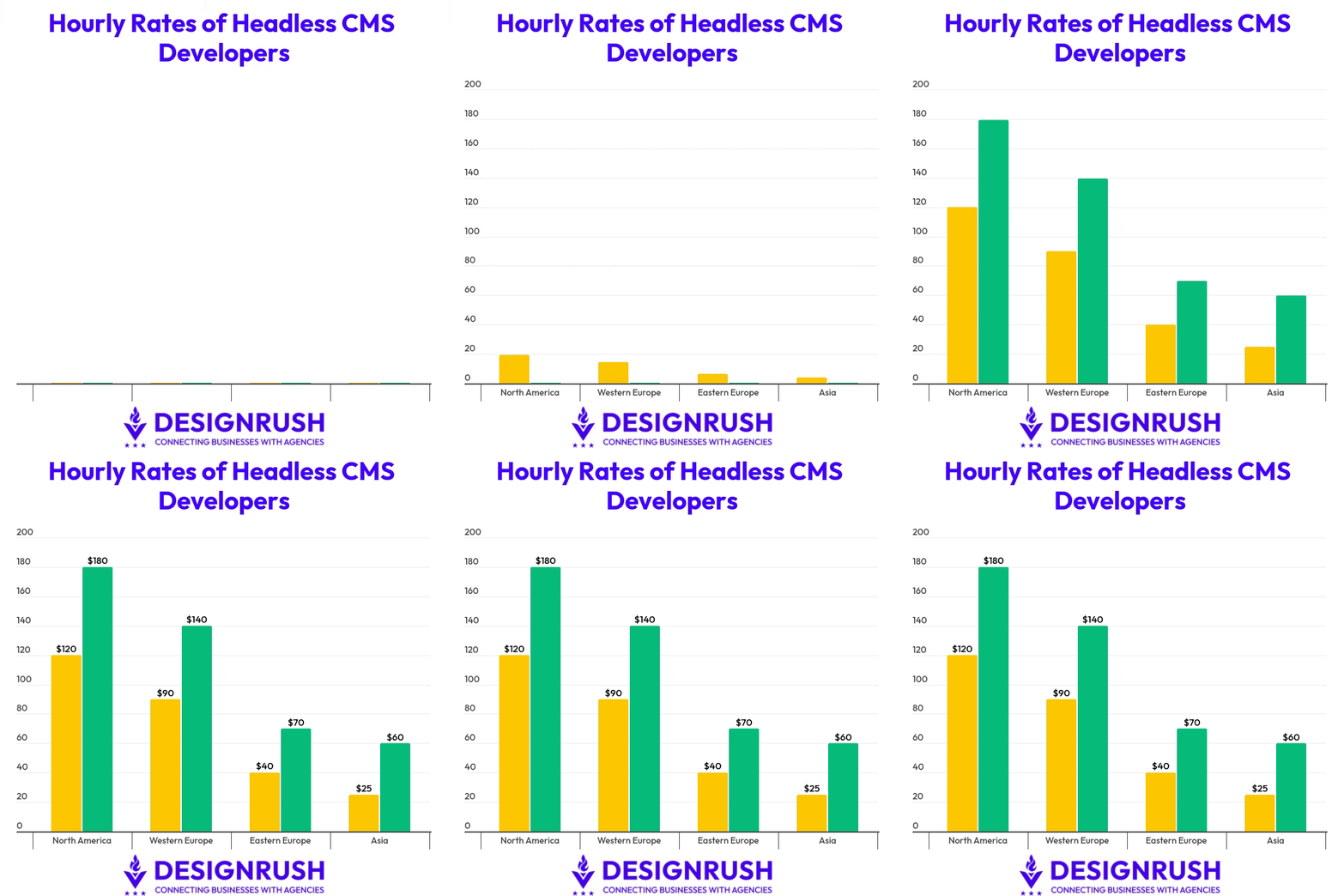
Here are the hourly rates of headless CMS developers per region:
- North America (United States and Canada): $120-$180 per hour
- Western Europe: $90-$140 per hour
- Eastern Europe: $40-$70 per hour
- Latin America: $35-$70 per hour
- Asia: $25-$60 per hour
Based on these hourly rates, here are the approximate costs of each headless CMS project:
- Content migration starts at $2,000-$10,000, depending on data volume and complexity.
- Small builds using a static site generator can start at $8,000-$25,000.
- Standard marketing and business sites that are dynamic, have basic analytics, and simple integration requirements can cost $20,000-$80,000.
- Mid-size platforms can cost $50,000-$150,000 for a scalable headless CMS, advanced integrations, and custom APIs.
- Web apps start at $40,000 for basic functions but go beyond $80,000-$150,000 for more complex requirements.
- Headless commerce stores start at $30,000-$60,000 for small businesses and startups, but can reach over $500,000 a global content delivery system.
- Enterprise builds often start at $100,000, depending on integration requirements, security and compliance controls, and data structures.
How long does it take to build a headless CMS project?
A headless CMS project can take 10-12 weeks for a small-scale project, like a multi-channel marketing website. However, more complex builds can take 12-20+ weeks, and enterprise replatforms can run 4-9 months.
The actual project timeline will depend on your project's complexity, core features and functions, integration and compliance requirements, and feedback loops. Here is an estimated timeline breakdown:
| Discovery and planning (2-4 weeks) | Stakeholder workshops to define business objectives, audiences, performance indicators, governance, and technical requirements. |
| Designing and prototyping (3-5 weeks) | Crafting the wireframes, architecture, design systems, and key components. |
| Content migration (2-10+ weeks, often in parallel with development) | Audit and migration plan, content cleanup, mapping, redirecting SEO, and validation. |
| Development and integration (4-8 weeks) | Content modeling, roles/permissions, environments, front-end build, and integrations (e.g., CRM and data analytics tools). |
| Testing and quality assurance (2-3 weeks) | Testing the website's performance, usability, accessibility, security, and reliability. |
| Launch (1-2 weeks) | Deploying the website to a live site and monitoring it for potential issues, so it can be resolved quickly. |
How do you choose the best headless CMS agency for your business?
Consider these steps when choosing a headless CMS company for your business:
- Define your project scope and goals, performance targets, key features, channels, and compliance and security requirements.
- Shortlist headless CMS companies with proven experience in your project type, technical stack, and industry by examining their case studies and looking for measurable business results.
- Analyze customer reviews and testimonies to assess communication, project management, on-time delivery, and how they handle changes and issues.
- Issue a request for proposal and compare them based on scope, assumptions, deliverables, team composition, and total cost of ownership.
- Interview the team working on your project to ask about process, quality assurance, compliance and security controls, ownership, and post-launch services.
- Choose a headless CMS agency that is strategic, transparent, responsive, and clearly understands your constraints, success metrics, and tech environment.
What questions should you ask before hiring?
Ask these questions before hiring a headless CMS agency to verify that it has the right skills and experience to execute your project:
Relevant Background
- What headless CMS platforms and architectures do you specialize in?
- Can you share past headless CMS projects similar to our scope, integration, and migration requirements? What were the results?
- What is your experience in our industry, and can you provide 3 client references we can contact?
Services and Processes
- Can you walk us through your end-to-end process, from discovery to launch and iteration?
- How do you ensure security, scalability, and accessibility in your design and development process?
- How do you handle quality across devices and channels?
- What are your post-launch services? Will you provide ongoing maintenance and iteration support?
Related to Your Project
- How will you design the content model, workflows, and permissions for our teams (marketing, legal, regional teams)?
- How will the headless CMS solution integrate with my existing technologies?
- Will you provide training to my employees so we can update and manage the platform independently?
- What do we own after launch (code repos, cloud accounts, documentation, CI/CD), and how do handoffs work?
Sources
DesignRush sustains a directory of over 40,000 agencies categorized by service category, location, expertise, and reviews. We build our database in two ways:
- Our dedicated team of agency experts actively searches the web for top-performing companies. We then pull information from their websites, online presence, and client testimonials to verify their status and qualifications prior to listing.
- The agencies listed get notified of their profiles on the website and they can choose to claim it or not, which suggests their availability for more collaborations.
Agencies can also reach out to DesignRush and must go through the verification process prior to being listed.

Why companies trust DesignRush
Every agency is independently vetted before it can be listed or ranked
 4.8
4.8 4.8
4.8Some agencies pay for sponsored placement, clearly labeled and held to the same vetting standards.
Frequently Asked Questions About Headless CMS Companies
What are the typical services provided by headless CMS developers?
Headless CMS companies plan, implement, and operate a headless content management system (CMS), so teams can efficiently publish content across websites, apps, and other digital channels. Typical headless CMS development services include:
- Headless CMS consulting and strategy: Advising businesses on the best headless CMS vendor and architecture or optimizing current platforms to meet their goals.
- Platform migration: Moving content and assets from legacy systems while preserving data integrity, security, and SEO with minimal downtime.
- Custom headless CMS development: Building the content models, automations, and user roles as well as the front and back end to ensure easy maintainability and reliable performance.
- API and plugin development: Integrating the headless CMS platform with third-party systems, such as payment gateways, CRMs, ERPs, and marketing automation tools.
- Ongoing maintenance and support: Continuously monitoring the platform's performance, resolving issues, installing security patches and updates, and managing infrastructure.
What is the difference between headless CMS and traditional CMS?
A headless CMS separates the content management backend from the frontend experiences. As such, content is delivered via APIs to any channel (websites, mobile apps, and IoT devices), so teams can reuse the same content across multiple experiences.
On the other hand, a traditional CMS has a unified back- and front-end (monolithic), meaning that there is a single interface that often comes in the form of a website. It can still power multiple channels, but doing so requires extensive tooling and customization.
Here are more details on their differences:
| Headless CMS platforms | Traditional CMS platforms | |
| Advantages |
|
|
| Disadvantages |
|
|
What are the most common headless CMS platforms?
Based on our research, here are some of the most common headless CMS platforms that developers use:
- WordPress: While it is a traditional CMS, it can be converted into a headless platform when paired with a modern JavaScript framework. Use this platform if you already have an existing WordPress-based site and want to migrate to a headless one.
- Strapi: An open-source, self-hosted headless CMS, enabling teams to have higher control over their data and infrastructure while being able to customize plugins, APIs, and workflows. Choose Strapi if you want to keep your data within your servers, and data sovereignty is non-negotiable.
- Contentful: A digital experience platform (DXP) with an API-first architecture and an extensive library of pre-built integrations. This platform is common for enterprises with complex needs and legacy tools.
- Sanity: Known for its collaboration features and flexible content management, Sanity is ideal for businesses that prioritize agility through controlled yet automated workflows.
While these are the most common platforms, reputable headless CMS companies will recommend a tech stack that best matches your goals, technical requirements, existing systems, operating models, team capabilities, and target audiences.
What companies benefit the most from headless CMS?
Many organizations benefit the most from a headless CMS when they need to publish content to multiple digital channels, scale across regions, or build custom experiences without being constrained by a single website template system. Common scenarios include:
- eCommerce and retail with multiple customer touchpoints (web, app, in-store screens) and heavy integrations (PIM, inventory, CRM, marketing automation), where teams want faster experimentation and performance.
- Brands running omnichannel campaigns (web + mobile + social + email + in-product) that need to reuse content consistently across channels.
- Product-led or platform businesses building multiple front ends (customer portals, apps, partner dashboards) that require developer flexibility and frequent releases.
- Global enterprises managing multiple markets, languages, and brands—where content governance, localization workflows, and reusable components are essential.
When should a company NOT use headless CMS frameworks?
A headless CMS may not be the best fit if:
- You need to launch quickly on a tight budget, and a template-based website will meet your goals.
- Your site is simple (e.g., a landing page or small brochure site), and you do not need multiple channels, complex integrations, or frequent changes.
- You do not have ongoing development capacity (in-house or via a retainer) to maintain the front end, integrations, and updates.
- Your team depends on visual page-building and WYSIWYG (what you see is what you get) editing and you are not prepared to invest in a headless setup that delivers an equivalent editorial experience.
Latest Trends Related to Headless CMS
-preview-webp.webp)