Connect with vetted headless CMS developers to drive better UX, conversions, and ROI through consistent omnichannel experiences. Filter agencies by expertise, budget, and location to find the right partner.
Organic rankings are determined by five factors: top services, reviews, portfolio, awards/press, and team expertise. Sponsored listings pay for a placement that appears above organic positions. Sponsorship does not affect star ratings or review content - read more on our methodology page.
Software design, development and AI studio in Ogden, Utah.
HQ is a 25-person software design, development and AI studio in Ogden, Utah. Since 2012 we've launched 250+ products, including AI tools, web and mobile apps, and marketing sites, and we take AI-built prototypes and make them production ready...
Top Services:
- Software Development
- AI Development
- Mobile App Development
- Design Services
- Web Development
- Show more
- Location
- Ogden, Utah
- Number of Employees
- Under 49
- Average Hourly Rate
- $115/hr
- Minimal Budget
- $25,000 - $50,000
- Portfolios Count
- 10 Projects Listed
Data sourced from the agency's DesignRush profile, its website, and other relevant accountsHQ Services
Data sourced from the agency's DesignRush profileRevere Health Nomi Health Autoliv WGU Labs Messenger Stationery Parallel Weave Instructure GE Vivint
HQ Reviews & Testimonials
Matt Taylor's Review Sourced from Google
Experience working with HQ has been great, treating us more as a partner rather than a client. They stay on top of app trends and help us to create great UI/UX experiences. They are big enough to deliver what we need with quick turnaround, yet small and nimble enough to be flexible with our demands. Definitely recommend!
Sam Wilkinson's Review Sourced from Google
HQ is quick, timely, and creative! The team was extremely helpful, and I look forward to working with them in the future!
Chris Bennett's Review Sourced from Google
I have worked with HQ one several projects and have been very pleased. They are always communicating on the status, their code is impeccable and the quality of work is great. +97thfloor will continue to use them on projects for our clients.
Reviews verified by DesignRush and sourced from the agency's profile View All ReviewsPractical AI. Hands-on experience.
The gap between AI ambition and AI value is execution. Globaldev combines AI transformation consulting, practical AI expertise, and hands-on delivery to define what makes sense, implement what works, and scale it across your organization, wit...
Top Services:
- Web Development
- UI/UX Design
- Software Development
- Mobile App Development
- Software Testing
- Show more
- Location
- Warszawa, Poland
- Number of Employees
- 250 - 499
- Average Hourly Rate
- $50/hr
- Minimal Budget
- $25,000 - $50,000
- Portfolios Count
- 26 Projects Listed
Data sourced from the agency's DesignRush profile, its website, and other relevant accountsGlobaldev Group Services
Data sourced from the agency's DesignRush profileTeva Pliant Budget Thuis Tarya Hoopit Tyler Technologies ECIT Beewise YOC IWC
Let's Dev This
247 Labs is one of the Top Software Development Companies in Canada, serving industries in Healthcare, Insurance, Finance, Retail and more. Our services include full custom software end to end development and AI...
Top Services:
- AI Development
- Mobile App Development
- Software Development
- Web Development
- WordPress Website Design
- Show more
- Location
- Toronto, Canada
- Number of Employees
- 50 - 99
- Average Hourly Rate
- $100/hr
- Minimal Budget
- $25,000 - $50,000
- Portfolios Count
- 6 Projects Listed
Data sourced from the agency's DesignRush profile, its website, and other relevant accounts247 Labs Services
Data sourced from the agency's DesignRush profileRogers GM Motorola Loblaw Ubisoft Coles Johnson&Johnson Guard.me YMCA Gillette
247 Labs Reviews & Testimonials
Ethan Feltz's Review Sourced from Google
247 Labs was great to work with. I would recommend them for any software development as they have the expertise to solve complex challenges and create great software.
Jesse Axelrod's Review Sourced from Google
All I have to say Ali you’re amazing. Your company did great thanks for getting my business Up and running again I appreciate everything you have done Your patience with me is fantastic. I highly recommend this company to anybody who needs web work. These guys came through for me pulled me out of the gutter from previous web designers and web management. Always will recommend these guys. Thanks Ali to you and your team
Kate Ruscito's Review Sourced from Google
If I could leave 10 stars, I would! Working with 247Labs on our website was one of the best decisions we made. From day one, their communication was clear, consistent, and easy to follow. We always knew what was happening, what was next, and where input was needed.Their team was responsive, open to feedback, and quick to turn ideas into improvements. They didn’t just execute, they brought smart suggestions that made the final product far better than what we initially envisioned.On the technical and design side, they’re INCREDIBLE. Our site is fast, clean, modern, and built with real attention to detail. Every element was expertly crafted and feels unique to us.What stood out most was how supportive they were throughout the entire process. They were patient, proactive, and genuinely invested in getting the best result for us.Absolutely use 247Labs if you need a website. They deliver, and then they go beyond that!
Reviews verified by DesignRush and sourced from the agency's profile View All ReviewsThe Right Software Can Change Everything
Atomic Object is a top-rated custom software design and development consultancy. Our co-located, U.S.-based team works with executives to improve their bottom line by delivering new products, enhancing existing products, modernizing legacy products, and integrating AI into their software systems...
Top Services:
- Mobile App Development
- AI Development
- Software Development
- Web Development
- Product Design
- Show more
- Location
- Grand Rapids, Michigan
- Number of Employees
- 100 - 249
- Minimal Budget
- $25,000 - $50,000
- Portfolios Count
- 1 Project Listed
Data sourced from the agency's DesignRush profile, its website, and other relevant accountsAtomic Object Services
Data sourced from the agency's DesignRush profileQuell NSF International Eaton Corporation Priority Health Ford Motor Company Cultural Intelligence Center Steelcase Drug Free Sport MedHub Domino's
Atomic Object Reviews & Testimonials

Consumer IoT Review from Mason Ferlic
GripFusion is a sports technology startup developing Tactile Intelligence. Our flagship product, the ForceBall, is the first grip-sensing baseball. We approached Atomic Object with the challenge to build a React Native iPad app to connect with the embedded electronics over BLE and visualize sensor data in real time. Atomic stepped up to the plate and hit a home run! They took early R&D code and we're able to successfully navigate IoT challenges, large amounts of sensor data, and seamless UX. The developer team worked closely with our technical staff to incorporate evolving firmware and hardware improvements. The design team did hundreds of hours of user discovery and product feedback to ensure we deliver a cutting-edge experience. Overall, Atomic has the breadth and depth to tackle complex hardware-software systems.
Daniel Schoonmaker's Review Sourced from Google
Atomic Object is one of the best companies across the board in Michigan. Fantastic maker of custom-software solution and a model of organizational thought leadership. I've been working with the company in some capacity for nearly 20 years and learn something new in every interaction I've ever had.More than that, they are a value-centered organization that you will be proud to partner with. They've built this company the right way. An impactful community leader and employer of choice.
Rik Cordero's Review Sourced from Google
As a freelance Video Producer, I recently wrapped up another fun project with the folks over at Atomic Object, and I've gotta say, it was an experience worth mentioning. Collaborating with their marketing team on a series of authentic and engaging customer-facing and internal videos was nothing short of fantastic. Their seamless planning and logistics during pre-production, coupled with easy going personalities during production, made the process a breeze. Post-production brought our collective vision to life with meticulous story editing and videos that reflect their unique culture and values. Their team's dedication to kindness, empathy, and diversity made this collaboration not just successful, but truly enjoyable.
Reviews verified by DesignRush and sourced from the agency's profile View All ReviewsCustom software for Australian businesses
National Digital is a Gold Coast-based software engineering company building custom web applications, booking platforms, portals, integrations and e-commerce systems for Australian businesses. Senior engineers deliver reliable, scalable platforms across AWS, Cloudflare and modern web technologies...
Top Services:
- Software Development
- Web Development
- Location
- Burleigh Heads, Australia
- Number of Employees
- Under 49
- Average Hourly Rate
- $150/hr
- Minimal Budget
- $25,000 - $50,000
Data sourced from the agency's DesignRush profile, its website, and other relevant accountsNational Digital Services
Data sourced from the agency's DesignRush profileGRATOFY LUXICO MyStrengths
The experience is the brand®
The Office of Experience (OX) is a Chicago-based digital agency helping ambitious B2B companies outperform their peers. At the intersection of customer experience, marketing, and technology, OX unites strategy, design, and engineering to transform how companies connect with customers. Capabilities span B2B...
Top Services:
- Digital Strategy
- UI/UX Design
- eCommerce Development
- Web Design
- Digital Marketing
- Show more
- Location
- Chicago, Illinois
- Number of Employees
- 50 - 99
- Average Hourly Rate
- $175/hr
- Minimal Budget
- $25,000 - $50,000
Data sourced from the agency's DesignRush profile, its website, and other relevant accountsOffice of Experience Services
Data sourced from the agency's DesignRush profileAMEX GBT Mack Trucks GEICO Nasdaq Medica HealthEquity Oscar Health Sunrise Senior Living VSP Global DDN
Office of Experience Reviews & Testimonials
Michelle t's Review Sourced from Google
If you are looking for an amazing digital team, these are your people! True professionals and a blast to work with!
Ashley Freeland's Review Sourced from Google
Such an awesome time. They did a great job with the details. Take your time going through so you don't miss something.
Reviews verified by DesignRush and sourced from the agency's profile View All ReviewsYour Trusted Partner for Enterprise AI, Planning, Analytics & Automation
GenXAI is a publicly listed technology company building enterprise planning and data systems. Our team of 450+ consultants delivers Anaplan and SAP led implementations, ERP transformation, data analytics and engineering, and application development for clients across India, the United States, Malaysia, and...
Top Services:
- ERP Consulting
- CRM Consulting
- Big Data Analytics
- IT Services
- Business Consulting
- Show more
- Location
- Jaipur, India
- Number of Employees
- 250 - 499
- Average Hourly Rate
- $50/hr
- Minimal Budget
- $25,000 - $50,000
Data sourced from the agency's DesignRush profile, its website, and other relevant accountsGenXAI Analytics Services
Data sourced from the agency's DesignRush profileBajaj Finserv Reliance General Insurance Snapdeal Clever ALKEM Max Healthcare Meril Group NDDB Dairy Services Godrej Eternal Limited (Zomato)
GenXAI Analytics Reviews & Testimonials
Sawan Singh's Review Sourced from Google
Really solid experience with GenXAI Analytics. We needed help with our Anaplan setup and they got it done without the usual back-and-forth headaches. The team actually listened before jumping to solutions, which isn't as common as you'd hope. Would work with them again.
Deepak Bunkar's Review Sourced from Google
Great experience working with GenXAI. Their consultants know their stuff and focus on practical fixes rather than overcomplicating things. The project came in on time and on budget.
Aman Pareek's Review Sourced from Google
We had an excellent experience working with GenXAI. Their team demonstrated exceptional professionalism, technical expertise, and a deep understanding of our business requirements throughout the engagement.One of the highlights of the project was their Enterprise Performance Management (EPM) implementation. The team took the time to understand our planning, budgeting, forecasting, and reporting needs, and delivered a well-structured solution that streamlined our business processes and improved decision-making. Their expertise in EPM implementation, combined with their consultative approach, ensured a smooth deployment and successful adoption.Communication was transparent, timelines were well managed, and the team was always responsive to our questions and feedback. They consistently focused on delivering high-quality solutions while providing valuable recommendations to enhance the overall outcome.Overall, GenXAI proved to be a reliable technology partner with strong capabilities in EPM, AI, analytics, and digital transformation. We are extremely satisfied with the results and would highly recommend them to organizations looking for a trusted implementation and consulting partner.
Reviews verified by DesignRush and sourced from the agency's profile View All Reviews
















Explore Web Development Specializations
- Angular Development
- Backend Development
- Bubble
- CakePHP
- Casino
- Companies for Fintech
- Contentful
- Drupal
- Front End
- Jamstack Development
- Joomla Development
- Next.js
- No Code Development
- Pegasystems
- Podia
- Property Management
- React.JS
- Ruby on Rails
- Sitecore
- Small Businesses Website Development
- TYPO3
- Umbraco
- Webflow
- WordPress
- Zoho Creator
Popular Services
Everything You Need to Know Before Hiring a Headless CMS Agency
How do headless CMS companies help your business?
Headless CMS agencies help you design and implement a content platform and delivery stack that lets teams ship digital experiences faster, scale across channels, and integrate cleanly with your existing systems.
Faster iteration cycles and reduced downtime
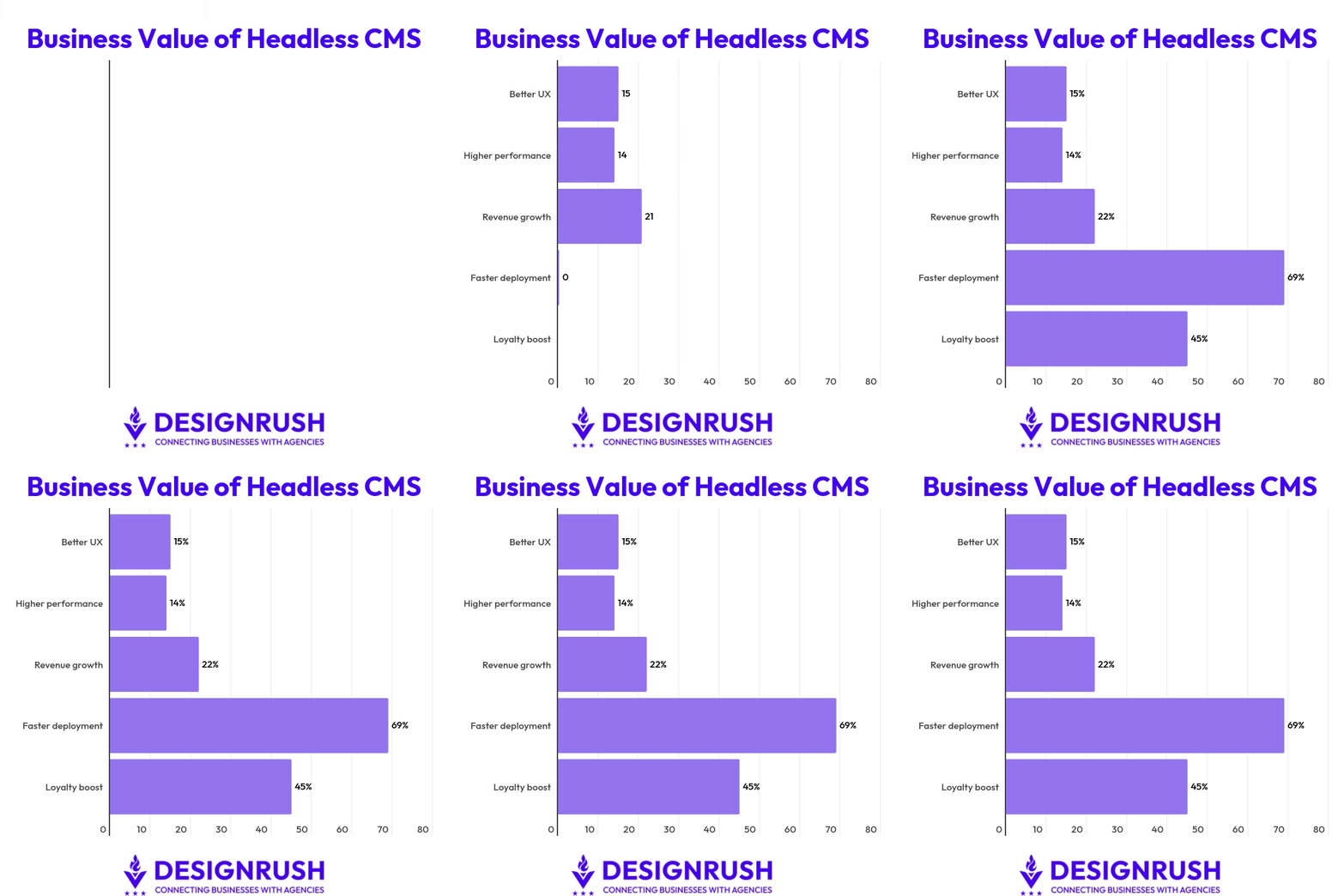
By decoupling the content platform from the front end, content teams can publish while developers ship front-end improvements on independent release cycles. In return, 69% of users report faster time-to-market and higher productivity.
Better user experiences
With 98% of mobile app users expecting consistent UX and a 123% bounce rate for slow-loading mobile sites, headless CMS companies can help you deliver unified yet personalized user experiences. They achieve this by reusing structured content across touchpoints while maintaining centralized governance.
In fact, businesses switching to headless CMS report having 15% better UX and 14% improved performance.
Stronger conversions and ROI
With more localized and personalized user experiences, businesses are reporting higher conversion rates and ROI with their headless CMS systems. According to Gitnux, headless commerce adopters experience:
- 22% year-one-year revenue growth vs. 12% for non-headless CMS stores
- 45% increase in customer retention after adopting a headless CMS
- 320% ROI in 18 months
Moreover, IDC research found that omnichannel buyers spend 15%-20% more than those purchasing on a single channel.
How much do their services cost?
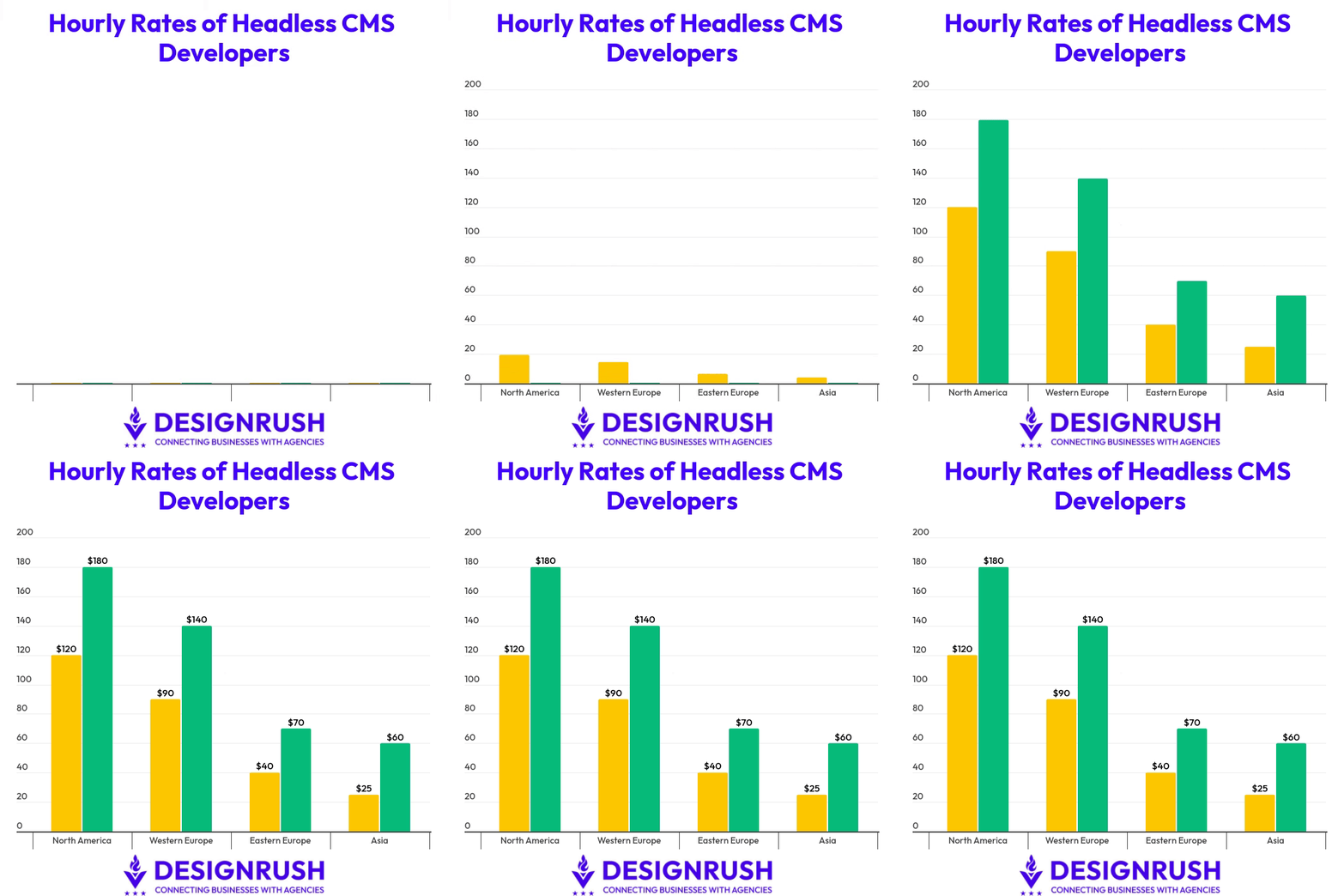
The cost to build a digital solution with headless CMS architecture can range between $8,000 to over $500,000. The final billing will depend on scope, integrations, migration effort, number of channels, and build complexity.
Here are the hourly rates of headless CMS developers per region:
- North America (United States and Canada): $120-$180 per hour
- Western Europe: $90-$140 per hour
- Eastern Europe: $40-$70 per hour
- Latin America: $35-$70 per hour
- Asia: $25-$60 per hour
Based on these hourly rates, here are the approximate costs of each headless CMS project:
- Content migration starts at $2,000-$10,000, depending on data volume and complexity.
- Small builds using a static site generator can start at $8,000-$25,000.
- Standard marketing and business sites that are dynamic, have basic analytics, and simple integration requirements can cost $20,000-$80,000.
- Mid-size platforms can cost $50,000-$150,000 for a scalable headless CMS, advanced integrations, and custom APIs.
- Web apps start at $40,000 for basic functions but go beyond $80,000-$150,000 for more complex requirements.
- Headless commerce stores start at $30,000-$60,000 for small businesses and startups, but can reach over $500,000 a global content delivery system.
- Enterprise builds often start at $100,000, depending on integration requirements, security and compliance controls, and data structures.
How long does it take to build a headless CMS project?
A headless CMS project can take 10-12 weeks for a small-scale project, like a multi-channel marketing website. However, more complex builds can take 12-20+ weeks, and enterprise replatforms can run 4-9 months.
The actual project timeline will depend on your project's complexity, core features and functions, integration and compliance requirements, and feedback loops. Here is an estimated timeline breakdown:
| Discovery and planning (2-4 weeks) | Stakeholder workshops to define business objectives, audiences, performance indicators, governance, and technical requirements. |
| Designing and prototyping (3-5 weeks) | Crafting the wireframes, architecture, design systems, and key components. |
| Content migration (2-10+ weeks, often in parallel with development) | Audit and migration plan, content cleanup, mapping, redirecting SEO, and validation. |
| Development and integration (4-8 weeks) | Content modeling, roles/permissions, environments, front-end build, and integrations (e.g., CRM and data analytics tools). |
| Testing and quality assurance (2-3 weeks) | Testing the website's performance, usability, accessibility, security, and reliability. |
| Launch (1-2 weeks) | Deploying the website to a live site and monitoring it for potential issues, so it can be resolved quickly. |
How do you choose the best headless CMS agency for your business?
Consider these steps when choosing a headless CMS company for your business:
- Define your project scope and goals, performance targets, key features, channels, and compliance and security requirements.
- Shortlist headless CMS companies with proven experience in your project type, technical stack, and industry by examining their case studies and looking for measurable business results.
- Analyze customer reviews and testimonies to assess communication, project management, on-time delivery, and how they handle changes and issues.
- Issue a request for proposal and compare them based on scope, assumptions, deliverables, team composition, and total cost of ownership.
- Interview the team working on your project to ask about process, quality assurance, compliance and security controls, ownership, and post-launch services.
- Choose a headless CMS agency that is strategic, transparent, responsive, and clearly understands your constraints, success metrics, and tech environment.
What questions should you ask before hiring?
Ask these questions before hiring a headless CMS agency to verify that it has the right skills and experience to execute your project:
Relevant Background
- What headless CMS platforms and architectures do you specialize in?
- Can you share past headless CMS projects similar to our scope, integration, and migration requirements? What were the results?
- What is your experience in our industry, and can you provide 3 client references we can contact?
Services and Processes
- Can you walk us through your end-to-end process, from discovery to launch and iteration?
- How do you ensure security, scalability, and accessibility in your design and development process?
- How do you handle quality across devices and channels?
- What are your post-launch services? Will you provide ongoing maintenance and iteration support?
Related to Your Project
- How will you design the content model, workflows, and permissions for our teams (marketing, legal, regional teams)?
- How will the headless CMS solution integrate with my existing technologies?
- Will you provide training to my employees so we can update and manage the platform independently?
- What do we own after launch (code repos, cloud accounts, documentation, CI/CD), and how do handoffs work?
Sources
DesignRush sustains a directory of over 40,000 agencies categorized by service category, location, expertise, and reviews. We build our database in two ways:
- Our dedicated team of agency experts actively searches the web for top-performing companies. We then pull information from their websites, online presence, and client testimonials to verify their status and qualifications prior to listing.
- The agencies listed get notified of their profiles on the website and they can choose to claim it or not, which suggests their availability for more collaborations.
Agencies can also reach out to DesignRush and must go through the verification process prior to being listed.

Why companies trust DesignRush
Every agency is independently vetted before it can be listed or ranked
 4.8
4.8 4.8
4.8Some agencies pay for sponsored placement, clearly labeled and held to the same vetting standards.
Frequently Asked Questions About Headless CMS Companies
What are the typical services provided by headless CMS developers?
Headless CMS companies plan, implement, and operate a headless content management system (CMS), so teams can efficiently publish content across websites, apps, and other digital channels. Typical headless CMS development services include:
- Headless CMS consulting and strategy: Advising businesses on the best headless CMS vendor and architecture or optimizing current platforms to meet their goals.
- Platform migration: Moving content and assets from legacy systems while preserving data integrity, security, and SEO with minimal downtime.
- Custom headless CMS development: Building the content models, automations, and user roles as well as the front and back end to ensure easy maintainability and reliable performance.
- API and plugin development: Integrating the headless CMS platform with third-party systems, such as payment gateways, CRMs, ERPs, and marketing automation tools.
- Ongoing maintenance and support: Continuously monitoring the platform's performance, resolving issues, installing security patches and updates, and managing infrastructure.
What is the difference between headless CMS and traditional CMS?
A headless CMS separates the content management backend from the frontend experiences. As such, content is delivered via APIs to any channel (websites, mobile apps, and IoT devices), so teams can reuse the same content across multiple experiences.
On the other hand, a traditional CMS has a unified back- and front-end (monolithic), meaning that there is a single interface that often comes in the form of a website. It can still power multiple channels, but doing so requires extensive tooling and customization.
Here are more details on their differences:
| Headless CMS platforms | Traditional CMS platforms | |
| Advantages |
|
|
| Disadvantages |
|
|
What are the most common headless CMS platforms?
Based on our research, here are some of the most common headless CMS platforms that developers use:
- WordPress: While it is a traditional CMS, it can be converted into a headless platform when paired with a modern JavaScript framework. Use this platform if you already have an existing WordPress-based site and want to migrate to a headless one.
- Strapi: An open-source, self-hosted headless CMS, enabling teams to have higher control over their data and infrastructure while being able to customize plugins, APIs, and workflows. Choose Strapi if you want to keep your data within your servers, and data sovereignty is non-negotiable.
- Contentful: A digital experience platform (DXP) with an API-first architecture and an extensive library of pre-built integrations. This platform is common for enterprises with complex needs and legacy tools.
- Sanity: Known for its collaboration features and flexible content management, Sanity is ideal for businesses that prioritize agility through controlled yet automated workflows.
While these are the most common platforms, reputable headless CMS companies will recommend a tech stack that best matches your goals, technical requirements, existing systems, operating models, team capabilities, and target audiences.
What companies benefit the most from headless CMS?
Many organizations benefit the most from a headless CMS when they need to publish content to multiple digital channels, scale across regions, or build custom experiences without being constrained by a single website template system. Common scenarios include:
- eCommerce and retail with multiple customer touchpoints (web, app, in-store screens) and heavy integrations (PIM, inventory, CRM, marketing automation), where teams want faster experimentation and performance.
- Brands running omnichannel campaigns (web + mobile + social + email + in-product) that need to reuse content consistently across channels.
- Product-led or platform businesses building multiple front ends (customer portals, apps, partner dashboards) that require developer flexibility and frequent releases.
- Global enterprises managing multiple markets, languages, and brands—where content governance, localization workflows, and reusable components are essential.
When should a company NOT use headless CMS frameworks?
A headless CMS may not be the best fit if:
- You need to launch quickly on a tight budget, and a template-based website will meet your goals.
- Your site is simple (e.g., a landing page or small brochure site), and you do not need multiple channels, complex integrations, or frequent changes.
- You do not have ongoing development capacity (in-house or via a retainer) to maintain the front end, integrations, and updates.
- Your team depends on visual page-building and WYSIWYG (what you see is what you get) editing and you are not prepared to invest in a headless setup that delivers an equivalent editorial experience.
Latest Trends Related to Headless CMS
-preview-webp.webp)