Capitalizing on artificial intelligence requires moving past generic solutions to find an agency with the right balance of data architecture expertise, integration capability, and industry focus. Browse our directory to evaluate and shortlist top-performing AI development companies based on verified client reviews, portfolio depth, and specialized domain focus.
- Home
- AI Companies
List of AI Development Agencies
Expertise
- AI Expertise
- Agentic AI
- AI Application Development
- AI Automation
- AI Consulting
- AI Customer Service
- AI Cybersecurity
- AI Supply Chain
- Chatbot Solution
- Cognitive Computing AI
- Computer Vision
- Conversational AI
- Core AI
- Data Annotation
- Edge AI
- Generative AI
- Industry AI
- Machine Learning
- NLP AI
- Predictive Analytics
- Robotics AI
- Robotics Process Automation
- Vector Database
- Voice Recognition AI
Beer
- Agriculture
- AI
- Arts
- Automotive
- Beauty
- Beer
- Boutique
- Construction
- Consumer Goods
- Corporate Services
- Crypto
- Delivery & Takeaway
- Dental
- Design
- eCommerce
- Education
- Electronics
- Energy & Mining
- Entertainment
- Fashion
- Finance
- Fintech
- Food and Beverage
- Gambling
- Gaming
- Government
- Hardware & Networking
- Health Care
- Higher Education
- Hobbies & Gifts
- Home & Garden
- Home Services
- Hospitality
- HR
- Industrial
- Insurance
- Legal
- Luxury
- Manufacturing
- Media & Communications
- Music
- NFT
- Nonprofit
- Other
- Pets
- Professional Services
- Public Administration
- Public Safety
- Publishing
- Real Estate
- Recreation & Travel
- Restaurants
- Retail
- Social Networks
- Software & IT Services
- Sports
- Supplements
- Transportation & Logistics
- Travel
- Wellness & Fitness
$25,000 - $50,000
Organic rankings are determined by five factors: top services, reviews, portfolio, awards/press, and team expertise. Sponsored listings pay for a placement that appears above organic positions. Sponsorship does not affect star ratings or review content - read more on our methodology page.
AGENCY LISTING COMING SOON.
AI Development Specializations
Services Related to AI Development
Popular Services
How to Hire the Best AI Development Company
What can AI development companies do for your business?
AI software development companies provide the infrastructure and expertise to turn raw data into a competitive asset for their clients.
AI examples include predictive analytics tools, AI chatbots, recommendation engines, fraud detection systems, automated document processing, and internal copilots for sales, support, or engineering teams.
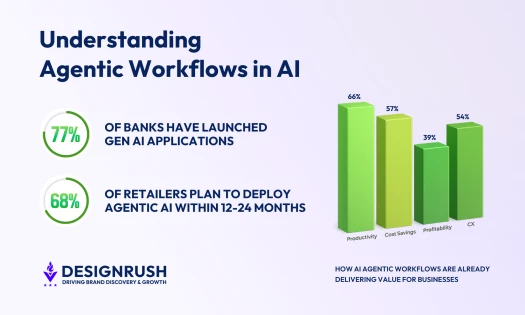
According to the Deloitte 2026 State of AI Report, 66% of organizations have already achieved significant productivity and efficiency gains through enterprise AI adoption.
In software engineering, specialized AI development companies have helped companies like Walmart generate or support over 40% of their new code using AI, drastically shortening development cycles.
By implementing Agentic AI, the AI that can take actions rather than just answer questions, AI development agencies are turning customer service from a cost center into a revenue driver.
Recent data shows that generative AI can improve customer response times by 82% (reducing an 11-minute wait to just 2 minutes) while handling the equivalent workload of 700 full-time agents in large-scale deployments.
67% of IT professionals now report a positive ROI on their AI investments as of early 2026, a massive jump from the 24% reported just a year prior.
Companies developing AI provide the predictive infrastructure needed to forecast trends and personalize sales at scale.
McKinsey estimates that Generative AI could add between $2.6 trillion and $4.4 trillion annually to the global economy. In marketing, AI implementation has led to an average 85% increase in Click-Through Rate (CTR) through hyper-personalization.
While only 20% of companies have already achieved direct revenue growth, 74% of organizations are scaling AI initiatives to drive new revenue streams by the end of 2026.
How can you choose the best AI development agency?
To choose the right agency without getting lost in the tech talk, focus on these simple pillars:
- Look for proof of production, not demos
Many AI development companies can build a Proof of Concept (PoC). Fewer of them can run an AI solution in production for 12+ months. Ask for live case studies and how they handle monitoring, updates, failures, and model drift. If they avoid MLOps, they are not production-ready. - Review case studies and public work
Check reviews, testimonials, and long-term case studies. If AI software development companies have a public product or demo, try it. If their own AI does not behave reliably, your solution will not either. - Verify industry and U.S. compliance experience
Trusted AI development agencies must understand where AI is legally risky. Hiring, healthcare, finance, and consumer AI all have different rules. A strong company can explain bias controls, audits, and Explainable AI without hand-waving. - Confirm ownership and IP rights
You should own the code, the custom-trained model weights, and your data. Confirm your data will not be reused to train models for other clients. In 2026, unclear ownership is a serious risk. - Assess data and integration capability
Top companies in AI development can work with messy data and legacy systems. If they only talk about models and ignore integration, expect delays and cost overruns. - Evaluate how they deliver
Best AI development companies ship in phases. They launch a real, limited use case first, then scale. Clear timelines and tradeoffs signal maturity. - Watch for warning signs
Overpromising accuracy, avoiding security questions, vague timelines, or refusing to discuss ownership are red flags.
The best agency is the one that can ship, integrate, and maintain your AI solution in production, not the one with the loudest AI claims.
What red flags to avoid when hiring AI developers?
You want to avoid wrappers, i.e., people who just put a pretty interface on top of someone else's tech without understanding how it works.
The top red flags to watch for when choosing AI development companies include:
- Promising 100% accuracy
If an AI developer claims their system is perfectly accurate or never hallucinates, that is not realistic. All AI models have error rates. Experienced AI software development companies explain how they measure errors and what guardrails they use to catch failures. - Treating AI as a black box
If they cannot explain how the AI reaches decisions, especially for hiring, finance, or healthcare use cases, this is a serious risk. In 2026, many U.S. regulations require explainable and auditable AI decisions. - Showing only demos, not live systems
A polished demo does not prove delivery. Reliable AI development agencies can point to AI solutions that have been running in production for months and explain how they are maintained over time. - Ignoring data quality and security
Strong AI starts with clean, well-managed data. If an artificial intelligence development company does not ask about data sources, privacy, access controls, or storage, it is focusing on the wrong things. - No plan for MLOps after launch
AI systems degrade over time. If they cannot explain how models are monitored, updated, retrained, or rolled back, the solution will fail in production. - Lack of industry and U.S. compliance knowledge
AI rules differ by industry. An AI development agency that treats all use cases the same may expose you to legal and compliance risk, especially in regulated environments. - Unclear ownership of IP and model weights
You should own the code, custom model weights, and outputs. If ownership or data usage rights are vague, this is a major red flag. - No way to verify their work
If there are no reviews, references, or publicly available AI products to test, you cannot validate quality. If their own AI does not behave reliably, neither will yours. - Focusing on tools instead of outcomes
When developers lead with specific models or tools instead of business results, projects often fail to deliver ROI. Mature teams start with outcomes and constraints, not hype.
What additional factors impact overall AI development costs?
The cost of AI is way more than the initial build. Most organizations find that the hidden operational and regulatory costs can eventually exceed the development price tag.
Beyond the initial code, here are the primary factors that impact your total cost of ownership (TCO):
1. Data Preparation and Pipeline (30-50% of initial budget)
AI is only as good as the data it’s fed with. If your data is "messy" (stored in different formats, missing values, or siloed), the agency will spend weeks just cleaning it before training even starts.
For supervised AI, humans often need to manually tag thousands of images or text snippets, which is labor-intensive.
As your business data changes, the pipes that feed information into the AI must be updated to prevent the system from breaking.
2. Compliance and "Explainability" (The 2026 Regulatory Tax)
New laws (like the Colorado AI Act and the EU AI Act, reaching full enforcement in 2026) have introduced mandatory costs:
You must pay for third-party or internal audits to prove your AI isn't discriminating in areas like hiring or lending.
Regulators now require documented risk assessments before deploying high-risk AI.
Fitting compliance into an already-built system can cost 10x more than building it in from day one.
3. Infrastructure and "Model Drift" (Recurring Costs)
Once an AI is live, it requires constant feeding.
Running complex models (Inference) requires expensive GPU power. As your user base grows, these cloud bills can spike unexpectedly.
AI models actually get "dumber" or outdated over time as the world changes (known as Model Drift). You should budget 15-25% of the original build cost annually for retraining and updates.
What questions to ask before hiring an AI development company?
Before hiring AI development agencies, ask them the following questions:
Relevant background
- Can you show a custom AI solution that has been live in production for over 12 months?
- What experience do you have with current U.S. AI regulations such as the Colorado AI Act or California AI laws?
- Do you have case studies in our specific industry?
Services and processes
- How do you handle model drift and post-launch monitoring?
- What is your process for bias auditing and Explainable AI?
- Do you build wrappers on public AI APIs, or do you support private or on-premise deployments?
- How do you approach MLOps after deployment?
Related to your project
- Who owns the intellectual property, including the code and model weights?
- Will our proprietary data be used to train models for other clients?
- What ongoing costs should we expect beyond development?
- What would the first live use case look like, and how soon could it go live?
Sources
DesignRush sustains a directory of over 40,000 agencies categorized by service category, location, expertise, and reviews. We build our database in two ways:
- Our dedicated team of agency experts actively searches the web for top-performing companies. We then pull information from their websites, online presence, and client testimonials to verify their status and qualifications prior to listing.
- The agencies listed get notified of their profiles on the website and they can choose to claim it or not, which suggests their availability for more collaborations.
Agencies can also reach out to DesignRush and must go through the verification process prior to being listed.
Latest Trends Related to Artificial Intelligence
Artificial Intelligence
Top 20 AI Companies in 2026: Leaders, Innovators and the Battle for Market Dominance