
The key to podcasting ROI in 2026 is to look at the numbers. The data reveals exactly where audiences engage, convert, and deliver the highest return.
Podcast Statistics: Key Findings
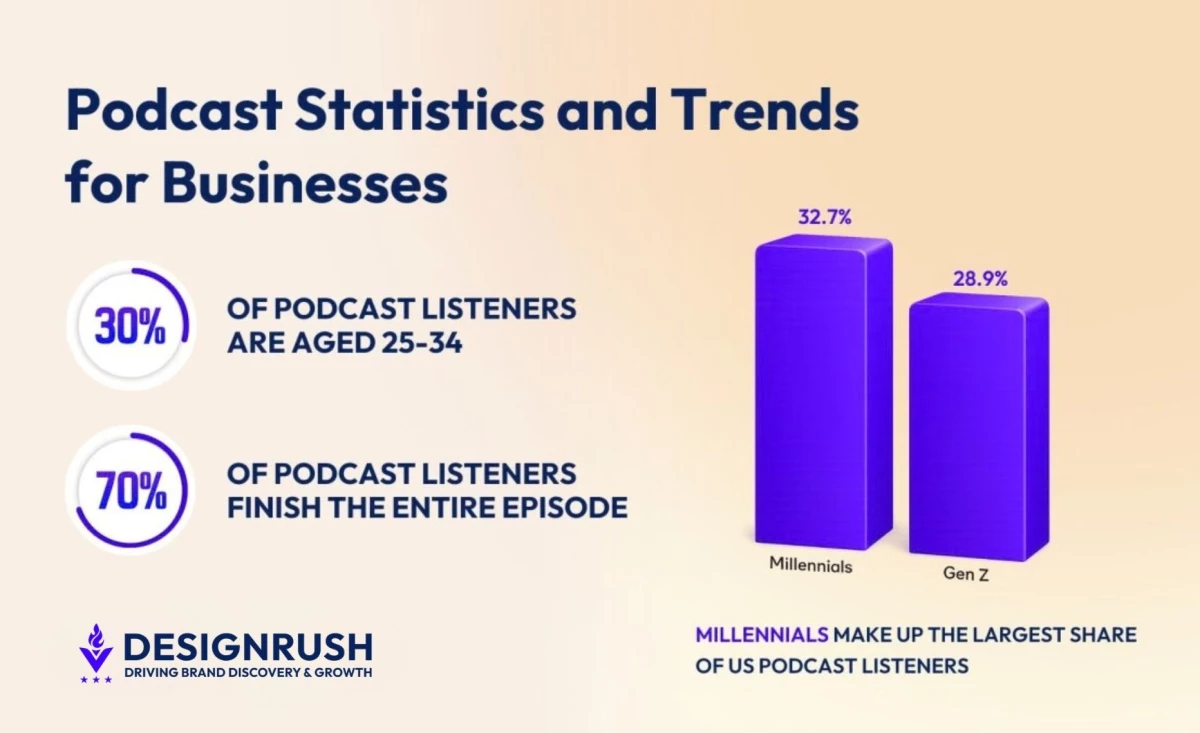
- Over 70% of podcast listenersfinish most or all of each episode, and 46% tune in within 24 hours of its release, showing a habitual, appointment-style listening behavior ideal for repeated brand exposure.
- An estimated 83% of podcast listening happens on mobile devices, with sessions often lasting 30–60 minutes.
- Podcast fans show an unusually high ad tolerance, with 56% more likely to trust host-read ads.
Podcast Statistics at a Glance
We’ll unpack listener demographics, platform trends, and audience behaviors to turn podcast data into revenue.
Successful brands rely on analytics to drive audience segmentation, creative strategy, and platform placement. We cover it all in our 2026 podcast statistics roundup.
Podcast Audience Growth Statistics
As of early 2026, there were approximately 4.57 million podcast titles worldwide and over 400 million episodes (Demand Sage).
At the same time, the global podcast audience has surged to over 619 million in 2026, according to Backlinko’s annual report, up from 580 million in 2025 and 546 million in 2024, growing at 6.83% year-over-year.
Young adults aged 25–34 are the core of the podcast listener base, making up over 30% of global audiences in many markets, as per Triton Rankers.
In the U.S., about 55% of consumers ages 12 and up listen to podcasts on a monthly basis, and 40% on a weekly basis.
About 66% of US consumers aged 12–34 listen monthly, the report also found, the highest reach of any age bracket. This audience segment is digitally native, highly mobile, and seeks content that informs and entertains.
Here’s how to activate this high-value demographic effectively:
- Tailor messaging to early-career professionals who are likely in the market for lifestyle upgrades, subscriptions, and professional tools.
- Prioritize platforms like Spotify and Apple Podcasts, as these platforms capture the majority of this demographic.
- Craft campaigns around themes like career growth, productivity, and premium experiences. Ads for tools that help “level up” their lives resonate strongly.
- Use data to personalize creatives. This audience responds to ads that feel tailored — e.g., referencing their interests or pain points — rather than generic spots.
Here are the top podcast listener numbers:
- Millennials make up the largest share of U.S. podcast listeners at 32.7% (44.3 million), with Gen Z close behind at 28.9%, according to eMarketer.
- Growth is happening at both ends of the age spectrum: the 18–24 and 45–54 segments are the fastest-growing podcast listener cohorts, as per Exploding Topics.
- The podcast gender gap has essentially closed. Women now account for nearly 50% of all podcast listeners (Backlinko).
- Gen Z discovers new podcasts via social and algorithms 1.5 times more than older folks, as per Analyzify’s report.
- Many Gen Z listeners consume a wide range of genres. On average, they follow ~6.8 different topics, including fiction and narrative shows (Analyzify).
- According to Edison Research’s The Podcast Consumer report, podcast listeners skew higher income overall: more than 56% have an annual household income above $75K+.
Podcast Platforms & Revenue Stats
Advertising remains the backbone of podcast revenue. According to the latest revenue study from Interactive Advertising Bureau (IAB) and PwC, U.S. podcast advertising revenue reached $2.4 billion in 2024, reflecting a 26% year-over-year increase. In 2026, worldwide podcast ad spending is expected to top $4.7 billion.
This growth is being fueled by:
- Expanded programmatic ad buying
- Increased brand investment in host-read sponsorships
- More sophisticated measurement and attribution tools
- The rise of video podcast monetization
Platforms are playing an equally important role in this expansion. Audio-first services like Spotify and Apple (via Apple Podcasts) continue to anchor podcast distribution, investing in creator tools, subscription models, and advertising marketplaces that streamline monetization.
According to Acast, podcast ads drive the highest short-term ROAS among channels like TV, radio, and social, with a 4.9x return on ad spend, making it one of the most ROI-positive channels today.
Unlike other media, podcast audiences tolerate ads and often welcome them, especially when delivered by trusted hosts. Nearly 50% of “super listeners” (those who consume many hours) don't mind ads if they’re relevant and well-integrated (Acast).
To take full advantage of this high-engagement environment:
- Use host-read ads wherever possible. A familiar voice boosts credibility and cuts through ad fatigue.
- Personalize when possible. Tailored messages that match the audience's habits or show content perform best.
- Optimize frequency and rotate creatives. With the average listener hearing 6-7 episodes per week, ensure your message stays fresh without becoming repetitive.
- Use platforms that support Dynamic Ad Insertion (DAI), which allows for scalable demographic or contextual targeting.
The following key stats reinforce these insights:
- DAI powers 90%+ of podcast ad revenue, according to The Interactive Advertising Bureau and PwC’s research.
- According to Acast’s research, 64% of listeners actively pay attention to podcast ads, and 95% have taken action after hearing one.
- 42% of Americans trust podcast ads more than ads on other media like TV or newspapers, as they are perceived to be more authentic, per Quill Podcasting.
- Gen Z is highly responsive: 82% of Gen Z listeners have taken action after hearing a podcast ad (Analyzify).
- Affluent listeners are highly likely to act on podcast ads. According to Acast’s research, 62% have made a purchase based on one host-read ad.
Platform Leaders in the Podcast Ecosystem
YouTube has emerged as a dominant force in podcast distribution, reporting over one billion monthly podcast viewers in 2025. Its scale and built-in discovery engine have made it a central touchpoint in the broader podcast ecosystem.
Roughly 42% of monthly podcast listeners say they use YouTube to access podcast content, making it the most-used platform for podcast consumption today.
But traditional audio platforms remain deeply embedded in the ecosystem:
- Spotify accounts for approximately 33% of monthly podcast listeners.
- Apple Podcasts attracts about 24% of listeners.
Platform Strategy: Spotify, Apple, YouTube
Understanding each platform’s strengths is critical for shaping creative, placement, and targeting. Platform choice impacts distribution, format, monetization, and discoverability, especially as Apple expands into in-app video and YouTube continues to scale podcast viewership, blurring the line between audio and video.
- Spotify leads podcast engagement for younger audiences
- Apple podcasts dominate with 45% of global downloads
- YouTube unlocks visual-first podcasting for Gen Z
1. Spotify Leads Podcast Engagement for Younger Audiences
Spotify’s audience tends to be younger, with 52% aged 18-34, and 54% of them male. (Analyzify).
Spotify is often the first podcast app for new, younger listeners globally (Edison Research). Regions like Europe, North America, and increasingly Asia use Spotify as a default podcast source (where available).
Here are some key activation tips for Spotify:
- Use dynamic ad insertion to serve personalized messages based on region, genre, or mood.
- Retarget with sequential messaging or app-based follow-ups to keep the conversation going.
- Use dynamic creatives by producing variations of your ad copy or audio to fit different segments. With Spotify’s Ad Studio, you can swap out elements based on the target demographic, making the ads feel highly relevant and personalized.
- Keep ads upbeat and concise. Gen Z responds to authenticity and humor, so avoid overly polished commercial tones.
These stats reinforce Spotify's impact among younger listeners globally:
- Spotify’s data showed that teenagers (13–17) had the highest surge in listening in 2023, followed by the 45–54 age group, as per Statista.
- A study by Nielsen found that campaigns using dynamic ad insertion on Spotify experienced a 90% increase in ad recall and a 2.2x increase in brand awareness.
2. Apple Podcasts Dominate With 45% of Global Downloads
View this post on Instagram
Apple podcasts remain the largest platform by downloads, with roughly 45% of new episode downloads globally (far ahead of any other single app), as per Analyzify.
Professionals and serious enthusiasts often favor Apple’s platform due to its longevity, curation, and seamless integration across devices.
Plus, creators can now publish video episodes directly inside the Apple Podcasts app, allowing users to toggle between audio and video experiences seamlessly.
This makes Apple a hybrid consumption platform with new sponsorship inventory and monetization opportunities.
Strategic considerations for Apple Podcasts now include video-enabled placements:
- Combine host-read integrations with video-supported ad formats where available.
- Consider Apple’s native opportunities. Apple Podcasts now supports features like subscription content and curated channels. Brands can sponsor bonus episodes for subscribers or collaborate with creators to create branded content on these channels.
3. YouTube Unlocks Visual-First Podcasting for Gen Z
Many podcasters, especially in genres like talk shows, pop culture, and education, record video versions of their episodes for YouTube. Gen Z, in particular, loves this, with 84% of Gen Z podcast fans preferring podcasts with a video component (Analyzify).
Here are key actionable insights to utilize YouTube vodcasts:
- Sponsor pre-rolls or mid-rolls in video podcasts to get your message in front of engaged viewers.
- Use visual overlays and QR codes during video ads to boost action-based metrics.
- Use storytelling and product demos. Sponsor a video podcast and provide the host with a physical product to unbox or demo on-air. This visual proof builds trust ("seeing is believing") and is far more impactful than just an audio description.
- Use video cues. Ensure your branding is visually present during host-read ad breaks. Viewers will notice these visual details, but be sure it doesn’t disrupt the show’s flow; it should feel natural to the content.
Podcast Listening Habits & Consumption Trends
Podcast audiences don’t just glance at content for a few seconds — they actively listen, often with undivided attention, which creates a powerful environment for advertisers.
Here’s how specific listener behaviors translate into better ad performance:
- Most listeners tune in for 30–60 minutes per session
- Nearly 83% of podcast listening happens on mobile
- Listeners are loyal and subscribe to multiple shows
Most Listeners Tune In for 30–60 Minutes per Session
Podcast sessions are long (usually 30 to 60 minutes per episode), with over 70% of listeners finishing most or all of the content, as per FasterCapital’s findings.
This deep engagement, often during commutes, workouts, or downtime, creates a prime environment for storytelling and repeated brand exposure within a single session.
Listeners aren’t rushing past content; they’re immersed, which leads to high message retention. Research by Nielsen confirms that podcast ads drive an exceptional 71% aided brand recall rate.
In other words, a listener who hears your podcast ad is far more likely to remember your brand than someone scrolling past a banner.
What this means for brands and agencies:
- Prioritize mid-roll ad placement, where attention is highest and ad-skipping is lowest.
- Use narrative-driven ad formats, such as 60-second host reads, to build an emotional connection and increase message retention.
- Treat each episode as a multi-touch opportunity. Within a single session, listeners may hear your brand mentioned multiple times, especially with integrated sponsor reads and segment breaks.
Sustained attention translates into stronger recall, higher intent, and better conversion outcomes:
- The average listener consumes 6–8 episodes per week, totaling 7+ hours of listening time, often while multitasking (WPBeginner).
- Episodes with 70%+ completion rates are a goldmine for advertisers. It means most of the audience likely heard all mid-roll ads and sponsor messages (FasterCapital).
- The same report shows that this level of completion can drive up to 3× higher ad recall compared to episodes with early drop-off.
- Mid-roll ads deliver 30-35% higher conversion rates than pre-roll (Podscribe), largely because by the middle of an episode, listeners are deeply engaged and less likely to skip.
- On average, listeners download about 5.6 episodes weekly (Triton Rankers).
Nearly 83% of Podcast Listening Happens on Mobile
Podcasting is a screenless, on-the-go medium. An estimated 86% of podcast listening happens on mobile devices (Buzzsprout), typically through apps on smartphones while listeners are driving, exercising, or doing chores.
In these moments, listeners are not tapping on screens. They’re absorbing and listening. That means your ads must be concise, voice-friendly, and easy to act on later.
To optimize for mobile-first, screenless listening behavior:
- Include short, catchy CTAs and memorable URLs or discount codes.
- Plan campaigns with multitasking in mind — listeners may be commuting, cleaning, or walking.
- Keep brand names, URLs, or promo codes simple and repeatable (e.g., example.com/save, code ROCKSTAR).
- Use “sticky” phrasing or repetition to lodge offers in memory.
- Consider follow-up touchpoints, like retargeting or reminder emails, to bridge the gap between ad exposure and online action.
While mobile dominates, it’s not the only device involved in podcast consumption. To understand the broader device landscape, here are key statistics from Triton Digital’s latest end-of-year report:
- <3% of podcast listening happens via smart speakers.
- Desktop and laptop listening remains minimal, though some listeners start on one device and continue on another.
- Cross-device consumption is growing, but mobiles remain the primary and most valuable touchpoint for advertisers.
Listeners Are Loyal and Subscribe to Multiple Shows
Podcasts enjoy listener loyalty levels few channels can match. Many users subscribe to multiple shows in their favorite genres and tune in weekly, if not daily.
Nearly 46% of podcast listeners say they listen to new episodes within 24 hours of release (Analyzify), demonstrating habitual, appointment-style listening.
If a target customer listens to ~7 episodes a week, you might reach them multiple times in a context they enjoy. This loyalty and routine create repeated exposure for sponsors, translating to a strong brand lift over time.
View this post on Instagram
Podcast fans also often trust their favorite hosts — so much so that 56% say host-read ads make them more likely to trust the product being promoted (Quill Podcasting).
To activate this behavior and promote long-term impact:
- Sponsor entire seasons or multi-episode arcs to establish brand consistency and drive multi-touch reach. One-off ads get heard once; season-long integrations get remembered.
- Choose podcasts with consistent themes and expert hosts. These formats build trust and retention.
- Rotate creatives every few weeks to avoid fatigue while maintaining presence. Consistency builds credibility, but novelty keeps attention.
These stats underscore the opportunity:
- 40% of U.S. adults are now weekly podcast listeners, as per Edison Research.
- 80% of podcast listeners trust the advice of their favorite hosts, which is comparable to trusting a friend’s recommendation (Acast & Nielsen).
Podcast Genre Performance
Not all podcast content is equal when it comes to marketing outcomes. Selecting the right genre for your ads or sponsorship can dramatically affect reach, resonance, and ROI.
Here’s a breakdown of top-performing genres and how to use them:
- Comedy and pop culture offer the broadest reach
- Niche genres deliver high intent and conversion
- Health & self-development: Long-term trust builders
Comedy and Pop Culture Offer the Broadest Reach
If your goal is broad awareness and viral buzz, comedy and pop culture podcasts are prime territory. Comedy is the #1 podcast genre worldwide by share of listening hours (30%), as per Statista.
Comedy also leads video podcast viewership, with 27.55% of viewers choosing the category, per Analyzify.
These shows also attract a young, engaged demographic, which is ideal for top-of-funnel awareness or DTC product launches.
What this means for businesses:
- Use comedy to build viral momentum and social media chatter.
- Emphasize fun, product experience, or relatable lifestyle benefits.
- Pop culture podcasts often feature guest interviews. Brands can sponsor episodes featuring an influencer or celebrity aligned with their campaign, tapping into trending conversations.
- DTC & lifestyle brands: Launch a quirky new consumer product, and a funny podcast host could riff on it humorously. This approach creates instant affinity and recall.
These stats further highlight the reach and engagement potential of comedy and pop culture podcasts:
- Comedy accounts for 30% of total listening hours globally (Backlinko).
- True crime podcasts, which have a majority female audience (about two-thirds), also attract a young following, with 67% under 35 years old (Edison Research).
Niche Genres Deliver High Intent and Conversion
View this post on Instagram
Targeting niche genres yields a measurable ROI lift. Finance and B2B podcasts drive lead gen up to 2.7× higher ROI (Acast).
Genres like finance, tech, and B2B-focused podcasts deliver smaller but high-intent and conversion-prone audiences. These listeners are decision-makers, professionals, and enthusiasts actively seeking information.
These genres typically serve as mid- to bottom-of-funnel channels. Listeners have a problem-solving mindset; they’re open to solutions that hosts or ads recommend (especially if technical or niche).
Here are some strategies to utilize these insights:
- Focus on thought leadership and product credibility to build trust within niche audiences.
- Use expert hosts or branded segments to highlight authority and deepen listener engagement.
- For B2B SaaS or enterprise services, consider sponsoring tech or business podcasts like cloud computing or marketing technology shows to directly engage with decision-makers.
- For financial products, finance podcasts are ideal, as the audience is actively managing money or running businesses. Ads featuring host-read testimonials about how your service saved time or money can be especially effective.
Here are additional statistics that show the strong engagement in these genres:
- B2B & senior professional listeners are highly motivated by learning; they over-index on seeking information and self-improvement over entertainment (Radio Ink).
- The same report shows senior executives are among the heaviest podcast users, with 83% listening to podcasts weekly.
- Only ~18% of women podcast listeners tune into tech or sports, as per Nielsen’s report.
- Business podcasts attract power listeners — those who listen 5+ hours/week (Buzzsprout).
- 88% of American podcast listeners tune in to learn new things, which reinforces the strong intent in these genres (Pew Research Center).
Health & Self-Development: Long-Term Trust Builders
Personal development, wellness, and health podcasts have seen a rise in popularity, especially in regions like Asia-Pacific where 64% of Filipino podcast listeners prioritize personal growth or self-improvement content, as per The Fourth Wall’s study.
Globally, “Health & Fitness” podcasts now account for roughly 15% of podcast consumption by genre share, while Priori Data puts “Self-help” podcasts at 14%.
Listeners of these genres are deeply invested in the content — they view the hosts as mentors or coaches. This level of trust makes these genres excellent for building long-term brand affinity and loyalty.
Here are some insights on how to create high-trust content:
- Sponsor health podcasts and have hosts share personal experiences with your product. Testimonial-style ads can be highly effective, as listeners view hosts as trusted mentors rather than traditional advertisers.
- Engaged audiences often listen during personal, reflective moments. Your messaging should speak to their growth and well-being.
- Ensure your CTAs are action-oriented and aligned with their goals (e.g., "Take control of your wellness today" or "Start your self-improvement journey now").
- Integrating your product or service into educational content is key.
Podcast Statistics: Final Take
With Spotify investing in video, Apple enabling native in-app video, and YouTube anchoring visual discovery, podcast platforms are converging into multi-format ecosystems.
Platform strategy is now about optimizing creative, monetization, and targeting across environments that increasingly support both formats.
It’s time to connect your brand with an audience that’s fully tuned in.
Our team ranks agencies worldwide to help you find a qualified partner. Visit our Agency Directory for the top podcast production companies, as well as:
- Top Audio Production Companies
- Top Video Production Companies
- Top Content Marketing Agencies
- Top Media Buying Agencies
- Top Social Media Marketing Agencies
Our design experts also recognize the most innovative design projects across the globe. Given the recent uptick in video podcasting, you'll want to visit our Awards section for the best & latest in video production.
Podcast Statistics FAQs
1. Which demographic delivers the best podcast ROI in 2026?
Adults 25–34 with higher incomes are the top performers. This group makes up 66% of U.S. listeners and over-indexes on mobile and professional content, driving high engagement and conversion (Backlinko, Buzzsprout).
2. What podcast genres are most effective for B2B campaigns?
Finance, technology, and business podcasts generally offer the highest intent and trust for B2B. These genres attract decision-makers (e.g., entrepreneurs and IT leaders) who are actively seeking insights.
An advertisement or sponsorship within these shows benefits from the host’s authority and the audience’s problem-solving mindset.
3. How does listener behavior shape ad performance?
Long listening sessions (30+ minutes) boost ad recall and conversion. Loyalty and repetition also increase engagement, with 46% of listeners tuning in within the day of release (Nielsen, Analyzify).
4. How does podcast advertising compare to other media channels?
Podcasts offer longer engagement, higher trust, and better conversion rates compared to traditional digital media like social or display ads. With podcast ads, listeners tend to stay engaged for longer periods of time, often 30–60 minutes per session.
This deep engagement naturally leads to higher ad recall and message absorption, something that shorter, quicker formats like social ads struggle to achieve.