
Your audience is everywhere. Are your messages connecting?
Uncover 50+ insights and actionable strategies to align content across channels, increase engagement, and drive measurable conversions.
Content Marketing Statistics: Key Findings
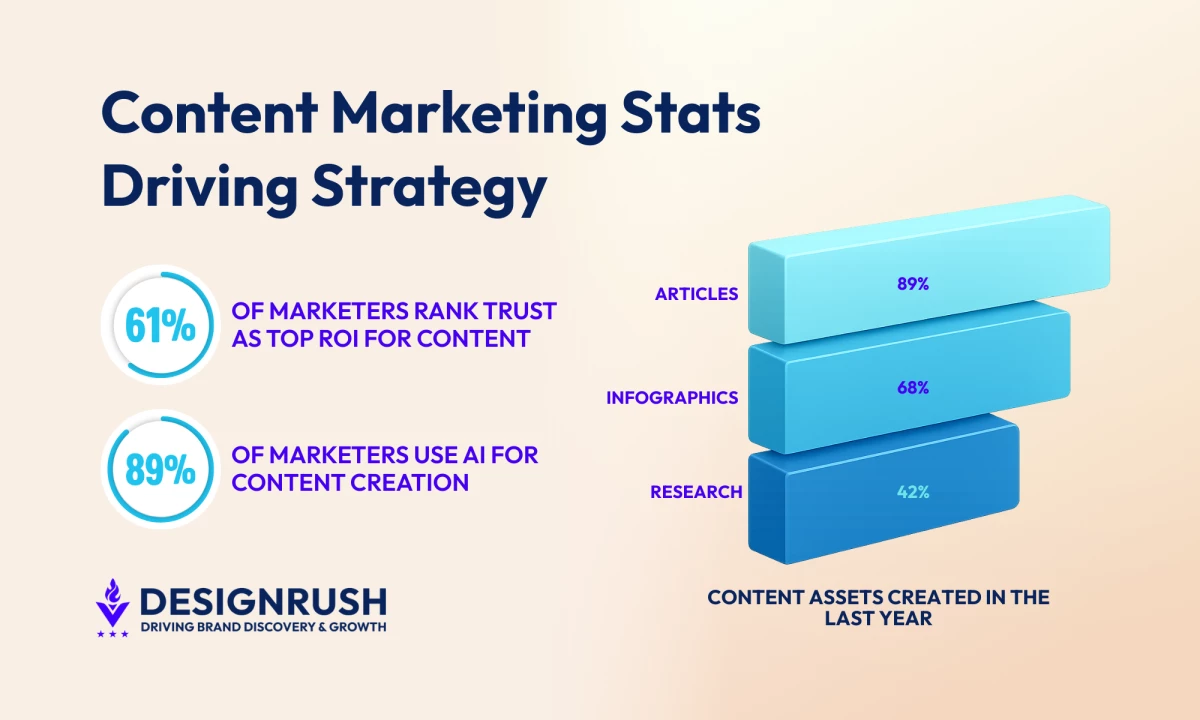
- 61% of marketers report trust and credibility as the top return from content marketing. Build authority by producing transparent, research-backed content, not just high-volume output.
- 89% of marketers use AI for content creation, but only disciplined governance delivers results. Ensure human oversight preserves brand voice, accuracy, and differentiation.
- 62% of marketers struggle to create stage-specific content. Deliver content aligned with awareness, consideration, and decision stages to reduce friction and drive conversions.
Why Trust Is the New Growth Engine in Content Marketing
Content marketing has grown well beyond simply driving traffic.
It’s now about building credibility, connecting with audiences, and driving measurable business impact.
As trust becomes central to these efforts, the focus is shifting from short-term conversions to cultivating long-term relationships.
Trust and Credibility Now Matter More Than Traffic
For many marketing teams, success used to mean clicks and leads. That priority is shifting.
- Today, 61% of marketers say trust and credibility are the top returns from content marketing.
- This surpasses engagement (57%) and even lead generation (55%).
That change signals something bigger. Content is no longer just a demand-generation tool; it’s a reputation-building engine.
The brands that earn trust go beyond capturing attention. They build loyalty, preference, and long-term growth. When trust becomes the goal, content strategy changes with it.
How To Turn Credibility Into Conversions
- Choose depth over volume: Instead of producing more, focus on producing better. Well-researched, transparent, insight-driven content builds authority far more effectively than high output alone.
- Work closely with sales to surface real objections: The most credible content addresses the questions buyers are already asking. Sales conversations are a goldmine for relevance and clarity.
- Build long-term positioning, not short-term spikes: Use content to consistently reinforce what your brand stands for. Authority compounds over time, and trust outperforms trend-driven tactics in the long run.



Inaccurate Information Erodes Brand Trust at Scale
When product details fall short, trust follows.
- 75% of consumers say they think less of a brand after encountering incomplete or inaccurate product information. 44% will abandon purchases when sufficient information isn’t available, and 19% report seeing inconsistent product data across platforms.
- The upside is just as clear: 75% of shoppers are more likely to return to brands where product information is easy to access and understand.
In an omnichannel world, content isn’t just support material — it directly influences revenue, retention, and overall brand perception. Accuracy, clarity, and consistency are now competitive requirements.
How To Build Trust and Retain 75% of Customers
- Centralize and distribute product data from one source of truth: Ensure your eCommerce site, marketplaces, retail partners, and distributors all pull from the same validated dataset.
- Audit regularly for accuracy and alignment: Even minor inconsistencies across platforms can undermine credibility. Ongoing reviews prevent small errors from scaling into larger trust issues.
- Treat product content as a conversion driver: Clear, complete information reduces friction, builds confidence, and encourages repeat purchases.
Data Fragmentation Is Undermining Marketing Performance
According to Salesforce, 85% of marketing teams say expectations are increasing, 69% report that acquiring new customers is becoming harder, and 64% struggle to keep up with rapidly changing buyer behaviors.
Despite these growing pressures, only one in four marketers feel fully satisfied with how their sales, support, and marketing data are integrated.
This highlights a critical disconnect: teams know what customers want, but the tools and systems to deliver on those expectations are often lacking.
Jeremy Durant, Business Principal at Bop Design, underscores the importance of bridging this gap:
“At Bop Design, we’ve seen the biggest content wins happen when marketing teams consistently sit down with sales.
Sales brings the frontline perspective by talking to prospects — the real objections, typical competitors, common questions, why deals are won or lost, etc. — that perspective can turn into high-impact content.”
The takeaway is clear: the knowledge is inside your organization. The missing piece is integration.
First-party data collection is accelerating, giving teams more tools to close this gap. According to Content Marketing Institute:
- 77% of teams collect data through direct engagement, 68% via content-driven collection, and 63% through CRM and sales interactions.
- The results speak for themselves: 52% of teams report better targeting, and up to 26% see increased conversions thanks to structured data strategies.
Still, challenges remain. Data quality issues (24%) and operational complexity (21%) continue to limit impact. Without careful governance, even the best insights can fail to translate into results.
Strategic Takeaway
Winning in 2026 won’t be about producing more content. It will be about connecting content, sales intelligence, and first-party data into unified, compliant systems.
The brands that master this integration will unlock smarter targeting, sharper messaging, and measurable revenue growth, turning insights into real business impact.
Content Creation: Even With Bigger Budgets, Execution Is the Issue
The global content marketing industry is projected to reach $107 billion in revenue by 2026, reinforcing just how central content has become to modern marketing strategy.
In fact, 45% of marketing leaders say they’re increasing their content budgets, a clear sign that executives see content as a serious growth driver.
But even as content marketing investment is climbing, performance gaps haven’t disappeared.
Despite larger teams, expanded tool stacks, and greater executive visibility, many organizations struggle to translate strategy into consistent, high-impact output.
Audience Insight Drives Success, But Execution Holds Teams Back
Understanding your audience is key to effective content.
- 82% of B2B marketers say audience understanding is the single biggest driver of content marketing success.
- High-quality content (77%) and industry expertise (70%) are close behind.
The blueprint for success isn’t a mystery. What’s harder is delivering on it consistently.
- According to Statista+, 55% of marketers struggle to create high-quality content, and 47% say they don’t have the right tools to support their efforts.
- At the same time, 43% face budget constraints, and another 43% admit they struggle to measure performance effectively.
- Most telling, only 46% believe they measure content performance accurately.
The issue isn’t awareness. Teams understand what drives results, but many lack the systems, structure, and measurement discipline to execute at scale.
In a fast-moving market, that execution gap quietly erodes momentum and limits growth.
Turn Insights Into Action and Join the 82% Winning With Audience Data
Insight alone isn’t enough. It needs operational backing.
- Invest in research before production: Let real audience data guide topics, formats, and distribution decisions, not assumptions.
- Measure what actually matters: Track content’s influence on pipeline velocity, deal quality, and retention, rather than defaulting to surface-level traffic metrics.
- Build repeatable systems: Clear briefs, defined KPIs, and consistent governance frameworks reduce friction and raise the overall quality bar.
The teams that outperform won’t just understand their audience better. They’ll build the infrastructure to act on that understanding every time.
Misaligned Content Is Costing Conversions
Today’s buyers rarely move in a straight line, but they still expect content that reflects where they are in the decision process.
Even so, 62% of marketers say they struggle to create content tailored to different stages of the buyer journey.
The cracks show up quickly:
- 45% of content teams fail to deliver consistent consumer experiences, and 37% report inconsistent messaging across touchpoints. (ON24)
- Furthermore, 51% say their campaigns can feel generic. (Salesforce)
When content doesn’t align with buyer intent, friction builds. Trust starts to erode, momentum slows, and conversions stall.
Instead of guiding prospects forward, brands leave them navigating disconnected messages, and many simply opt out.
Guide Buyers, Close Deals, and Beat the 62% Execution Gap
Top-performing teams map content to the buyer’s journey, not just campaigns. When each stage is intentional, content stops being noise and starts becoming guidance.
- Awareness: Focus on education, thought leadership, and building authority. Address problems first, then offer solutions.
- Consideration: Offer side-by-side comparisons, case studies, and direct responses to objections. Reduce ambiguity and build confidence.
- Decision: Provide ROI validation, implementation clarity, and tangible proof points that make the purchase feel logical and low risk.
Turning Omnichannel Presence Into Measurable Results
Marketing today happens everywhere at once. Companies are engaging audiences across 10 different channels on average, from social media and email to events, paid ads, and marketplaces.
With customers expecting two-way conversations (83%), simply being present isn’t enough. Responsiveness has become a key differentiator. (Salesforce)
- Social media dominates attention: 95% of marketers use organic social, with LinkedIn (94%) and Facebook (79%) leading adoption. (Content Marketing Institute)
- Paid amplification is nearly as common: 90% invest in paid social, and 75% use PPC to extend reach.
But reach and impressions don’t always translate to trust or influence. When it comes to thought leadership and meaningful engagement, owned channels lead the way. (Content Marketing Institute)
- LinkedIn tops at 76% effectiveness, email newsletters follow at 54%, and speaking events or webinars register at 52%.
- Social platforms distribute attention; owned channels cultivate credibility and deeper relationships.
Metrics reinforce this distinction. While 80% of marketers track engagement, only 63% measure business impact, indicating many teams still optimize for interaction rather than tangible results.
In a world of omnichannel noise, authority, relationship depth, and audience ownership are what drive long-term performance.
Make Omnichannel Efforts Count and Outperform the 69% Who Lag
- Invest in email and owned media for durable conversions: Email remains one of the highest-leverage channels, offering direct access, personalization, and measurable ROI. Build newsletters, communities, and proprietary research assets that accumulate value over time.
- Strengthen LinkedIn authority positioning: Consistent thought leadership and insight-driven content from executives outperform sporadic promotion.
- Prioritize integration across channels: Omnichannel complexity is rising, and 69% of teams struggle to respond promptly. Align systems, processes, and brand messaging to maintain clarity and consistency across touchpoints.
The takeaway is clear: distribution alone doesn’t drive growth. Authority, consistency, and responsive engagement across owned and earned channels do.
AI in Content Marketing: From Experimentation to Performance Powerhouse
AI is becoming foundational in modern content marketing. But adoption alone doesn’t guarantee impact.
AI Adoption Is Soaring But Strategy Still Matters
In 2026, AI has moved beyond experimentation. It’s now an operational powerhouse.
- 89% of marketers now use AI for content creation. (Content Marketing Institute)
- Among those users, 87% report improved productivity, and 80% see efficiency gains.
- Beyond speed, 65% say AI enhances creative capabilities, 58% note quality improvements, and 39% report stronger content performance.
The business impact is tangible. Teams deploying AI effectively see 20% higher marketing ROI and 19% higher conversion rates.
Yet AI isn’t a magic bullet. 22% of marketers see no meaningful lift in creativity, and 21% notice no quality improvement.
These numbers highlight a crucial point: automation accelerates output, but differentiation still depends on strategy and human insight.
Maximize AI Impact and Avoid the 22% Who See No Creative Lift
AI is strongest as an operational multiplier, not a strategic replacement.
- Use AI as an operational multiplier, not a replacement: Drafting, repurposing content, summarizing data, and reporting performance can all be streamlined without losing quality.
- Keep humans in the driver’s seat for differentiation: Brand authority, narrative depth, nuanced positioning, and original research remain human-led disciplines.
- Leverage AI to enhance responsiveness without sacrificing voice: With 81% of marketers using AI to help respond to inquiries, it can close gaps in speed and efficiency. (Salesforce)
Investing in AI Is Easy, Using It Well Is What Counts
AI adoption has become a top investment priority.
- 45% of marketers plan to increase spending on AI-powered marketing tools in 2026, making it the leading area of investment (Content Marketing Institute).
- Teams are seeing real benefits: 68% report faster content creation, and 57% have increased their output because of AI workflows.
But with growth comes scrutiny. The conversation is shifting from “Should we use AI?” to “How do we control it responsibly?”
- 65% of content teams say their organization’s AI guidelines prioritize accuracy and fact checking, 62% focus on data privacy, and 59% emphasize preserving brand voice.
- 49% of marketers report that their leaders require human review before publishing.
Turn AI Investment Into Real Results, Not Just Hype
In 2026, AI alone won’t deliver competitive advantage. Success will come from disciplined deployment, thoughtful governance, and human-led strategy.
- Establish clear AI usage frameworks: Define where automation is allowed, where human oversight is mandatory, and how outputs are validated.
- Protect brand voice and positioning: Ensure AI-generated content aligns with tone, messaging, and strategic goals.
- Balance speed with accountability: Governance should enable scale without sacrificing trust or brand integrity.
Content Marketing Statistics: Final Thoughts
Teams that combine trust-building content, data-driven insights, stage-aligned messaging, and smart AI workflows will drive measurable growth and sustainable competitive advantage.

Our team ranks agencies worldwide to help you find a qualified partner. Visit our Agency Directory for the top content marketing companies, as well as:
- Top Content Creation Companies
- Top Digital Marketing Agencies
- Top Marketing Strategy Agencies
- Top Growth Marketing Agencies
- Top AI Marketing Companies
Content Marketing Statistics FAQs
1. How can small teams compete with larger content budgets?
Small teams can win by prioritizing trust, accuracy, and audience insight. Targeted, high-quality content combined with repeatable workflows and clear measurement often outperforms high-volume campaigns from bigger teams.
2. What’s the most effective channel for thought leadership?
Owned channels such as LinkedIn and email newsletters consistently deliver authority and measurable engagement.
While social media drives awareness, these channels build credibility, foster trust, and produce higher conversion rates over time.
3. How can AI improve content marketing without eroding brand voice?
AI should handle operational tasks like drafting, repurposing, and performance analysis. Human oversight ensures messaging, narrative depth, and brand tone remain consistent, preserving differentiation while benefiting from efficiency gains.
4. What’s the biggest mistake content marketers make with AI?
The most common misstep is using AI as a replacement for human strategy. Without governance, fact-checking, and human insight, AI can amplify errors and generic content instead of creating real business impact.
5. How should companies allocate content marketing budgets in 2026?
Invest strategically across AI tools, content quality initiatives, and owned channels like email and LinkedIn. Dedicate funding to governance, data integration, and measurement systems to maximize ROI and minimize wasted spend.