
Your choice between a full-service and a niche agency sets the tone for how your marketing runs, how you operate, how fast you adapt, and how effectively you spend. I’ve helped many businesses make this call, and it always shapes growth more than a creative strategy.
Full-Service vs. Niche Marketing Agency: Key Points
- If your budget sits between $2K-$6K/month, start with a full-service retainer to centralize efforts and reduce management load.
- When spending under $5K/month, use niche partners for targeted wins in SEO, paid, or CRO, but assign an internal lead to avoid the $9K+ yearly cost of coordination inefficiencies.
- 56% of brands work with two to three agencies, and 66% of top performers use multiple partners, showing that hybrid models deliver the best results.
The Choice That Defines How Your Marketing Actually Works
I’ve sat across from a $40 million brand watching their growth flatline. Nothing was wrong with the product or the creative. The problem was the model running their marketing.
Every idea got stuck in process, every pivot took weeks. I’ve seen that happen more than once. Great teams slowed down by the wrong setup.
The truth is, this decision doesn’t look big at first. But the agency model you choose quietly decides how fast your business can move, how clearly you see results, and how well your strategy actually works.
Factor | Full-Service Agency | Niche Agency |
Best for | Enterprises, global brands, multi-channel programs | Startups, SaaS, eCommerce, fast-moving sectors |
Average Monthly Cost Range | $2,000–$6,000+ | $400–$5,000+ (per channel) |
Integrated, Cross-Channel Strategy | ✅ | ❌ |
Deep Channel Expertise | ❌ | ✅ |
Speed and Agility | ❌ | ✅ |
Centralized Communication | ✅ | ❌ |
Lower Coordination Overhead | ✅ | ❌ |
Faster Experimentation and Testing | ❌ | ✅ |
Scales Across Multiple Regions | ✅ | ❌ |
Specialized Tooling and Techniques | ❌ | ✅ |
Flexible Contracts | ❌ | ✅ |
Long-Term Strategic Consistency | ✅ | ❌ |
Full-Service vs. Niche Marketing: What’s the Difference?
Full-service agencies hold 50.8% of the US market and specialized or boutique firms made up the other 49.2%.
That near-even split mirrors what I’ve seen for years advising brands: the market is torn between integration and specialization.
I can tell you from the start that neither approach is automatically better; it comes down to trade-offs in breadth vs. depth, flexibility, expertise, cost, control, and scalability.
Here’s how they compare.
- Flexibility and speed
- Breadth of services under one roof
- Depth of expertise in key channels
- Cost Efficiency beyond the retainer
- Control over strategy and execution
- Ability to scale with your growth



Flexibility and Speed
I learned the real difference between structure and speed during a SaaS rebrand.
Our full-service agency needed three weeks to update campaign messaging after a strategy shift. When I later hired a niche content firm, they made the same adjustment in three days.
That kind of agility changes outcomes. It’s basically how specialized teams work. They test, learn, and adapt without waiting on approvals or internal politics.
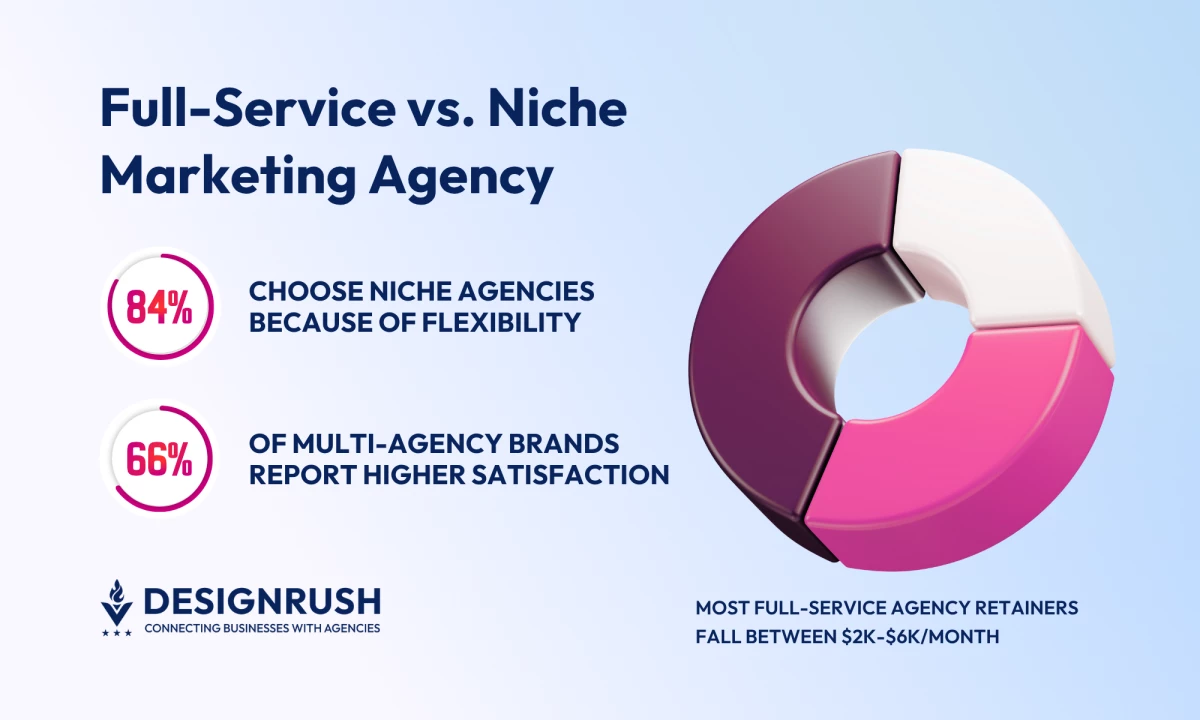
It’s also why 84% of companies now choose smaller, niche agencies specifically for their flexibility.
What I would do here is:
- If I’m working with an enterprise company managing several markets or product lines, I go full-service. It gives structure, one strategy, and unified reporting across every channel. I want one partner accountable for the big picture.
- If I’m working with a startup or a growth-stage business, I go niche. At that stage, speed beats structure. I’d rather have a small team that can test, fail, and pivot fast than a big machine that takes weeks to move.
Breadth of Services Under One Roof
A full-service agency offers everything under one roof, and that can be really convenient, especially when you want an integrated strategy and centralized communication.
But breadth doesn’t always mean depth.
I’ve seen enterprise clients spend six figures on “all-in-one” retainers only to discover that creative quality or channel execution lags behind specialized competitors.
Niche agencies, on the other hand, focus on one thing, and do it exceptionally well.
Even agencies see this shift from the inside. As Matthew Burleton, Creative Director and Co-Founder of Long Story Short, told DesignRush:
“When we operated as a full-service agency, we found it challenging to attract bigger clients because they tend to prefer agencies with a focused and specialized approach rather than a ‘jack of all trades.’”
That observation matches what I see in practice.
What I’d recommend:
- Go full-service when your brand needs coordination, integrated reporting, and consistency across touchpoints.
- Go niche when you’re focused on rapid growth in one area and need advanced, hands-on expertise.
- Combine both when you’re scaling. Use a full-service partner for direction and niche teams to sharpen performance where it matters most.
Depth of Expertise in Key Channels
Full-service teams are generalists: strong at integration, but uneven across channels. The top 5% of their specialists are excellent, but the rest are spread thin.
Niche agencies are built differently.
They invest deeply in tools, training, and frameworks that outperform generalist approaches.
I once compared SEO deliverables from both: the niche team built a technical audit so deep it revealed crawl budget issues the full-service agency never noticed.
So, if your industry spends 60%+ of its marketing budget on digital (and many do), you must pair integrated strategy with deep channel mastery.
A generalist full-service agency alone won’t cover the depth your performance demands.
Here’s what I’d do:
- For a large or multi-channel brand, I’d keep a full-service agency for coordination and cross-channel strategy, but only if they can plug in specialist partners for depth.
- For a performance-driven business, I’d go niche. Channel experts deliver better ROI when every dollar needs to show impact.
- For a scaling team, I’d blend both: A full-service partner steering strategy, and niche agencies strengthening the highest-value channels.
Cost Efficiency Beyond the Retainer
Here’s the math most leaders miss.
A full-service retainer consolidates cost: one vendor, one invoice, fewer management hours. But you pay a premium for convenience.
Niche agencies often come cheaper per channel, but the coordination costs rise if you manage multiple partners.
Let’s break this down across full-service, industry-niche, and service-specific agency models, with real project data and examples from my consulting experience.
- Full-service marketing agency cost
- Industry niche marketing agency cost
- Service niche marketing agency cost
Full-Service Marketing Agency Cost
DesignRush data from 350+ projects shows most full-service retainers fall between $2K-$6K/month, while growth and enterprise programs stretch to $10K-$60K+.
Program Type | Typical Monthly Range | Who It Fits Best | Key Advantage |
Standard Retainer | $2,000 - $6,000 | SMBs testing digital strategy | Simplifies execution under one roof |
Growth Program | $10,000 - $20,000+ | Mid-market firms scaling channels | Strong integration across paid + organic |
Enterprise / Multi-Market | $30,000 - $60,000+ | Global or multi-brand portfolios | Strategic alignment across regions |
Example
- If I hire a full-service team for $150/hr and need about 60 hours per month, that’s $9,000/month.
- Over 12 months, I’ll spend roughly $108,000, but that covers branding, SEO, ads, and reporting under one roof.
Now, if I split those channels across three smaller agencies, each charging around $3K/month, the total is similar: $9,000/month. But I’ll spend extra time managing them.
Even 10 extra management hours per month at an internal rate of $75/hr adds $9,000/year in hidden costs.
My conclusion is that full-service looks pricier at first, but it often breaks even once coordination time is factored in.
Industry Niche Marketing Agency Cost
Industry-specific agencies charge a bit more than generalists but save money in onboarding and compliance.
They already know the jargon, seasonal patterns, and audience triggers, meaning less “paid learning” and fewer early misfires.
Industry | Typical Monthly Range | Strategic Advantage |
$2,000 - $12,000 | Deep CRO, ROAS, and omni-channel attribution know-how | |
SaaS | $5,000 - $20,000 | Lifecycle marketing and product-led growth expertise |
$750 - $50,000+ | Regulatory experience reduces compliance errors | |
$1,000 - $10,000+ | Localized omnichannel strategy, promotions, events | |
$67,000 - $166,000 | Heavy governance, multi-region regulation management |
Example
Let’s say a SaaS company pays a niche agency $12K/month for 6 months = $72K total.
A generalist full-service agency quotes $10K/month for the same project = $60K total.
On paper, the niche partner costs $12K more, but because they already know SaaS funnels and lifecycle metrics, the campaigns go live a month earlier.
That extra month could generate $20K–$30K in new MRR, which easily outweighs the difference.
What we can learn from this example is that the niche team costs slightly more, but the faster launch and fewer errors make it more efficient overall.
Service Niche Marketing Agency Cost
Service-specific agencies are usually the most cost-efficient per output.
You pay directly for performance: SEO deliverables, paid media optimization, CRO experiments, not layers of management.
But there’s a trade-off: once you manage multiple niche vendors, internal coordination costs rise. I’ve seen clients save 20% on fees, only to lose that margin in project management overhead.
Here are the costs based on DesignRush’s data:
Service Family | Typical Monthly Range | Median | Notes |
Digital Advertising | $400 - $500 | $417 | Entry-level display or social add-ons |
Social Media Marketing | $400 - $2,000 | $1,200 | Ranges from community to paid campaigns |
PPC | $300 - $6,000K | $625 | Most sit between $600-$2.5K; enterprise >$10K |
$1,000 - $4,000 | $1,250 | Automation, drip flows, lifecycle funnels | |
SEO (Core) | $600 - $10,000 | $2,320 | From on-page basics to full content + tech retainers |
Branding and Strategy | $800 - $20,000 | $3,330 | Identity, tone, and creative direction |
Lead Generation (B2B) | $700 - $46,700 | $5,420 | SMB inbound → enterprise ABM campaigns |
SEO (Link Building) | $3,200 - $31,000 | $10,000 | Multi-region outreach and content programs |
Example
If I hire separate vendors for SEO ($2,300), PPC ($625), and Email ($1,250), my total spend is $4,175/month.
Over 6 months, that’s about $25K, but add roughly $3K in management time to keep everyone aligned, and it’s closer to $28K.
A full-service team quoting $5K/month for 6 months ($30K) suddenly doesn’t look that expensive, right?
When you calculate true cost (fees + time + lost ramp-up), the “expensive” option is often the smarter one.
Control Over Strategy and Execution
With a full-service agency, you delegate more in terms of strategy, execution, reporting.
That’s efficient, but you lose visibility into the “how.” For some CMOs, that’s a relief; for others, it’s a red flag.
Niche agencies give you granular control. You own the direction; they execute.
Here’s the reality:
- Most full-service marketing agencies start with 3-6-month pilot terms, then lock clients into 12-month renewals. That longer commitment limits agility because once you sign, pivoting strategy or switching partners becomes slower and costlier.
- Niche partnerships are typically shorter and more flexible, allowing you to test strategies or vendors faster without contractual friction.
Ability to Scale With Your Growth
Full-service models scale faster.
You can expand into new services without sourcing new vendors. That’s why enterprises rely on them as they can handle multi-region rollouts, governance, and cross-channel data.
Niche partners scale laterally.
You add more specialists as you grow. It’s less efficient operationally but often higher in performance.
Here’s the trade-off: Scaling with a full-service agency gives reach and stability; scaling with niche partners gives adaptability and innovation.
Here’s how I would choose:
- For enterprise brands, I’d go full-service to scale efficiently across markets. You need one structure, one process, and a partner who can manage compliance, governance, and multi-region rollout without breaking consistency.
- For growth-stage businesses, I’d build a network of niche agencies to stay agile. At that stage, creativity, experimentation, and speed matter more than structure.
Which Marketing Model Fits Your Needs?
Every company sits somewhere on this spectrum:
Business Stage | Best Fit | Reason |
Startup / Early Growth | Niche | You need agility, learning, and quick feedback loops. |
Scaling / Mid-Size | Hybrid | A core full-service partner with niche add-ons for depth. |
Enterprise / Mature Brand | Full-Service | You need integration, governance, and unified data. |
When I advise clients, I ask three questions:
- How often does your strategy change?
- Fast-changing strategies need niche partners who can pivot quickly and test new ideas without process delays.
- Stable, long-term strategies work better with a full-service agency that can sustain consistency and scale across channels.
- Do you have the internal capacity to manage multiple vendors?
- Strong internal marketing leadership can coordinate multiple niche agencies efficiently.
- Lean teams without that bandwidth perform better under a single full-service partner that handles integration.
- Are you optimizing for efficiency or innovation?
- If efficiency and control are your top priorities, go full-service.
- If innovation and speed drive your growth, go niche.
By the time we answer those three, the right model is usually obvious, and long before the RFP even starts.
It’s the same pattern Alyssa Villa, founder of Canilla Creative, sees on her side of the table.
She told DesignRush that smaller businesses or those without a dedicated marketing team usually seek full execution, wanting a partner to “take the reins and drive their marketing efforts forward.”
Larger companies, on the other hand, come in with in-house muscle as they already know what works and just need guidance or validation.
As she puts it, “They come to us for advisory services to validate their ideas or get expert insights on specific areas they’re struggling with.”
How To Match Your Agency to Your Project
I’ve learned that the right agency model depends less on budget and more on the nature of the project.
Every scope has a pace. Match the pace wrong, and performance drops fast.
Here’s how I approach it.
Project Type | Best Agency Model | Why | Example Scenario |
New Product Launch / Market Entry | Niche Agency | Fast testing, quick pivots, rapid learning | SaaS startup uses a niche paid media team to test channels in 30 days and find the winning funnel early. |
Marketing Restructure / International Expansion | Full-Service Agency | Centralized strategy, unified data, consistent execution across markets | D2C brand expanding in Europe relies on one agency for aligned creative, media, and analytics in all regions. |
Scaling or Transition Phase | Hybrid Model | One lead partner for strategy, specialists for performance | Healthcare brand keeps a full-service partner for governance while SEO and CRO specialists boost digital results. |
My rule of thumb:
- One agency when you need harmony.
- Many agencies when you need breakthroughs.
Find More Agency Hiring Resources:
- Questions To Ask a Digital Marketing Agency
- Planning Your Digital Marketing Budget
- Digital Marketing Objectives That Drive Real Business Outcomes
Full-Service vs. Niche Marketing Agency: What Is the Right Choice?
After ten years advising brands from Series A startups to Fortune 500s, here’s the pattern I see:
- Early-stage companies grow faster with niche partners because they value speed, testing, and channel mastery.
- Established brands sustain growth with full-service agencies because they rely on scale, governance, and integration.
- The smartest teams build hybrid ecosystems: One strategic lead supported by niche experts driving performance in key areas.
That approach isn’t just anecdotal. Research found that 56% of brands work with two to three agencies, and 66% of those most satisfied with their results use multiple partners.
The data confirms what experience already shows: the best outcomes come from combining orchestration with specialization.

Our team ranks agencies worldwide to help you find a qualified partner. Visit our Agency Directory to find top-rated digital marketing companies, as well as:
- Top Content Marketing Agencies
- Top SEO Agencies
- Top PPC Agencies
- Top Email Marketing Agencies
- Top Social Media Marketing Agencies
Full-Service vs. Niche Marketing FAQs
1. How do I know when it’s time to switch from niche to full-service?
When coordination starts costing you more than execution. If you’re spending more time managing vendors than reviewing performance, it’s time for a centralized model.
2. Can a full-service agency deliver the same depth as a specialist?
Rarely across every channel. They’ll have strong areas, but you’ll always trade some depth for integration. That’s why many companies keep a full-service lead and niche partners for high-impact channels.
3. Which model delivers better ROI?
It depends on your stage. Startups get faster returns from niche agility. Established brands see steadier growth from full-service integration. The best results usually come from blending both.