
Logo design used to start with a sketchpad. Today, high-performing teams start with prompts.
ChatGPT isn’t replacing designers, but it’s reshaping how strong logo ideas are formed.
ChatGPT Prompts for Logo Design: Key Findings
- Teams get the most value by using ChatGPT before visual design begins, aligning positioning, symbolism, and differentiation early instead of fixing weak concepts later.
- Since 26% of adults are more likely to trust brands with familiar logos, early concept decisions directly impact credibility, recall, and brand confidence.
- ChatGPT excels at surfacing directions and stress-testing ideas, but designers still make the final calls on nuance, balance, and emotional resonance.
Why Successful Teams Use ChatGPT for Logo Design
ChatGPT works best in logo design when it’s treated as a thinking tool, not a generator.
Used intentionally, it helps teams explore ideas, test directions, and sharpen brand positioning faster, without jumping straight to visuals.
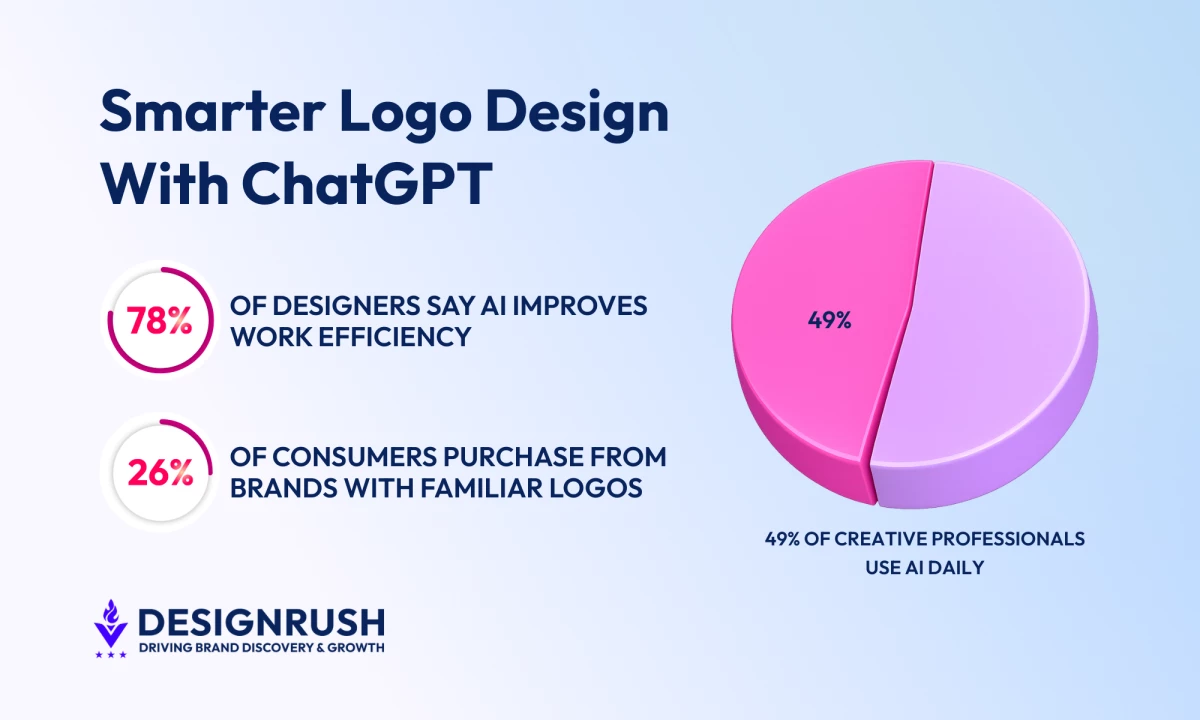
That approach is quickly becoming standard practice. Nearly eight in ten designers (78%) say AI meaningfully improves how efficiently they work. This explains why tools like ChatGPT are now embedded in early-stage brand and logo workflows.
Design teams aren’t testing the waters anymore; they’re using AI directly in concept development, positioning exercises, and creative direction.
The stakes are high. Research shows that 26% of adults are more likely to trust a business when its branding or logo feels familiar, reinforcing why clarity, consistency, and strong first impressions matter.
Logo decisions made early ripple across trust, recall, and long-term brand equity.
Below are the exact ChatGPT prompts design teams use to unlock these benefits and move from blank page to brand-ready direction.
4 Essential Categories of Logo Prompts
Rather than churning out generic logos, ChatGPT (especially when paired with image-capable models) can use metaphors, critique structures, and even suggest asset systems that reflect brand complexity.
“It’s a great springboard — not for final logos — but for creative direction that designers can visualize and sketch,” says Nikita Sherbina, co-founder and CEO of AI Screen.
“We’ve used it during a client rebranding sprint, and they loved the speed at which we could present clear concept narratives,” she adds.
But not all prompts are created equal. To get meaningful results, you must align your prompts with specific stages of the logo design process, from research to refinement.
These four categories help structure your approach for maximum impact in terms of creativity and strategy.
- Competitor and market analysis
- Core concept and brand essence
- Color, typography, and style direction
- Iterative refinement and versatility
1. Competitor and Market Analysis
Begin with strategic insight. These prompts analyze existing logos in your market to pinpoint visual strengths and brand positioning.
They help reveal patterns — color trends, symbol usage, typographic styles — that define the competitive environment.
| Sample prompt for competitor and market analysis |
|
I’m creating a new brand in [industry] for [target audience] and want to understand the current logo landscape before designing anything. Analyze the logos of these competitors: [Competitor 1–4]. For each, briefly assess:
Then summarize the market by identifying:
Conclude with 2 to 3 logo positioning directions a new brand could use to stand out. Present insights as concise bullet points. |
2. Core Concept and Brand Essence
These prompts translate your brand’s mission, values and personality into visual metaphor concepts.
They help you investigate logo ideas that are aesthetically pleasing, symbolically meaningful, and aligned with your identity.
| Sample prompt for core concept and brand essence |
|
I want to develop logo concepts that express the core essence of my brand, not just its industry. Brand details:
Based on this, generate:
Avoid generic industry symbols. Focus on concepts that feel distinctive, timeless, and meaningful rather than trendy. Present the output as a structured list that can be used directly for sketching and creative exploration. |
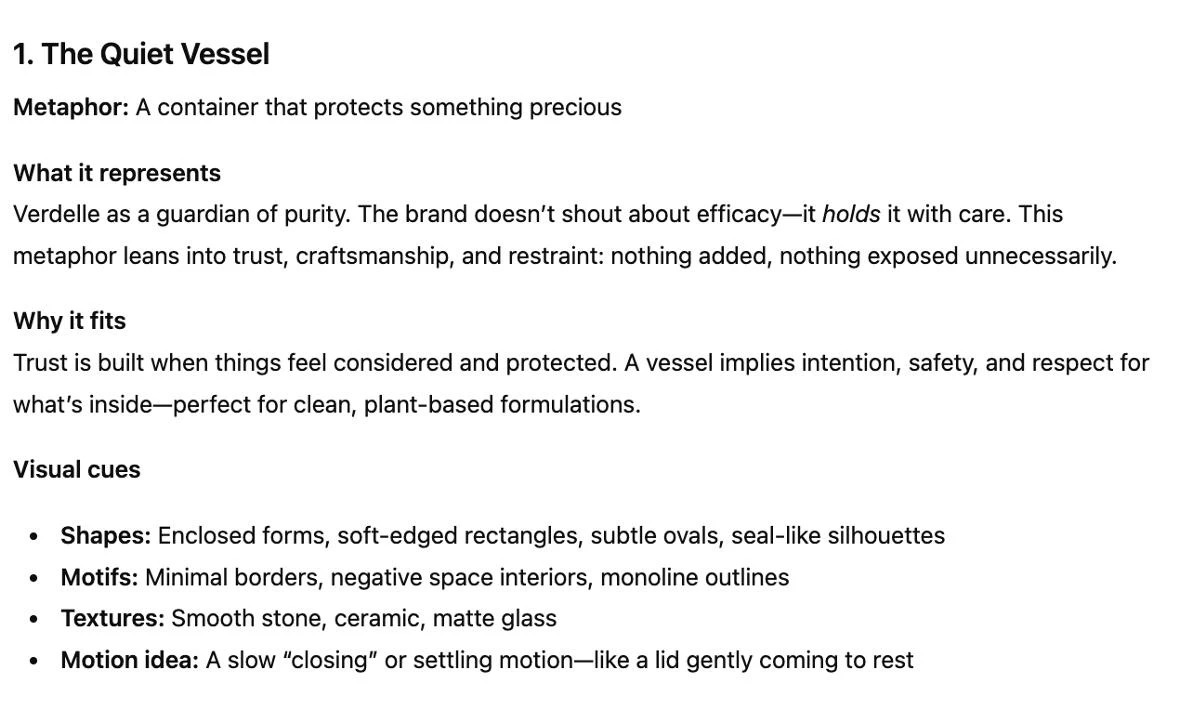
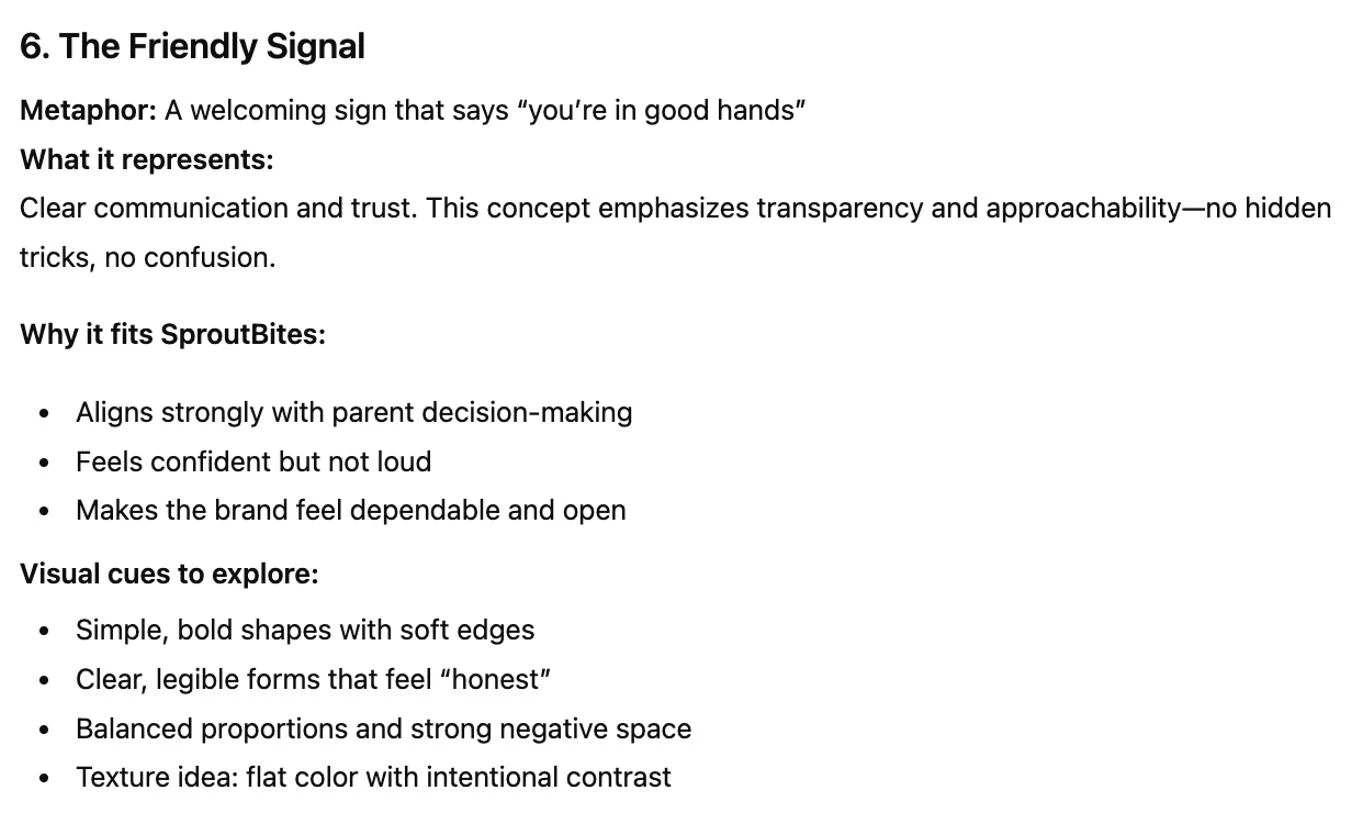
ChatGPT 5.2 Auto came up with logo concept directions framed as visual metaphors for two fictional brands. The two most promising ones are:
3. Color, Typography, and Style Direction
Here, your prompts dig into the "how it looks." These are designed to generate tailored palettes, typographic pairings and stylistic rules that express emotion, hierarchy, scalability and medium.
This ensures that logos are beautiful as well as functional across environments.
| Sample prompt for color, typography and style direction |
|
I want to define the color, typography, and overall style direction for a logo that is both visually strong and functional across digital and physical environments. Brand context:
Based on this, provide:
Evaluate each direction for readability, scalability, and accessibility. Present insights as concise bullet points suitable for logo development. |
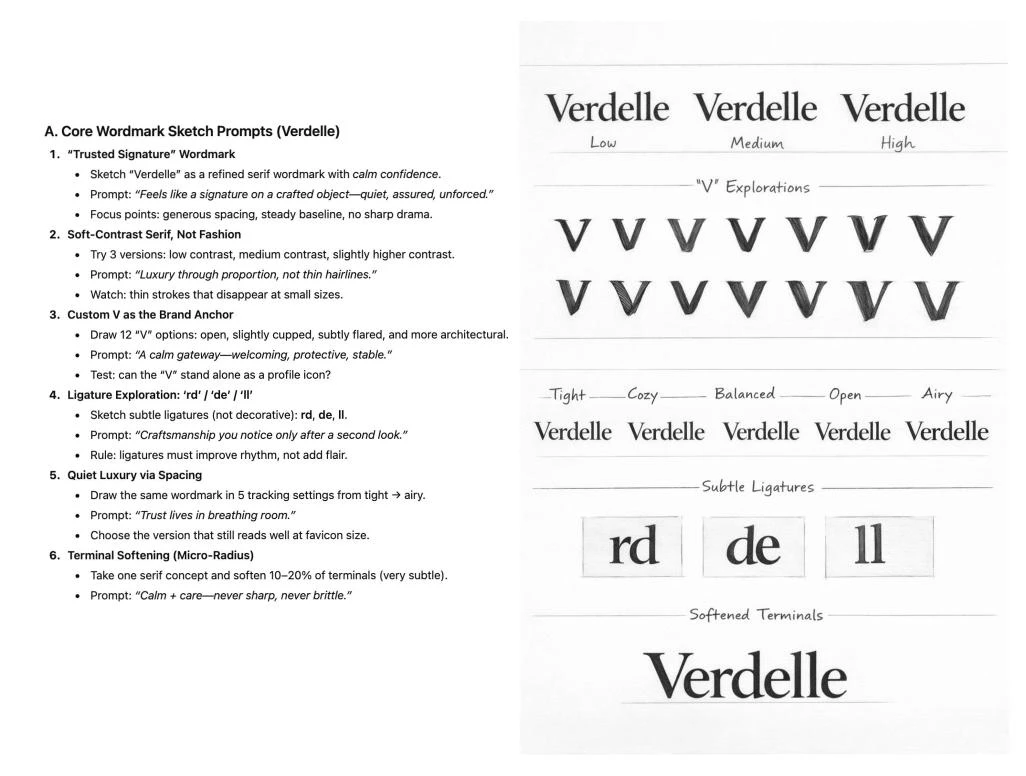
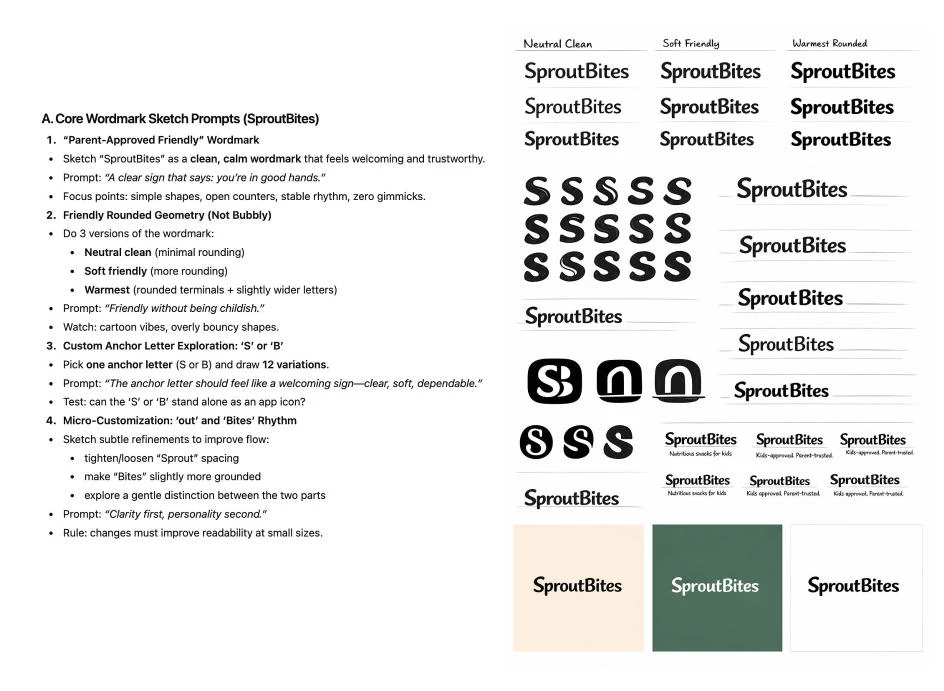
ChatGPT 5.2 Auto provided style directions and logo sketch prompts for the previous fictional brands, which were then fed to Sora:
4. Iterative Refinement & Versatility
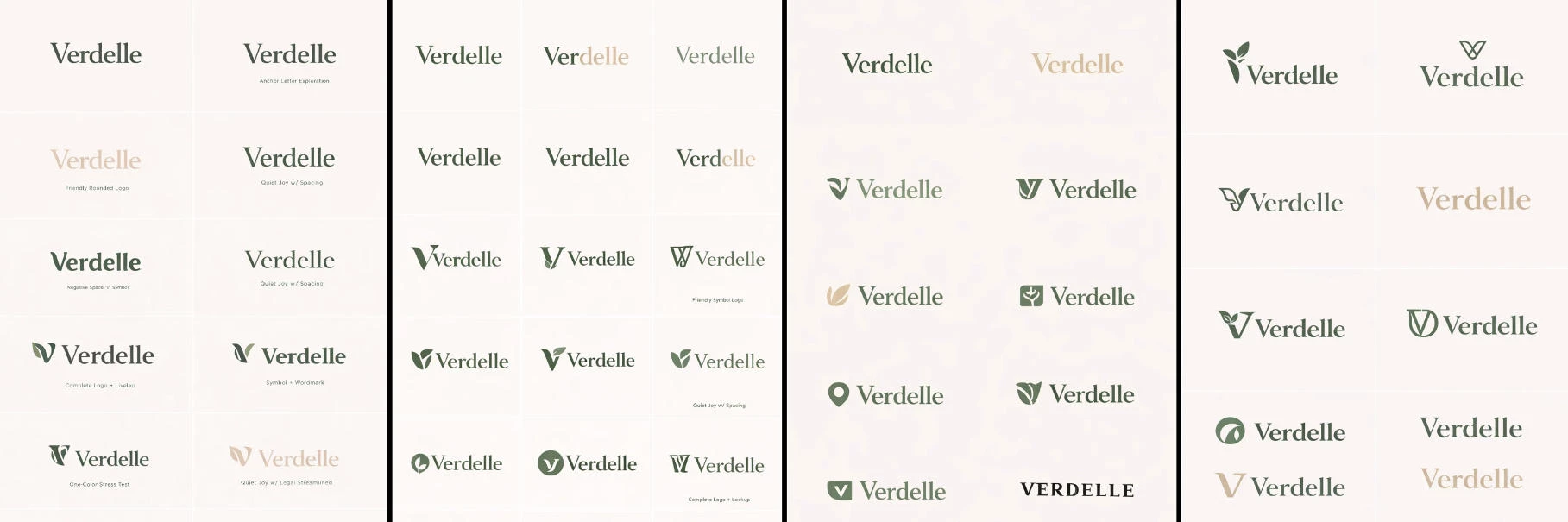
These prompts guide ChatGPT through structured critique and improvement. They focus on adaptability for logo legibility at small sizes, monochrome reproduction, and icon hierarchy.
This ensures your identity system holds strong in digital, print, and social applications.
| Sample iterative refinement and versatility prompt |
|
I have an early logo direction and want to pressure-test and refine it for versatility across formats, sizes, and contexts. Logo description or concept: [Briefly describe the logo, symbol, typography, and colors, or paste the concept text generated earlier] Evaluate the logo against the following criteria:
Then provide:
Present feedback as concise bullet points that can be used directly for iteration and revision. |
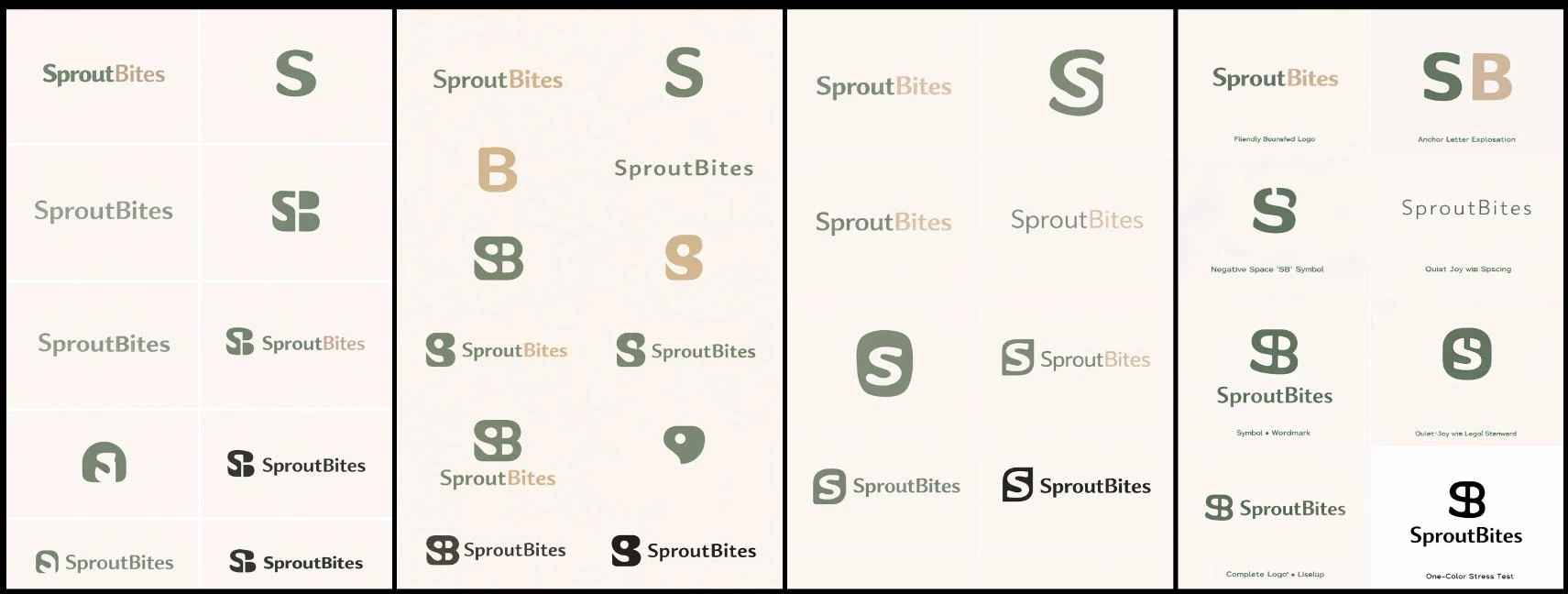
Tips and Best Practices for Using ChatGPT in Logo Design
To get high-quality logo designs from ChatGPT, combine technical precision with brand context and ethical safeguards. Here's how:
- Be specific, not vague
- Provide rich brand context
- Use a layered prompting approach
- Safeguard data and IP
- Avoid bias and promote inclusivity
- Maintain human oversight
- Include legal guardrails
1. Be Specific, Not Vague
Avoid short or generic prompts. Instead, detail who the logo is for, where it will appear, and what values or themes it should express.
Including specific design cues like “minimalist wordmark with geometric forms” or “dynamic icon suited for outdoor signage” helps guide AI toward outputs that reflect both creative intent and practical application.
“AI has become our best partner for getting those initial creative ideas flowing with incredible speed,” says Kevin Heimlich, CEO of The Ad Firm.
He explains that prompting AI to brainstorm symbolic metaphors with rationale helps it move beyond surface visuals and reflect the brand’s deeper values.
He adds: “I've found that when you start with meaningful symbolism first, the visual execution becomes much stronger because the concept already has depth.” This approach consistently yields more distinctive ideas than simply asking for, say, "a modern finance logo”, he explains.
2. Provide Rich Brand Context
Include relevant background like your industry, target audience, tone of voice, and competitive landscape.
@w.bautista.jr Prompt Craft_ Elevate with Context ChatGPT isn’t dumb — you’re starving it of context. Most people give AI one lazy sentence and expect executive-level thinking. That’s not how reasoning works. If you want better output, you need to give better inputs: context, constraints, and a clear definition of success. Stop asking ChatGPT questions like a tourist. Start assigning it work like an operator. Operator Prompt (copy/paste) Act as a skeptical business operator. Here is the idea: [insert idea] Here is the target market: [insert market] Here is how the business makes money: [insert monetization] Here is the main risk I am concerned about: [insert risk] Challenge my assumptions and tell me why this might fail. Do not protect my ego. Be direct and specific. Keywords chatgpt for business, ai for operators, chatgpt prompts, ai strategy, business ai, using chatgpt correctly, chatgpt tips, ai thinking, operator mindset, business automation, ai productivity, strategic thinking, ai tools for founders, chatgpt mistakes, ai leverage, business systems, decision making, critical thinking with ai
♬ original sound - Wilson Bautista Jr.
Supplementing brand narrative with descriptive keywords such as “premium,” “eco-conscious,” or “tech‑savvy” enables AI to craft visuals that work best for a specific audience and market positioning.
3. Use a Layered Prompting Approach
Break the process into stages:
- Stage 1: Analyze the market
- Stage 2: Ideate concepts based on brand essence
- Stage 3: Refine style, color, and form
This way, you can enrich output and support clearer creative decision-making. Tracking each iteration (along with metrics like style consistency, color fidelity, or recognition goals) helps refine prompts more strategically
4. Safeguard Data & IP
Don’t feed confidential brand details into public platforms. Use anonymized data or enterprise-secure environments when working with sensitive content.
Compliance with privacy and IP regulations protects assets and builds trust with clients who expect ethical and responsible handling.
5. Avoid Bias and Promote Inclusivity
Guide ChatGPT to create designs that are culturally respectful and free from harmful stereotypes. Use prompts that emphasize inclusive symbolism and accessibility, such as:
“Use globally recognizable visuals that reflect cultural diversity and avoid gendered or exclusionary elements.”
This ensures your logo concepts resonate ethically and equitably with diverse audiences.
6. Maintain Human Oversight
Always review AI-generated outputs to ensure they align with your brand’s tone, audience expectations, and real-world usability. Elements like layout balance, emotional resonance, and cross-platform legibility often require human intuition to assess properly.
Human oversight also helps counter design fixation and supports divergent thinking for more original, context-aware work.
“AI expands options, but strategic human curation keeps the result cohesive,” says Carla Niña Pornelos, general manager of Wardnasse.
Since its strength lies in ideation rather than execution, blending outputs with traditional design methods, like hand sketching or design sprints, “helps ensure the final logo feels both innovative and intentional”, she explains.
7. Include legal guardrails
Request designs that are legally safe to use. For example: “Ensure this logo concept can pass trademark clearance in Class 35 (advertising and business).”
This embeds risk reduction into your process. Further to that, prompting for “distinct distinctive features only” and “exclude stylistic overlaps with known marks” can substantially reduce resemblance.
Limitations of ChatGPT in Logo Design
While ChatGPT is a powerful creative partner, it does have its limitations. Here are a few things it can’t do (at least for now):
@pinkponycreative Can ChatGPT design you a logo…? (A.I verus Logo Designer) 🔥😱 It’s nothing new to be talking about A.I. online—it’s a hot topic that sparks division and conversation. And honestly, it should. A.I. is speeding up processes and seems like the solution people think they want for services like logo design. But truth be told, it often falls short. Take our recent rebrand for Alice Car Rentals (The logo was designed and created by me, but the creative direction and full visual identity were designed by my agency, @pinkponycreative ) If we fed the same brief into ChatGPT, we’d get a very obvious result. Nothing strategic. Nothing tailored specifically to that brand. Nothing that screams personality or flair. In fact, the result I got from ChatGPT couldn’t have been more generic. What we logo designers actually do is create a design that, when broken down, holds symbolic meaning unique to the brand. In the case of Alice Car Rentals, we were creating a visual identity for a car rental company on a mission to offer a warm, budget-friendly, and stress-free way to explore local destinations. With an emphasis on local knowledge, quality vehicles, and exceptional service, the company aims to blend local expertise with global standards. So, we designed a logo that brings together multiple layers of meaning: a location pin, a road, an ‘A’ for Alice, Uluru Rock (a popular Australian destination), and dots inspired by Aboriginal art—reflecting the cultural richness of the region Alice Car Rentals services. Which brings us to the almighty question: How do we really feel about A.I. and the direction it’s heading? #logomaker #visualidentity #logodesign #brandboard ♬ Red Bellied Black Snake - The Beefs
- It can’t replace designers: AI can offer direction, inspiration, and refinement, but it lacks the intuition, emotional nuance, and brand accountability of a trained designer.
- It can’t guarantee legal safety: ChatGPT doesn’t verify trademarks. Even if you prompt it for originality, outputs still need legal review before use.
- It can’t visualize like a designer (without help): Even with image capabilities, current models may miss the finesse of human art direction, especially in logo balance, negative space, and spatial hierarchy.
- It doesn’t understand context changes in real-time: Brand priorities shift, stakeholders have opinions, and creative direction evolves. AI can’t sense these cues unless you explicitly input them.
In short, ChatGPT accelerates the process, but design judgment still belongs to humans.
"The real limitation with ChatGPT in visual branding is that it does not have taste,” says Valentin Radu, founder of Omniconvert.
He explains that it cannot evaluate quality or decide what is a good fit. “That judgment still needs to come from someone with creative experience,” he says.
ChatGPT Prompts for Logo Design: Final Words
Generative AI, when harnessed deliberately, is no gimmick. Through structured, prompt‑driven workflows it becomes a strategic asset in logo design. It’s no substitute for human judgment, emotion, and craft, but its role as an augmentation tool is clear.
By blending scalable AI-generated variation with strategic, expert refinement, you can deliver logos that are faster‑to-market, brand‑smart, and creatively compelling.
Our team ranks agencies worldwide to help you find a qualified partner. Visit our Agency Directory for the top logo design companies, as well as:
- Top Creative Agencies
- Top Graphic Design Companies
- Top Branding Agencies
- Top Creative Agencies
- Top Full-Service Digital Agencies
Our design experts also identify the most innovative design projects worldwide. Visit our Awards section to see the best & latest in logo design.
ChatGPT Prompts for Logo Design FAQs
1. Can ChatGPT create a final logo on its own?
No. ChatGPT supports strategy, ideation, and critique, but final logos require human judgment, visual refinement, and production skills to ensure quality, originality, and real-world usability.
2. Do these prompts work for rebrands as well as new brands?
Yes. Rebrands often gain more value, especially for reassessing competitors, redefining brand essence, and aligning new visuals with existing equity and audience expectations.
3. Is using ChatGPT for logo design safe from a legal standpoint?
It can lower risk through differentiation prompts, but ChatGPT doesn’t check trademarks. Every final logo still needs formal clearance and legal review before commercial use.
4. What’s the biggest mistake teams make with logo prompts?
Starting with visuals instead of strategy. Skipping market analysis and concept framing usually results in generic logos that lack clarity, meaning, and long-term brand strength.