
Customer experience used to be about responding quickly. In 2026, it’s about predicting needs before customers ask.
The brands winning today are building AI systems that recommend products, resolve issues autonomously, personalize every interaction, and hand customers to human agents only when empathy or nuance is required.
AI in Customer Experience: Key Findings
- Agentic AI is making CX proactive: Tools like Walmart’s Sparky and Delta Concierge anticipate customer needs, complete tasks autonomously, and manage multi-step interactions across channels.
- Human escalation remains critical for trust: Klarna’s experience showed AI performs best handling scale and speed, while humans manage emotionally sensitive or complex customer situations.
- AI CX success depends on strong data foundations: Unified customer data, reliable integrations, and ongoing monitoring are essential for accurate personalization, automation, and consistent customer experiences.
Personalized, Instant Support Has Become the New Customer Experience Standard
Customer expectations have outpaced what traditional service models can deliver.
Today, people expect instant answers, personalized experiences, and seamless support across every channel.
And they notice immediately when a brand falls short.
Gartner projects that by 2029, 80% of customer interactions will be resolved without human involvement, as systems become capable of handling most routine needs at scale.
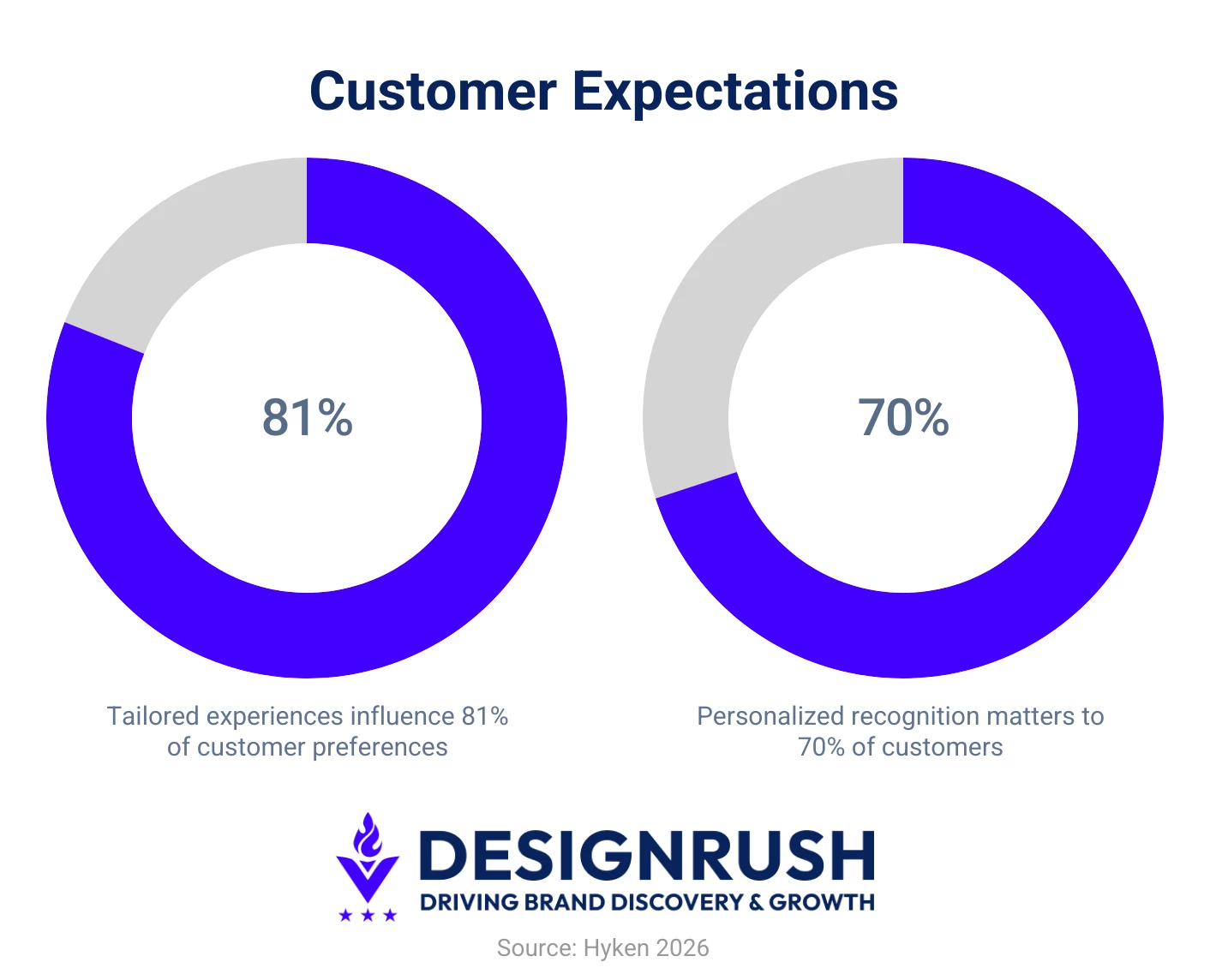
Personalization is a major driver behind this change. Research from Hyken shows that 81% of customers prefer brands that tailor experiences to them, while 70% say it matters when a company recognizes them and understands their history.
The sections below explore real-world examples across industries, along with the governance factors that determine whether customer experience investments succeed or stall.



1. Klarna: Agentic AI Handles Two-Thirds of All Customer Service
Klarna, the global buy-now-pay-later giant, partnered with OpenAI to deploy an AI-powered service agent that within its first month handled 2.3 million customer conversations, the equivalent workload of 700 full-time agents.
Unlike a simple chatbot that answers FAQ questions, Klarna's agent operates agentically: it reads the customer's message, looks up account data, processes refunds, resolves payment disputes, and closes the ticket.
The results were striking:
- Resolution time dropped from 11 minutes to under 2 minutes
- Repeat inquiries decreased by 25%
- The agent supported customers across 23 markets and 35+ languages, 24/7
- By Q3 2025, Klarna said the system was handling the workload of 853 employees
- The company reported $60 million in cost savings from the deployment
Crucially, Klarna's story also illustrates the real-world limits of pure automation. By May 2025, the company had quietly reintroduced human agents for complex, emotionally sensitive cases, after customer complaints about generic or empathy-lacking responses on nuanced issues.
Their revised approach where AI handles volume while humans handle relationships has since become a widely cited model for responsible AI CX deployment.
2. Walmart: "Sparky" and the Agentic Shopping Future
Available via the "Ask Sparky" button in the Walmart app, the generative AI shopping assistant goes far beyond search.
Customers can describe a scenario (e.g., "I'm hosting a birthday party for a 7-year-old on Saturday") and Sparky will synthesize product reviews, pull relevant items across categories, factor in current promotions, and suggest a curated cart.
What makes Sparky agentic is its ability to reason across tasks, not just retrieve information.
Walmart's roadmap envisions the assistant automatically reordering household essentials, booking services, and responding to images, audio, and video inputs. It acts on customer needs rather than merely responding to them.
Early business results validated the investment. Customers who engage with Sparky show a 35% higher average order value than those who don't, according to Walmart's CFO on a 2026 earnings call.
Walmart has since deepened the agentic infrastructure by partnering with both Google Gemini and OpenAI ChatGPT, allowing shoppers to browse Walmart inventory and complete purchases directly within those platforms.
3. Decathlon: AI Service Bots Streamline Omnichannel Support
Global sporting goods retailer Decathlon partnered with Parloa to deploy AI-powered customer service bots across phone, chat, and messaging channels.
Using conversational AI, Decathlon’s bots now handle more than 500,000 customer interactions annually.
The system can automatically identify customers through their order numbers, route inquiries to the most relevant agents, and answer common support questions without human intervention.
Decathlon’s AI platform intelligently routes customers to the right agents, automates repetitive tasks like order updates and returns, and delivers consistent support across phone, chat, and messaging channels.
The system eliminated 20% of repetitive workloads while reducing wait times and improving service efficiency.
4. AAA Washington: Agentic AI for Roadside Assistance and Member Support
The American Automobile Association's Washington chapter deployed Salesforce Agentforce to build an autonomous service agent capable of handling a broad range of member support requests.
Today, it handles everything from roadside assistance inquiries and membership renewals to benefit explanations and appointment booking.
Unlike a scripted chatbot, the AAA Washington agent understands the full context of a member's profile, reasons about what they likely need, and takes action.
It pulls membership details, confirms eligibility, routes requests to the appropriate field team, and closes the loop with a confirmation.
The deployment reflects a growing pattern in insurance and member services, where customer queries are high-volume, time-sensitive, and emotionally loaded (a broken-down car is rarely a calm situation).
By deploying Agentforce, AAA Washington has moved from reactive ticket handling toward proactive, context-rich member care, freeing its human agents to focus on the complex, empathy-intensive interactions where they genuinely add value.
"Agentforce is helping us serve our members faster and more effectively, so our team can focus on the moments that truly matter," said Jim Ryan, Chief Information Officer of AAA Washington.
5. Capital One’s “Eno”: AI Alerts for Proactive Banking
Capital One was one of the first U.S. banks with an AI chatbot. Eno is an intelligent assistant that lives in the app and via text. It offers proactive insights and alerts to help customers manage their money.
For example, Eno will message users if it detects a potential double charge (“Did you mean to tip 150%?”) or if a free trial is about to convert to a paid subscription.
It monitors transactions in real time and reaches out about suspicious or notable activities. By catching fraud and mistakes early and being available 24/7, Eno has improved customer peace of mind.
It augments the bank’s service team by handling millions of interactions automatically (and passes off to live agents for complex issues or requests outside its scope).
6. Mayo Clinic: AI Chatbot for Patient Education
The Mayo Clinic has deployed NLP-based bots in a few capacities. One notable example is an AI-powered patient education chatbot Mayo created.
Patients can ask this bot questions about symptoms, conditions, or medications and get evidence-based answers drawn from Mayo’s vast medical knowledge base. It’s like having a digital health librarian available 24/7.
The chatbot personalizes responses and provides links to Mayo’s articles or suggests next steps (like “schedule a check-up”). This has helped Mayo scale its patient outreach, especially useful during times like COVID-19 surges when many people have urgent questions.
Mayo Clinic has also experimented with AI assistants for appointment scheduling and reminders. By automating routine scheduling and FAQ tasks, Mayo frees up nurses and support staff to focus on in-depth patient needs.
7. Sephora: Virtual Try-On Drives Up to 90% Higher Conversion in Beauty
Sephora’s flagship AI tool, Sephora Virtual Artist, uses computer vision and deep learning to let customers virtually try on thousands of makeup products directly through the app or website camera, without stepping into a store.
Studies of Sephora's AR try-on tools show that virtual try-on users demonstrate significantly higher purchase intent, with conversion rates up to 90% higher than non-users. The brand has reported meaningful reductions in returns as customers buy with greater confidence.
The app also feeds a personalization loop: the AI tracks which products a customer tries, which shades they hover on, and what they ultimately buy, then uses that data to serve more relevant recommendations and retargeted ads.
App users who engage regularly with these AI features spend twice as much annually and purchase twice as frequently as the average Sephora customer.
Since the launch of its first AI tools in 2016, Sephora grew its eCommerce revenue from $580 million to over $3 billion. The brand attributes this trajectory in large part to its commitment to AI-led personalization across digital and in-store experiences.
8. Bank of America's "Erica": 3 Billion Interactions and Counting
Bank of America’s conversational AI assistant Erica has become the most widely adopted AI-driven financial assistant in the industry, surpassing 3 billion client interactions and now averaging over 58 million conversations per month across nearly 50 million users.
Erica handles a broad range of tasks: tracking spending trends, alerting customers to unusual transactions, guiding them through investment questions, and scheduling branch appointments.
It also delivers proactive financial insights, such as notifying customers when their balance is trending downward or when they're eligible for premium rewards. More than 1.7 billion of those interactions have been proactive, meaning Erica reached out to clients before they had to ask.
Unlike purely generative AI tools, Erica deliberately runs on deterministic NLP, meaning every answer it gives is grounded in verified bank data.
This approach has made Erica a trust benchmark in financial services, demonstrating that in high-stakes sectors, AI reliability often matters more than AI creativity.
"We can't afford to be 90% right," said Jorge Camargo, Bank of America's head of digital platforms. "Clients expect our answers to be 100% right, 100% of the time."
9. Delta Air Lines: Delta Concierge as a Personal Travel Agent
Delta Concierge, a generative AI-powered assistant built into the Fly Delta app, is designed to serve as a context-aware personal travel companion for every SkyMiles member.
Delta Concierge has identity-aware architecture, so it can access a customer's full travel profile (booking history, seat preferences, loyalty status, past disruptions) to deliver genuinely personalized responses.
Ask it about your gate, and it already knows your flight. Ask about your bag, and it pulls live tracking without making you enter a confirmation number.
When complex issues arise, it performs an orchestrated handoff to a human reservations agent, with full context attached, so the customer never has to repeat themselves.
Delta Concierge is explicitly designed to move AI CX in aviation from reactive FAQ-answering toward autonomous, multi-step journey management: the defining characteristic of agentic AI in action.
10. Spotify: AI DJ Turns Passive Listening Into a Conversation
Spotify's AI DJ does something no streaming tool had done before: it combines real-time music recommendation with a dynamic, voiced commentary layer that explains why it's playing what it's playing, then asks if you want something different.
Powered by Spotify's personalization models and generative AI voice synthesis, the DJ analyzes listening history, time of day, mood signals, and recently played content to build a continuously updating session.
In 2025, Spotify took this further by giving the DJ the ability to take requests in natural language.
A user can say "something energetic for a workout" or "go back to the 90s indie stuff" and the system interprets intent, calls multiple recommendation tools, and reassembles the session. This is a textbook example of agentic AI applied to entertainment.
Spotify's AI Playlist feature works similarly: users describe a vibe or moment in plain language, and an AI agent builds a custom playlist in seconds, using intent-interpretation and multi-tool orchestration.
For entertainment and media brands, Spotify's approach shows how AI CX can be woven into the product experience itself, not just layered onto customer service.
Risk & Governance: Avoiding Customer Experience AI Pitfalls
An uncontrolled AI can make thousands of mistakes or bad decisions in seconds, which then require human cleanup or could harm customers.
Sray Agarwal, Head of Responsible AI at Infosys, further emphasizes this point:
“Ethical AI functions like a seat belt in a car – it's essentially a safety feature. It ensures that AI doesn't discriminate among people and operates transparently and explainable...
Toxic prompts and answers that could harm sentiments or well-being aren't permitted. AI remains stable, providing consistent answers with repeated runs rather than unpredictable or unstable outcomes."
Done right, though, AI can build trust. Responsible, transparent use can be a brand differentiator; so, make governance a selling point.
The Hallucination Problem: When AI Confidently Gets It Wrong
McKinsey's 2025 Global Survey on AI found that inaccuracy was the most commonly reported risk from generative AI deployments, cited by nearly one-third of all respondents.
For CX teams, the trust damage from a single confidently wrong answer can outweigh weeks of positive interactions.
Three mitigation strategies have emerged as industry standard:
- Retrieval-Augmented Generation (RAG): RAG systems pull answers from product catalogs, pricing databases, and return policies instead of relying solely on model training. This keeps responses accurate, current, and aligned with real business information.
- Confidence-threshold escalation: Strong AI systems recognize uncertainty. When confidence in an answer drops below a set threshold, the interaction automatically transfers to a human agent instead of risking inaccurate or misleading responses.
- Continuous conversation monitoring: AI systems need regular transcript reviews to catch inaccurate responses, awkward phrasing, or declining performance early. Ongoing monitoring helps teams identify issues before errors scale across thousands of interactions.
When AI CX Fails: Warning Signs to Watch
Even well-funded customer experience deployments can underperform.
Klarna’s experience is a strong example. After rolling out large-scale automation in 2024, the company brought more human agents back into support workflows in 2025 after customers reported frustrating experiences during emotionally sensitive disputes and complex cases.
The issue wasn’t the technology itself; it was relying too heavily on automation in situations that required empathy, judgment, or flexibility.
Watch for these early warning signs that a deployment is underperforming:
- Rising repeat contacts on the same issue, indicating the AI is closing tickets without actually resolving them
- Declining CSAT scores on AI-handled interactions relative to human-handled ones
- Customers explicitly requesting a human agent at higher rates than your baseline
- Support staff spending time correcting or apologizing for AI responses rather than handling new requests
- Longer-than-expected resolution times on issues the AI was supposed to handle autonomously
Realistic timelines matter too. Most mid-market deployments using existing platforms take three to six months from kickoff to live deployment.
Meaningful performance data typically takes another two to three months of live traffic. Expecting transformative ROI in the first quarter sets teams up for disappointment and premature abandonment of implementations that simply needed more time to calibrate.
How to Get Started with AI in Customer Experience: A 5-Step Framework
Here's a practical starting point for teams moving from interest to implementation.
- Audit your CX data and channels: Identify where customer interactions happen and evaluate the quality of your data. AI systems rely on accurate, connected information, so inconsistencies can lead to poor personalization and unreliable customer experiences.
- Start with repetitive, low-risk interactions: Focus on high-volume tasks like FAQs, order tracking, appointment booking, or password resets. These are easier to automate, deliver faster ROI, and allow teams to test AI safely.
- Choose the right deployment approach: Companies typically choose between standalone AI tools, integrated CX platforms, or fully custom systems. Integrated platforms scale more easily and require significantly less maintenance.
- Design escalation paths before launch: AI should never trap customers in endless loops. Define which issues require human agents, establish escalation triggers, and ensure customer context transfers smoothly during handoffs.
- Measure performance against clear benchmarks: Establish metrics like response times, resolution rates, support costs, and customer satisfaction before deployment. Tracking performance at regular intervals helps teams continuously improve customer experiences over time.
Most mid-market deployments using existing platforms take 3–6 months from kickoff to live. Custom builds typically require 12+ months.
Budget for a further 2–3 months of live traffic before you have enough data to meaningfully optimize performance.
What You'll Need Before You Start
Understanding the timeline is only part of the picture. Three internal resources determine whether an AI CX project succeeds or stalls:
- Data infrastructure: AI customer experience systems depend on clean, connected customer data across platforms like CRMs, helpdesks, and eCommerce systems. Without unified data, personalization and automation break down.
- IT and integration capacity: Even prebuilt AI platforms require API integrations, security reviews, and ongoing technical support. Companies often underestimate the internal resources needed to configure and maintain these systems.
- Change management for support teams: Agents need clear guidance on when AI handles interactions, when humans step in, and how workflows evolve. Strong onboarding and communication reduce resistance and improve long-term success.
AI in Customer Experience: Final Thoughts
AI is no longer a future-facing experiment in customer experience; it’s becoming the operational layer behind how modern brands communicate, personalize, and scale support.
The companies seeing the strongest results are not treating AI as a standalone tool. They’re redesigning customer journeys around it, combining automation, predictive intelligence, and human support into a single experience.

Our team ranks agencies worldwide to help you find a qualified partner. Visit our Agency Directory for the top customer service outsourcing companies, as well as:
- Top AI Customer Service Companies
- Top Call Center Companies
- Top Inbound Call Center Companies
- Top Outbound Call Center Companies
- Top Outsourced Customer Support Companies in California
AI in Customer Experience FAQs
1. What is agentic AI in customer service?
Agentic AI goes beyond answering questions. It can understand intent, make decisions, complete multi-step tasks, and take action on behalf of customers, such as processing refunds, rebooking travel, or managing personalized shopping experiences across channels.
2. What are the risks of AI in customer service?
The biggest risks include inaccurate responses, poor handling of sensitive situations, biased recommendations, and frustrating escalation experiences. Problems usually stem from weak data, insufficient monitoring, or over-automation. Strong governance, human oversight, and clear escalation paths are essential to maintaining customer trust.
3. How much does AI customer service cost?
Costs vary widely depending on complexity. Small businesses can launch basic chatbot tools for a few hundred dollars monthly, while enterprise-grade platforms with integrations, automation, and agentic capabilities can cost hundreds of thousands annually, plus implementation and training expenses.
4. Can AI replace human customer service agents?
AI can automate repetitive, high-volume interactions like FAQs, order tracking, and appointment scheduling, but human agents remain critical for emotionally sensitive, complex, or high-stakes conversations. Most successful companies use AI to augment support teams, not fully replace them.