How to Hire a Small Business PPC Company
Table of Contents
Is my ad budget big enough to get results, or will I fund someone's learning curve?
Agencies widely recommend a minimum ad spend of $2,000-$5,000 per month because campaigns below that threshold lack the click volume needed to run A/B tests, identify winning keywords, and achieve statistical significance.
Accounts spending under $5,000 per month saw 18% higher CPCs and 31% lower conversion rates than the median in 2026 , according to benchmark data from Digital Applied — a structural disadvantage that compounds as AI bidding algorithms require data volume to optimize effectively.
Google's own Smart Bidding needs at least 30 conversions per month , and often 50 or more for Target ROAS strategies , to optimize effectively; below that threshold, the algorithm is largely guessing.
Most small business PPC agencies charge 10-20% of monthly ad spend as a PPC management fee , which means on a $2,000 ad budget , you're looking at $400 going to management alone before a single click.
A $2,000 monthly fee can be a smart investment on a $20,000 ad budge t.
That same $2,000 fee can feel painful on a $4,000 budget , especially if campaigns are not producing enough revenue to justify it.
The honest readiness question: Is my monthly ad spend large enough for an agency to actually optimize, or am I buying presence without performance?
Should the agency have verifiable experience in my specific industry, or are they generalists applying a template?
Ask which accounts the small business PPC agency manages that resemble yours in terms of average contract value, conversion type, and monthly ad spend.
Ask what their average client cost per acquisition looks like in your category.
If they cannot answer specifically, they may not have the relevant experience.
Industry CPC variance is enormous and directly affects how much a poorly matched agency will cost you.
According to WordStream's 2025 benchmark analysis of over 16,000 campaigns, attorneys and legal services averaged $8.58 per click , while arts and entertainment averaged just $1.60 .
That’s a nearly 5x difference that demands entirely different bidding strategies and optimization approaches.
The average cost per lead in legal services ran $131.63, compared to around $33 in arts and entertainment.
Cheap clicks are not always the cheapest leads, because a low CPC with a poor conversion rate can still produce a higher CPL than an expensive click with strong intent.
A small business PPC services provider without domain experience in your vertical will discover this through expensive trial and error.
What to ask: Show me three accounts in my vertical that you've managed for 12 months or more. What was the CPA trend over that period?
What do the reporting metrics tell me, and am I about to pay for a vanity scorecard?
Monthly reports land in your inbox showing strong impressions, healthy CTRs, and rising click volume.
You don't know how to ask whether any of those clicks became customers.
Six months later, you realize you've been measuring the wrong things.
One of the biggest mistakes in PPC advertising is celebrating vanity metrics like click-through rates while revenue stays flat.
Clicks do not pay the bills. Revenue does.
Most agency monthly reports are PDF exports of the Google Ads dashboard with brand colors added — you see the same numbers already available in the platform UI.
According to PPC Chief's 2026 data , cost per click increased for 87% of industries in 2025 , meaning campaigns that look "busy" with high click volume are quietly getting more expensive.
A report that doesn't surface cost-per-lead or ROAS trends is hiding the part of the story that matters most.
One industry survey found that only 10% of Google Ads accounts receive weekly updates from their manager.
What a real report shows: Cost per acquisition (CPA), return on ad spend (ROAS), lead quality trends, and pipeline attribution.
According to Shopify's 2026 PPC statistics roundup , the average cost per lead for Google Ads across all industries in 2025 was $70.11 .
If the report that a small business PPC company provides doesn't show you your CPL, you have no way of knowing whether you're above or below the benchmark for your category.
What does the contract say about how I exit, and what data do I keep when I leave?
A PPC contract without performance expectations is essentially a contract for activity, not results.
Losing your historical conversion data and audience lists when switching small business PPC agencies means starting from scratch, which has a real cost in both time and campaign performance.
Before switching agencies, you must secure full account access, download all historical data, including search term reports, auction insights, conversion history, and audience lists, and understand your contract exit terms.
Doing this after you've already given notice is too late.
Three contract clauses to demand before signing:
All accounts created in your name with admin access retained throughout
Full data export delivered within 48 hours of contract termination
A performance-based exit clause allowing termination without penalty if defined benchmarks aren't met within a set timeframe.
How will I know after 90 days whether this agency is working or just busy?
Top small business PPC agencies should be willing to commit to specific KPIs, such as cost-per-acquisition or return on ad spend targets.
They should also explain what causes would lead them to adjust those targets and over what timeframe.
Weekly check-ins during the first 90 days are appropriate for a new engagement; if an agency proposes only quarterly reviews, that cadence is insufficient for early-stage optimization.
According to Digital Applied's 2026 Google Ads benchmarks , AI-powered bidding now drives 78% of all Google Ads spend , and advertisers using these strategies report an average 22% lower cost per conversion compared to manual management.
Still, the advantage varies dramatically by account maturity, which is exactly why the first 90 days of active optimization matter so much.
Performance that has been consistently below baseline for 90 or more days with no credible explanation or improvement plan is a clear signal to consider walking away .
The same goes for an agency that is unresponsive or evasive about account access.
Set these in writing before day one: Your agreed CPA or ROAS target , the timeframe for the learning phase, the reporting cadence, and the specific trigger that gives you a no-penalty exit.
If the agency offering small business PPC services won't commit to these in writing, the confidence they're selling you in the pitch is not backed by their contract.
Why Companies Trust DesignRush
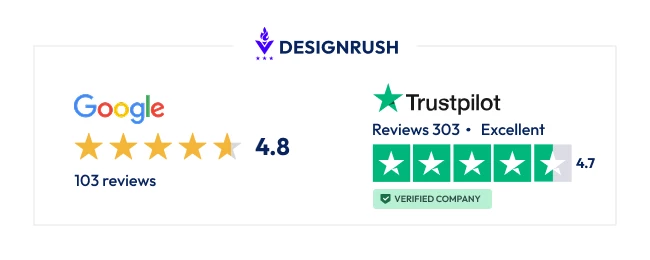
Rated 4.8 on Google and 4.7 on Trustpilot , the DesignRush Agency Directory is a reliable resource for finding small business PPC agencies. We owe this to our executive selection team, which follows a strict screening process when featuring agencies on the platform, assessing key performance indicators, like portfolio, client reviews, and industry reputation.
Sources
DesignRush sustains a directory of over 40,000 agencies categorized by service category, location, expertise, and reviews. We build our database in two ways:
Our dedicated team of agency experts actively searches the web for top-performing companies. We then pull information from their websites, online presence, and client testimonials to verify their status and qualifications prior to listing.
The agencies listed get notified of their profiles on the website and they can choose to claim it or not, which suggests their availability for more collaborations.
Agencies can also reach out to DesignRush and must go through the verification process prior to being listed.

 Proposals