
In this guide, I’ll explain how pricing really works behind the scenes, what current market benchmarks look like, why costs rise in some industries faster than others, and which levers actually help keep spend under control.
Google Ads Cost: Key Findings
- Average cost per click is about $5.26, but the same keyword can cost more or less day to day depending on competition, intent, and relevance at the moment of search.
- Smaller, high-income markets often show higher CPCs because advertisers compete for fewer but more commercially valuable searches.
- Businesses that focus on intent filtering, segmentation, and conversion quality outperform those that simply try to lower CPC.
Are Google Ads Worth the Cost?
In practice, Google Ads is worth it when it brings in customers at a price that makes sense for the business.
I’ve seen companies pay high click costs and still win because their leads convert and sales close. I’ve also seen cheap traffic go nowhere.
The cost itself is not the problem. What matters is whether those clicks turn into real revenue.
How Google Ads Pricing Actually Works
Google Ads is a real-time relevance auction where price, quality, and context are evaluated together, every single time a user searches or loads a page.
You don’t pay your bid, but you pay the minimum needed to beat the advertiser below you, adjusted for quality.
Let me explain this in plain language.
- Step 1: A search creates a market, not a fixed price
- Step 2: Google compares usefulness before price
- Step 3: Ads are ranked by overall value, not budget
- Step 4: You don’t pay your bid
Step 1: A Search Creates a Market, Not a Fixed Price
Every time someone searches on Google, a new market is created in that moment.
There is no standard price for a click. Cost depends on:
- How many businesses want that search
- How valuable that search appears to be
- How competitive the moment is
This is why the same keyword can cost more on one day and less on another.
Step 2: Google Compares Usefulness Before Price
When multiple businesses want to appear, Google doesn’t start by asking who will pay the most.
It first evaluates:
- How closely each ad matches the search
- How likely the ad is to be clicked
- Whether the landing page delivers what the ad promises
Only after that does bid price come into play.
Step 3: Ads Are Ranked by Overall Value, Not Budget
Your position is determined by overall value.
That value is a mix of:
- Your maximum bid
- The relevance of your message
- The quality of your landing page
- The expected usefulness to the searcher
A smaller advertiser can outrank a larger one if their ad is clearly more relevant.
Step 4: You Don’t Pay Your Bid
Even if you bid high, you only pay what’s necessary to beat the advertiser below you.
- If your ad quality is strong, Google effectively gives you a price discount.
- If your ad is weak or generic, you pay more to compensate.
This is the core mechanic most businesses misunderstand.



How Much Does Google Ads Cost Right Now?
Google Ads has a market rate rather than a fixed price that moves with competition and buyer intent.
The best way to estimate what you’ll pay right now is to use recent benchmark data as a reality check, then map it to your industry.
Based on LocaliQ’s latest report, the current search benchmarks look like this:
- Average cost per click (CPC): $5.26
- Average click-through rate (CTR): 6.66%
- Average conversion rate: 7.52%
- Average cost per lead (CPL): $70.11
That’s the middle of the market baseline. But the number you’ll actually experience depends heavily on your industry.
Google Ads Cost by Industry
In practice, I look less at CPC in isolation and more at how efficiently each industry turns that cost into real leads and revenue.
This breakdown shows how different industries stack up across cost per click, conversion rate, and cost per lead, and what those numbers actually mean when you’re managing budgets day to day.
| Industry | Average CPC | Average Conversion Rate | Average CPL | What This Means |
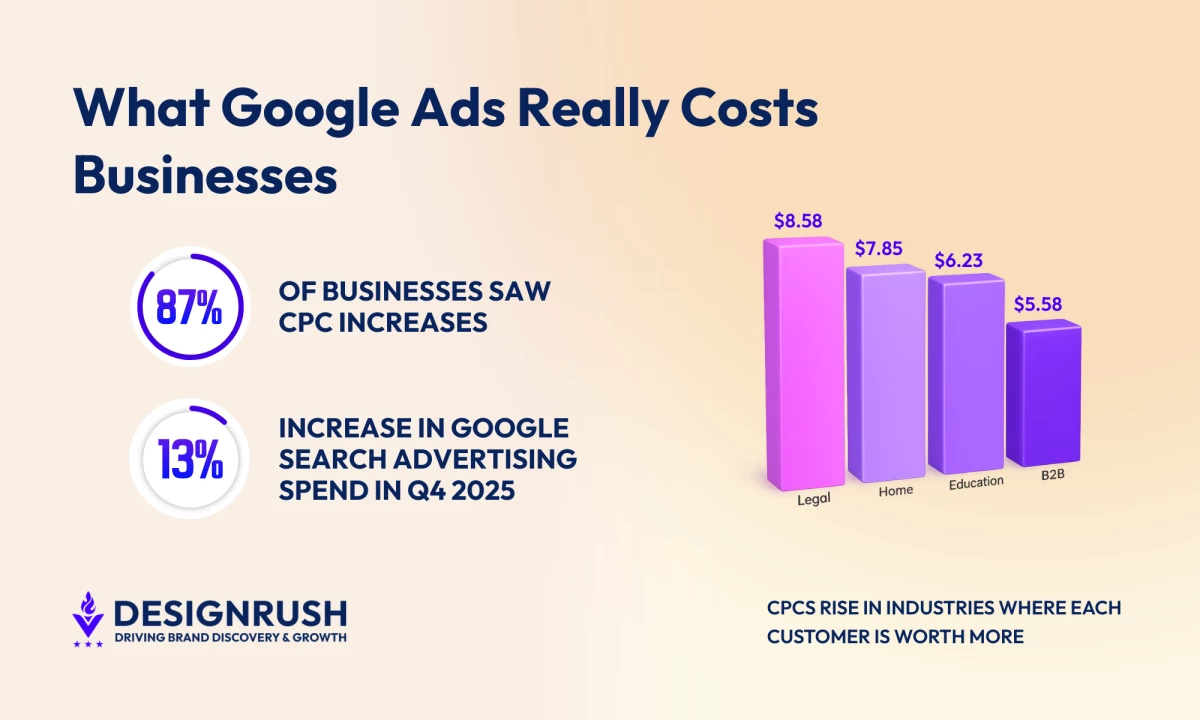
| Legal Services | $8.58 | 5.09% | $131.63 | Expensive clicks, high lead value. Pricing reflects intense competition and strong purchase intent. |
| Home & Home Improvements | $7.85 | 7.33% | $90.92 | Costs rising fast, but leads convert well. Margin and close rate matter more than CPC. |
| Dental Services | $7.85 | 9.08% | $83.93 | High CPC justified by strong intent and repeat revenue potential. |
| B2B | $5.58 | 5.14% | $103.54 | Moderate CPC, higher CPL due to longer sales cycles and qualification friction. |
| Finance & Insurance | $3.46 | 2.55% | $83.93 | Clicks aren’t expensive, but conversion efficiency is lower. Funnel quality is critical. |
| Education & Instruction | $6.23 | 11.38% | $90.02 | CPCs rising sharply, but strong conversion rates offset some of the cost pressure. |
| Real Estate | $2.53 | 3.28% | $100.48 | Cheap clicks, expensive leads. Volume is easy; quality filtering is not. |
| Health & Medical | $5.00 | 11.62% | $56.83 | One of the best efficiency profiles when targeting is tight. |
| Automotive: Repair & Service | $3.90 | 14.67% | $28.50 | Strong local intent drives excellent conversion and low CPL. |
| Ecommerce / Shopping | $3.49 | 3.83% | $47.94 | CPC is reasonable; success depends on product pricing and margins. |
| Travel & Hospitality | $2.12 | 5.75% | $73.70 | Low CPC but highly seasonal and sensitive to demand shifts. |
| Restaurants & Food | $2.05 | 7.09% | $30.27 | Very affordable clicks and leads, but typically lower transaction values. |
Let’s say you’re a home improvement business spending $3,000 a month on Google Ads.
Clicks come in around $8, which brings roughly 350-400 visits. About 7% of those turn into leads, ending up with 25-30 inquiries at around $90-$100 each.
From there, performance comes down to turning a few of those leads into signed jobs.
Google Ads Cost by Country
In 2026, the highest costs are concentrated in countries where advertiser competition is intense, purchasing power is strong, and search intent skews heavily commercial.
These markets tend to attract more aggressive bidding, even when overall search volume is lower.
The table below highlights the countries with the highest average cost per click, showing where advertisers typically pay a premium just to stay visible.
| Country | Average CPC |
| Iceland | $0.83 |
| Albania | $0.65 |
| Luxembourg | $0.65 |
| United States | $0.61 |
| Australia | $0.57 |
| Montenegro | $0.55 |
| United Kingdom | $0.48 |
| Canada | $0.45 |
| Austria | $0.45 |
| Finland | $0.45 |
From what I see in live accounts, a higher CPC doesn’t automatically mean more traffic.
In many of these markets, advertisers are fighting over smaller but far more valuable audiences, and that concentrated demand is what pushes prices up faster than in larger, higher-volume countries.
What Actually Determines Google Ads Cost
Let’s talk about what really determines what you pay, from the perspective of someone who goes through this regularly.
When it comes down to it, Google Ads costs are driven by market forces and value signals that affect how often Google shows your ads and how much competition you face for the attention of the people you’re trying to reach.
Here are the fundamentals that move the needle:
- Competitive demand for keywords
- Buyer intent and commercial value
- Ad relevance and quality
- Landing page experience and conversion path
- Auction dynamics at the moment of search
- Seasonality and external trends
- Your bidding strategy and tracking accuracy
- Stronger search engagement and click growth driven by AI
1. Competitive Demand for Keywords
Google’s own benchmarks show that 87% of industries saw CPC increases in 2025, with average cost per click climbing nearly 13% year-over-year.
That reflects more companies bidding for the same commercial keywords, especially where buyer intent and transaction value are high.
For example, terms like roof repair near me or corporate legal services quote naturally attract more advertisers because those clicks often yield high-value clients.
2. Buyer Intent and Commercial Value
Searches that show clear purchase intent, like bookkeeping services for small business versus what is bookkeeping, cost more because they sit closer to a buying decision.
These clicks convert more often, move faster through the sales process, and produce leads businesses can act on immediately.
Google prices each auction based on how likely a click is to turn into a conversion, so searches with stronger revenue signals naturally attract higher bids.
3. Ad Relevance and Quality
Google rewards ads that match user intent and deliver a good experience.
If your ad copy, keywords, and landing page are tightly aligned with what users want, Google shows your ad more often and charges you less per click.
Businesses with stronger relevance frequently pay less than competitors with weaker relevance, even when those competitors bid more.
Alex Birkett, former HubSpot growth lead, emphasizes that search performance improves when businesses optimize for user intent and experience rather than chasing platform signals.
In Google Ads, this shows up directly in cost efficiency: ads that serve real user needs convert better and cost less over time, while surface-level optimizations inflate spend without improving results.
4. Landing Page Experience and Conversion Path
Google uses signals from your landing page, such as load speed, content relevance, and conversion continuity, as part of the pricing equation.
Better pages often lower your effective cost because they indicate higher chances of a good user outcome.
5. Auction Dynamics at the Moment of Search
Google runs an auction every time someone searches. That auction considers:
- Who’s targeting that keyword right now
- How relevant each ad is
- How much each advertiser is willing to pay
Because these factors fluctuate every minute of the day, costs fluctuate too. That’s why average CPCs from recent data reflect a constantly changing vibe rather than a fixed rate.
6. Seasonality and External Trends
Seasonality and broader trends cause demand and costs to ebb and flow over time.
During peak commercial periods, say the holiday shopping season or other high-demand moments, advertiser competition intensifies and drives up costs.
For instance, retailers typically see CPC spikes around major holidays.
In Q4 2025 (the holiday period), Google Ads CPCs were expected to increase by about 25-35% on competitive retail keywords as brands piled into auctions around Black Friday and Cyber Monday.
7. Your Bidding Strategy and Tracking Accuracy
Your chosen bidding method (manual, target CPA, maximize conversions) affects how Google approaches each impression.
Smart Bidding uses conversion signals to bid more aggressively where the platform predicts success.
If you’re using a strategy like Target CPA or Maximize Conversions, Google will bid more aggressively on impressions deemed likely to convert and bid lower on less promising ones.
In fact, Google explicitly states that Smart Bidding “uses your conversion tracking data to get you more conversions at a lower cost,” optimizing bids auction-by-auction to avoid unprofitable clicks.
This means that accurate conversion tracking is critical. If your tracking is weak or incomplete, the algorithm is flying blind, and that can drive costs up.
8. Stronger Search Engagement and Click Growth Driven by AI
One emerging factor in the cost equation is the overall growth of search volume and ad clicks, partly driven by new AI-powered experiences in search.
Even as certain ad auctions get more crowded, Google is managing to serve more total impressions and clicks to users, which influences advertisers’ spending patterns.
Recent industry data shows that user engagement with search ads is increasing. For example, in Q4 2025 Google search advertising saw a 13% year-over-year increase in spend, accompanied by a surge in ad clicks, which is the highest click growth rate in about five years.
Notably, during that time the average CPC remained relatively stable, even slightly down, because the surge in clicks was supply driven.
Google attributed this trend partly to AI-driven search results, expanding query volume, and making it easier for consumers to find commercial information.
How To Keep Google Ads Costs Under Control
The businesses that control Google Ads costs best change how and where they compete.
Large brands offer a clear pattern: they accept that high-intent clicks cost more and focus instead on efficiency, relevance, and downstream value.
Here’s how that looks in practice.
- Airbnb: Scaling paid search without letting costs run away
- Booking.com: Paid search anchored in conversion, not click price
- TUI UK: Improving return by integrating paid search with broader analytics
- L’Oréal Taiwan: Precision targeting to reduce waste and lift revenue
- IKEA UK: Better data integration to improve paid search ROI
1. Airbnb: Scaling Paid Search Without Letting Costs Run Away
As Airbnb expanded globally, it leaned heavily on paid search to capture demand in new markets.
Rather than bidding broadly across generic travel terms, Airbnb focused on high-intent searches tied to location, availability, and booking behavior, aligning ads tightly with user intent.
This approach allowed Airbnb to scale Google Ads spend while maintaining strong conversion performance, even in competitive travel markets where CPCs tend to rise quickly.
The strategy was about ensuring every paid click sat close to a booking decision.
2. Booking.com: Paid Search Anchored in Conversion, Not Click Price
Booking.com consistently appears in discussions about travel brands that leverage paid search to capture ready-to-book traffic.
Analysis of Booking.com’s display and search strategies shows the company aggressively competes for travel queries during peak demand periods and uses tailored creatives and landing experiences optimized for conversions, not just awareness.
3. TUI UK: Improving Return by Integrating Paid Search with Broader Analytics
On Google’s own success story page, TUI UK is featured as a case of combining paid search with robust analytics and creative optimization.
TUI used data-driven insights from Google Marketing Platform to increase return on ad spend by about 13%, demonstrating that strategic ad optimization improves outcomes.
Smart integration of analytics with paid search helps brands avoid wasted spend on underperforming segments and reallocate budgets where performance is strong, indirectly controlling CPCs by improving overall campaign efficiency.
4. L’Oréal Taiwan: Precision Targeting to Reduce Waste and Lift Revenue
Also from Google’s success stories, L’Oréal Taiwan has used predictive targeting to reach the right customers and boost offline revenue significantly, 2.5× to be exact.
This was driven by audience segmentation and relevance.
Precision audience targeting, especially with first-party data, reduces irrelevant spend and improves the conversion quality of each paid click.
5. IKEA UK: Better Data Integration to Improve Paid Search ROI
Another story from Google’s platform shows IKEA UK using advanced tooling to boost ad spend ROI.
Rather than focusing on lowering CPCs, IKEA focused on improving bid management, audience segmentation, and tracking to allocate spend effectively.
Improved bidding and segmentation means fewer wasted impressions and better use of budget, which helps control effective CPC costs even when gross CPCs remain high.

Our team ranks agencies worldwide to help you find a qualified partner. Visit our Agency Directory for the top PPC agencies, as well as:
- Top Video Production Companies
- Top Creative Agencies
- Top Video Marketing Agencies
- Best Google Ads Agencies
- Top Social Media Marketing Agencies
Google Ads Costs FAQs
1. How much does Google Ads cost per month for a business?
There is no fixed monthly cost. Most businesses spend anywhere from a few hundred dollars to tens of thousands per month, depending on industry competition, customer value, and growth goals. What matters more than spend is whether the cost per lead or sale makes economic sense.
2. Is Google Ads pay-per-click or pay-per-impression?
Google Ads primarily works on a pay-per-click model for search campaigns. You only pay when someone clicks your ad. Other formats, like display or video, can use impression-based pricing, but search ads are click-based.
3. Why do Google Ads costs vary so much by industry?
Industries where one customer is worth more tend to have higher costs. Legal, home services, healthcare, and B2B categories see higher CPCs because advertisers are willing to pay more for customers with high lifetime value.
4. Does Google increase ad prices over time?
Google does not set fixed prices or raise fees. Costs rise when more advertisers compete for the same searches or when buyer intent becomes more valuable. Google Ads prices reflect market demand, not platform price hikes.
5. Is it better to focus on lowering CPC or lowering cost per lead?
Cost per lead or sale matters more than cost per click. Paying more per click can still be profitable if conversion rates and lead quality are strong. Cheap clicks that do not convert usually increase total costs.