
Law firms can burn through a PPC budget and still have no clear idea of which ads are bringing in cases worth taking on. PPC for law firms means paying to appear when potential clients search for legal help, making every wasted click costly.
This guide shows how sharper campaign structure, reliable tracking, and case-level reporting can improve results before your firm spends another dollar.
PPC for Law Firms: Key Findings
- A lower cost per lead doesn’t always mean better performance. Firms need to track qualified consultations, signed cases, and cost per signed case to understand ROI.
- Search Ads and Local Services Ads serve different purposes, with Search Ads offering more control and LSAs focusing on direct local inquiries.
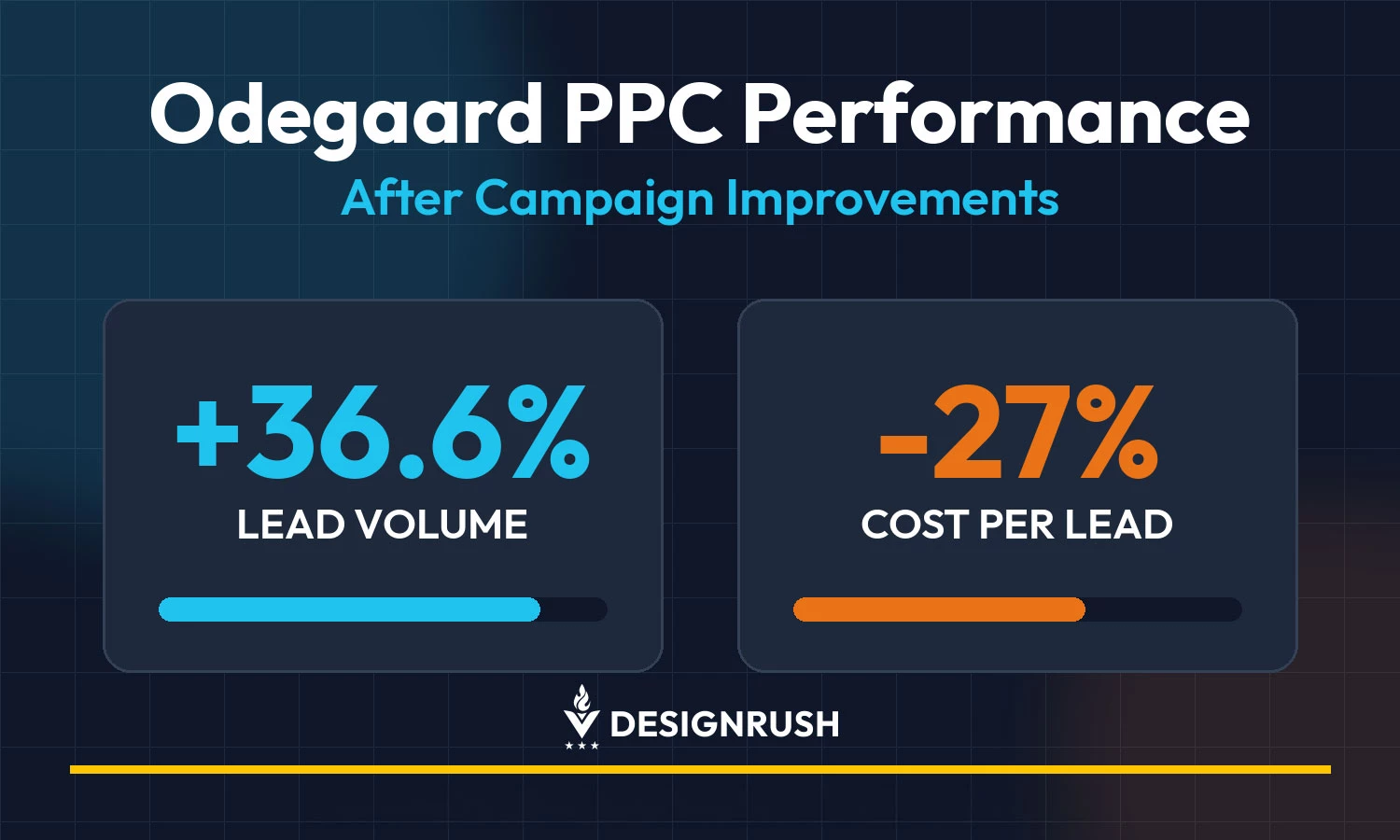
- Odegaard Injury Lawyers increased leads by 36.6%, reduced CPL by 27%, and annual ad spend flat after Disruptive Advertising reworked its campaign structure, tracking, and targeting.
Is Your Firm’s PPC Underperforming? 3 Warning Signs
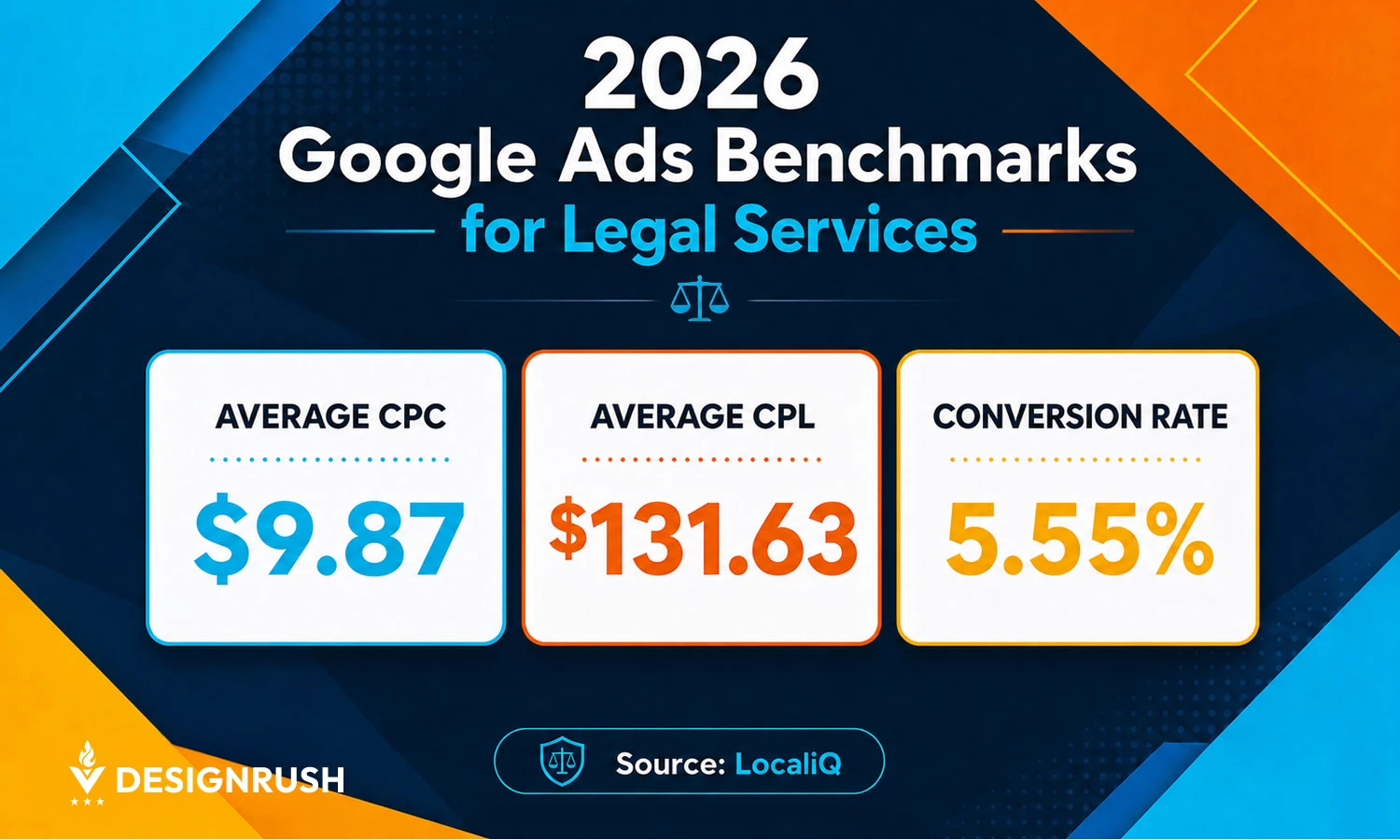
A busy Google Ads account is not necessarily a profitable one. In LocaliQ’s 2026 search advertising benchmark, attorneys and legal services recorded:
- An average cost per click of $9.87
- An average cost per lead of $131.63
- A conversion rate of 5.55%
These figures show how expensive law firm PPC can be, but they cannot show whether those leads became signed cases.
The following warning signs point to a deeper problem than an expensive keyword or an underperforming ad.
1. Cost per Lead Keeps Rising Without More Signed Cases
A higher cost per lead isn’t automatically a problem. It may still be profitable when the firm attracts better cases or improves its signed-case rate. It becomes a warning sign when spend remains steady, lead volume falls, and consultations or signed cases show no corresponding improvement.
The firm’s own performance trend matters more than a broad industry average. The average CPL for attorneys and legal services is $131.63, but LocaliQ’s analysis also stresses that firms can sustain higher lead costs when those leads produce better bottom-line results.
2. Clicks and Inquiries Are Growing, but Signed Cases Are Not
More traffic has little value when it comes from people outside the firm’s location, practice areas, or case criteria. If clicks, calls, and forms increase while accepted cases remain flat, the PPC campaign is generating activity rather than significant growth.
Click-through rate and conversion rate show whether people respond to an ad, but they don’t reveal whether the right people responded. LocaliQ similarly describes CPC and CTR as useful account health metrics rather than as final measures of PPC success.
3. Reporting Treats Every Inquiry as an Equal Conversion
A viable prospective client shouldn’t be treated the same as spam, a vendor call, an existing client, or a matter the firm cannot accept.
When every call and form submission is recorded as an equal conversion, reports overstate performance, and automated bidding may direct more money toward campaigns that produce inquiries rather than cases.
Google’s enhanced conversions for leads are designed to connect website leads with outcomes that occur later and offline.
For law firms, that means passing qualified-lead, consultation, or signed-case data back into Google Ads instead of ending measurement at the initial call or form submission.
Minor bid adjustments rarely fix these warning signs because the underlying problem usually sits deeper in the account.



PPC for Lawyers: 6 Strategies You Should Know
The most effective PPC advertising for law firms focus on what happens before and after the click, not just the bid itself.
These six approaches cover the account structure, tracking, ad copy, landing pages, channel mix, and case-level metrics that shape campaign performance.
- Separate Campaigns by Practice Area, Search Intent, and Case Value
- Fix Conversion Tracking Before Changing Your Bids
- Write PPC Ads That Convert Without Violating Legal Advertising Rules
- Match Every Ad to a Practice-Specific Landing Page
- Use Search Ads and Local Services Ads for Different Jobs
- Optimize for Signed Cases, Not the Cheapest Leads
1. Separate Campaigns by Practice Area, Search Intent, and Case Value
A law firm’s PPC account should reflect how the firm makes money, not simply how its services appear on the website.
Personal injury, estate planning, criminal defense, and business law attract different searches, carry different case values, and often need separate budgets, ads, and landing pages.
Start by separating practice areas that have different case values and require different budgets or intake processes.
A car accident campaign should not compete for the same daily budget as estate planning, when the latter may justify a much higher acquisition cost and require a faster intake response. Shared budgets can redirect spend across campaigns, but only when those campaigns have similar goals.
Within each one, group closely related searches together:
- Campaign: Personal injury
- Ad group: Car accidents
- Ad group: Truck accidents
- Ad group: Motorcycle accidents
A search for “truck accident lawyer near me” should trigger an ad and landing page about truck accident claims, not a generic personal injury message. Google recommends grouping related keywords and ads by service to improve relevance.
Search intent and geography matter too. Broad terms such as “lawyer” may signal early research, while “DUI lawyer open now in Phoenix” shows a specific need, location, and urgency. High-intent searches should not be buried inside broad campaigns where their performance is harder to see.
A cleaner structure also supports stronger ad relevance and landing page alignment, two factors Google uses when calculating Quality Score.
Look for:
- Practice areas sharing one budget despite different case values
- Broad ad groups containing unrelated services
- Multiple campaigns targeting the same searches or locations
- High-intent terms buried inside low-value traffic
- Campaigns spending consistently without producing viable cases
Odegaard Injury Lawyers faced this issue while spending more than $156,000 annually on Google Ads. Disruptive Advertising streamlined the account and paused underperforming campaigns that were consuming budget without supporting the firm’s growth goals.
“We didn’t just need more leads. We needed better ones. Disruptive helped us clean up what wasn’t working and build a system that actually supports growth.
Now we’re getting more opportunities without increasing spend, which completely changed how we think about scaling.” - Odegaard Injury Lawyers
2. Fix Conversion Tracking Before Changing Your Bids
Google Ads can only optimize toward the outcomes it can see. When every call or form submission is counted as a successful conversion, the platform may direct more budget toward campaigns that generate activity rather than viable cases.
Law firms need tracking that follows a lead beyond the first inquiry:
- Call tracking: Connects each call to its campaign, ad, and keyword while filtering missed calls, existing clients, spam, and other non-leads.
- Form-to-CRM tracking: Records where each inquiry came from and what happened after submission.
- Offline conversion imports: Sends later outcomes, such as qualified consultation or signed-case status, back into Google Ads.
- Consistent lead stages: Gives intake teams clear definitions for new inquiry, qualified lead, consultation booked, consultation completed, and signed case.
Without those steps, a campaign generating 50 weak inquiries may appear more successful than one producing 20 leads that regularly become clients. Bid adjustments made with incomplete data can reinforce the wrong pattern.
How Disruptive Advertising Improved Visibility and Reduced CPL
Odegaard Injury Lawyers was investing more than $156,000 annually in Google Ads, but its tracking couldn’t clearly show which campaigns produced quality cases.
Disruptive Advertising used its Vision, Strategy, Execution, and Team (VSET) framework to connect the firm’s growth goals with campaign execution, then improved tracking, streamlined the account, refined targeting, and shifted optimization toward conversion quality.
| Metric | Before | After | Change |
| Total leads | 213 | 291 | +36.6% |
| Cost per lead | $733 | $536 | -27% |
| Annual ad spend | $156,000 | $156,000 | No increase |
| Lead quality | Limited visibility | Improved | Positive |
3. Write PPC Ads That Convert Without Violating Legal Advertising Rules
Legal PPC copy has to persuade without creating expectations the firm cannot support.
ABA Model Rule 7.1 sets the general standard by prohibiting false or misleading communications about a lawyer or the lawyer’s services, but firms must also follow the advertising rules in every state they target.
That rules out obvious promises such as:
- We guarantee you will win
- Get the maximum settlement
- No. 1 criminal defense firm without reliable substantiation
Testimonials, case results, awards, and specialist credentials need the same care. A true statement can still mislead when it implies that another client should expect the same outcome, omits an important condition, or uses a title the lawyer is not permitted to claim.
The ABA rule is only the baseline. States apply their own professional-conduct and advertising rules, and they don’t always agree.
Any campaign running across state lines should therefore be reviewed against the rules in every state it targets.
Compliant copy doesn’t have to be vague. Good legal ads usually answer four questions quickly:
- What does the firm handle?
- Who or where does it serve?
- What can the searcher do next?
- What verifiable reason is there to choose the firm?
Urgency can also be useful when it is grounded in fact. “Speak with an attorney today” is safer than language designed to frighten or pressure a vulnerable person.
Availability claims should match reality; a 24/7 ad that routes callers to voicemail after 6 p.m. creates both a trust problem and wasted spend.
Connor O'Hanlon, Director of PPC at SmartSites, emphasizes the importance of staying within Google’s regulations:
"The regulations are more specific about what you can and cannot say in the ad copy, so standing out from your competition is a challenge. This makes great branding, aggressive bidding, and a well-performing landing page crucially important for any law firm to compete."
Before launch, review:
- Guarantees or implied promises
- Best, top, leading, and similar superiority claims
- Testimonials and past-result language
- Awards, rankings, and specialist titles
- Required disclaimers
- The rules of every targeted jurisdiction
The goal is specific, credible copy that gives the prospective client a reason to act without overstating what the firm can deliver.
4. Match Every Ad to a Practice-Specific Landing Page
The landing page should carry on the conversation started by the search and the ad. Sending every visitor to the homepage forces them to work out whether the firm handles their issue, serves their location, and is available to help.
A user searching “truck accident lawyer in Denver” should land on a page about Denver truck accident claims, not a homepage that covers workers’ compensation, defective products, and estate planning.
That continuity matters across the entire conversion path.
According to Jeff Carterson, Founder and Project Manager at SevenCube, effective PPC campaigns succeed when they match user intent through “high-quality, targeted ad copy, ad extensions that add value, and optimized landing pages.”
“Ultimately, if you’re delivering exactly what someone is looking for, they don’t care if it’s an ad,” Carterson says.
Google evaluates landing-page experience partly on how relevant and useful the page is to the person who clicked the ad. Along with expected click-through rate and ad relevance, it is one of the three components of Quality Score.
Each paid-search landing page should align with:
- Practice area: truck accidents, DUI defense, divorce, bankruptcy
- Case type: commercial truck collision instead of personal injury in general
- Location: the city, county, or state targeted by the campaign
- Offer: free case review, fixed-fee consultation, or another accurate term
- Action: call, complete a form, or book a consultation
Trust signals should appear before the user has to hunt for them. Depending on the practice area and local rules, that may include attorney credentials, jurisdictions served, genuine client reviews, relevant case experience, and clearly qualified past results.
Forms require more judgment as a firm may need the visitor’s location, the type of legal issue, the date of the incident, or conflict-check information before accepting the inquiry.
The useful test is whether each field changes the next intake decision. If it doesn’t, remove it.
Mobile visitors also need an obvious call button, readable text, forms that work without pinching and zooming, and a page that loads quickly.

Google recommends a Largest Contentful Paint of 2.5 seconds or less for a good loading experience, measured at the 75th percentile of visits. Google Ads also notes that landing-page speed is one of the most direct ways to improve results from mobile traffic.
Also, make sure the firm can respond after the conversion. A high-performing landing page has limited value when urgent calls go unanswered or form submissions sit untouched until the next business day.
Intake coverage should match the hours and response promises used in the ad.
5. Use Search Ads and Local Services Ads for Different Jobs
Search Ads and Local Services Ads can appear for similar legal queries, but they offer different levels of control and charge firms differently.
| Area | Search Ads | Local Services Ads |
| Charging model | Usually pay per click | Pay per valid lead |
| Targeting | Keywords, locations, schedules, audiences, and devices | Service types and service areas |
| Control | Ad copy, landing pages, bids, and negative keywords | Business profile, services, budget, and bid |
| Best use | Specific case types, branded searches, and tailored landing pages | Prominent local lead generation |
| Main risk | Paying for clicks that never become inquiries | Paying for leads that do not fit the firm’s case criteria |
Search Ads suit firms that need tighter control over queries, ad copy, and landing pages. LSAs focus on direct local inquiries and can generate calls, messages, or bookings, with Google charging for eligible leads rather than clicks.
In the U.S., law firms must complete Google’s screening and verification process, which may include licensing, business registration, insurance, background checks, and review requirements.
A practical split is to use Search Ads for specific queries, such as “commercial truck accident attorney Denver,” and LSAs for broader local demand, such as “personal injury lawyer near me.”
Track both separately and compare cost per signed case, not just cost per click or lead.
6. Optimize for Signed Cases, Not the Cheapest Leads
Cost per lead is useful, but it stops before the metric that matters most to the firm. A low CPL can look impressive while hiding poor qualification, missed consultations, weak intake, or a low signed-case rate.
The fuller funnel is:
The fuller funnel includes leads, qualified leads, booked consultations, attended consultations, and signed cases.
Track at least:
- Qualified lead rate
- Consultation booking rate
- Consultation show rate
- Signed-case rate
- Cost per signed case
- Expected fee or case value
- Revenue or expected value by campaign
The core calculation is:
Cost per signed case = PPC spend ÷ signed PPC cases
Consider two campaigns:
| Metric | Campaign A | Campaign B |
| Cost per lead | $300 | $500 |
| Leads | 100 | 100 |
| Signed-case rate | 5% | 20% |
| Signed cases | 5 | 20 |
| Total spend | $30,000 | $50,000 |
| Cost per signed case | $6,000 | $2,500 |
Campaign B looks worse when judged by CPL alone because each lead costs $200 more. Once signed-case outcomes are included, however, it acquires each new case for $3,500 less.
Case value matters too. A campaign producing five suitable commercial matters may be more valuable than one generating 30 low-fee inquiries.
Firms should compare acquisition cost with expected case value, fee structure, case duration, and likely profitability.
This downstream information should also flow back into the ad platform. Google’s enhanced conversions for leads can connect offline outcomes recorded in a CRM with the campaigns that generated the original inquiries, giving automated bidding better conversion data.
Break performance out by practice area or campaign so the firm can compare leads, qualified consultations, signed cases, cost per signed case, and expected case value side by side.
What Results Can You Expect From PPC for Lawyers?
PPC can put a law firm in front of prospective clients as soon as its ads are approved and eligible to enter relevant auctions.
What it cannot promise is immediate profitability. The account still needs enough data to show which searches, locations, and case types produce viable inquiries.
Early Results: Visibility and Initial Lead Data
During the early stage, firms can expect to learn:
- Which searches trigger calls and forms
- Which locations produce poor-fit inquiries
- Whether ads and landing pages match search intent
- How quickly the intake team responds
- Where leads drop out before consultation
These findings are valuable, but a campaign shouldn’t be judged on its first few conversions. A handful of expensive clicks or unsuitable leads can distort results, particularly in smaller campaigns.
As Data Builds: Better Targeting and Cost Control
Once leads have progressed through intake, firms can compare campaigns by qualified consultations and signed cases rather than clicks alone.
Google’s enhanced conversions for leads allow advertisers to connect later CRM outcomes with the original ad interaction, giving its bidding systems better information about which leads are valuable.
At this stage, firms should be able to identify which keywords, locations, ads, and practice areas deserve more budget and which are generating activity without useful case opportunities.
Longer-Term Results: More Predictable Case Acquisition
A mature PPC program should show:
- Cost per signed case
- Signed-case rate by campaign
- Practice areas and locations worth scaling
- Campaigns producing the highest-value matters
- The effect of intake speed and follow-up on returns
The Odegaard Injury Lawyers case study shows what that can look like in practice. After its campaign structure, tracking, and targeting were improved, lead volume rose by 36.6%, and CPL fell by 27%, while annual ad spend remained flat.
Final Thoughts on PPC for Lawyers
Campaign structure, compliant messaging, relevant landing pages, reliable tracking, and case-level reporting all help firms see where budget is working and where it is being wasted.
That level of visibility can be difficult to build internally, particularly when several practice areas, locations, and intake teams are involved.
Experienced PPC agencies can help law firms audit the account, fix tracking issues, and connect campaign decisions to business goals before additional spend magnifies existing problems.

Our team ranks agencies worldwide to help you find a qualified partner. Visit our Agency Directory for the top law firm PPC agencies, as well as: