
Pay-per-click (PPC) for financial services uses paid search and social ads to generate loan applications, insurance quotes, adviser consultations, and funded accounts.
Problems usually start when the platform sees the form submission but not what happens next. A qualified applicant and an unusable lead can look identical in the ad account, leaving teams to optimize around a metric that does not reliably predict revenue.
In this PPC for financial services guide, we cover six practical fixes, each backed by a real campaign result.
PPC for Financial Services: Key Findings
- A $74.44 lead can cost $186 to $298 after qualification. Disruptive Advertising cut one client’s A-tier lead cost from $19,049 to $5,173.
- Better bidding data lifted Scotiabank’s conversion rate by 15.4%, HDFC Life’s lead validity by 175%, and Zoe Financial’s top client segment to 60% of sales.
- Compliance affects performance too. Meta’s targeting limits make landing-page gains like ICICI Lombard’s 30% lift in form completions especially valuable.
Finance and Insurance Search Ads Convert Just 2.64% of Clicks, Making Bad Lead Data Expensive
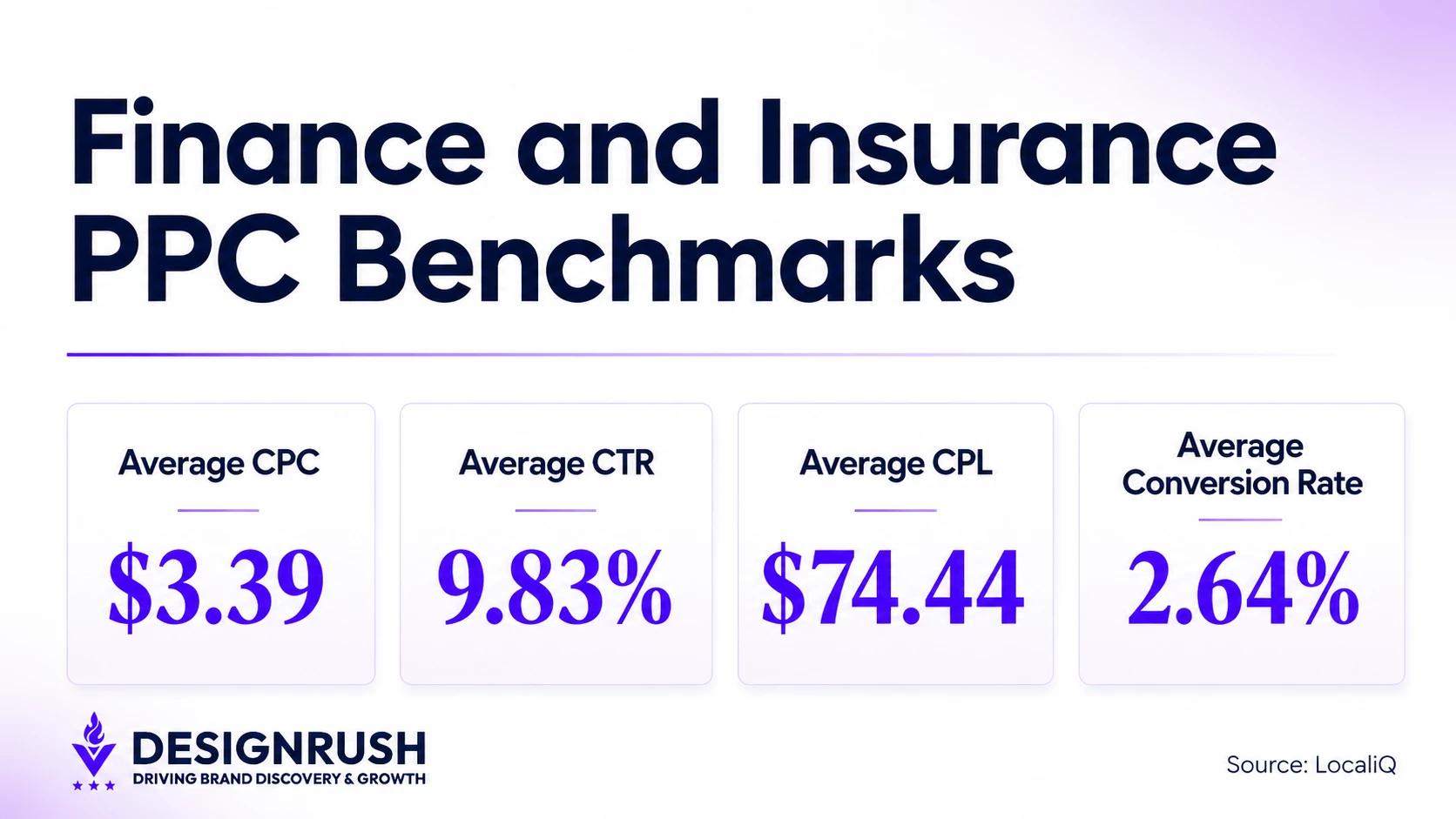
Finance and insurance search ads converted 2.64% of clicks in LocaliQ’s 2026 benchmarks, the lowest rate among the industries measured, while the average cost per lead reached $74.44.
That figure includes calls, chats, emails, and form submissions, but it does not show whether the person met the company’s credit, income, asset, location, or intent requirements.
In financial services PPC campaigns, treating every submitted form as a primary conversion teaches automated bidding to find more people who will complete it, even when many never qualify.
The Reported Cost per Lead Can Hide the Real Acquisition Cost
At the benchmark average of $74.44 per submission:
- A 40% qualification rate raises the cost per qualified lead to about $186.
- A 25% qualification rate pushes it close to $298.
The campaign may still look efficient inside the ad platform because conversion volume remains strong, even as the sales team receives more leads it cannot use.
Increasing spend under those conditions usually magnifies the existing problem because the bidding system has more budget to pursue the same conversion pattern it has already learned.
The rest of this PPC for financial services guide shows how teams clean up those signals and scale around qualified leads rather than raw form volume.
1. Set Bidding Around the Lead Stage That Predicts Revenue
Start with the earliest CRM stage that consistently separates viable prospects from the rest of the pipeline. Depending on your goals, that may be a sales-qualified lead, an approved application, completed consultation, or funded account.
Once that stage is clear, import it into the ad platform as an offline conversion and use the initial form submission as a secondary event for reporting.
Lead scoring can serve the same purpose when qualification happens automatically, provided the score reflects criteria that sales teams already use rather than a separate marketing definition of quality.
Before changing the bidding setup, check that:
- The chosen CRM stage has a clear definition that marketing and sales both use.
- Each lead is imported once, even if its status changes several times.
- The time between the ad click and the imported outcome falls within the conversion window.
- Form submissions remain available for reporting but no longer carry the same bidding weight as qualified outcomes.
- Performance is judged by qualified lead volume and cost, rather than an improved qualification rate on its own.
The new signal also needs enough volume to guide bidding reliably. Moving straight from every form submission to a rare funded-client event can leave the system with too little data, particularly in smaller accounts or services with long sales cycles.
In those cases, an intermediate stage such as a qualified application often gives the campaign a stronger signal without reducing the available dataset too sharply.
Watch the number of qualified leads alongside the cost per qualified lead while the campaign adjusts.
A lower cost means little if the change leaves the sales team with half as many viable opportunities.
Disruptive Advertising Lowered a Financial Services Client’s $20,000-Plus Cost per A-Tier Lead
Disruptive Advertising worked with a financial services company whose cost per A-tier lead had climbed above $20,000, despite the account continuing to generate a high volume of inquiries.
The agency removed conversion actions that had little connection to lead quality and rebuilt the campaign around stronger behavioral and qualification data.
It refined the audience and bidding inputs gradually so the account could improve the quality mix without sharply reducing the number of leads entering the pipeline.
The results included:
- Cost per A-tier lead fell from $19,049 to $5,173.
- High-quality lead volume increased from 45 to 50 per month.
- ROAS and profitability improved significantly.
2. Improve Keyword Strategies for Financial Services PPC With Audience Data
Paid search for financial services gets expensive quickly when broad terms such as loans, insurance, and investing attract people who are still comparing options.
More specific searches tied to a policy type, lending need, investment product, location, or eligibility requirement usually provide a clearer indication of intent.
Google’s AI Max and Performance Max rely on more than keyword lists when deciding where to spend. Audience signals, negative keywords, remarketing data, and first-party customer information all influence which users the campaigns prioritize.
Jeff Carterson, Founder of SevenCube, points to the level of detail available through platforms such as Google Ads and LinkedIn.
“Whether it’s job titles, industries, or specific pain points, these platforms let you deliver ads that feel personalized.”
For financial advertisers, the most useful signals are those tied to eligibility and buying intent. Use them to sharpen targeting:
Use those inputs to sharpen targeting:
- Add in-market and demographic signals that reflect the people most likely to qualify.
- Use remarketing lists to reach visitors who have already viewed key product or application pages.
- Keep negative keywords updated to filter out research, job-seeker, free, and DIY searches.
- Feed qualified lead and customer data back into the account so the system learns from outcomes beyond the initial click.
The strongest audience signals come from traits and behaviors linked to qualification, rather than broad interests that happen to overlap with the product.
HDFC Life Increased Average Lead Validity by 175% With Professional Audience Targeting
HDFC Life was generating display leads without a reliable way to judge whether those prospects had the financial standing to purchase a policy.
The insurer moved part of its acquisition strategy to LinkedIn, where professional profile data gave it more control over the audiences receiving its campaigns.
It paired brand content aimed at building awareness with demand-generation activity designed to capture prospects further down the funnel.
The LinkedIn case study reported:
- Qualified leads increased by 175% compared with other channels.
- LinkedIn visitors spent 50% more time on the website.
- Campaigns generated 37 million impressions across a target audience of 27 million Indian professionals.
- Cost per lead was slightly higher than on display networks, but the improvement in lead quality made the additional cost worthwhile.
3. Simplify the Account Structure So Smart Bidding Has More Data To Work With
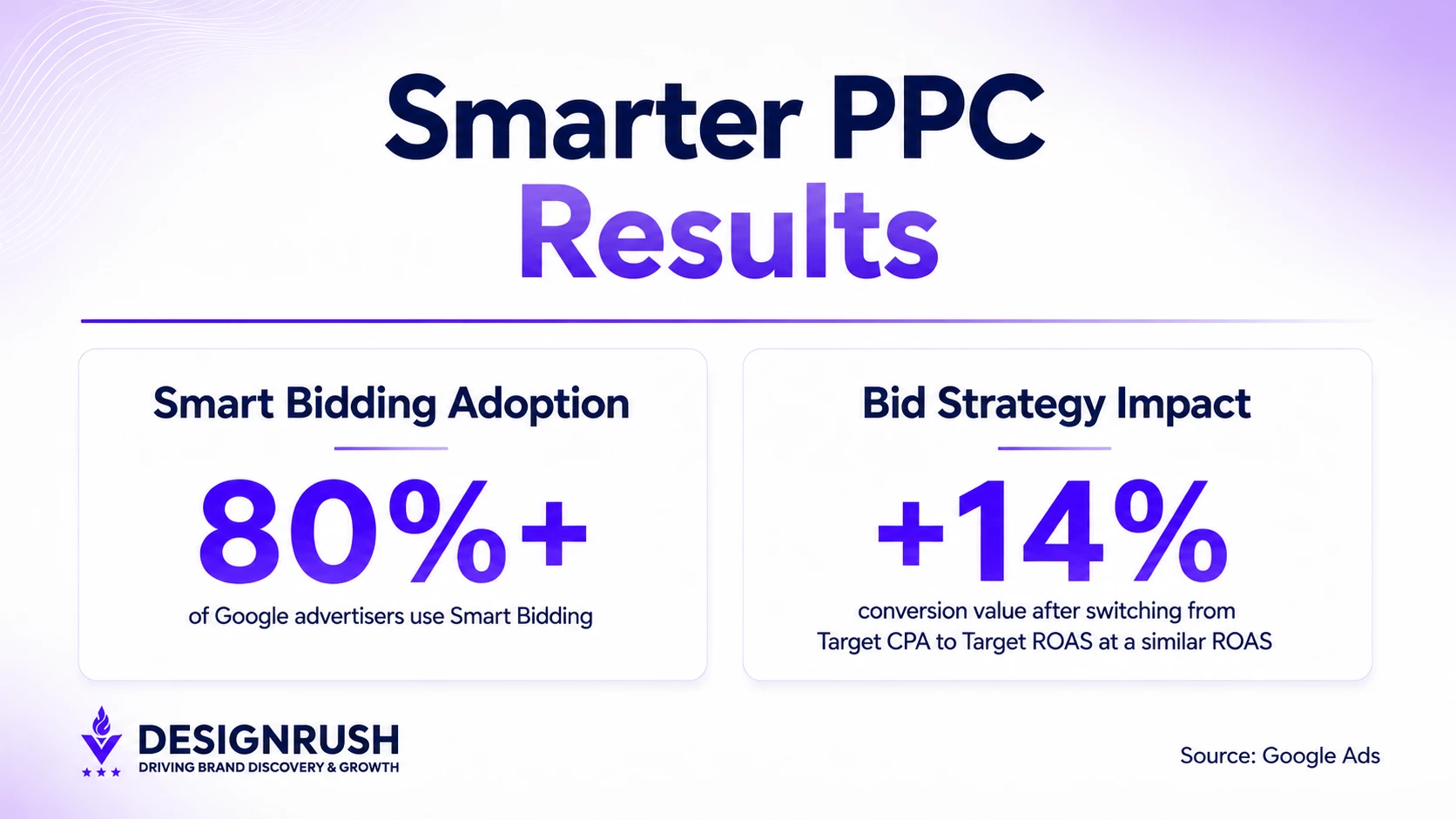
Smart Bidding has less to work with when conversions are scattered across dozens of campaigns and ad groups.
Each segment may make sense on paper, but a handful of monthly conversions rarely gives the system enough information to identify which searches and users are most likely to produce a qualified lead.
Review the account structure when:
- Qualified conversions are split among campaigns that each receive very little monthly volume.
- Similar products or audiences are separated only because they target slightly different keyword themes.
- Target CPA or target ROAS is running on campaigns without enough conversion history to support stable bidding.
- The account still optimizes toward an early action because deeper outcomes do not have enough volume within each campaign.
Group campaigns around meaningful differences such as product, market, audience, or profitability rather than creating a separate structure for every keyword theme.
This gives each bid strategy a larger pool of conversion data while preserving the distinctions that affect budgets, messaging, and lead value.
Consolidation also makes it easier to apply target CPA or target ROAS to the right outcome.
A campaign generating enough qualified applications can optimize toward that stage directly, instead of relying on an earlier action simply because the deeper conversion is spread too thinly across the account.
Scotiabank Improved Its Application-to-Transaction Rate by 15.4% and Increased Mobile Transactions by 25.8%
Scotiabank used a weighted conversion formula in Search Ads 360 to distinguish between application starts and completed credit card applications, giving more value to the event that better predicted a transaction.
The Google Marketing Platform case study reported the following results after ten weeks:
- Application-to-transaction rate improved by 15.4%
- Mobile transactions increased by 25.8%
- Impression share lost due to rank improved by 78%
- Average position improved by 33.3%
4. Recover Conversions That Click-Based Tracking Misses
Google kept third-party cookies in Chrome after changing its phaseout plans in April 2025, but conversion gaps remain.
Tracking can still break when users decline consent, switch devices, browse with stricter privacy settings, or complete a sale long after the original ad click.
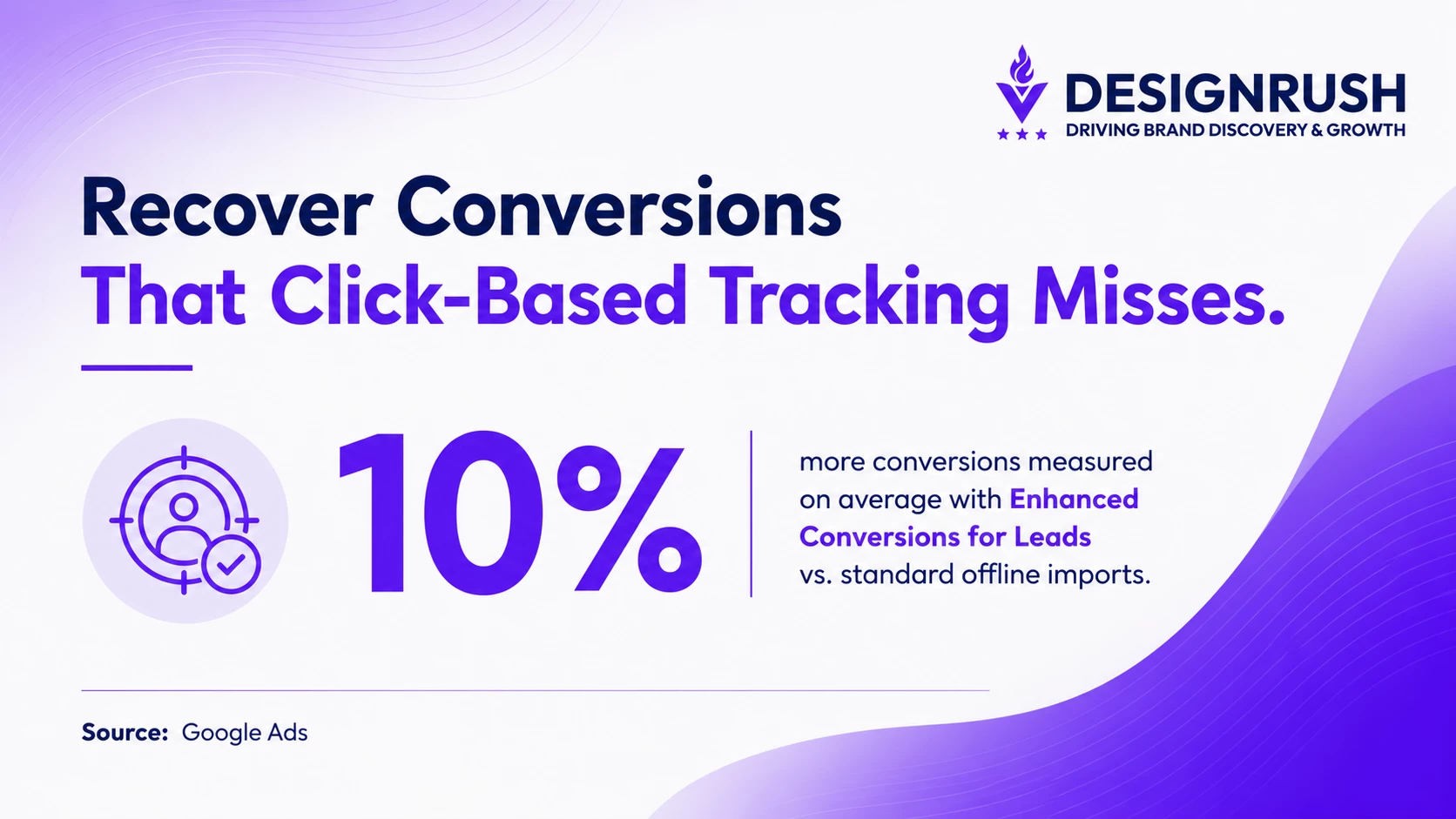
Enhanced Conversions for Leads uses hashed first-party details, such as an email address or phone number, to match CRM outcomes with earlier Google Ads interactions. This can reconnect an approved application, funded account, or completed sale when the original click ID is unavailable.
Google reports that advertisers using Enhanced Conversions for Leads measure 10% more conversions on average than those relying on standard offline imports.
Consent Mode covers the consent side of measurement by adjusting tag behavior according to each visitor’s choice and supporting modeled reporting when direct tracking is limited.
As of June 2026, Google is bringing Enhanced Conversions for web and leads under one account-level setting, allowing customer data to come from website tags, Data Manager, and API connections.
The quality of the match still depends on the data entering the system:
- Capture email addresses and phone numbers in a consistent format so Google can match them accurately.
- Remove duplicate CRM records so the same lead or sale is not imported more than once.
- Keep click IDs whenever they are available because they remain the strongest direct link to the original ad interaction.
- Check shared or missing contact details because they can connect an outcome to the wrong lead or prevent a match entirely.
- Import later-stage outcomes consistently so the campaigns receive enough reliable data to guide bidding.
Zoe Financial Grew Its Most Valuable Client Segment to 60% of Sales
Zoe Financial connected its HubSpot CRM with Google Ads and imported conversion events from across the lead-to-sales journey.
Assigning values to those stages helped the campaigns favor prospects more likely to become high-value clients rather than optimizing around form submissions alone.
The Think with Google case study reported:
- Zoe Financial’s most valuable client segment grew to 60% of total sales.
- This was the segment’s highest share since the company was founded in 2018.
Zoe Financial used standard offline conversion imports, while Enhanced Conversions for Leads builds on this setup by using hashed first-party data to match more CRM outcomes with earlier ad interactions.
5. Reduce Friction on Financial Services Landing Pages
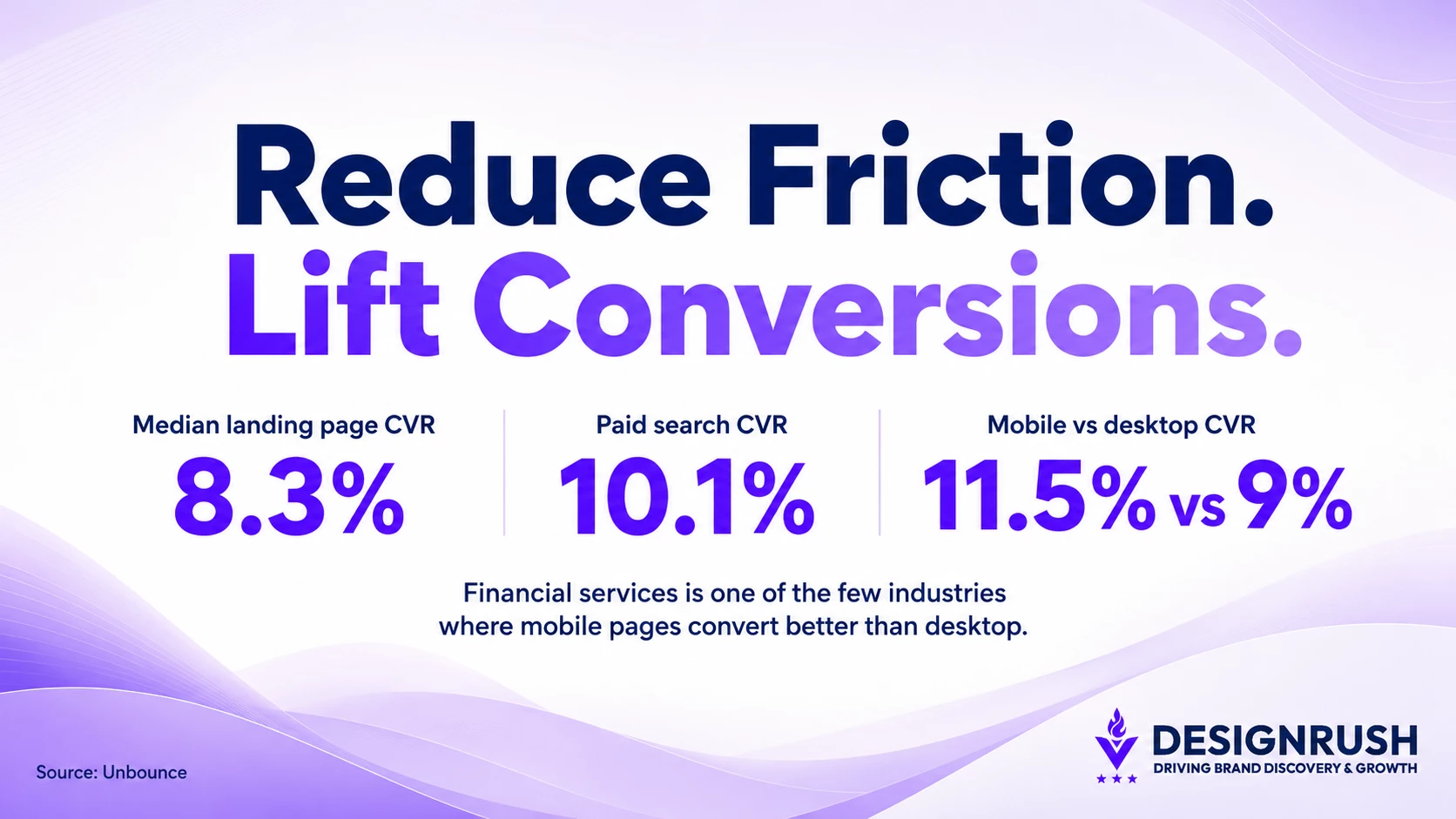
Financial services landing pages play a major role in campaign performance, with Unbounce’s benchmark placing the industry’s overall median landing page conversion rate at 8.3%, rising to 10.1% for paid search, while mobile pages convert at 11.5% compared with 9% on desktop.
The spread between product lines is wide, with insurance pages converting at 18.2%, credit and lending at 8.8%, and investing at 3.9%.
Much of the drop-off happens when the page asks for too much too soon.
Financial advertisers still need to show required disclosures and collect enough information to qualify the lead, but that does not mean every field belongs in the first step.
The strongest pages explain the offer clearly, keep the required information visible, and limit the initial form to details the business genuinely needs at that stage.
As Carterson puts it, “If you’re delivering exactly what someone is looking for, they don’t care if it’s an ad.” That depends on carrying the same product, claim, and eligibility details from the ad onto the page.
Financial services is also one of the few categories in Unbounce’s data where mobile visitors convert better than desktop users, at 11.5% versus 9%, so field order, button placement, page length, and disclosure layout should all be tested on a smaller screen.
Review each financial services landing page for:
- A clear match between the product, offer, and claim shown in the ad and those presented at the top of the page.
- Required fees, business details, and relevant disclosures that remain visible without additional clicks.
- A first form step limited to the contact and qualification details needed at that stage.
- Important product information placed before the form rather than scattered further down the page.
- A separate mobile test, since field order, button placement, and page length can affect completion differently on a smaller screen.
Start with the details needed to identify or qualify the lead, then collect the remaining information later in the process. This is particularly useful on mobile, where a long first step can lose someone before the business captures any way to follow up.
ICICI Lombard Increased Form Completions by 30.09% and Mobile-Number Submissions by 44.25%
ICICI Lombard and Tatvic tested a revised mobile health insurance form after finding that users were dropping off before entering their phone numbers.
The new version placed the policy name, benefits, and selling points above the fold, moved the mobile-number field to the start of the form, and made the quote CTA sticky and easier to reach.
The VWO case study reported:
- Form completions and “Get a Quote” interactions increased by 30.09%.
- Mobile-number submissions increased by 44.25%.
6. Check the Compliance and Ad Policy in Financial Services PPC
Verification, ad eligibility, targeting limits, and regulatory review all need to be settled before campaign performance becomes relevant.
The exact requirements depend on the product, the countries being targeted, and whether the advertiser is a broker-dealer, investment adviser, bank, insurer, or lender.
Google Verifies Financial Advertisers by Target Location
Google defines financial products and services broadly, covering the management or investment of money and cryptocurrency, including personalized advice.
In countries where Financial Services Verification applies, approval is tied to the location being targeted rather than granted globally.
For 24 additional EEA markets, rolling enforcement will begin on July 23, 2026. Advertisers contacted by Google must first complete verification through G2 and then submit the resulting code to Google.
G2 checks the financial service offered, the advertiser’s authorization status, and its registration details against the relevant regulator. Agencies managing affected accounts are also covered.
However, completing verification does not make every financial product eligible.
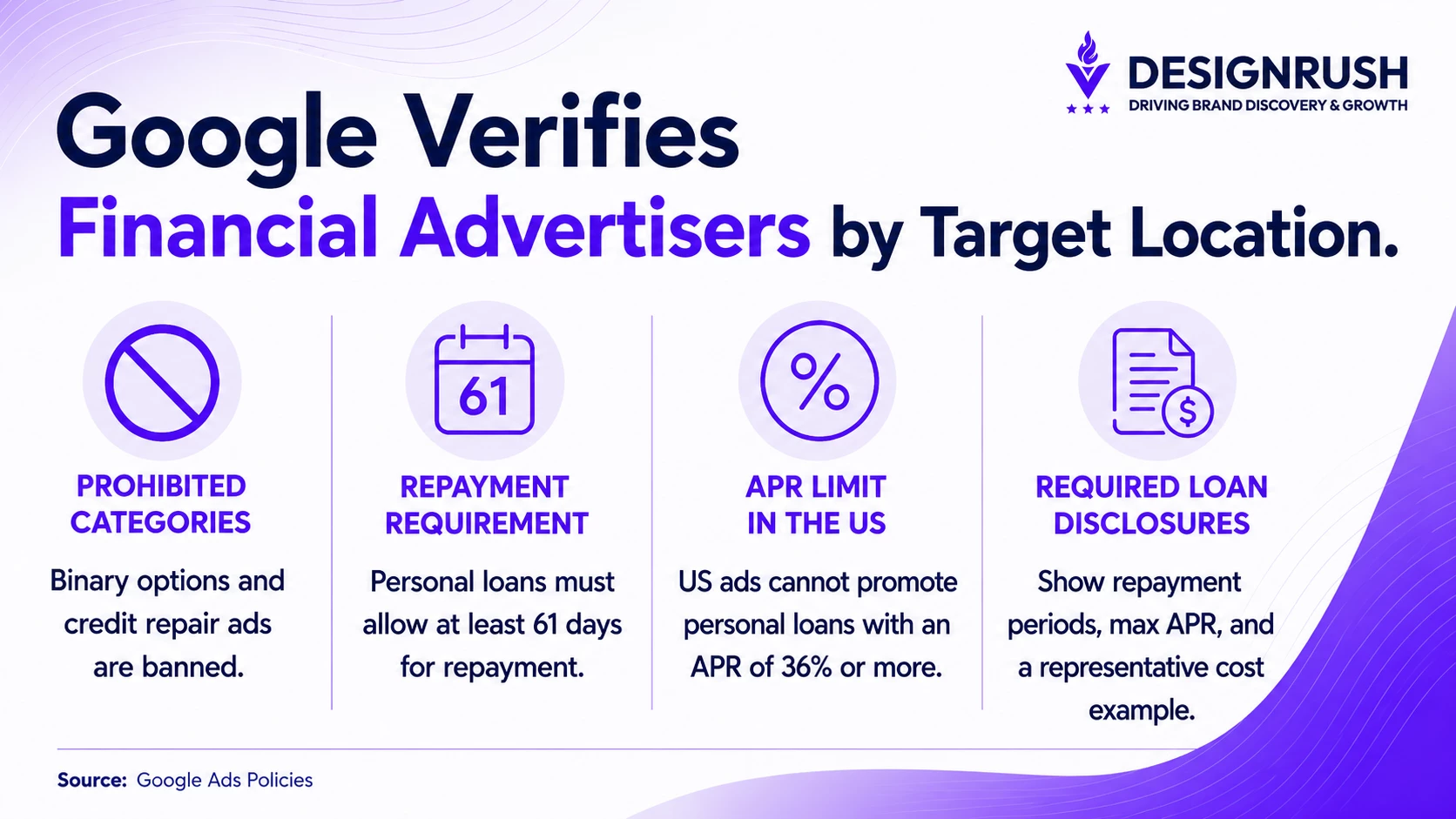
Google prohibits ads for binary options and credit repair services. Personal loans must allow at least 61 days for repayment, while US ads cannot promote personal loans with an APR of 36% or more.
Loan advertisers also need to show repayment periods, the maximum APR, and a representative cost example on the destination page.
Broker-Dealer Ads Fall Under FINRA Rule 2210
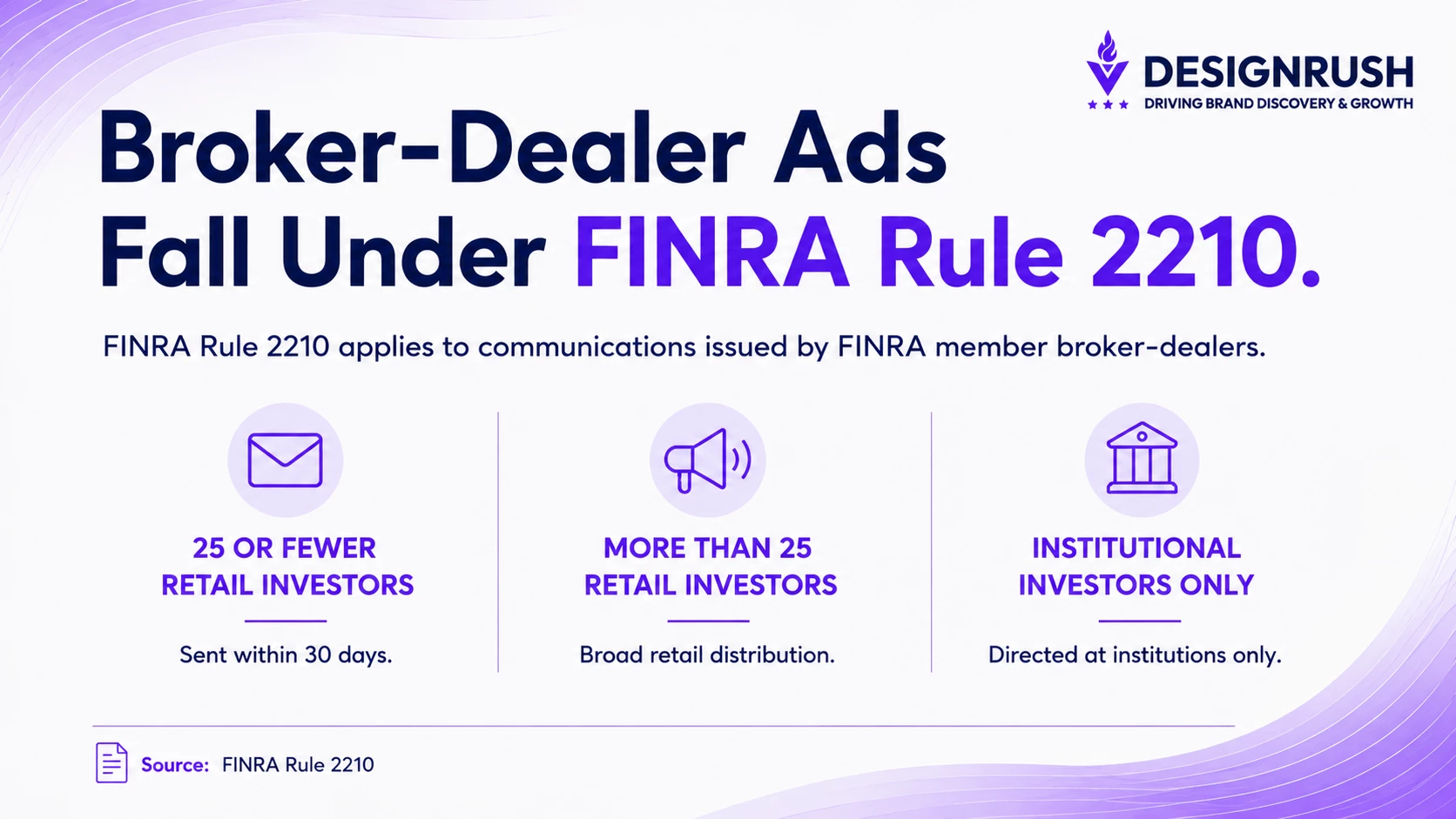
FINRA Rule 2210 applies to communications issued by FINRA member broker-dealers.
It separates them into correspondence sent to 25 or fewer retail investors within 30 days, retail communications distributed to more than 25, and communications intended only for institutional investors.
Retail communications generally require approval from a qualified registered principal before use, although the rule contains several exceptions.
Paid creator content can fall within the same review and recordkeeping obligations.
FINRA fined M1 Finance $850,000 in March 2024 after approximately 1,700 influencers promoted the firm without adequate preapproval, supervision, or record retention.
FINRA found that some posts were misleading or failed to present risks fairly, making this its first formal enforcement action involving a broker-dealer’s supervision of social media influencers.
Investment Adviser Ads Fall Under the SEC Marketing Rule
The SEC Marketing Rule, Rule 206(4)-1, covers advertisements from SEC-registered investment advisers. Adopted in December 2020 and mandatory since November 4, 2022, it replaced the former advertising and cash solicitation rules.
The rule requires advisers to support material claims and present benefits alongside relevant risks or limitations. Testimonials and endorsements may be used when the adviser meets the applicable disclosure, oversight, written-agreement, and promoter eligibility requirements.
Performance advertising carries additional rules covering net returns, time periods, extracted results, and hypothetical performance.
A firm registered as both a broker-dealer and an investment adviser may need to comply with FINRA Rule 2210 and the SEC Marketing Rule at the same time.
Which layer applies to you:
- Broker-dealer: FINRA Rule 2210
- Registered investment adviser: SEC Marketing Rule (206(4)-1)
- Dually registered: Both
- Bank, insurer, or lender with no securities activity: Platform ad policy and general state/local advertising law (no FINRA/SEC layer)
Financial Advertising Rules Differ by Platform
Platform | Requirement to check before launch |
Google Ads | Country-specific Financial Services Verification, required disclosures, and product restrictions |
Meta | Financial Products and Services Special Ad Category, regional verification requirements, and restricted audience controls |
Microsoft Advertising | Its own financial products and services policies and any market-specific authorization requirements |
Financial services ads are restricted, while UK-targeted ads may only come from FCA-authorized advertisers |
Meta limits controls such as age, gender, ZIP or postal code, exclusions, lookalike audiences, and some interests for campaigns in its Financial Products and Services category.
With fewer demographic filters available, more of the qualification work falls to the offer, landing page, form, and first-party conversion data.
Those elements determine whether the campaign can separate serious prospects from the broader audience Meta allows it to reach.
How To Set Up an Effective Financial Services PPC Campaign by Segment
Retail banking, wealth management, insurance, and lending each come with different search behavior, lead values, sales cycles, and platform rules, so the PPC approach has to shift with the segment.
- Retail banks and credit unions PPC
- PPC for wealth management firms and RIAs
- PPC for insurance providers
- PPC for fintech and lending companies
Retail Banks and Credit Unions PPC
PPC for banks and credit unions often works at the branch level because local intent carries more weight than it does for most financial advertisers.
Someone searching for a checking account near me or credit union in LA is often comparing nearby branches rather than researching the broader category.
- Keep Google Business Profile hours, addresses, phone numbers, categories, and map pins aligned with each branch page so paid visitors do not encounter conflicting information.
- Set location assets and targeting radiuses around the distance customers realistically travel for each product to avoid paying for clicks outside the branch’s practical service area.
- Track calls, appointments, direction requests, applications, and store visits by branch so the account reflects both online and offline outcomes.
- Send local searches to pages with the correct branch details, product information, eligibility requirements, and opening hours so visitors can act without searching elsewhere.
- Compare performance by location because competition, demand, application rates, and account value may differ considerably between branch areas.
- Separate new-customer campaigns from online banking, support, and branch-information searches so existing customers do not inflate acquisition results.
PPC for Wealth Management Firms and RIAs
Wealth management prospects may spend weeks reviewing the firm, its advisers, fees, credentials, and investment approach before booking a consultation.
Downloads and page visits can support that journey, but they say little about whether the prospect is eligible or ready to speak with an adviser.
- The account should follow deeper actions such as attended consultations, accepted prospects, opened accounts, and funded assets.
- State minimum portfolio requirements clearly enough to reduce unsuitable inquiries while giving qualified prospects the information they need before booking.
- Track booked, attended, and sales-accepted consultations separately because a calendar submission does not always lead to a viable opportunity.
- Use longer conversion windows because prospects may return through branded search, email, direct traffic, or another device several weeks after the first click.
- Import CRM stages such as qualified prospect, proposal issued, account opened, and assets funded so bidding reflects progress toward revenue.
- Limit campaigns to markets where the firm and its advisers are authorized to operate to prevent spending on prospects they cannot serve.
- Review client quotes, ratings, testimonials, and paid endorsements under the SEC Marketing Rule because disclosure and oversight requirements may apply.
- Exclude searches from job seekers, students, DIY investors, and people looking for free advice because broad adviser terms often attract traffic with no commercial value.
PPC for Insurance Providers
Insurance campaigns are harder to manage when auto, life, commercial, and employee-benefits products share one budget and CPA target.
Their premiums, renewal rates, sales effort, and close rates are too different for a single benchmark.
The cheapest lead may come from a low-value policy, while a more expensive commercial lead may produce years of revenue.
- Set CPA targets by policy line because premiums, commissions, renewal rates, cross-sell potential, and customer value vary widely between products.
- Measure bound policies separately from quote completions because pricing, underwriting, eligibility, and missing documents can prevent a quote from becoming a sale.
- Include renewal value when assessing acquisition costs because a policy that looks expensive in year one may become profitable over several renewals.
- Adjust campaigns by market because carrier availability, licensing, pricing, and underwriting rules can change by state or region.
- Monitor response times because high-intent prospects often request several quotes and may choose the provider that responds first.
- Track call duration, policy type, agent outcome, and sales progress so phone leads can be judged by quality rather than call volume alone.
- Plan for open enrollment, renewals, vehicle purchases, home purchases, and business launches because these events can change both demand and lead value.
- Send policy and revenue outcomes back into the account so automated bidding does not favor easy quote completions that rarely become valuable customers.
PPC for Fintech and Lending Companies
Fintech and lending advertisers should confirm product eligibility before building the campaign.
Google restricts certain lending products and requires specific disclosures, while Meta limits several audience controls for financial products and services.
With fewer targeting options, the application flow and first-party data carry more of the qualification work.
- Compare the product’s APR, repayment terms, fees, licensing, jurisdiction, and structure with each platform’s policy because an ineligible offer may be rejected or suspended.
- Display borrowing costs, repayment periods, representative examples, and provider details clearly so users understand the offer and the landing page meets disclosure requirements.
- Account for Meta’s limits on age, gender, location granularity, exclusions, and detailed targeting because they reduce how precisely campaigns can filter audiences.
- Measure approval and funding rates because a high number of submitted applications can still produce very few eligible borrowers.
- Remove duplicate submissions, synthetic identities, and inaccurate applicant details before importing conversions so bidding does not learn from fraudulent or unusable leads.
- Use approved applications, funded loans, active accounts, first deposits, or repayment events when they reflect customer value more accurately than the initial signup.
- Review drop-off at each application step so the team can separate avoidable UX problems from necessary identity, credit, and affordability checks.
- Separate campaigns where rates, licensing, product availability, or disclosure rules differ by market so each audience sees an eligible and accurate offer.
- Measure activation, deposits, transactions, subscriptions, and repayment behavior because the initial signup may reveal little about the customer’s eventual value.
Where Financial Services PPC Goes From Here
PPC for financial services becomes easier to scale once the account reflects the outcomes the business actually values.
Qualified leads, approved applications, funded accounts, and closed clients give bidding systems a clearer picture of where revenue comes from, while cleaner campaign structures, stronger audience data, and better landing pages help preserve that quality as spend grows.
The examples throughout this article show that better performance usually starts with a stronger feedback loop between the ad platform, the CRM, and the sales process. Once that connection is in place, budget increases have a better chance of producing profitable growth.

Our team ranks agencies worldwide to help you find a qualified partner. Visit our Agency Directory for the top PPC agencies, as well as: